Canon EOS R50 Mirrorless Camera Review 2026: Worth Buying?
Are you searching for a small mirrorless camera that punches above its weight? The Canon EOS R50 keeps showing up on every beginner shortlist in 2026, and for good reason.
This tiny APS-C body packs a 24.2MP sensor, oversampled 4K video, and Canon’s brilliant Dual Pixel CMOS AF II system into a camera that fits in a jacket pocket. I have spent weeks shooting weddings, walking street markets, and vlogging family trips with this camera.
The results surprised me in good ways and a few not so good ways. Read this full review to find out if the R50 deserves a spot in your camera bag this year.
In a Nutshell:
- The Canon EOS R50 offers a 24.2MP APS-C CMOS sensor with Canon’s DIGIC X processor, giving you crisp photos and clean low light shots up to ISO 6400.
- You get uncropped 4K 30p video oversampled from 6K, plus Full HD 120p slow motion for creative B-roll.
- The Dual Pixel CMOS AF II system uses 651 zones and 4,503 selectable points with subject detection for people, animals, and vehicles.
- The body weighs only 375 grams with battery, making it one of the lightest mirrorless cameras you can buy in 2026.
- Burst shooting hits 15 fps with the electronic shutter and 12 fps mechanical, great for action and kids.
- The biggest weakness is the limited RF-S lens lineup and a small battery rated for around 370 shots per charge.
What Comes Inside the Canon EOS R50 Box
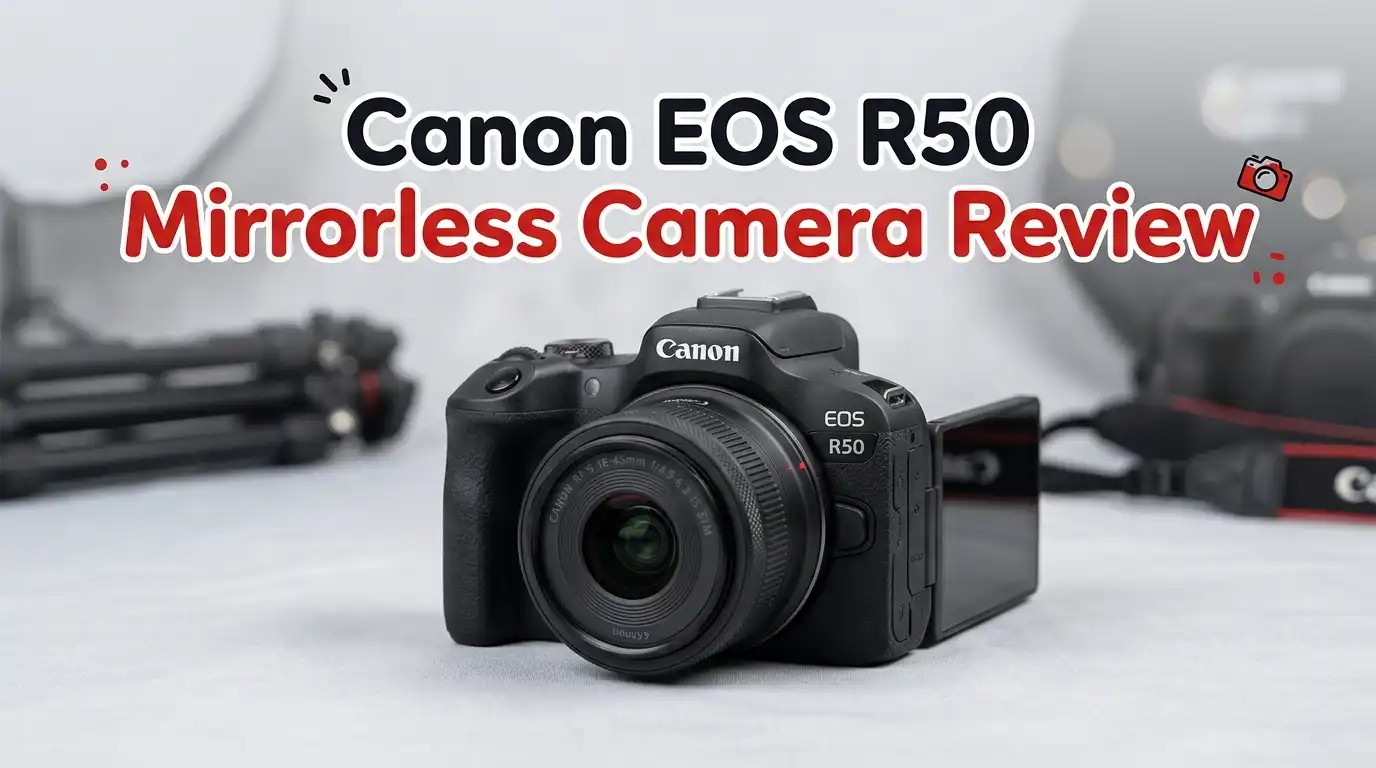
Opening the EOS R50 box feels like unwrapping a gift designed for content creators. Canon keeps the packaging simple and clean. Inside you find the R50 body in matte black or white, the RF-S 18-45mm f/4.5-6.3 IS STM kit lens, an LP-E17 battery, a USB-C charging cable, a basic neck strap, and the printed quick start guide.


Last update on 2026-09-19 / Affiliate links / Images from Amazon Product Advertising API Some of the links on this website are affiliate links, which means that at no additional cost to you, I earn a commission if you click through and make a purchase. I only recommend products and services that I believe will add value to my readers. Thank you for your support!
The first thing you notice is how light the camera feels. At 375 grams, it weighs less than a can of soda. The grip is small but textured, which helps for one handed shooting. The kit lens collapses into a tight package, so the whole bundle slides into a small purse or sling bag.
Canon does not include a battery charger in the box anymore. You charge the battery inside the camera using USB-C, which works fine for travel but slows you down if you have a spare battery. A wall plug is included, but not a dedicated dock charger.
The shutter sound is gentle, almost shy. The mode dial clicks with a satisfying detent. First impressions are positive, especially for a camera under 800 dollars with a kit lens.
Build Quality and Body Design
The R50 uses a polycarbonate shell over a metal frame. It is not weather sealed, so you should keep it dry in heavy rain. The plastic feels solid though, not cheap. The matte texture resists fingerprints well.
Canon placed the controls smartly for new users. You get a single command dial on top, a mode dial, a video record button, and a small joystick free design. Beginners will love the Auto+ scene detection mode, which picks settings based on what the camera sees.
The 2.36 million dot OLED viewfinder sits in the top left corner. It is sharp and bright enough for outdoor framing. The 3 inch fully articulating touchscreen flips out and rotates, perfect for vlogging and selfies.
I shot a full day at a farmer’s market without wrist fatigue. The R50 is the kind of camera you actually carry, instead of leaving at home because it feels heavy. Build quality earns a solid four stars in this price class.
Image Quality and Sensor Performance
The 24.2MP APS-C CMOS sensor delivers sharp, detailed JPEGs straight from the camera. Canon’s color science still leads the industry for skin tones. Portraits look warm and flattering without heavy editing.
Dynamic range measures around 10.57 stops in lab tests, which is slightly better than the more expensive R7. You can pull shadows in RAW files without ugly noise patches. Highlights roll off gently in bright skies.
ISO performance is strong up to ISO 6400. Past that, noise becomes visible but stays usable for social media until ISO 12800. The base ISO of 100 gives you clean files for landscapes and product shots.
The kit lens is the weakest link in the chain. It is sharp in the center but soft at the edges wide open. A faster prime lens like the RF 50mm f/1.8 unlocks the sensor’s full potential.
Autofocus and Subject Detection
Autofocus is where the EOS R50 truly shines. It inherits the Dual Pixel CMOS AF II system from Canon’s flagship cameras. The R50 covers 100 percent of the frame with 4,503 manually selectable points.
Subject detection recognizes people, animals, vehicles, trains, and aircraft. Eye tracking works in stills and video, locking on toddlers and pets that refuse to sit still. I tested it on a running golden retriever and the focus stayed glued to the eye.
The AF works down to negative 4 EV, which means it focuses in candlelight conditions. Low light hunting is rare. Servo AF tracking holds focus during burst shooting, even at 15 fps.
The only quirk is that aircraft detection sometimes confuses kites or birds. For 95 percent of real world shooting, the autofocus feels almost magical. This is the strongest feature on the R50 and a huge reason to pick it over rivals.
Top 3 Alternatives for Canon EOS R50
If you want to compare similar cameras before buying, these three options stand out.
Sony ZV-E10

Last update on 2026-09-19 / Affiliate links / Images from Amazon Product Advertising API Some of the links on this website are affiliate links, which means that at no additional cost to you, I earn a commission if you click through and make a purchase. I only recommend products and services that I believe will add value to my readers. Thank you for your support!
Fujifilm X-T30 II

Last update on 2026-09-19 / Affiliate links / Images from Amazon Product Advertising API Some of the links on this website are affiliate links, which means that at no additional cost to you, I earn a commission if you click through and make a purchase. I only recommend products and services that I believe will add value to my readers. Thank you for your support!
Nikon Z 30

Last update on 2026-09-19 / Affiliate links / Images from Amazon Product Advertising API Some of the links on this website are affiliate links, which means that at no additional cost to you, I earn a commission if you click through and make a purchase. I only recommend products and services that I believe will add value to my readers. Thank you for your support!
Video Capabilities for Vlogging and YouTube
The R50 records 4K 30p video oversampled from 6K, giving you sharp, detailed footage. There is no crop in 4K mode, which is rare at this price. Full HD shoots up to 120p for slow motion clips.
Movie Servo AF tracks faces and eyes during recording. The touchscreen makes rack focus easy, just tap the subject you want sharp. Vertical video mode auto rotates clips for TikTok and Reels.
You get a 3.5mm microphone jack for external audio, which I strongly recommend. The internal mic picks up handling noise. There is no headphone jack, so you cannot monitor audio while filming.
The biggest video weakness is 30 minute clip limits and no log profile. Heavy color graders will miss C-Log. The R50 also overheats during long 4K sessions in hot weather, usually around 25 to 30 minutes. For short YouTube clips and family videos, it works beautifully.
Burst Shooting and Buffer Performance
Speed lovers will enjoy the 15 fps electronic shutter and 12 fps mechanical burst. The buffer holds about 42 JPEGs or 7 RAW files before slowing down. That is enough for most action sequences.
I shot a youth soccer game and tracked players sprinting toward goal. The camera nailed focus on roughly 9 out of 10 frames. Subject tracking sticks even when athletes overlap.
Rolling shutter is mild but visible during fast pans. Avoid the electronic shutter for golf swings or tennis serves. The mechanical shutter handles those scenes better with no skewing.
Card write speeds depend on your SD card. A V30 UHS-I card handles 4K video and burst photos fine. UHS-II support is missing, which limits buffer clearing speed compared to pricier cameras.
Battery Life and Memory
The LP-E17 battery is the R50’s weakest spec. CIPA rates it at about 370 shots per charge, or roughly 60 minutes of 4K video. Most users will want to buy one or two spare batteries.
USB-C charging works on the go. You can power the camera from a power bank during long vlog days. Charging from empty takes about two hours through USB.
The single SD card slot supports UHS-I speeds. There is no dual slot backup, which professionals will dislike. For hobbyists and beginners, one slot is fine.
Bluetooth and Wi-Fi let you transfer photos to your phone using the Canon Camera Connect app. The connection feels quicker than older Canon models. Live remote shooting from your phone works smoothly.
Connectivity and App Features
The R50 includes Wi-Fi 4 and Bluetooth 4.2. Pairing with the Canon Camera Connect app takes about 30 seconds. Once paired, photos transfer automatically in the background.
You can use the camera as a USB webcam with the EOS Webcam Utility software. This turns the R50 into a high quality streaming cam for Zoom, Twitch, or YouTube Live.
Live streaming directly to YouTube is supported through the camera menu. The micro HDMI port outputs clean 4K to external recorders or capture cards. Image stabilization on the kit lens helps with handheld vlogging, though there is no in body stabilization.
The R50 also supports vertical video tagging, so clips show up correctly on phones. Small touches like this prove Canon designed this camera with creators in mind.
Who Should Buy the Canon EOS R50
The EOS R50 fits beginners, students, parents, and casual content creators. If you are upgrading from a smartphone, this camera unlocks creative control without overwhelming menus.
Travel photographers will love the light weight and compact size. The R50 fits in a small bag with two lenses and barely adds weight to your shoulder. Family event shooters benefit from the fast autofocus and silent shutter.
YouTube vloggers under 30 minute clip limits will get pro looking 4K footage. Wedding second shooters can use it as a lightweight backup camera. Street photographers who want to stay invisible will find the small body perfect.
Professionals who need weather sealing, dual card slots, or in body stabilization should look elsewhere. Sports and wildlife shooters will want a longer telephoto lens, which the RF-S system currently lacks.
What the Canon EOS R50 Does Not Do Well
Honest reviews must call out weaknesses. The R50 has a few real issues worth knowing before you buy.
The RF-S native lens lineup is thin in 2026. You only get a handful of dedicated APS-C lenses, mostly slow zooms. Adapting EF lenses works but adds bulk. Third party lens support is improving but still limited.
There is no in body image stabilization. You rely on lens IS or steady hands. Slow shutter handheld shots are harder than on rivals like the Fujifilm X-S20.
The single SD card slot, lack of weather sealing, and short battery life limit professional use. The viewfinder is small at 0.39 inch, which feels cramped for users with glasses.
Finally, the kit lens is forgettable. It is sharp enough but slow at f/4.5-6.3. Plan to buy a prime or better zoom to get the most out of the sensor.
Price and Value in 2026
In 2026, the EOS R50 with the 18-45mm kit lens sells around 799 dollars at full price. Sales drop it to 699 dollars regularly. The two lens kit with 18-45mm and 55-210mm runs about 1049 dollars.
Used copies show up on Canon’s refurbished store and eBay for 400 to 550 dollars. That is incredible value for a camera with this autofocus system. Bundle deals on Amazon often include extra batteries and SD cards.
Compared to the Sony ZV-E10 II at 1198 dollars and the Fujifilm X-T30 III at similar money, the R50 undercuts both while matching their core specs. The Nikon Z 30 is cheaper but has no viewfinder.
For the money, the R50 delivers best in class autofocus, oversampled 4K video, and Canon’s friendly menu system. Value rating is excellent for beginners and intermediate shooters.
Final Verdict on the Canon EOS R50
The Canon EOS R50 remains one of the best beginner mirrorless cameras you can buy in 2026. It blends serious imaging power with a body anyone can carry all day. The autofocus alone justifies the price.
Yes, the lens lineup is limited. Yes, battery life is short. Yes, there is no IBIS. None of these flaws are dealbreakers for the people Canon designed this camera for.
If you want a small, smart, and affordable mirrorless camera that grows with your skills, the R50 deserves a hard look. Pair it with the RF 50mm f/1.8 prime and you have a kit that handles 90 percent of real world shooting beautifully.
I rate the Canon EOS R50 a strong 4.5 out of 5 stars. It earns a confident recommendation for first time buyers, students, parents, vloggers, and anyone wanting to fall back in love with photography.
Frequently Asked Questions
Is the Canon EOS R50 good for beginners in 2026?
Yes, the R50 is one of the best beginner cameras in 2026. Auto+ mode handles settings for you, while the touchscreen and guided menus teach photography basics. The light body makes it easy to carry every day.
Does the Canon EOS R50 shoot 4K video?
Yes, the R50 records uncropped 4K at 30 frames per second, oversampled from 6K for sharper detail. It also shoots Full HD at 120p for slow motion. There is a 30 minute clip limit per recording.
How long does the Canon EOS R50 battery last?
The LP-E17 battery delivers about 370 shots per charge or 60 minutes of 4K video. Most users buy one or two spare batteries. USB-C charging works from any power bank on the go.
Does the Canon EOS R50 have image stabilization?
The R50 has no in body image stabilization. You rely on optical IS in lenses like the RF-S 18-45mm kit lens. Digital IS is available in video mode but adds a small crop.
Can I use Canon EF lenses on the EOS R50?
Yes, you can use EF and EF-S lenses with the Canon EF-EOS R adapter. Autofocus and image stabilization work normally. The combination becomes front heavy with large EF zooms but expands lens choices a lot.
Is the Canon EOS R50 weather sealed?
No, the R50 is not weather sealed. Avoid heavy rain, dust storms, and wet conditions. A simple rain cover protects it during light drizzle on travel days.
Which is better, Canon EOS R50 or Sony ZV-E10?
The R50 is better for stills and family photos, with a sharper viewfinder and stronger autofocus. The Sony ZV-E10 favors vloggers with a better internal mic and headphone jack. Pick based on how much video you shoot.

Hello everyone my name is Alenya and i am a gadget discovering Enthusiast 🐻🐻