DJI Neo Fly More Combo Review 2026: Worth Buying?
If you create beauty content, skincare tutorials, or lifestyle vlogs, you already know the single biggest frustration: getting smooth, cinematic aerial footage without hiring a camera operator.
The DJI Neo Fly More Combo promises to solve this problem with a palm-sized, 135-gram drone that launches from your hand, tracks you automatically, and captures stabilized 4K UHD video.
For solo beauty creators, influencers, and vloggers, this combo pack bundles everything you need—drone, RC-N3 controller, three batteries, and a two-way charging hub—into one affordable kit.
In a Nutshell
- Ultra-Lightweight Build: At just 135 grams, the DJI Neo does not require FAA registration in the United States, and it launches directly from your palm with zero setup friction.
- 4K UHD Video with EIS: The onboard camera records in 4K resolution with electronic image stabilization, producing footage smooth enough for Instagram Reels, TikTok, and YouTube Shorts.
- AI-Powered Subject Tracking: The drone uses intelligent tracking algorithms to follow you automatically. This is a game-changer for solo beauty creators shooting outdoor tutorials, product reveals, or “get ready with me” content.
- Three Batteries Included: Each battery delivers approximately 18 minutes of flight, giving you a combined 54 minutes of total airtime per session. That is enough for multiple takes.
- RC-N3 Controller for Precision: While the Neo flies controller-free, the included RC-N3 remote unlocks manual control, extended range, and more cinematic framing options for advanced shots.
- QuickShots Cinematic Modes: Pre-programmed flight patterns like Dronie, Rocket, Circle, and Helix give you professional-looking aerial transitions with a single tap.

Last update on 2026-09-19 / Affiliate links / Images from Amazon Product Advertising API Some of the links on this website are affiliate links, which means that at no additional cost to you, I earn a commission if you click through and make a purchase. I only recommend products and services that I believe will add value to my readers. Thank you for your support!
What Exactly Comes Inside the DJI Neo Fly More Combo
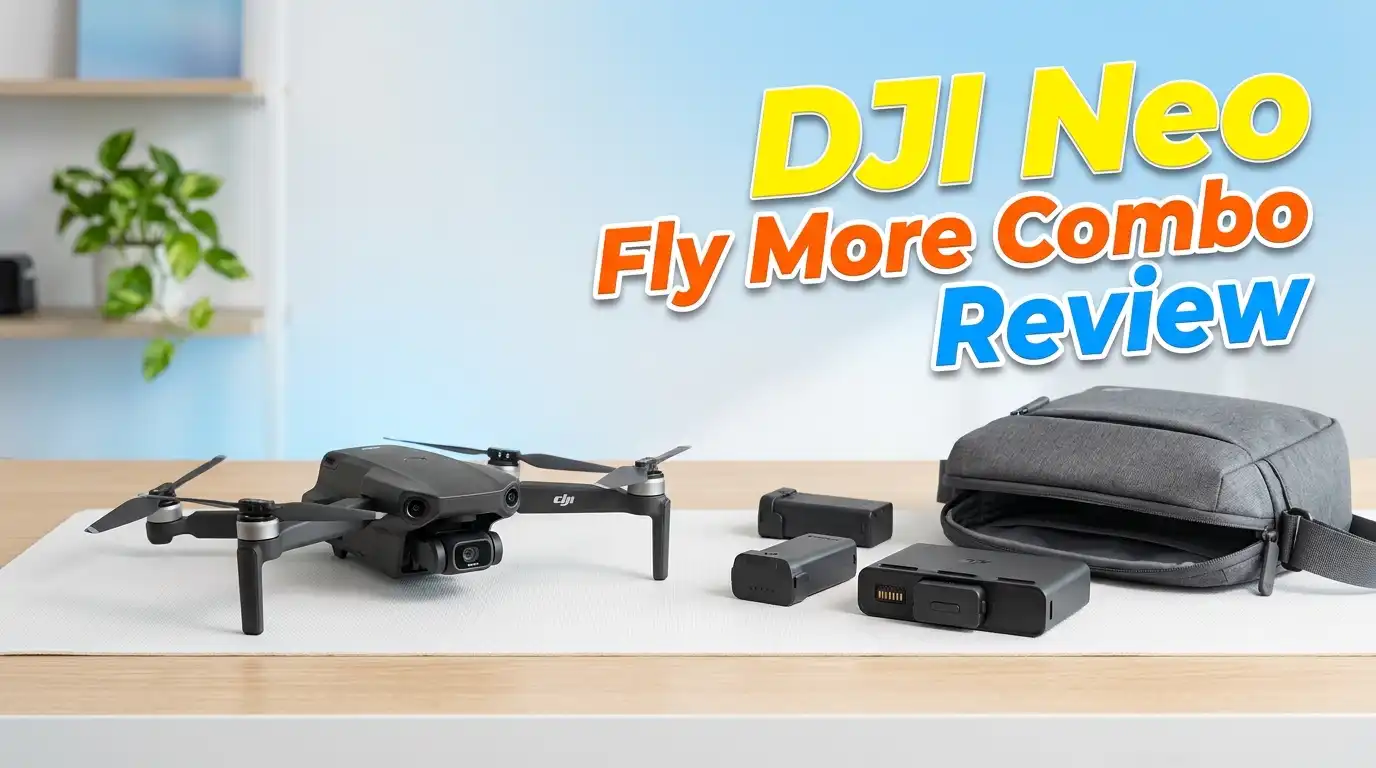
The Fly More Combo is the most complete package DJI offers for the Neo. You get the DJI Neo aircraft with full-coverage propeller guards, one pre-installed intelligent flight battery, two additional spare batteries, the RC-N3 remote controller, a two-way charging hub, extra propellers, screwdriver, and all necessary cables.
This kit originally retailed for $349 but has seen price drops as low as $259 in early 2026. Compared to the base model at $149 or the three-battery combo at $219, the Fly More Combo adds the RC-N3 controller, which significantly expands what you can do with this drone.
The charging hub handles two batteries simultaneously and doubles as a power bank. That small detail makes a big difference when you are on location and need to charge your phone or another device.
Unboxing Experience and First Impressions
The packaging is clean, minimal, and very DJI. A compact cardboard box with matte finishes opens to reveal each component nested in molded inserts. Everything fits snugly. Nothing rattles.
The drone itself is shockingly small. It sits comfortably in one hand. The full-coverage propeller guards make it feel safe rather than fragile. Picking it up for the first time, you notice the plastic is dense and well-constructed—not flimsy.
The RC-N3 controller feels familiar if you have used other DJI products. It connects quickly and adds a professional layer of control that the palm-only experience lacks. Overall, the unboxing feels premium for a sub-$300 product.
Top 3 Alternatives for DJI Neo Fly More Combo
DJI Flip (RC-N3)

Last update on 2026-09-19 / Affiliate links / Images from Amazon Product Advertising API Some of the links on this website are affiliate links, which means that at no additional cost to you, I earn a commission if you click through and make a purchase. I only recommend products and services that I believe will add value to my readers. Thank you for your support!
HOVERAir X1 Self-Flying Camera Drone

Last update on 2026-09-19 / Affiliate links / Images from Amazon Product Advertising API Some of the links on this website are affiliate links, which means that at no additional cost to you, I earn a commission if you click through and make a purchase. I only recommend products and services that I believe will add value to my readers. Thank you for your support!
Potensic ATOM SE GPS Drone with 4K EIS Camera


Last update on 2026-09-19 / Affiliate links / Images from Amazon Product Advertising API Some of the links on this website are affiliate links, which means that at no additional cost to you, I earn a commission if you click through and make a purchase. I only recommend products and services that I believe will add value to my readers. Thank you for your support!
Camera Quality and Skin Tone Accuracy
The 4K UHD camera on the DJI Neo records at 30fps with a 1/2-inch CMOS sensor. For social media content, the results are impressive. Colors appear natural and well-balanced in daylight conditions.
Skin tone reproduction is reasonable. In golden hour lighting, faces look warm and flattering. Under overcast skies, skin can appear slightly flat and desaturated. If you shoot beauty content where accurate color matters, you may need minor post-production color grading.
The electronic image stabilization (EIS) keeps footage smooth, but it does crop the frame slightly. Do not expect the same dynamic range or detail you would get from the DJI Mini 4 Pro or the DJI Flip. This is an entry-level sensor, and it performs like one.
Subject Tracking and Autonomous Flight Performance
This is the feature that matters most for solo creators. You power on the drone, select your tracking mode from the DJI Fly app, and the Neo launches from your palm. It locks onto you and follows.
The AI-powered subject tracking is genuinely reliable outdoors. It held a steady lock on me during walking shots, slow jogging, and even moderate cycling. It occasionally lost tracking when I moved through dense tree cover, but it recovered quickly.
One limitation: the Neo does not have obstacle avoidance sensors. It relies on you to steer clear of obstacles during autonomous flight. In open environments, this is not a concern. In tight spaces, proceed with caution.
Battery Life and Charging Efficiency
Each intelligent flight battery provides roughly 18 minutes of flight time under standard conditions. Wind, temperature, and flight mode all affect this number.
With three batteries in the Fly More Combo, you get approximately 54 minutes of usable airtime. That is plenty for most content shoots. The two-way charging hub takes about 90 minutes to fully charge all three batteries sequentially.
The charging hub accepts USB-C input and can also output power to charge a phone. This dual function makes it a practical travel companion. Battery swaps take about ten seconds. The batteries click in and out cleanly.
Controller vs Controller-Free Flying
The DJI Neo works brilliantly without a controller for quick, autonomous shots. You tap a mode on the app, hold the drone in your palm, and it takes off. This is perfect for impromptu content.
However, the RC-N3 controller changes the experience entirely. With it, you gain manual camera control, longer range, and the ability to compose precise framing. For beauty creators who want a specific angle—say, a dramatic overhead reveal or a slow pullback from a product flatlay—the controller is essential.
If you only plan to use autonomous tracking modes, you could save money with the base model. But if you want creative flexibility, the Fly More Combo is the smarter investment.
Who Should Skip the DJI Neo Fly More Combo
This drone is not for everyone. If you are a professional videographer expecting cinema-grade image quality, the Neo will disappoint. The sensor is small, dynamic range is limited, and low-light footage is noisy.
Indoor use is possible but not ideal. The propellers are loud in enclosed spaces, and without obstacle avoidance, you risk collisions with furniture and walls. Content creators who film in studios should stick to traditional camera setups.
If you live in a very windy area, the Neo struggles. At 135 grams, strong gusts push it around. DJI rates its max wind resistance at about 10.7 m/s, but real-world stability degrades well before that threshold.
QuickShots and Creative Flight Modes
DJI’s QuickShots modes are genuinely fun and produce polished results. The options include Dronie (flies backward and upward), Rocket (ascends straight up), Circle (orbits around you), and Helix (spirals upward while circling).
Each mode runs for about 10 to 15 seconds and produces ready-to-post clips. For beauty and lifestyle content, the Circle and Dronie modes are the most useful. They add cinematic production value to otherwise static content.
You also get access to Easy Acro mode for flips and rolls if you connect the drone to DJI Goggles and an FPV controller. This is less relevant for beauty creators but adds versatility for lifestyle and travel content.
Build Quality, Durability, and Portability
The DJI Neo feels built to survive drops and minor collisions. The ducted propeller design means that if it bumps into a branch or wall, it tends to bounce off rather than break. Multiple long-term reviewers report crashing it repeatedly with zero damage.
At 135 grams, it fits into a jacket pocket or a small pouch inside a makeup bag. You do not need a dedicated drone backpack. This portability factor is a genuine advantage for creators who are already carrying ring lights, tripods, and camera gear.
The RC-N3 controller adds some bulk, but it is still compact. The entire Fly More Combo fits into a small carrying case that DJI sells separately.
Final Verdict on the DJI Neo Fly More Combo
The DJI Neo Fly More Combo is the most accessible aerial content creation tool available in 2026. It is not a professional cinema drone. It is a practical, pocket-sized content machine for solo creators, beauty influencers, and lifestyle vloggers who want smooth, stabilized overhead and tracking shots without hiring a crew.
At its current price point of around $259, it delivers outstanding value. The three-battery setup, RC-N3 controller, and charging hub make the Fly More Combo the clear winner over the base model for anyone who plans to use this drone regularly.
If your content lives on Instagram, TikTok, or YouTube Shorts, the DJI Neo Fly More Combo gives you a visual edge that no selfie stick or tripod can match.
Last update on 2026-09-19 / Affiliate links / Images from Amazon Product Advertising API Some of the links on this website are affiliate links, which means that at no additional cost to you, I earn a commission if you click through and make a purchase. I only recommend products and services that I believe will add value to my readers. Thank you for your support!
Frequently Asked Questions
Is the DJI Neo Fly More Combo good for filming beauty tutorials outdoors?
Yes. The AI subject tracking and palm takeoff make it ideal for solo outdoor beauty shoots. The drone follows you automatically while recording stabilized 4K footage. Golden hour lighting produces the best skin tone results. You will want to color grade slightly for overcast conditions.
Does the DJI Neo require FAA registration in the United States?
No. At 135 grams, the DJI Neo falls under the 250-gram threshold and does not require FAA registration for recreational use. You also do not need a Remote ID module for casual flying or Capture Me mode.
How long does the battery last on the DJI Neo Fly More Combo?
Each battery provides approximately 18 minutes of flight. The Fly More Combo includes three batteries, giving you roughly 54 minutes of total flight time. The two-way charging hub fully recharges all three batteries in about 90 minutes.
Can the DJI Neo fly indoors for product photography or studio content?
Technically yes, but it is not recommended. The propellers are loud in enclosed spaces, and the drone lacks obstacle avoidance sensors. For indoor content, a gimbal-stabilized camera or a traditional tripod setup will produce better results with less risk.
What is the difference between the DJI Neo base model and the Fly More Combo?
The base model includes only the drone and one battery for around $149. The Fly More Combo adds two extra batteries, the RC-N3 remote controller, and a two-way charging hub for approximately $259. The controller unlocks manual flight control, extended range, and more precise framing.
Is the DJI Neo Fly More Combo better than the HOVERAir X1?
Both drones target solo content creators. The DJI Neo offers better 4K video quality, longer flight time, and optional controller support. The HOVERAir X1 is slightly lighter and simpler to operate but has a shorter battery life and fewer creative flight modes. For beauty and lifestyle creators who want more flexibility, the DJI Neo Fly More Combo is the stronger choice.

Hello everyone my name is Alenya and i am a gadget discovering Enthusiast 🐻🐻