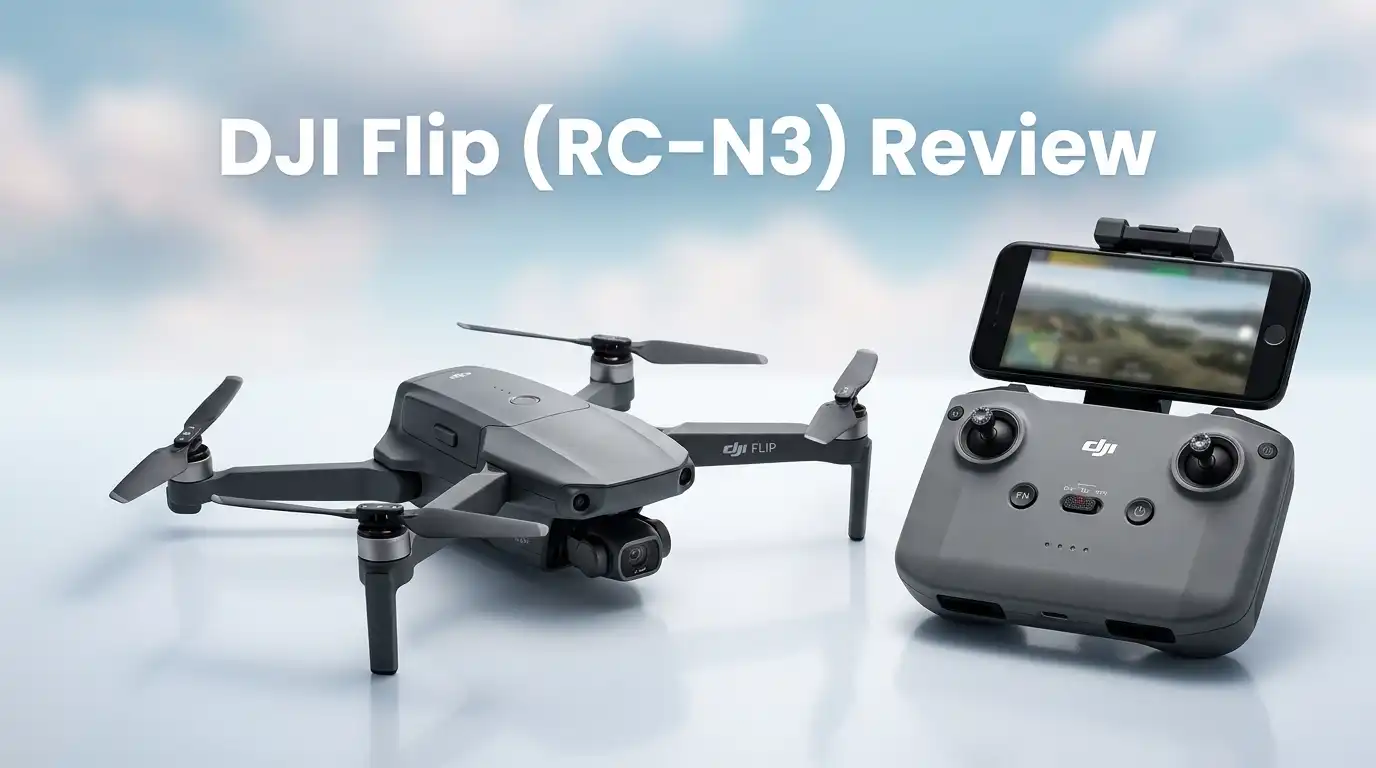
DJI Flip (RC-N3) Review 2026: Worth Buying?
The DJI Flip arrived at a time when beginner drone pilots needed something specific: a portable, safe, and genuinely capable camera drone that didn’t demand professional-level skill.
Most sub-$500 drones force a painful compromise between image quality and ease of use. You either get a sharp camera on a fragile frame or a protected build with a mediocre sensor. The DJI Flip (RC-N3) refuses to play that game.
This foldable, sub-249g drone packs a 1/1.3-inch CMOS sensor, shoots 4K/60fps HDR video, and wraps every propeller in full-coverage guards. It launches from your palm, tracks your movements, and folds down small enough to stuff into a jacket pocket.
In a Nutshell
- Image Quality Punches Up: The 1/1.3-inch sensor with f/1.7 aperture delivers 48MP stills and 4K/60fps HDR video virtually identical to the DJI Mini 4 Pro, which costs $300+ more.
- Truly Beginner-Safe: Foldable full-coverage propeller guards, automatic braking, and a 3D infrared sensing system make this the safest sub-250g DJI drone available.
- Palm Launch and Land: No flat surface needed. Press a button, launch from your hand, and it returns to your palm with reliable precision.
- 31-Minute Flight Time: The 3110 mAh battery provides a competitive 31 minutes per charge and recharges fully in about 70 minutes through the aircraft.
- O4 Video Transmission: The DJI O4 system delivers 1080p/60fps live view with a max range of 13 km (FCC), a significant upgrade over Wi-Fi-only drones.
- Not a Pro Drone: It lacks omnidirectional obstacle avoidance, 360-degree active tracking, and waypoints. Wind performance at higher gusts is limited despite the Level 5 rating.

Last update on 2026-09-19 / Affiliate links / Images from Amazon Product Advertising API Some of the links on this website are affiliate links, which means that at no additional cost to you, I earn a commission if you click through and make a purchase. I only recommend products and services that I believe will add value to my readers. Thank you for your support!
Unboxing and First Impressions
The DJI Flip (RC-N3) ships in a compact white box that feels purposefully minimal. Inside, you get the DJI Flip drone, the DJI RC-N3 remote controller, one Intelligent Flight Battery, a set of spare propellers with screws, a USB-C cable, and documentation.
The drone itself feels surprisingly sturdy. The polycarbonate propeller guards fold flat against the body, and the whole unit collapses into something roughly the size of a large smartphone. Unfolding it is intuitive—each arm clicks firmly into place.
The RC-N3 controller requires your smartphone for a display. It clamps your phone at the top, connects via USB-C, and pairs through the DJI Fly app. The controller feels solid but basic compared to the screen-equipped RC 2.
Build Quality and Design
The DJI Flip looks nothing like a traditional drone. With its four circular propeller guards fully deployed, it resembles a compact hovercraft more than anything. Some users call it ugly. I call it functional.
At under 249 grams, this drone sidesteps FAA registration requirements in the United States. That weight figure includes the battery and a microSD card. The folded dimensions measure just 136 x 62 x 165 mm, making this one of the most packable camera drones ever made by DJI.
The propeller guards are not removable. They fold inward against the body for transport. This fixed design adds crash resilience at the cost of some aerodynamic drag, which becomes noticeable in moderate wind.
Camera Performance and Image Quality
The 1/1.3-inch CMOS sensor is the centerpiece of this drone. It captures 48MP photos in both JPEG and DNG/RAW formats. The f/1.7 aperture paired with 2.4μm 4-in-1 pixels pulls in impressive light, producing clean images even in early morning and golden hour conditions.
Video shoots at 4K/60fps with HDR and supports 10-bit D-Log M color for post-production flexibility. Slow motion tops out at 4K/100fps, which is genuinely useful for cinematic b-roll. The 3-axis mechanical gimbal (tilt, roll, pan) keeps footage buttery smooth.
Real-world footage rivals the DJI Mini 4 Pro. Colors are accurate, stabilization is reliable, and the 48MP stills hold detail well even when cropped. Close-up portrait shots produce a natural background blur thanks to that wide aperture. This is a serious camera on a very small drone.
Flight Performance and Controls
The DJI Flip offers three flight modes: Sport (12 m/s max speed), Normal (12 m/s), and Cine (slower, smoother movements for filming). Max ascent speed hits 5 m/s. The drone hovers with ±0.1 m vertical accuracy using vision positioning.
Flight time realistically lands between 25 and 28 minutes with active filming, slightly below the advertised 31-minute maximum. The O4 transmission system maintains a crisp 1080p/60fps live feed on your phone through the RC-N3 controller, with roughly 120 ms latency.
Multiple users on Reddit report that wind performance is the Flip’s weakest link. Despite a Level 5 (10.7 m/s) wind resistance rating, the drone visibly struggles in gusts above 20 mph. Forward speed drops dramatically in headwinds. For calm conditions, it flies beautifully. In coastal or mountain winds, plan accordingly.
Top 3 Alternatives for DJI Flip (RC-N3)
DJI Mini 4 Pro (DJI RC 2)

Last update on 2026-09-19 / Affiliate links / Images from Amazon Product Advertising API Some of the links on this website are affiliate links, which means that at no additional cost to you, I earn a commission if you click through and make a purchase. I only recommend products and services that I believe will add value to my readers. Thank you for your support!
Potensic ATOM SE GPS Drone


Last update on 2026-09-19 / Affiliate links / Images from Amazon Product Advertising API Some of the links on this website are affiliate links, which means that at no additional cost to you, I earn a commission if you click through and make a purchase. I only recommend products and services that I believe will add value to my readers. Thank you for your support!
DJI Neo Mini Drone

Last update on 2026-09-19 / Affiliate links / Images from Amazon Product Advertising API Some of the links on this website are affiliate links, which means that at no additional cost to you, I earn a commission if you click through and make a purchase. I only recommend products and services that I believe will add value to my readers. Thank you for your support!
Smart Features and Intelligent Flight Modes
DJI packed the Flip with AI-powered shooting modes that make cinematic footage accessible to complete beginners. QuickShots include Dronie, Circle, Helix, Rocket, Boomerang, and Asteroid—all executed automatically with a few taps in the DJI Fly app.
Subject tracking works from behind, from the side, and from the front. It uses the phone’s connection or the controller to lock onto a person and follow them. However, consumer feedback consistently notes that 360-degree active tracking is absent. The drone tends to default to rear tracking even when side tracking is selected, which limits creative angles.
Palm takeoff and landing is the standout convenience feature. Hold the drone in your hand, press the button, and it lifts off. Return-to-Home brings it back to your palm or a set GPS point. Voice control through the DJI Fly app adds another hands-free option, though it works best in quiet environments.
Who Should Buy the DJI Flip (RC-N3)
This drone serves a clear audience. First-time drone pilots benefit most from the protected propellers and simplified controls. You can crash into a tree branch and walk away without replacing a single prop blade. That peace of mind is worth the trade-offs.
Travel vloggers and content creators will appreciate the vertical shooting mode (2.7K at up to 30fps) and the integrated audio recording through your smartphone. The noise reduction algorithm filters out propeller buzz. The compact size means you can carry it in a small daypack without a dedicated drone bag.
Families on vacation get a quick-deploy camera that anyone can launch from a hand. No runway, no flat surface, no stress. If your goal is capturing aerial memories rather than professional cinematography, the Flip delivers.
Who Should Skip This Drone
The DJI Flip is not for experienced pilots seeking advanced features. It lacks omnidirectional obstacle avoidance—the forward-facing 3D infrared sensor covers only one direction. Several Reddit users report the front sensor triggering false positives in foggy or misty conditions.
Professional videographers will miss waypoint navigation, object tracking for vehicles, and the stronger wind resistance of heavier drones like the DJI Air 3S. The 31-minute flight time also falls short for intensive shoot days without extra batteries.
FPV enthusiasts should look elsewhere entirely. The Flip is not compatible with DJI Goggles or the DJI Motion Controller. If immersive flying matters to you, the DJI Neo or Neo 2 are better starting points.
DJI Flip (RC-N3) Pricing and Value
The DJI Flip (RC-N3) carries a retail price of $439. Periodic sales on Amazon have dropped it to around $349–$369, making it an exceptional value during promotions. The upgraded version with the DJI RC 2 controller (built-in screen) runs $639, and the Fly More Combo with three batteries, a charging hub, and a shoulder bag costs $779.
For what you get—a 1/1.3-inch sensor, O4 transmission, 3-axis gimbal, and protected propellers—the $439 base price undercuts the DJI Mini 4 Pro by over $300 while delivering nearly identical image quality. The RC-N3 controller is functional but requires your phone. Budget-conscious buyers should start here and upgrade later if needed.
Last update on 2026-09-19 / Affiliate links / Images from Amazon Product Advertising API Some of the links on this website are affiliate links, which means that at no additional cost to you, I earn a commission if you click through and make a purchase. I only recommend products and services that I believe will add value to my readers. Thank you for your support!
Manufacturer Claims vs. Real-World Observations
DJI markets the Flip as a Level 5 wind-resistant drone. In practice, real consumers consistently report that the drone struggles in sustained winds above 15 mph. The enclosed propeller guards create additional surface area that catches gusts. The rating holds true in controlled lab conditions, but field performance tells a different story.
The advertised 31-minute flight time assumes constant forward flight at 6 m/s with no wind. Expect 25–28 minutes during typical mixed-use sessions involving hovering, tracking, and directional changes. This is standard for the category, but the gap between claim and reality is worth noting.
DJI’s claim of a 13 km transmission range (FCC) is technically accurate in open, interference-free environments. Urban flying realistically yields 1–2.5 km of reliable signal. Suburban environments push that to 2.5–7 km. These numbers align with the O4 system’s published interference benchmarks.
Frequently Asked Questions
Does the DJI Flip require FAA registration in the United States?
No. The DJI Flip weighs under 249 grams, which exempts it from FAA registration for recreational use. You do not need to obtain a Remote ID module either, though the drone itself does not include built-in Remote ID hardware. Always verify current local regulations before flying.
Can I fly the DJI Flip without a controller?
Yes. The DJI Flip supports controller-free flight using your smartphone via Wi-Fi direct through the DJI Fly app. You can also use voice commands. However, range is limited to approximately 50 meters without the RC-N3 controller. For extended flights, the controller is essential.
How does the DJI Flip compare to the DJI Mini 4 Pro?
Both drones share the same 1/1.3-inch sensor and produce very similar image quality. The Mini 4 Pro adds omnidirectional obstacle avoidance, longer flight time (34 minutes), waypoint navigation, and better wind handling. The Flip wins on portability, crash protection, palm launch capability, and price ($439 vs. $759+).
Is the DJI Flip good for indoor flying?
The full-coverage propeller guards make the Flip one of the safest DJI drones for indoor use. It can bump into walls and furniture without damaging the propellers. The forward infrared sensor helps avoid collisions in well-lit rooms. Low-light environments can cause the sensor to behave unpredictably, so exercise caution indoors at night.
What microSD card should I use with the DJI Flip?
DJI recommends Kingston CANVAS Go! Plus or Lexar Professional 1066x cards in capacities from 64GB to 512GB. Use a U3, V30, A2 rated card to handle the 150 Mbps maximum video bitrate. The drone also includes 2 GB of internal storage for emergency backup footage.

Hello everyone my name is Alenya and i am a gadget discovering Enthusiast 🐻🐻