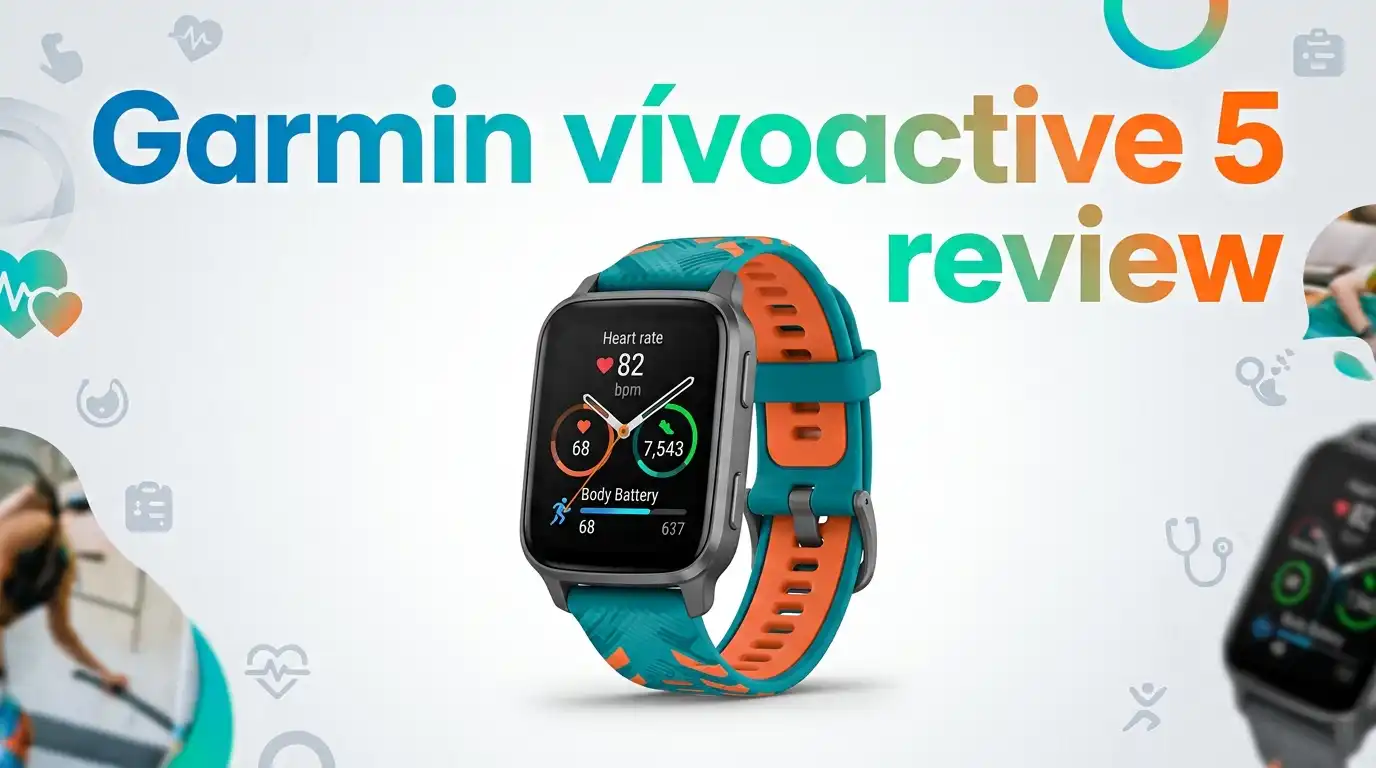
Garmin vívoactive 5 review 2026: Still Worth It?
Choosing a mid-range fitness smartwatch in 2026 feels harder than ever. Apple, Samsung, and Fitbit keep flooding the wrist-tech space, yet Garmin’s vívoactive 5 still gets recommended on every forum thread.
The question is whether a watch launched in late 2023 can hold its ground against newer rivals like the vívoactive 6 and Forerunner 165.
This review answers one specific concern: can the vívoactive 5 deliver accurate sleep, recovery, and GPS data without forcing you into Garmin’s premium tier? I tested it for several weeks, compared notes with long-term owners, and pulled patterns from verified buyer feedback. Here is the honest verdict.
In a Nutshell
- Display & build: A 1.2-inch AMOLED touchscreen that stays bright outdoors, paired with a lightweight aluminum bezel that suits slim and average wrists.
- Battery life: Up to 11 days in smartwatch mode, dropping to about 5 days with always-on display and roughly 21 hours with continuous GPS.
- Health tracking: Includes Body Battery, Sleep Coach, automatic nap detection, HRV status, Pulse Ox, and respiration tracking.
- Sport modes: Over 30 built-in activities, wheelchair mode, strength workouts with rep counting, and connected GPS for running and cycling.
- Smart features: Garmin Pay, music storage for offline playback, smartphone notifications, and a small but functional app store via Connect IQ.
- Best for: Casual runners, walkers, gym-goers, and sleep-focused users who want Garmin’s ecosystem without paying Fenix-level prices.
What the Garmin vívoactive 5 Actually Is


Last update on 2026-08-28 / Affiliate links / Images from Amazon Product Advertising API Some of the links on this website are affiliate links, which means that at no additional cost to you, I earn a commission if you click through and make a purchase. I only recommend products and services that I believe will add value to my readers. Thank you for your support!
The vívoactive 5 is Garmin’s everyday smartwatch. It targets people who want fitness data without the data overload of a Forerunner. The casing is aluminum, the strap is silicone, and the screen is a vibrant AMOLED panel that finally replaces the dim MIP display of older models.
Inside, it carries a built-in GPS, an optical heart-rate sensor, and a Pulse Ox monitor. It supports safety alerts, music storage for around 500 songs, and Garmin Pay for contactless purchases.
What makes it stand out is the Sleep Coach and nap detection. These were once Fenix-exclusive features, and seeing them on a sub-$300 watch matters. The vívoactive 5 is essentially a wellness-first watch with serious athletic backup.
Unboxing and First Impressions
The box is small, recyclable cardboard, and refreshingly minimal. Inside you get the watch, a magnetic charging cable, and a brief quick-start booklet. No charger brick, no extras, no fuss.
The watch feels lighter than expected at 36 grams. The silicone strap is soft, slightly grippy, and does not pull arm hair like cheaper bands tend to. The single side button has a satisfying click.
Pairing through the Garmin Connect app took under three minutes. Firmware updates pushed automatically. The AMOLED screen lit up bright and crisp, and the haptic feedback felt subtle rather than buzzy. It is not luxurious, but it feels considered.
Display and Daily Wear Feel
The 1.2-inch AMOLED is the headline upgrade over the vívoactive 4. Colors look saturated, blacks are true, and outdoor visibility in direct sunlight is excellent. Indoor brightness can be dialed down to preserve battery.
On the wrist, the watch sits flush without snagging on sleeves. The case is 42.2 mm wide and 11.1 mm thick, which suits small to medium wrists well. People with larger wrists may want the Venu 3 or vívoactive 6 instead.
The touchscreen is responsive, but the lack of a second physical button takes adjustment. Swipes occasionally trigger by accident in the shower or under long sleeves. Most users adapt within a week.
Top 3 Alternative for Garmin vívoactive 5

Last update on 2026-08-28 / Affiliate links / Images from Amazon Product Advertising API Some of the links on this website are affiliate links, which means that at no additional cost to you, I earn a commission if you click through and make a purchase. I only recommend products and services that I believe will add value to my readers. Thank you for your support!
Garmin Forerunner 165

Last update on 2026-08-28 / Affiliate links / Images from Amazon Product Advertising API Some of the links on this website are affiliate links, which means that at no additional cost to you, I earn a commission if you click through and make a purchase. I only recommend products and services that I believe will add value to my readers. Thank you for your support!
Garmin Venu Sq 2

Last update on 2026-08-28 / Affiliate links / Images from Amazon Product Advertising API Some of the links on this website are affiliate links, which means that at no additional cost to you, I earn a commission if you click through and make a purchase. I only recommend products and services that I believe will add value to my readers. Thank you for your support!
Garmin Forerunner 165 Music
Health and Wellness Tracking
This is where the vívoactive 5 earns its price. Body Battery gives a running tally of your energy reserves from 0 to 100. After a poor night, the number is honest, sometimes brutally so. After a rest day, it rebounds quickly.
Sleep Coach analyzes your sleep history and recommends a personalized sleep duration each night. It nudges you toward earlier bedtimes after intense workouts. The nudges feel useful rather than nagging.
HRV status, Pulse Ox, stress scores, and a women’s health menstrual tracker round out the wellness suite. Accuracy is mostly strong, though Pulse Ox can be noisy if the strap is loose. Snug fit, accurate readings.
Sleep Tracking and Nap Detection in Practice
Sleep tracking is detailed. The watch logs light, deep, and REM stages, plus restlessness and an overall score out of 100. Across multiple weeks, the totals matched my actual bedtime within 10 to 15 minutes most nights.
Nap detection is the controversial feature. It activates after roughly 20 minutes of stillness during the day. That sounds great, except many users report false naps recorded while reading, meditating, or watching a movie.
If you genuinely nap, the data is helpful. If you sit still often, expect occasional ghost naps. There is no way to fully disable the feature, which is a real flaw for office workers and frequent readers.
Sport Modes and GPS Performance
The vívoactive 5 ships with more than 30 activity profiles, from running and cycling to pickleball, HIIT, and yoga. Strength workouts automatically count reps for most common exercises, with surprising accuracy on dumbbell curls and shoulder presses.
GPS accuracy on outdoor runs was solid. Distance was within 1 to 2 percent of mapped routes in open areas. Tree cover and tall buildings caused minor drift, which is normal for single-band GPS at this price.
There is no multi-band GNSS and no altimeter, which means elevation gain is estimated rather than measured. Trail runners and hikers should look at the Forerunner 165 or higher.
Smart Features and Notifications
Notifications from your phone arrive promptly and look clean on the AMOLED screen. iPhone users can only reply with preset responses, while Android users get quick text replies. This is a platform limitation, not a Garmin one.
Garmin Pay works at most contactless terminals. Setup takes a few minutes through your bank app. Music storage holds offline playlists from Spotify, Amazon Music, and Deezer, so phone-free runs are possible.
The Connect IQ store offers watch faces, data fields, and apps. Selection is smaller than Apple’s App Store, but it covers the basics. Calling and a microphone are missing, so this is not a replacement for an Apple Watch in voice features.
Battery Life in Real Use
Garmin claims 11 days in smartwatch mode. In testing with always-on display disabled, Pulse Ox set to sleep only, and one daily 30-minute GPS workout, I hit 8 to 9 days per charge. That is impressive.
With always-on display enabled, expect closer to 4 to 5 days. GPS-heavy users running an hour daily will land in the 3 to 4 day range. The magnetic charger fills the watch from empty in under 90 minutes.
Compared with Apple Watch SE (about 18 hours) or Fitbit Sense 2 (around 6 days), the vívoactive 5 is a clear winner for people who hate charging.
Where the Garmin vívoactive 5 Falls Short
Honest flaws matter. The watch has no built-in altimeter, no ECG, no skin temperature sensor, and no FDA-cleared health features. The hardware is good, not premium.
The nap detection over-reports for sedentary users. The touchscreen sometimes registers stray taps in rain. The single button limits navigation speed during intense workouts, where physical buttons feel safer than swipes.
It is not for serious trail runners, triathletes, or cyclists who need multi-band GPS and detailed training load metrics. Those users should look at the Forerunner 265 or Fenix line. It is also a poor fit for anyone who wants on-watch calling.
Who Should Buy the vívoactive 5
This watch fits casual fitness enthusiasts, walkers, gym-goers, and sleep-focused users. It also suits first-time Garmin owners who want the ecosystem without the learning curve of a Forerunner.
People with small or medium wrists will find it comfortable. Side sleepers will appreciate the slim profile. Anyone who values battery life over flashy features will be happy.
Skip it if you need an altimeter, advanced training metrics, voice calls, or ECG. Also skip it if your budget can stretch slightly higher; the vívoactive 6 adds dual-band GPS for a modest premium.
Expert FAQs
Is the Garmin vívoactive 5 still worth buying in 2026?
Yes, if you find it discounted under $250. The core features, Sleep Coach, Body Battery, AMOLED display, and 11-day battery, still match newer mid-range watches. The vívoactive 6 brings improvements, but the price gap often makes the 5 the smarter buy.
How accurate is the heart-rate sensor?
For steady-state activities like walking, jogging, and cycling, accuracy is within 2 to 3 beats per minute of a chest strap. For high-intensity intervals and weightlifting, accuracy drops, which is typical of wrist-based optical sensors. A chest strap pairs easily over ANT+ or Bluetooth for serious training.
Can you swim with the vívoactive 5?
Yes. It carries a 5 ATM water rating and supports pool swim tracking with stroke detection, lap counts, and SWOLF scores. Open-water swim mode is included too. Hot tubs and high-pressure showers should still be avoided.
Does it work with iPhone and Android equally?
It pairs with both, but Android users get quick text replies while iPhone users are limited to preset responses. Health data syncs equally well to Garmin Connect on both platforms.
How does it compare with the Apple Watch SE?
The Apple Watch SE offers calls, Siri, and a larger app ecosystem. The vívoactive 5 wins on battery life, sleep tracking depth, and recovery insights. Pick the SE for smart features, the vívoactive 5 for fitness and wellness.
Is the nap detection a dealbreaker?
For some, yes. If you read, meditate, or sit still often during the day, you will get false naps. Garmin has not added a full disable toggle as of 2026. If this annoys you, consider the Forerunner 165, which handles naps more conservatively.
Does it support contactless payments everywhere?
Garmin Pay works wherever contactless terminals are accepted, but it depends on whether your bank participates in Garmin’s payment network. Coverage is strongest in the US, UK, Canada, and most of Europe. Check Garmin’s bank list before buying if this feature is essential.
How long will Garmin support it with updates?
Garmin typically supports watches for 4 to 5 years after launch. The vívoactive 5 launched in late 2023, so expect feature drops and bug fixes through at least 2027. The Sleep Coach algorithm already received refinements in 2025.

Hello everyone my name is Alenya and i am a gadget discovering Enthusiast 🐻🐻