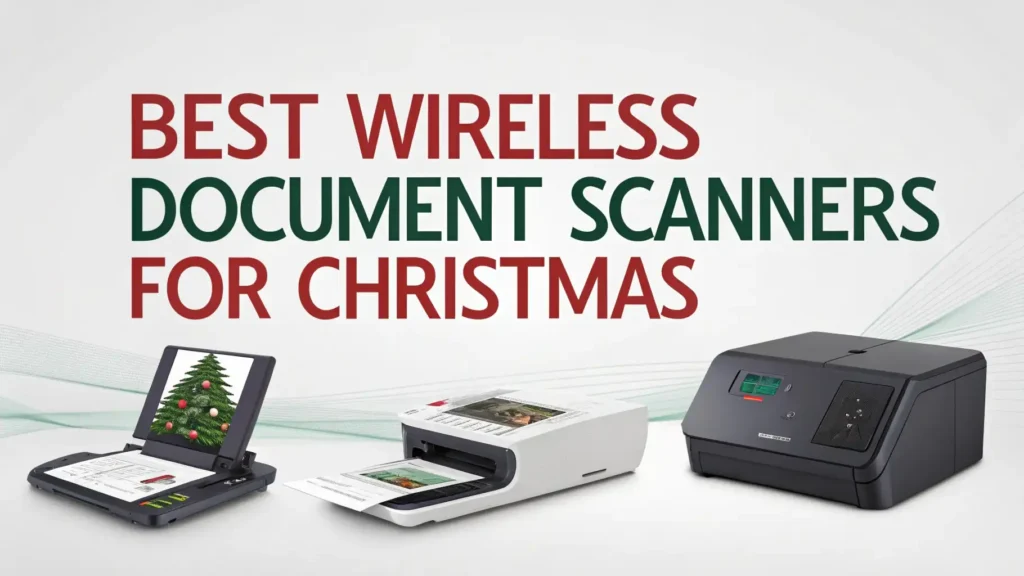
5 Best Wireless Document Scanners for Christmas 2026
Going paperless has become more than just a trend in modern offices. The right wireless document scanner can change how your team handles documents every single day.
This Christmas season brings excellent opportunities to upgrade your office equipment with the latest scanning technology that combines speed, convenience, and cloud connectivity.
The scanners we’re featuring today are currently available on Amazon and have earned top ratings from thousands of office users.
Key Takeaways:
- Speed matters for productivity. The scanners in this guide can process between 30 to 40 pages per minute, which means you can digitize a 100-page document in just a few minutes instead of spending your entire afternoon on manual scanning.
- Wireless connectivity changes everything. These devices connect to your office network via WiFi, allowing multiple team members to scan documents without physically connecting cables. You can scan directly to cloud storage services like Dropbox, Google Drive, or OneDrive from the scanner’s touchscreen.
- Duplex scanning saves time. All featured scanners include automatic two-sided scanning, which captures both sides of a document in a single pass. This feature alone cuts your scanning time in half compared to manual flipping.
- Automatic document feeders handle bulk work. With feeder capacities ranging from 20 to 100 sheets, you can load an entire stack of documents and let the scanner do all the work while you focus on other tasks.
- Touch screen controls simplify operation. Modern scanners come with intuitive color touchscreens that make it easy to select destinations, adjust settings, and manage scan jobs without needing a computer connection.
Why Your Office Needs a Wireless Document Scanner
Paper documents still fill most offices despite our digital age. Contracts arrive by mail, clients bring physical forms, and important records accumulate in filing cabinets. A wireless document scanner bridges the gap between your paper world and digital systems.
Remote work has made wireless scanning essential. Team members working from different locations need quick access to documents. When you scan directly to the cloud, everyone can access files instantly regardless of their location. This capability has become a must-have feature rather than a luxury addition.
The return on investment happens quickly with the right scanner. Think about the time your team spends walking to a traditional copier, waiting in line, and manually organizing scanned files. A dedicated wireless scanner at each workstation or department eliminates these bottlenecks completely.
ScanSnap iX2500: The Premium Office Solution

The ScanSnap iX2500 stands as the top choice for offices that demand the best scanning experience. This scanner features a large 5-inch touchscreen that makes navigation effortless. The 100-page automatic document feeder handles substantial scanning jobs without constant attention.
WiFi connectivity allows you to scan documents from any device on your network. The cloud integration works seamlessly with major platforms, sending your scans directly to where you need them. Setup takes just minutes even for non-technical users, thanks to the intuitive interface and simple configuration process.
The scanner processes documents at impressive speeds while maintaining excellent image quality. Text remains sharp and readable, which matters greatly when you’re digitizing important business documents. The built-in software includes OCR technology that converts scanned images into searchable and editable text files.
Pros:
- Large 5-inch color touchscreen for easy operation
- 100-sheet automatic document feeder handles big jobs
- Fast scanning speeds up to 30 pages per minute
- Excellent cloud integration with popular services
- High-quality OCR software included
Cons:
- Premium price point may exceed small business budgets
- Larger footprint requires adequate desk space
- Advanced features have a learning curve
ScanSnap iX1300: Best Value Wireless Scanner

The iX1300 delivers remarkable value for offices watching their budget. This compact scanner includes both wireless and USB connectivity options, giving you flexibility in how you connect to devices. The automatic document feeder holds 50 sheets, which suits most daily office scanning needs perfectly.
Amazon’s Choice designation reflects the strong customer satisfaction this scanner receives. Over 1,500 reviewers give it an average 4.2-star rating, praising its reliability and ease of use. The compact design fits easily on crowded desks without taking up excessive space.
You can scan directly to your preferred cloud service or mobile device without needing a computer connection. The scanner works with both manual feeding and the automatic feeder, allowing you to handle delicate documents carefully when needed. The included software suite provides tools for organizing, editing, and managing your digital files.
Pros:
- Affordable price point for quality wireless scanning
- Compact size saves valuable desk space
- Works with both automatic and manual feeding
- Amazon’s Choice product with excellent reviews
- Includes comprehensive scanning software
Cons:
- Smaller 50-sheet feeder capacity than premium models
- Slower scanning speeds for high-volume needs
- Touchscreen interface less advanced than premium options
Epson WorkForce ES-580W: Touch Screen Powerhouse

The Epson WorkForce ES-580W brings professional-grade features to mid-sized offices. The standout feature is the large 4.3-inch color touchscreen that provides intuitive control over all scanner functions. You can select scan destinations, adjust quality settings, and manage jobs without touching a computer.
This scanner excels at handling mixed document batches. The 100-sheet automatic document feeder accepts various paper sizes and weights in the same stack. Duplex scanning captures both sides in a single pass at speeds up to 35 pages per minute, making quick work of double-sided documents.
Network scanning capabilities let multiple users share the scanner across your office WiFi. You can set up custom scan profiles for different team members or document types, streamlining repetitive scanning tasks. The scanner connects directly to popular cloud services and includes robust software for document management.
Pros:
- Large 4.3-inch touchscreen for easy navigation
- 100-sheet ADF handles substantial scanning jobs
- Fast duplex scanning at 35 pages per minute
- Excellent image quality and color accuracy
- Network sharing supports multiple users
Cons:
- Higher price than entry-level wireless scanners
- Requires adequate desk space for footprint
- Software installation can be time-consuming initially
Epson WorkForce ES-60W: Ultra-Portable Wireless Scanner

The ES-60W redefines portable scanning for professionals who need flexibility. This compact scanner fits easily in a laptop bag and runs on USB power, eliminating the need for bulky power adapters. The wireless connectivity means you can scan documents anywhere you have WiFi access.
Despite its small size, this scanner delivers solid performance. It processes documents quickly and produces clear, readable scans suitable for business use. The battery-free design means you never worry about running out of power during important scanning sessions.
Mobile professionals love this scanner because it weighs less than a pound and measures just over 10 inches long. You can scan receipts at client meetings, digitize contracts at remote locations, or process documents while traveling. The scanner works seamlessly with smartphones and tablets through the Epson app.
Pros:
- Extremely portable and lightweight design
- USB-powered eliminates need for power outlet
- Wireless connectivity to phones and computers
- Affordable price for portable wireless scanning
- Perfect for remote work and travel
Cons:
- Single-sheet manual feed only, no document feeder
- Slower scanning speeds than desktop models
- Limited to smaller document sizes
- Image quality lower than full-sized scanners
Brother DS-640: Compact Mobile Scanner Champion

The Brother DS-640 earns praise from over 6,200 Amazon reviewers who rate it 4.3 stars. This slim scanner measures just 11.9 inches long and weighs barely over a pound, making it incredibly portable. The USB-powered operation means you can scan anywhere without searching for power outlets.
This scanner strikes an excellent balance between portability and performance. While it feeds documents one sheet at a time, the scanning process moves quickly enough for reasonable workloads. The image quality surprises users who expect compromises from such a compact device.
The wireless connectivity lets you scan directly to mobile devices or cloud services. Brother’s software suite includes useful features for organizing and editing scanned documents. The scanner handles various document types well, from standard letter paper to receipts and business cards.
Pros:
- Ultra-compact and lightweight for maximum portability
- USB-powered works anywhere without power adapter
- Excellent value under $105
- Strong 4.3-star rating from 6,200+ reviews
- Good scan quality for the size
- Wireless connectivity included
Cons:
- Manual feed only, no automatic document feeder
- Single-sided scanning requires manual flipping
- Small size limits maximum document width
- Not suitable for high-volume scanning needs
Understanding Wireless Scanner Features
Automatic Document Feeders transform your scanning experience. These mechanisms pull individual sheets from a stack and feed them through the scanner automatically. ADF capacity matters significantly for your workflow. A 20-sheet feeder works fine for occasional scanning, while busy offices benefit from 100-sheet models that handle substantial jobs without refilling.
Duplex scanning has become standard on quality scanners. This feature captures both sides of a document in one pass through the machine. The time savings add up quickly when you’re processing double-sided documents regularly. Without duplex capability, you must manually flip and rescan each page.
WiFi connectivity eliminates the traditional computer connection requirement. You can scan documents directly to network folders, email addresses, or cloud storage services. This wireless freedom means you can place the scanner wherever it makes sense for your workflow rather than where cables can reach.
Cloud Integration: Direct Upload Capabilities
Modern wireless scanners send files directly to cloud storage platforms. Dropbox, Google Drive, OneDrive, and Box integration comes standard on quality models. You can configure preset destinations on the scanner’s touchscreen, making cloud uploads as simple as pressing a button.
This direct cloud connectivity matters more than you might think. Files reach cloud storage instantly, making them available to remote team members immediately. You skip the intermediate steps of scanning to a computer and then uploading files manually. This workflow improvement saves minutes per scan and adds up to substantial time savings over weeks and months.
Security features protect sensitive documents during cloud transmission. Encrypted connections and secure authentication ensure your business information stays private. Many scanners let you configure different cloud destinations for different document types, automatically routing files to appropriate locations.
Scan Speed and Quality Considerations
Pages per minute ratings tell you how fast a scanner processes documents. Entry-level portable scanners typically scan 5 to 10 pages per minute. Desktop office scanners range from 25 to 40 pages per minute. For regular use, aim for scanners rated at 20 ppm or higher to avoid frustrating delays.
Resolution determines scan quality. Most document scanning happens at 300 DPI, which provides clear text and adequate detail for business documents. Photo scanning requires 600 DPI or higher for quality reproduction. The scanners featured here handle both document and photo scanning well at appropriate resolutions.
Color depth affects how accurately scanners capture colored documents. 24-bit color scanning reproduces colors faithfully for forms, charts, and photos. Black and white documents scan perfectly fine at lower color depths, and some scanners automatically detect document types to optimize settings.
Setting Up Your Wireless Scanner
Installation takes 15 to 30 minutes for most wireless scanners. You’ll unpack the device, install driver software on your computer, and connect the scanner to your WiFi network. Modern scanners include setup wizards that guide you through each step with clear instructions.
Network configuration requires your WiFi name and password. Some scanners include WPS buttons that simplify connection to compatible routers. Once connected to your network, the scanner becomes available to all authorized devices. Multiple computers can share one scanner without any additional hardware.
Software installation varies by manufacturer. Some companies provide comprehensive scanning suites with document management tools, OCR software, and cloud integration. Others offer minimal drivers that handle basic scanning functions. Read software descriptions before purchasing to ensure the included tools meet your needs.
Maintenance and Long-Term Care
Regular cleaning keeps scanners running smoothly. Dust and paper debris accumulate inside the scanning mechanism over time. Most manufacturers recommend cleaning the glass surfaces and feed rollers monthly with included cleaning cloths. This simple maintenance prevents image quality problems and feed jams.
Roller replacement becomes necessary after scanning thousands of pages. The rubber feed rollers gradually wear down, causing feeding problems. Replacement rollers cost between $20 and $50 and take just minutes to install. Check your scanner’s documentation for roller lifespan estimates based on your usage patterns.
Firmware updates improve scanner performance and fix bugs. Manufacturers release updates periodically to address issues and add features. Check the manufacturer’s website quarterly for new firmware versions. The update process typically involves downloading a file and running it while the scanner is connected.
Which Scanner Suits Your Office Best?
Small offices and home businesses find excellent value in the ScanSnap iX1300 or Brother DS-640. These scanners handle typical daily scanning needs without excessive cost. The compact sizes fit well in space-limited environments while delivering reliable performance.
Medium-sized offices benefit from the Epson WorkForce ES-580W or ScanSnap iX2500. The larger ADFs and faster scanning speeds justify the higher investment when multiple employees need scanning access. Network sharing capabilities let these scanners serve entire departments efficiently.
Mobile professionals should consider the Epson ES-60W or Brother DS-640 for their portability. These scanners travel easily and work anywhere with USB power. The wireless connectivity lets you scan documents on client sites or while working remotely without compromising quality.
Frequently Asked Questions
Can wireless scanners work without a computer connection?
Yes, modern wireless scanners can operate independently of computers. You can scan directly to cloud storage, email addresses, or network folders using the scanner’s built-in touchscreen. The scanner connects to your WiFi network and handles file transmission without computer involvement. Some models also support direct scanning to smartphones and tablets through dedicated mobile apps.
How do automatic document feeders prevent paper jams?
Quality ADFs use multiple sensors to detect paper thickness, double feeds, and feeding problems. Rollers grip paper gently but firmly to prevent slipping. Regular cleaning of feed rollers prevents most jams. Using paper within the specified weight range and loading sheets properly also reduces jam frequency significantly. Most modern scanners include jam detection that stops operation immediately to prevent damage.
Do I need special software to use wireless scanners?
Basic scanning works with minimal software, but manufacturers include comprehensive applications that enhance functionality. These programs provide OCR conversion, file organization, cloud integration, and image editing. Most scanners work with generic TWAIN drivers if you prefer third-party scanning software. Mobile scanning typically requires the manufacturer’s app for wireless connectivity.
What resolution should I use for business documents?
300 DPI works perfectly for standard business documents, contracts, and text materials. This resolution produces clear, readable text while keeping file sizes manageable. Increase to 600 DPI for documents containing small print or detailed graphics. Photo scanning requires 600 DPI or higher depending on intended use. Higher resolutions create larger files that take longer to scan and store.
Can multiple people share one wireless scanner?
Absolutely, network-connected wireless scanners support multiple users simultaneously. Each user can access the scanner from their computer, smartphone, or tablet. Some models let you set up individual user profiles with personalized scan settings and destinations. Network administration tools help manage access permissions and monitor scanner usage across your team.