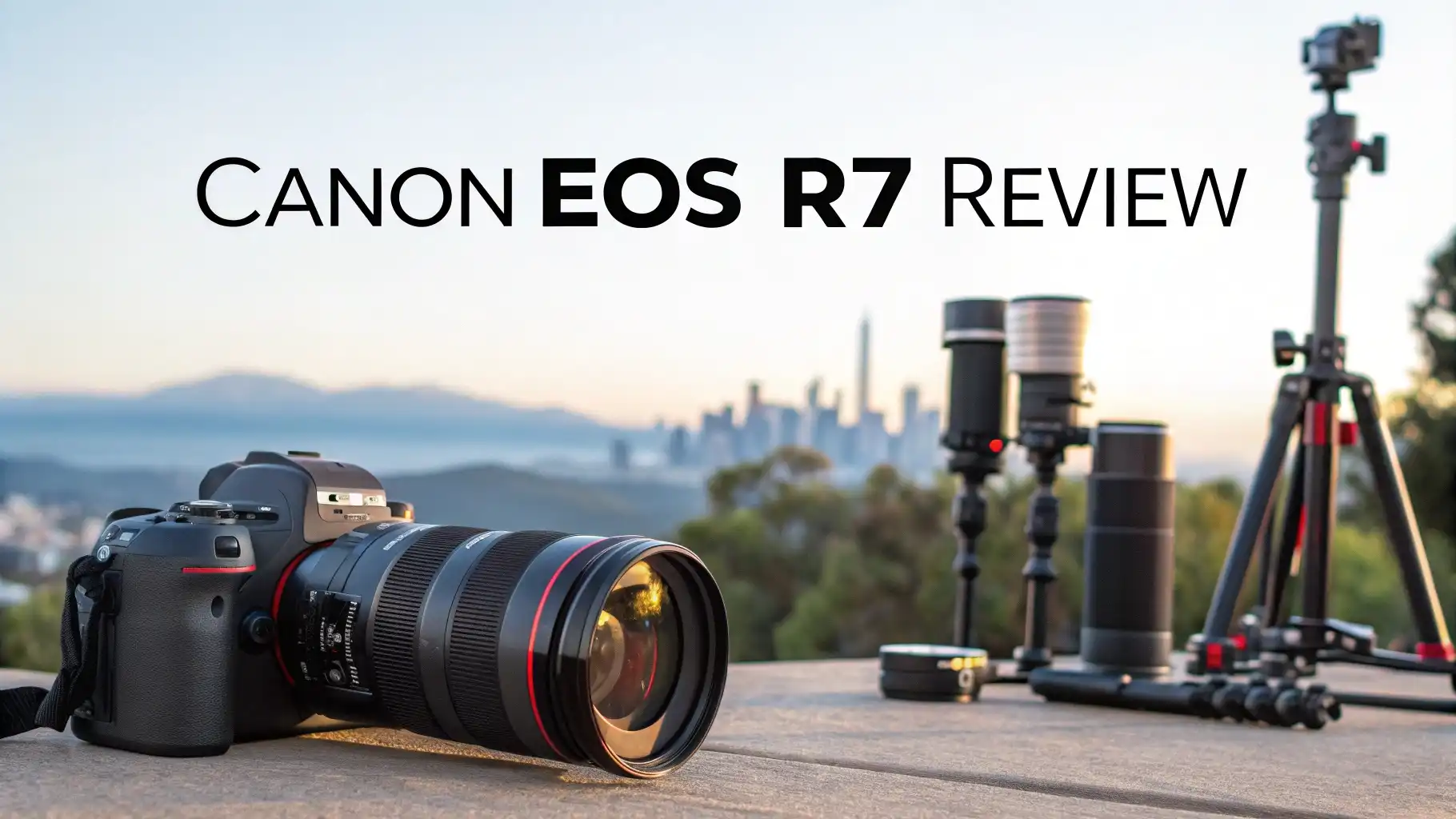
Canon EOS R7 Review: The Ultimate APS-C Mirrorless Camera
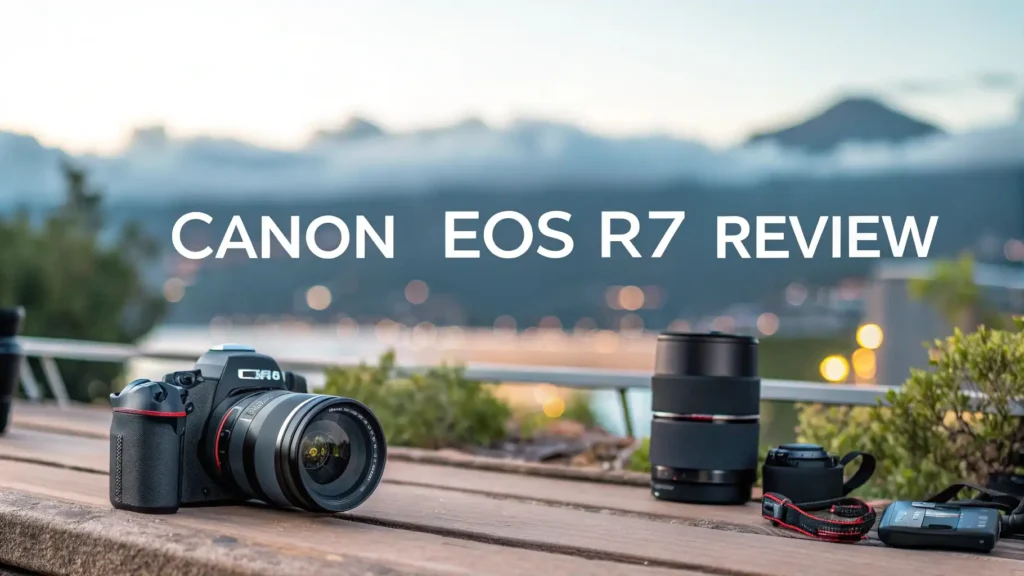
The Canon EOS R7 stands as a powerful contender in the mirrorless camera market. This camera brings professional features to enthusiasts and creators who demand speed, precision, and quality.
Whether you’re shooting wildlife, sports, or everyday moments, the R7 delivers exceptional performance at a reasonable price point.
The camera combines a 32.5 megapixel APS-C sensor with blazing fast shooting speeds and advanced autofocus technology.
Key Takeaways:
- High Resolution Sensor: The camera features a newly developed 32.5 megapixel APS-C CMOS sensor that delivers stunning image quality with excellent detail and dynamic range.
- Lightning Fast Performance: You get an impressive 15 frames per second with the mechanical shutter and up to 30 fps with the electronic shutter, perfect for capturing fast action moments.
- Advanced Autofocus System: The Dual Pixel CMOS AF II technology provides 651 autofocus areas with reliable subject detection and tracking for humans, animals, and vehicles.
- In-Body Image Stabilization: The built-in IBIS system works with compatible lenses to provide up to 7 stops of shake correction for sharper handheld shots.
- Professional Video Capabilities: Record 4K video at 60fps with 10-bit color depth and Canon Log support for serious videographers and content creators.
- Excellent Build Quality: The weather-sealed magnesium alloy body provides durability and protection for shooting in challenging outdoor conditions.

Canon EOS R7 Camera Body: What You Get
The Canon EOS R7 body delivers everything you need for professional photography work. The compact and lightweight design makes it easy to carry all day without fatigue. The camera weighs just 612 grams, making it perfect for long wildlife expeditions or sports events. The ergonomic grip provides comfort during extended shooting sessions. You get a fully articulating touchscreen that flips out for vlogging and creative angles. The electronic viewfinder displays a bright and clear image with 2.36 million dots.
The camera body includes dual SD card slots for backup and overflow recording. This feature gives you peace of mind during important shoots. The battery life provides approximately 660 shots per charge with the mechanical shutter. You can extend this with optional battery grips. The weather-sealed construction protects against dust and moisture. This allows you to shoot confidently in rain, snow, or dusty environments. The magnesium alloy chassis feels solid and durable in your hands.
The control layout follows Canon’s traditional design philosophy. All buttons and dials fall naturally under your fingers. You get customizable buttons for quick access to frequently used functions. The menu system organizes settings logically for easy navigation. The camera boots up quickly and responds instantly to your commands. The build quality exceeds expectations for a camera in this price range. Canon clearly designed this camera for serious photographers who demand reliability.
Canon EOS R7 with RF-S 18-150mm Lens Kit: Perfect All-Around Bundle

This kit bundles the R7 body with the versatile RF-S 18-150mm lens. The combination covers a focal range equivalent to 29-240mm on full-frame cameras. This range handles most shooting situations from wide landscapes to distant wildlife. The lens features optical image stabilization that works with the camera’s IBIS. Together they provide rock-solid stability for handheld shooting.
The RF-S 18-150mm lens delivers sharp images across its zoom range. The autofocus motor operates quietly and smoothly for both photos and videos. The lens collapses down for compact storage in your camera bag. You get a constant maximum aperture that makes exposure consistent throughout the zoom range. The lens construction includes 17 elements in 13 groups with one aspherical element.
This kit represents excellent value for photographers building their first RF-S system. You won’t need to buy additional lenses immediately. The range covers travel photography, events, portraits, and nature work. The lens performs well in good light and holds up reasonably in challenging conditions. Canon optimized the lens specifically for APS-C sensors. This means it produces high quality images without the bulk of full-frame glass.
The kit saves money compared to buying the body and lens separately. It makes sense for anyone moving from DSLRs to mirrorless. The lens provides room to grow as you develop your skills. You can always add specialized lenses later for specific needs.
Top 3 Alternative For Canon EOS R7
Canon EOS R10: Budget Friendly Option

Canon EOS R6 Mark II: Full Frame Upgrade

Sony A6700: Direct Competitor

Image Quality and Sensor Performance
The 32.5 megapixel APS-C sensor produces outstanding image quality. Files contain rich detail that holds up well under scrutiny and heavy editing. The sensor delivers excellent dynamic range for recovering highlights and shadows. Colors appear accurate and pleasing straight out of camera. Canon’s color science remains one of the best in the industry.
The crop factor of 1.6x effectively extends your lens reach. A 100mm lens becomes equivalent to 160mm on full-frame cameras. This makes the R7 ideal for wildlife and sports photography. You get more reach without carrying heavy telephoto lenses. The sensor resolution allows for aggressive cropping while maintaining quality.
Low-light performance proves adequate for most situations. The native ISO range extends from 100 to 32,000. You can push it to ISO 51,200 in expanded mode. Images remain clean and usable up to ISO 6400. Noise becomes visible at higher ISOs but remains manageable. The noise pattern has a pleasing film-like quality rather than digital harshness.
The sensor readout speed enables fast burst shooting without rolling shutter issues. RAW files provide plenty of latitude for post-processing. The camera captures subtle tonal transitions and maintains texture in both highlights and shadows. JPEG processing produces files ready for sharing with minimal adjustments needed.
Autofocus System: Fast and Reliable Tracking
The Dual Pixel CMOS AF II system represents a significant advancement. The autofocus covers approximately 100% of the frame for edge-to-edge focusing capability. You get 651 selectable AF points in certain modes. The system detects and tracks people, animals, and vehicles automatically. It recognizes eyes, faces, heads, and bodies for precise focusing.
Animal detection works with dogs, cats, and birds among other species. The system locks onto animal eyes even when they’re partially obscured. This proves invaluable for wildlife photography in challenging situations. The tracking sticks to subjects even when they move erratically or temporarily leave the frame. Subject detection eliminates much of the guesswork in action photography.
Focus acquisition happens nearly instantaneously in good light. The system maintains focus on moving subjects with impressive consistency. You can trust the autofocus during critical moments. The camera rarely hunts or loses lock on properly lit subjects. Low-light autofocus works down to -5 EV with certain lenses.
The face and eye detection works equally well for humans and animals. You can specify whether to prioritize left or right eye focus. The system seamlessly switches between detected subjects. Customizable AF settings let you fine-tune tracking sensitivity and behavior. The autofocus alone justifies the upgrade from older Canon DSLRs.
Continuous Shooting Speed and Buffer Depth
The R7 shoots at an impressive 15 frames per second with the mechanical shutter. This speed matches professional cameras costing significantly more money. Switch to the electronic shutter and the rate jumps to 30 fps. The fast shooting helps you capture peak action moments. You never miss the decisive instant when subjects move quickly.
The buffer allows approximately 50 RAW files at 15 fps before slowing down. This gives you about 3 seconds of continuous shooting. JPEG shooters get much more capacity before hitting buffer limits. The buffer clears reasonably quickly with fast UHS-II SD cards. You can resume shooting within seconds after filling the buffer.
Pre-shooting mode captures images before you fully press the shutter. The camera records up to 0.5 seconds of frames prior to shutter release. This feature helps you catch moments you might otherwise miss. Sports and wildlife photographers will find this capability incredibly useful. The camera essentially predicts your timing and fills in the gaps.
The electronic shutter operates completely silently for discrete shooting. This works great for wildlife that spooks easily or quiet venues. Some rolling shutter effect appears with very fast motion. The mechanical shutter remains preferable for most action photography. Battery life extends further with the mechanical shutter as well.
Video Capabilities for Content Creators
The Canon EOS R7 records impressive 4K video at up to 60 frames per second. The camera captures oversampled 4K from 7K worth of sensor data for exceptional detail. You get 10-bit 4:2:2 color recording internally for professional color grading. Canon Log support provides flat profiles with maximum dynamic range. The files handle color correction and creative grading beautifully.
Full HD recording goes up to 120 fps for smooth slow-motion footage. The video autofocus performs as reliably as it does for stills. Face and eye tracking works continuously during recording. Focus transitions happen smoothly without sudden jumps or hunting. The combination of stabilization and autofocus produces steady, sharp footage.
The articulating touchscreen simplifies vlogging and low-angle shots. You can monitor yourself while recording or checking composition. The screen flips completely forward for self-recording. Audio inputs include a 3.5mm microphone jack for external mics. A headphone jack lets you monitor audio levels during recording.
Video features include focus peaking, zebras, and waveform monitors. These tools help you nail exposure and focus while shooting. The camera records to SD cards with no time limits on clip length. Overheating rarely becomes an issue even during extended recording sessions. The R7 handles both casual content creation and serious video work.
Canon RF-S 10-18mm Ultra Wide Lens: Expand Your Perspective

The Canon RF-S 10-18mm ultra-wide lens opens creative possibilities. This lens provides an equivalent field of view of 16-29mm on full-frame cameras. The ultra-wide perspective works perfectly for landscapes, architecture, and vlogging. The lens delivers 4 stops of optical image stabilization. Combined with the R7’s IBIS, you get incredibly stable wide-angle footage.
The compact design makes this lens ideal for travel photography. It weighs only 150 grams and measures less than 45mm long when retracted. The lens extends during use but remains reasonably compact. Image quality impresses with good sharpness across the frame. Distortion remains well controlled for an ultra-wide zoom lens.
The maximum aperture of f/4.5-6.3 limits low-light shooting somewhat. However, the wide angle and stabilization help compensate. The lens excels at landscape work where you typically use smaller apertures. Vloggers appreciate the wide field of view for selfie-style recording. The STM motor provides smooth and quiet autofocus for video work.
In-Body Image Stabilization: Shoot Steadier
The five-axis in-body image stabilization system marks a major upgrade. You get up to 7 stops of shake correction with coordinated control IS. This allows handheld shooting in situations that previously required tripods. The system compensates for pitch, yaw, roll, horizontal shift, and vertical shift. Stabilization works with any attached lens, including older EF lenses via adapter.
The IBIS proves especially valuable for telephoto work and low-light photography. You can shoot at slower shutter speeds while maintaining sharpness. The system operates silently without adding weight to your lenses. Image stabilization transforms handheld shooting and expands your creative options. You maintain quality while gaining flexibility and spontaneity.
Video footage benefits tremendously from the stabilization system. Walking shots appear smooth and professional without gimbals. The electronic stabilization can be layered on top for even steadier results. Some slight crop occurs when using maximum stabilization for video. The trade-off proves worthwhile for the improved footage quality.
The stabilization system works across the entire zoom range of your lenses. It automatically adjusts parameters based on focal length and shooting conditions. You can customize stabilization settings for different shooting scenarios. The system shines when shooting wildlife from unstable positions or vehicles.
Canon RF-S 55-210mm Telephoto Lens: Reach Further

The Canon RF-S 55-210mm telephoto zoom extends your reach significantly. This lens covers an equivalent focal range of 88-336mm on full-frame cameras. The range suits wildlife, sports, and portrait photography beautifully. The lens includes optical image stabilization for sharp handheld telephoto shots. Paired with the R7’s IBIS, you get exceptional stability.
The STM motor provides fast and quiet autofocus performance. Focus tracking works smoothly for moving subjects. The lens produces sharp images with pleasing bokeh characteristics. Build quality feels solid despite the reasonable price. The zoom ring operates smoothly with appropriate resistance.
The compact retractable design saves space in your camera bag. The lens extends when powered on and ready to shoot. Maximum apertures of f/5-7.1 limit depth of field control somewhat. However, the long focal length still provides good subject separation. This lens represents excellent value for R7 owners wanting telephoto capability.
Low-light performance requires higher ISOs due to the variable aperture. The stabilization helps compensate by allowing slower shutter speeds. Colors and contrast match other RF-S lenses for consistent results. The lens handles well on the R7 body without feeling front-heavy.
Essential Accessories for Your Canon EOS R7
![ULBTER Screen Protector for Canon EOS R7 / R6 Mark III/EOS R6 Mark II/EOS R6 Camera, 9H EOSR6 EOSR7 Tempered Glass Screen Protector Edge to Edge Protection,Anti-Scrach Anti-Bubble [3 Pack]](https://devicediscoveries.blog/wp-content/plugins/aawp/public/image.php?url=YUhSMGNITTZMeTl0TG0xbFpHbGhMV0Z0WVhwdmJpNWpiMjB2YVcxaFoyVnpMMGt2TlRGd1pIbFpVbTQxVmt3dVgxTk1NVFl3WHk1cWNHYz18MTc3NjI2MzU4MA=)


Battery Life and Power Management
The Canon LP-E6NH battery provides solid performance for mirrorless standards. You get approximately 660 shots per charge when using the viewfinder. LCD shooting extends battery life to about 760 shots. Video recording drains the battery faster depending on resolution and recording time. Carrying spare batteries ensures you never miss important shots.
The camera charges via USB-C for convenient power management. You can charge while shooting using a power bank. This feature proves valuable for all-day events or travel situations. The battery indicator accurately shows remaining charge. Power management systems prevent unexpected shutdowns during critical moments.
Battery grips extend shooting time and improve handling with large lenses. The grip adds a second battery compartment for doubled capacity. It also provides vertical controls for portrait orientation shooting. The grip includes a tripod mount that aligns with the lens optical axis.
Build Quality and Weather Sealing
The Canon EOS R7 features professional-grade construction throughout. The magnesium alloy chassis provides rigidity without excessive weight. Weather sealing protects against moisture and dust intrusion. Gaskets seal all buttons, dials, doors, and the lens mount. You can confidently shoot in rain, snow, or sandy environments.
The camera feels solid and confidence-inspiring in your hands. Controls provide tactile feedback with positive clicks and smooth rotation. The shutter mechanism feels refined with a satisfying sound. Build quality matches cameras costing considerably more money. Canon clearly designed this camera to withstand professional use.
Who Should Buy the Canon EOS R7
Wildlife photographers benefit tremendously from the R7’s capabilities. The crop sensor provides extra reach while the fast autofocus tracks animals reliably. The burst rate captures fleeting moments in nature. Sports photographers appreciate the speed and tracking performance. The camera keeps up with fast action across various sports.
Travel photographers value the compact size and versatile feature set. The weather sealing provides peace of mind in diverse conditions. Content creators get excellent photo and video capabilities in one body. The autofocus and stabilization simplify one-person production work.
Frequently Asked Questions
Is the Canon EOS R7 good for beginners?
The Canon EOS R7 works well for serious beginners who want room to grow. The camera offers professional features without overwhelming complexity. The menu system organizes settings logically and helpfully. Auto modes handle settings when you’re learning. Manual controls become accessible as your skills develop. The investment makes sense if you’re committed to photography.
Can the Canon EOS R7 shoot in low light?
The R7 performs adequately in low-light situations up to ISO 6400. Images remain clean and usable at these sensitivity levels. Higher ISOs show noise but stay manageable with processing. The autofocus works down to -5 EV with certain lenses. Full-frame cameras handle extreme low-light better. However, the R7 covers most real-world shooting scenarios successfully.
Does the Canon EOS R7 have image stabilization?
Yes, the Canon EOS R7 includes five-axis in-body image stabilization. The system provides up to 7 stops of correction with compatible lenses. Stabilization works with any lens including adapted EF glass. The IBIS combines with optical stabilization in IS lenses. This coordinated control delivers maximum shake reduction. Video recording benefits greatly from the stabilization system.
What lenses work with the Canon EOS R7?
The R7 accepts all Canon RF and RF-S mount lenses natively. RF-S lenses are designed specifically for APS-C cameras like the R7. RF full-frame lenses also work but provide a cropped field of view. EF and EF-S lenses mount via Canon’s EF-EOS R adapter. Third-party RF mount lenses from Sigma and Tamron also work. The lens selection continues expanding regularly.
Is the Canon EOS R7 weather sealed?
Yes, the Canon EOS R7 features comprehensive weather sealing throughout. Gaskets protect against moisture and dust at critical points. The construction handles rain, snow, and dusty conditions confidently. You should still avoid submersion or extreme conditions. Weather-sealed lenses provide complete system protection. The sealing matches cameras in higher price brackets.
How long does the Canon EOS R7 battery last?
The Canon EOS R7 delivers approximately 660 shots per battery charge. LCD shooting extends this to about 760 shots per charge. Video recording consumes power faster depending on resolution and features. Carrying extra batteries ensures full day shooting capability. USB-C charging allows power bank charging in the field. Battery performance remains consistent across shooting conditions.
Can the Canon EOS R7 shoot 4K video?
Yes, the Canon EOS R7 records 4K video at up to 60 frames per second. The camera oversamples from 7K data for exceptional quality. You get 10-bit 4:2:2 color recording internally for professional work. Canon Log profiles provide maximum dynamic range for color grading. Full HD recording reaches 120 fps for slow-motion footage. Video autofocus and stabilization perform excellently.