Marshall Stanmore III Bluetooth Speaker Review 2026
If you love great sound and bold design, the Marshall Stanmore III probably caught your eye at some point. This speaker has been a fan favorite since its release, and it continues to hold its ground in 2026. But does it still deserve a spot on your shelf when newer competitors keep popping up?
In this review, we break down everything about the Marshall Stanmore III. We cover sound quality, design, connectivity, controls, and much more.
Whether you are shopping for a premium home Bluetooth speaker or upgrading your current setup, this post will help you make an informed decision.
Key Takeaways:
- The Marshall Stanmore III delivers 80 watts of total power through a 50W woofer amplifier and two 15W tweeter amplifiers. This setup fills medium to large rooms with clear, balanced stereo sound that stays clean even at high volume levels.
- The retro guitar amp design is a major selling point. The textured vinyl exterior, brass knobs, and Marshall script logo give this speaker an iconic look. It comes in three colors: black, cream, and brown.
- Bluetooth 5.2, RCA, and 3.5mm inputs give you three solid ways to connect your devices. You can stream wirelessly or plug in a turntable, TV, or other wired audio source.
- Analog bass and treble knobs on top let you adjust the sound profile in real time. The built in Dynamic Loudness feature also adjusts tonal balance automatically at different volume levels.
- The Marshall Bluetooth app offers additional EQ settings, firmware updates, and placement compensation. However, several reviewers note the app is somewhat limited in features compared to competitors.
- Priced around $379.99, the Stanmore III sits in the premium segment. It offers excellent value for a home speaker of this caliber, but it does not include a battery or smart assistant support.

Marshall Stanmore III Bluetooth Speaker: Overview and First Impressions
The Marshall Stanmore III is a plug in home Bluetooth speaker that sits in the middle of Marshall’s home speaker lineup. It falls between the smaller Acton III and the larger Woburn III. Marshall released this third generation model back in late 2022, and it still impresses in 2026.
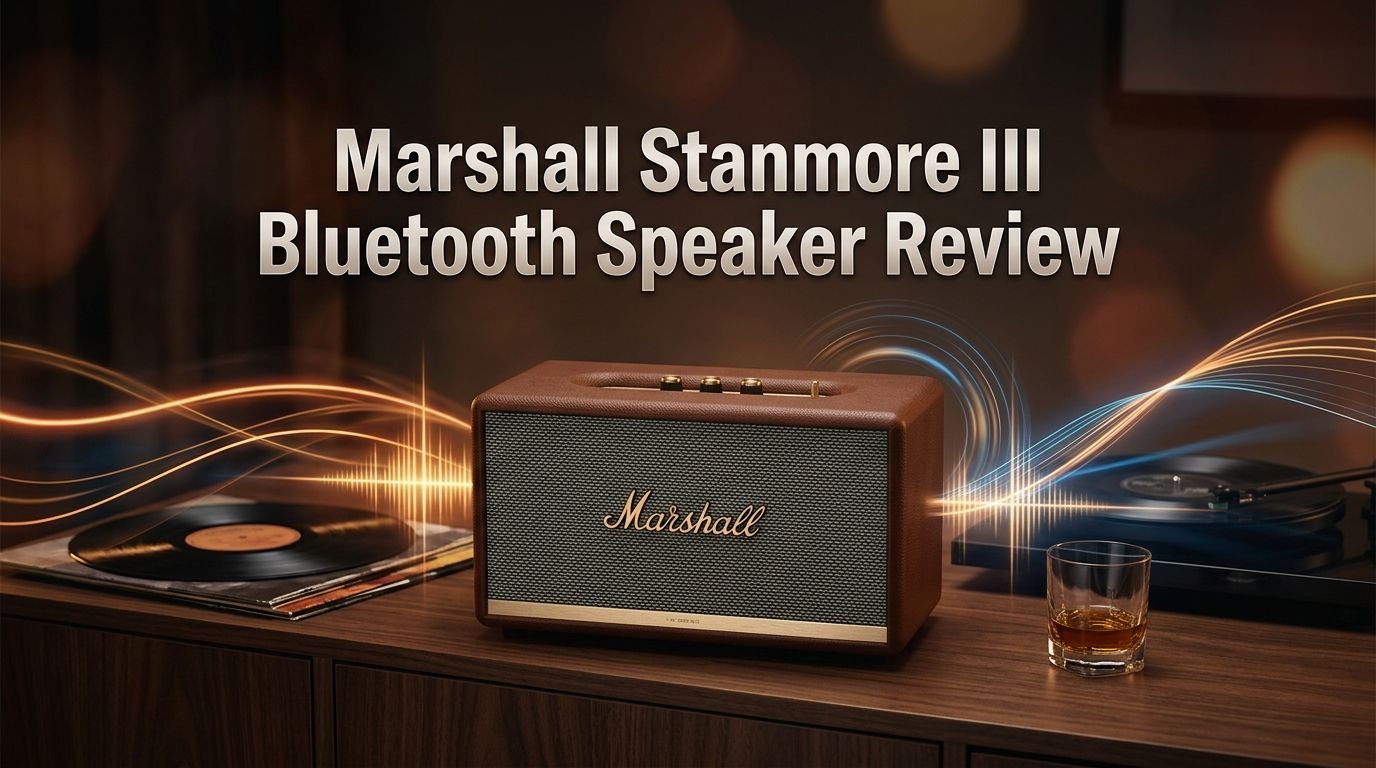
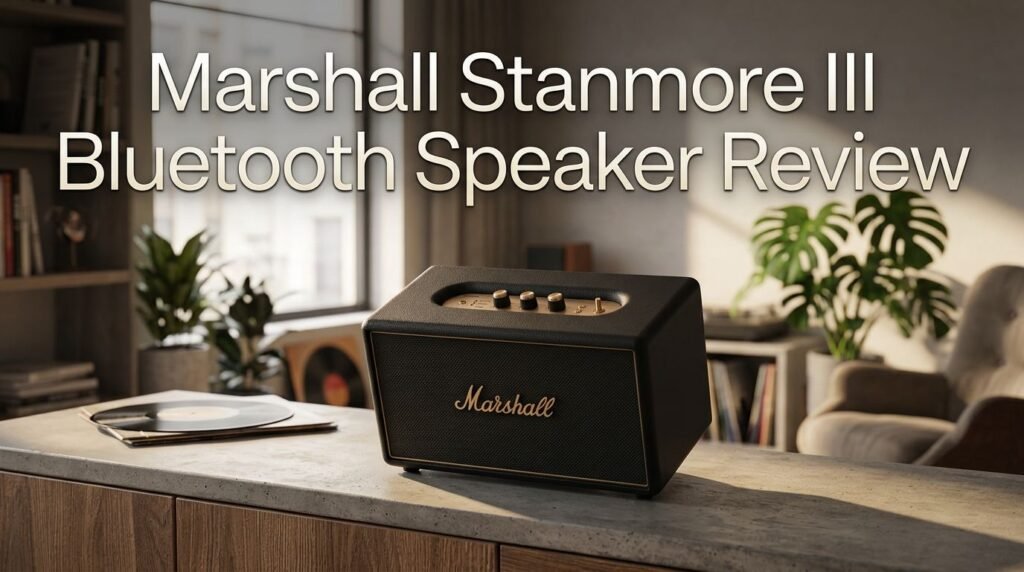
Your first impression of this speaker will likely be its stunning retro appearance. It looks like a miniature Marshall guitar amplifier. The front grille, the brass toggle switch, and the analog control knobs all scream vintage rock and roll. This speaker does not just play music. It makes a statement in any room.
The Stanmore III weighs about 10.07 pounds and measures roughly 13.78 x 7.68 x 7.48 inches. It is compact enough for a bookshelf or desk but large enough to command attention. Out of the box, you get the speaker, a power cable, and a quick start guide.
Setting it up takes less than a minute. Flip the brass power toggle, pair it through Bluetooth 5.2, and you are ready to go. The whole experience feels intentional and premium from the start.
Sound Quality: How Does the Marshall Stanmore III Perform?
Sound quality is the most important factor for any speaker purchase. The Stanmore III excels here with its two way driver system. A 5 inch woofer handles the low end. Two 0.75 inch tweeters manage the highs. Together, they produce 80 watts of power.
The bass on this speaker is deep and punchy. You feel it in your chest during bass heavy tracks. Yet it does not overpower the mids or highs. The treble remains crisp, bright, and detailed across genres. Whether you listen to rock, jazz, hip hop, or classical, the Stanmore III handles each genre with confidence.
The stereo separation is impressive for a single speaker unit. The dual tweeters angle outward, creating a wide soundstage that makes the music feel spacious. This is a noticeable upgrade from the Stanmore II.
At high volume levels, the Stanmore III stays remarkably clean. There is very little distortion, even when you push it near maximum output. The Dynamic Loudness feature also helps. It automatically adjusts the EQ at lower volumes so you do not lose bass or clarity when listening quietly.
Multiple professional reviews and user feedback confirm that this speaker punches above its weight class in sound performance.
Design and Build Quality: The Iconic Marshall Look
Few speakers look as good as the Marshall Stanmore III. The design draws directly from Marshall’s legendary guitar amplifier heritage. Every detail feels purposeful and authentic.
The exterior uses a textured vinyl wrap that mirrors the look and feel of real Marshall amps. The front grille features a woven mesh with the signature Marshall script logo in gold. Three brass analog knobs sit on top for volume, bass, and treble. A brass power toggle completes the classic look.
Build quality is solid and premium. The cabinet feels sturdy and well constructed. It does not flex or creak. The knobs turn with smooth, satisfying resistance. Even the power toggle has a deliberate, heavy click to it.
The Stanmore III comes in three color options: black, cream, and brown. Each version maintains the same high quality materials and finish. The black variant is the most popular, but the cream and brown options add a warm, vintage touch to any room.
The speaker’s weight and footprint mean it stays put on any surface. Rubber feet on the bottom prevent sliding and reduce vibration transfer. This is a speaker you place once and enjoy every day.
Top 3 Alternatives for Marshall Stanmore III
If you want to explore other options before making your final decision, here are three strong alternatives to the Marshall Stanmore III.
1. Sonos Era 300

The Sonos Era 300 offers spatial audio with Dolby Atmos support. It is a fantastic choice for listeners who want immersive, room filling sound. It also integrates deeply with the Sonos ecosystem and supports both Alexa and Sonos Voice Control. The Era 300 costs more than the Stanmore III, but it brings smart features and multi room capability that Marshall does not offer.
2. JBL Authentics 300

The JBL Authentics 300 is a retro styled speaker that directly competes with the Stanmore III. It features built in Google Assistant and Amazon Alexa. It also includes an 8 hour battery, which means you can move it around your home without a power cord. The sound quality is excellent, with deep bass from its 6.5 inch woofer.
3. Sonos Era 100

The Sonos Era 100 costs significantly less than the Stanmore III at around $249. It delivers clear, balanced sound and works beautifully as part of a multi room Sonos setup. If you value smart features and app ecosystem over raw power, the Era 100 is a smart buy.
Bluetooth and Connectivity Options
The Marshall Stanmore III gives you three ways to connect your audio sources. The primary connection method is Bluetooth 5.2. This is the latest standard available in this speaker, and it provides a stable, reliable wireless connection.
Bluetooth 5.2 delivers low latency and improved range compared to older Bluetooth versions. You can pair your phone, tablet, laptop, or any Bluetooth enabled device. Pairing is fast and straightforward. The speaker remembers previously connected devices for quick reconnection.
For wired connections, the Stanmore III includes a 3.5mm auxiliary input and an RCA input. The RCA input is especially useful for connecting a turntable or a dedicated music player. Vinyl lovers appreciate this feature because many modern speakers skip RCA altogether.
One limitation worth noting is the Bluetooth codec support. The Stanmore III supports SBC, the standard Bluetooth codec. It does not support aptX or AAC. This means audiophiles who care about wireless audio resolution may notice a slight difference. However, most casual listeners will not hear any issues.
The speaker does not support Wi Fi, AirPlay 2, or Chromecast. This means you cannot add it to a multi room audio system the way you can with Sonos or other Wi Fi enabled speakers.
Controls and User Experience
Using the Marshall Stanmore III feels intuitive and fun. The physical controls on top of the speaker give you direct access to the most important settings. You get a volume knob, bass knob, and treble knob. Each knob has a small LED ring around its base that shows the current level.
The brass power toggle on the front panel adds a tactile, satisfying on/off experience. It feels like flipping a real amp switch. A small LED indicator near the toggle shows the speaker’s status.
Beyond the physical controls, you can use the Marshall Bluetooth app on iOS or Android. The app lets you fine tune the EQ beyond what the hardware knobs offer. You can adjust bass, mid, and treble levels with more precision. The app also includes a placement compensation feature that optimizes the sound based on where you position the speaker.
However, the app experience is somewhat limited. There is no multi room support, no music streaming integration, and no smart assistant control. Compared to the Sonos or JBL apps, the Marshall app feels basic. Still, it covers the essentials well enough for most users.
The overall user experience is simple, fast, and satisfying. You do not need to read a manual or watch tutorials. Everything works as you would expect.
Bass and Treble Performance
The Marshall Stanmore III shines in its bass and treble reproduction. The dedicated 5 inch woofer produces bass that is deep, rich, and controlled. It does not sound muddy or boomy. The bass reflex design of the cabinet helps the low end breathe and resonate properly.
You can boost or cut the bass using the analog knob on top of the speaker. Turning it up adds a satisfying thump to your music. Turning it down tightens the sound for more vocal or treble focused genres. The range of adjustment is generous and practical.
The dual 0.75 inch tweeters handle the high frequencies with clarity and sparkle. Cymbals shimmer. Vocals cut through the mix. Acoustic guitar strings ring out with detail. The treble never sounds harsh or sibilant, even at higher settings.
The combination of adjustable bass and treble gives you real control over the listening experience. Very few Bluetooth speakers in this price range offer this level of analog customization. Most competitors rely on app based EQ only.
The Dynamic Loudness feature deserves a special mention here. At lower volumes, speakers often lose bass impact and treble clarity. Dynamic Loudness compensates for this by automatically boosting low and high frequencies at reduced volume levels. The result is a full, balanced sound no matter how loud or quiet you listen.
Marshall Stanmore III for Vinyl and Record Players
One of the standout features of the Stanmore III is its RCA input. This makes it a great companion for turntables and record players. Many modern Bluetooth speakers lack a dedicated RCA connection, so this is a genuine advantage.
If you own a turntable with a built in phono preamp, you can connect it directly to the Stanmore III using RCA cables. The sound quality through this wired connection is excellent. You bypass Bluetooth compression entirely and get a pure analog signal path.
The warm, full bodied sound signature of the Stanmore III complements vinyl playback beautifully. The speaker’s natural bass emphasis and smooth treble pair well with the warm character of vinyl records. Jazz, classic rock, and soul records sound particularly stunning.
For turntable owners, this speaker removes the need for a separate amplifier or receiver. The Stanmore III acts as an all in one powered speaker solution. Just plug in your turntable, adjust the bass and treble knobs, and enjoy your records.
Keep in mind that if your turntable does not have a built in preamp, you will need an external phono preamp between the turntable and the speaker. The Stanmore III does not include a phono stage.
Marshall App and Smart Features
The Marshall Bluetooth app is available for both iOS and Android. It provides a few useful features that expand the speaker’s capabilities beyond its physical controls.
The app includes a graphic EQ with adjustable bass, mid, and treble sliders. This gives you more precise control than the hardware knobs alone. You can create a custom sound profile and save it. The app also displays the current firmware version and prompts you to update when new firmware is available.
One helpful feature is Placement Compensation. This setting adjusts the speaker’s output based on whether you place it on a shelf, near a wall, or in a corner. Different placements affect bass response, and this feature helps the speaker sound its best in any position.
However, the app does not include smart assistant integration. There is no Alexa, Google Assistant, or Siri support. You cannot control the speaker with your voice. You also cannot stream music directly through the app or add the Stanmore III to a multi room audio group.
Compared to the Sonos app or the JBL One app, the Marshall app feels stripped down. It covers the basics but does not offer the depth or polish that competing apps provide. For most users, this is a minor issue. The physical controls handle everyday adjustments just fine.
Marshall Stanmore III vs Marshall Stanmore II: What Changed?
If you owned the Stanmore II, you might wonder what the third generation brings to the table. The upgrades are meaningful but not revolutionary.
The biggest change is Bluetooth 5.2, up from Bluetooth 5.0 in the Stanmore II. This means better range, lower latency, and improved connection stability. The Stanmore III also dropped the Wi Fi and multi room features that the Stanmore II had through Chromecast and Spotify Connect.
The sound profile received a subtle refinement. The Stanmore III has a wider soundstage and slightly improved clarity in the midrange. The bass response remains similar, but the overall presentation sounds more spacious and open.
Visually, the two speakers look almost identical. The Stanmore III has a slightly updated front panel design and a new power switch style. The color options remain the same: black, cream, and brown.
The removal of Wi Fi and Chromecast support is a controversial decision. Some users view it as a downgrade. Others appreciate the simplified, Bluetooth focused approach. If you relied on Wi Fi streaming or multi room audio with the Stanmore II, the Stanmore III may not be the right upgrade for you.
The price stayed roughly the same at $379.99, which makes the Stanmore III a solid buy for new customers but a harder sell for existing Stanmore II owners.
Room Size and Placement Tips
The Marshall Stanmore III performs best in small to medium sized rooms. Think bedrooms, home offices, kitchens, or living rooms up to about 400 square feet. In these spaces, the 80 watts of power fill the room comfortably without strain.
In larger rooms, the speaker still sounds good, but you may notice the soundstage thins out at greater distances. For open plan living areas or large entertainment rooms, the bigger Woburn III is a better fit.
Placement matters a lot with this speaker. Placing the Stanmore III on a shelf against a wall can boost bass response significantly. If the bass sounds too heavy, pull the speaker away from the wall or use the Placement Compensation feature in the Marshall app.
For the best stereo imaging, place the speaker at ear level and avoid tucking it into a tight corner. The outward angled tweeters project sound best when they have some room to breathe. A desk, bookshelf, or media console at ear height produces the best results.
The rubber feet on the bottom prevent vibration and keep the speaker stable. You do not need any special mounts or stands. The Stanmore III is ready to perform right out of the box with minimal setup.
Pros and Cons of the Marshall Stanmore III
Every product has strengths and weaknesses. Here is an honest look at what the Stanmore III does well and where it falls short.
The sound quality is a clear strength. The 80W output, dedicated woofer, and dual tweeters create a rich, detailed, and room filling audio experience. The adjustable bass and treble knobs add a hands on element that most competitors lack.
The design is another huge win. The vintage Marshall amp aesthetic is timeless. It looks fantastic in any setting. The build quality matches the premium price tag. Materials feel high end and durable.
Connectivity is adequate but limited. Bluetooth 5.2, RCA, and 3.5mm cover most use cases. However, the lack of Wi Fi, AirPlay 2, and smart assistant support is a real gap in 2026. Competing speakers from Sonos, JBL, and Bose offer these features at similar or lower price points.
The app could be better. It works, but it is not as feature rich or polished as rival apps. The absence of music streaming, multi room support, and voice control limits the Stanmore III’s appeal for smart home users.
No built in battery means this speaker stays tethered to a power outlet. It is not portable. If you need a speaker you can move around, look elsewhere.
Who Should Buy the Marshall Stanmore III?
The Marshall Stanmore III is perfect for music lovers who value sound quality and design above all else. If you want a speaker that sounds incredible and looks like a piece of rock history, this is your match.
It is ideal for vinyl enthusiasts who want a simple, high quality speaker to pair with their turntable. The RCA input and warm sound signature make it a natural fit for record players.
Home office workers will also love this speaker. It fills a room with rich, immersive sound that makes long work days more enjoyable. The adjustable EQ lets you switch from focus friendly jazz to energizing rock with a twist of a knob.
If you prioritize smart features, multi room audio, or voice assistant support, the Stanmore III may not be the best choice. Speakers like the Sonos Era 300 or JBL Authentics 300 offer more in those areas.
Budget conscious buyers should also consider whether the $379.99 price tag fits their needs. The speaker delivers exceptional value for what it offers, but cheaper alternatives exist if you are willing to sacrifice some sound quality or design appeal.
Final Verdict: Is the Marshall Stanmore III Worth It in 2026?
The Marshall Stanmore III remains a strong contender in the premium home Bluetooth speaker category in 2026. Its sound quality is excellent. Its design is iconic. Its physical controls offer a tactile, satisfying experience that touchscreens and apps cannot replicate.
Yes, it lacks Wi Fi, smart assistants, and a built in battery. These omissions hold it back from being the perfect home speaker. But if your priority is pure audio performance wrapped in stunning design, the Stanmore III delivers on that promise.
At $379.99, you get a speaker that sounds like it costs much more. The build quality will last for years. The retro aesthetic will never go out of style. For many buyers, those qualities matter more than the latest smart features.
Our recommendation? If you want a dedicated, high quality Bluetooth speaker for a single room, the Marshall Stanmore III is still one of the best options you can buy in 2026.
Frequently Asked Questions
Does the Marshall Stanmore III have a built in battery?
No, the Stanmore III requires a constant power connection. It does not have an internal battery. You must plug it into a wall outlet to use it. This makes it a stationary home speaker rather than a portable one.
Can I connect a turntable to the Marshall Stanmore III?
Yes, you can. The speaker includes an RCA input that works perfectly with turntables. If your turntable has a built in phono preamp, you can connect it directly. If it does not, you will need a separate phono preamp between the turntable and the speaker.
Does the Marshall Stanmore III support Alexa or Google Assistant?
No. The Stanmore III does not have any built in smart assistant support. You cannot control it with voice commands. If you need smart assistant integration, consider the Sonos Era 300 or the JBL Authentics 300 as alternatives.
What Bluetooth codecs does the Marshall Stanmore III support?
The Stanmore III supports the SBC Bluetooth codec. It does not support aptX, aptX HD, LDAC, or AAC. For most listeners, SBC provides perfectly acceptable audio quality over Bluetooth.
Is the Marshall Stanmore III loud enough for a large room?
The speaker produces 80 watts of total power. This is enough to fill small to medium rooms comfortably. In very large rooms or open spaces, you may find the volume and coverage insufficient. For larger spaces, consider the Marshall Woburn III, which offers more power.
How does the Marshall Stanmore III compare to the Sonos Era 300?
The Stanmore III focuses on pure sound quality and retro design. The Sonos Era 300 offers spatial audio, Dolby Atmos, smart assistant support, and multi room capability. The Marshall wins on design and analog controls. The Sonos wins on smart features and ecosystem integration. Your choice depends on what matters most to you.