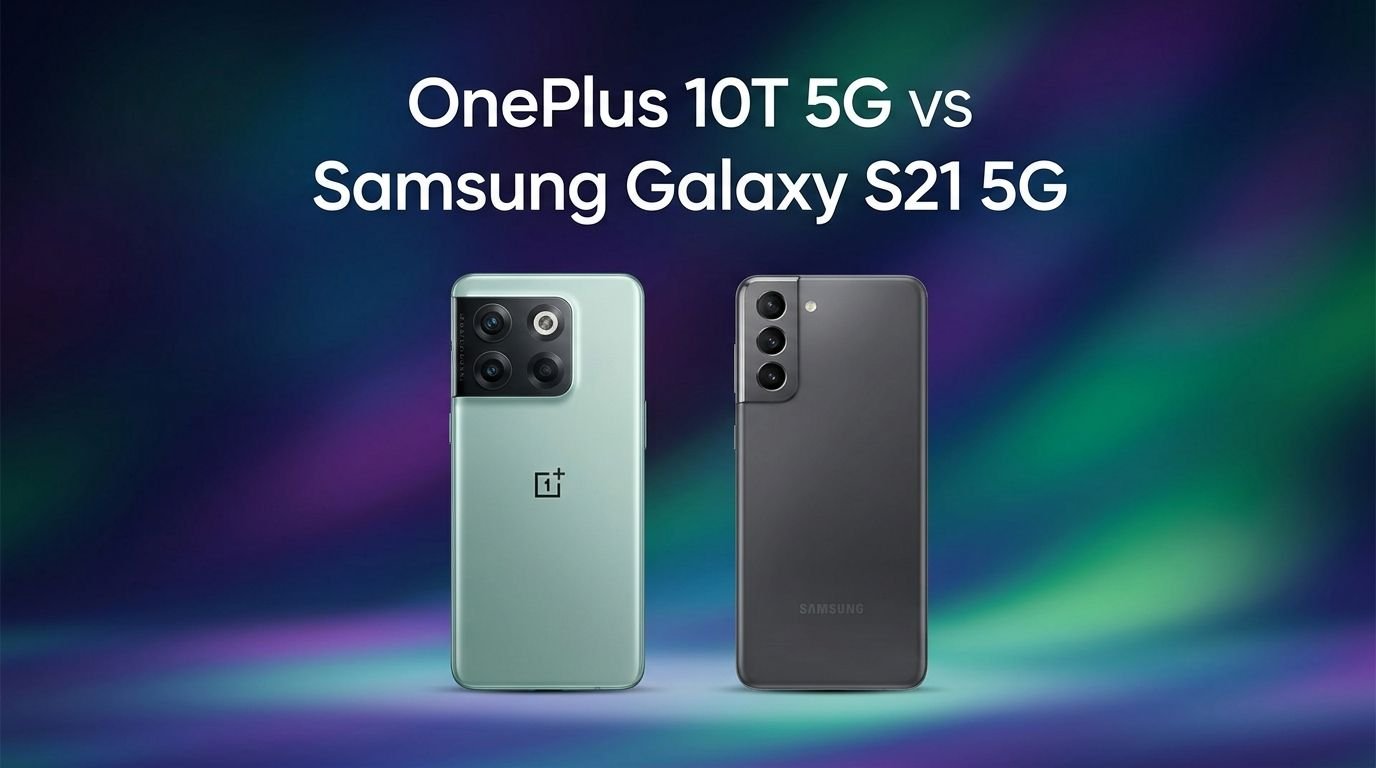
OnePlus 10T 5G vs Samsung Galaxy S21 5G: Which to Buy?
Are you torn between the OnePlus 10T 5G and the Samsung Galaxy S21 5G? Both phones pack serious power, stunning displays, and impressive cameras. Yet they take very different approaches to the smartphone experience.
The OnePlus 10T 5G arrived in August 2022 with a Snapdragon 8+ Gen 1 chip and blazing 125W fast charging.
The Samsung Galaxy S21 5G launched in January 2021 with a Snapdragon 888, wireless charging support, and Samsung’s trusted One UI software. Each phone has a loyal fan base, and each brings something unique to the table.
Key Takeaways:
- The OnePlus 10T 5G has a bigger 6.7-inch display, a larger 4800 mAh battery, and much faster 125W wired charging. It charges from 0 to 100% in about 19 minutes. The Samsung Galaxy S21 offers a more compact 6.2-inch screen with a 4000 mAh battery and 25W wired charging plus 15W wireless charging.
- Performance goes to the OnePlus 10T thanks to the newer Snapdragon 8+ Gen 1 chipset (4nm). The Galaxy S21 runs on the Snapdragon 888 (5nm), which is still fast but falls behind in benchmark scores and power efficiency.
- The Samsung Galaxy S21 has a more versatile camera system with a 64MP telephoto lens, 8K video recording, and better 4K selfie video. The OnePlus 10T has a higher-resolution 50MP main sensor but lacks a telephoto lens.
- Samsung wins on durability and extras. The Galaxy S21 has an IP68 water resistance rating, Gorilla Glass Victus, and wireless charging. The OnePlus 10T has no official IP rating and uses Gorilla Glass 5.
- Both phones now sell well below their original launch prices, making them excellent budget picks in 2026. The Galaxy S21 is often found under $200, while the OnePlus 10T hovers around $220 to $300.
- Samsung offers longer software support with up to four major Android upgrades, while the OnePlus 10T received fewer update commitments. Samsung’s software ecosystem also includes features like Samsung DeX and Wireless DeX.
OnePlus 10T 5G: Overview and First Impressions

The OnePlus 10T 5G made waves at launch with its focus on speed. It runs the Qualcomm Snapdragon 8+ Gen 1 chipset, built on a 4nm process. This means excellent power efficiency and flagship-level performance. RAM options go up to 16GB, which is remarkable for a phone in this price range.
The phone has a 6.7-inch Fluid AMOLED display with a 120Hz refresh rate and HDR10+ support. Colors pop, scrolling feels smooth, and media consumption is enjoyable. The screen uses Gorilla Glass 5 for scratch protection.
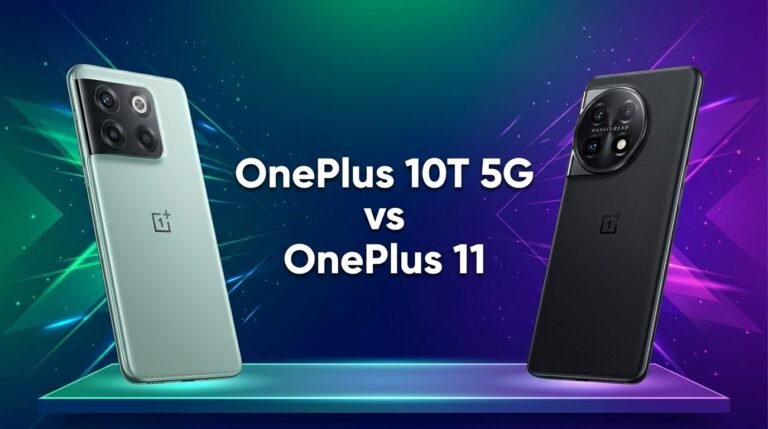
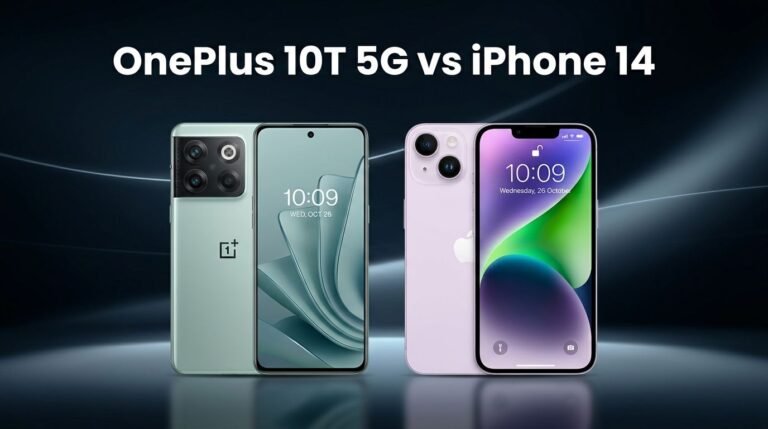
Its design features a glass front and back with a plastic frame. The phone weighs 204 grams and measures 8.8mm thick. It comes in Moonstone Black and Jade Green color options. The look is clean and modern, though the plastic frame may feel less premium to some buyers.
One standout feature is the 125W SuperVOOC charging (110V in the US delivers 125W). OnePlus claims a full charge in about 19 minutes. That is industry-leading speed and a huge advantage for busy users who need a quick top-up before heading out.
Pros:
- Snapdragon 8+ Gen 1 delivers top-tier performance
- 125W SuperVOOC charging fills the battery in about 19 minutes
- Large 6.7-inch 120Hz AMOLED display
- Up to 16GB RAM and 256GB storage
- Competitive price point
Cons:
- No official IP water resistance rating
- Plastic frame feels less premium
- No wireless charging support
- Limited software update commitment
- No telephoto camera lens
Samsung Galaxy S21 5G: Overview and First Impressions

The Samsung Galaxy S21 5G launched as Samsung’s most affordable flagship in 2021. It runs the Qualcomm Snapdragon 888 (in the US) and comes with 8GB of RAM and up to 256GB of storage. The phone delivered a premium experience at a lower price than previous Samsung flagships.
The Galaxy S21 features a 6.2-inch Dynamic AMOLED 2X display with a 120Hz refresh rate. Peak brightness hits 1300 nits, which is excellent for outdoor use. The screen uses Gorilla Glass Victus, Samsung’s strongest glass at the time.
Samsung chose a unique design with the “Contour Cut” camera housing that blends into the aluminum frame. The phone weighs just 169 grams and measures 7.9mm thick. It feels compact and easy to hold with one hand. Color options include Phantom Gray, Phantom White, Phantom Violet, and Phantom Pink.
The Galaxy S21 carries an IP68 rating, meaning it can survive submersion in 1.5 meters of water for 30 minutes. It also supports 15W wireless charging and 4.5W reverse wireless charging. These features give Samsung a practical edge for everyday use.
Pros:
- IP68 water and dust resistance
- Gorilla Glass Victus offers superior scratch protection
- Compact, lightweight design at 169 grams
- 15W wireless charging and reverse wireless charging
- Up to four major Android upgrades
- Samsung DeX desktop experience support
Cons:
- Slower 25W wired charging
- Snapdragon 888 runs hotter than newer chips
- Plastic back panel instead of glass
- Smaller 4000 mAh battery
- No microSD card slot
Display Comparison: Size, Quality, and Protection
The OnePlus 10T has a 6.7-inch Fluid AMOLED panel. It delivers a resolution of 1080 x 2412 pixels at 394 PPI. The display supports a 120Hz refresh rate and HDR10+. It is protected by Gorilla Glass 5.
The Samsung Galaxy S21 uses a 6.2-inch Dynamic AMOLED 2X display. Its resolution sits at 1080 x 2400 pixels with a sharper 421 PPI due to the smaller screen. It also supports 120Hz and HDR10+. Samsung’s display reaches a peak brightness of 1300 nits, while the OnePlus 10T was measured at 819 nits.
If you want a bigger screen for movies, gaming, and multitasking, the OnePlus 10T is the clear pick. Its 6.7-inch panel gives you significantly more real estate. However, the Samsung Galaxy S21 offers a brighter, sharper display thanks to higher PPI and peak brightness.
The Galaxy S21 also wins on screen durability. Gorilla Glass Victus provides better drop and scratch resistance than Gorilla Glass 5 on the OnePlus 10T. For users who tend to drop their phones or skip screen protectors, this difference matters.
Both displays perform well for daily use. The choice depends on whether you value screen size or brightness and durability.
Performance and Processing Power
The OnePlus 10T runs the Snapdragon 8+ Gen 1 chip, built on a 4nm process. This is a generation ahead of the Galaxy S21’s processor. It scored 1,016,958 on AnTuTu v9 and 3,907 on GeekBench v5.1. The Adreno 730 GPU handles gaming at high frame rates.
The Samsung Galaxy S21 uses the Snapdragon 888 (US version), built on a 5nm process. It scored 584,055 on AnTuTu v8 and 3,238 on GeekBench v5.1. The Adreno 660 GPU is capable but falls short of the newer Adreno 730.
In real-world use, the OnePlus 10T feels noticeably snappier. Apps open faster, multitasking is smoother, and the phone handles heavy games like Genshin Impact with less thermal throttling. The 8+ Gen 1 chip also runs cooler than the Snapdragon 888, which was known for heat issues under sustained loads.
The OnePlus 10T offers up to 16GB of RAM, compared to the Galaxy S21’s maximum of 8GB. This extra memory keeps more apps alive in the background. Power users and heavy multitaskers will appreciate this difference.
For raw speed and future-proofing, the OnePlus 10T wins this round decisively. The Galaxy S21 still performs well for everyday tasks, but it cannot match the newer chip in demanding scenarios.
Camera Systems: Photo and Video Quality
The OnePlus 10T features a triple camera system. The main sensor is a 50MP f/1.8 wide lens with OIS. It pairs with an 8MP ultrawide lens and a 2MP macro sensor. The front camera is 16MP. Video recording tops out at 4K at 60fps.
The Samsung Galaxy S21 also has a triple camera setup. It uses a 12MP f/1.8 main lens with OIS, a 64MP f/2.0 telephoto lens with 3x hybrid zoom, and a 12MP ultrawide lens. The front camera is 10MP with dual pixel PDAF. Video recording reaches 8K at 24fps.
Samsung’s camera system is more versatile due to the telephoto lens. You get real optical zoom and better portrait shots with natural background blur. The Galaxy S21 also records 8K video, which the OnePlus 10T cannot match.
The OnePlus 10T captures sharp photos with good detail from its 50MP sensor. Low-light performance is decent, and OIS helps stabilize shots. However, the 2MP macro lens is largely disappointing, and the lack of a telephoto limits shooting flexibility.
Samsung also delivers better selfie video quality. The Galaxy S21’s front camera records at 4K, while the OnePlus 10T’s selfie camera maxes out at 1080p. For video calls, vlogging, and social media content, Samsung has the edge.
Overall, Samsung wins the camera comparison with a more balanced and versatile system.
Battery Life and Charging Speed
The OnePlus 10T packs a 4800 mAh battery. GSMArena’s endurance test gave it a rating of 96 hours. The phone easily lasts a full day of moderate to heavy use. Standby time is excellent thanks to the efficient 4nm chipset.
The Samsung Galaxy S21 has a 4000 mAh battery with an endurance rating of 93 hours. It handles a full day of light to moderate use. Heavy users may need a top-up by late afternoon.
The real story is charging speed. The OnePlus 10T supports 125W SuperVOOC wired charging. It charges from 0 to 100% in approximately 19 minutes. That is a game-changer. You can plug in during a quick coffee break and leave with a full battery.
The Galaxy S21 supports 25W wired charging, which takes well over an hour for a full charge. However, it adds 15W wireless charging and 4.5W reverse wireless charging. You can charge your Galaxy Buds or other Qi devices on the back of the phone.
If fast wired charging is your priority, the OnePlus 10T dominates. If you prefer the convenience of wireless charging and don’t mind slower speeds, the Galaxy S21 offers more flexibility.
Build Quality and Durability
The OnePlus 10T uses a glass front, glass back, and a plastic frame. Both glass panels use Gorilla Glass 5. The phone has no official IP rating for water or dust resistance. It weighs 204 grams and feels solid in hand.
The Samsung Galaxy S21 features a Gorilla Glass Victus front, plastic back, and an aluminum frame. It carries an IP68 certification, which means full protection against dust and water submersion up to 1.5 meters for 30 minutes. It weighs just 169 grams.
This is an interesting trade-off. The OnePlus 10T has a glass back that looks and feels premium. The Galaxy S21 has a plastic back but compensates with a stronger aluminum frame and Gorilla Glass Victus on the front.
For durability and peace of mind, the Galaxy S21 is the safer choice. The IP68 rating protects against accidental spills, rain, and even a drop in a sink. The OnePlus 10T leaves you without that safety net.
The Galaxy S21 is also lighter by 35 grams, which makes a noticeable difference during long phone calls or extended one-handed use. Samsung’s Contour Cut design also adds a unique visual identity that holds up well.
Software Experience and Updates
The OnePlus 10T shipped with Android 12 and OxygenOS 13. OxygenOS was once famous for its clean, near-stock Android experience. Recent versions have added features from ColorOS, making it heavier. The phone received limited software update commitments from OnePlus.
The Samsung Galaxy S21 launched with Android 11 and One UI. Samsung promised four major Android upgrades and five years of security patches. This means the Galaxy S21 can run up to Android 15. One UI is feature-rich, polished, and well-supported.
Samsung’s software ecosystem includes extras like Samsung DeX, which turns your phone into a desktop-like experience when connected to a monitor. Wireless DeX works over Wi-Fi. These features are unique to Samsung and add real productivity value.
One UI also offers better integration with Samsung’s wider ecosystem. If you own a Samsung tablet, watch, or earbuds, the experience is seamless. Galaxy features like Link to Windows, Smart Switch, and Samsung Health are well-developed.
For long-term software support and feature depth, Samsung is the winner. The Galaxy S21 will continue receiving updates longer than the OnePlus 10T, making it a smarter investment for the future.
Connectivity and 5G Support
Both phones support 5G connectivity, but there are differences in band support and features. The OnePlus 10T supports Sub-6 5G bands across multiple carriers. It works well with T-Mobile, AT&T, and other GSM-based networks.
The Samsung Galaxy S21 (US version) supports both Sub-6 and mmWave 5G. This gives it access to Samsung’s fastest 5G speeds in supported areas. It also supports CDMA networks, making it fully compatible with Verizon.
Both phones feature Wi-Fi 6, NFC, and Bluetooth (5.2 on OnePlus, 5.0 on Samsung). The OnePlus 10T has slightly newer Bluetooth, which offers better connection stability and range. The Galaxy S21 uses USB 3.2, while the OnePlus 10T uses USB 2.0, giving Samsung faster wired data transfer speeds.
The Galaxy S21 also supports eSIM alongside a physical nano-SIM. This provides flexibility for travelers who want to use a local data plan without swapping SIM cards. The OnePlus 10T uses dual physical nano-SIM slots instead.
For network compatibility in the US, the Galaxy S21 has broader support. Its CDMA and mmWave capabilities make it work on every major carrier without issues.
Audio and Media Experience
Both phones feature stereo speakers and skip the 3.5mm headphone jack. The OnePlus 10T supports 24-bit/192kHz Hi-Res audio, which is great for audiophiles using wired USB-C headphones or high-quality Bluetooth codecs like aptX HD.
The Samsung Galaxy S21 supports high-bitrate audio and works well with Samsung’s AKG-tuned audio profile. Loudspeaker tests from GSMArena ranked the OnePlus 10T at -24.7 LUFS (Very Good) and the Galaxy S21 at -26.4 LUFS (Good). The OnePlus 10T plays louder and clearer through its speakers.
For media consumption, the OnePlus 10T’s larger 6.7-inch screen gives a better experience for streaming Netflix, YouTube, and gaming. Colors are vivid, and the 120Hz refresh rate makes scrolling through social media feeds feel fluid.
The Galaxy S21’s 6.2-inch display is compact but still delivers stunning AMOLED visuals. Samsung’s display technology is industry-leading, and the higher peak brightness makes outdoor viewing more comfortable.
If you prioritize louder speakers and a bigger screen, the OnePlus 10T is the better media device. If you want a brighter display with superior color accuracy, Samsung’s panel has a slight edge.
Pricing and Overall Value
Both phones have dropped significantly from their original launch prices. The OnePlus 10T launched at $649 and now sells for around $220 to $300 on Amazon. The Samsung Galaxy S21 launched at $799 and can be found for under $200 in many cases.
At these current prices, both phones offer incredible value. You get flagship-level features for mid-range money. The Galaxy S21 delivers more value per dollar spent, given its lower price, IP68 rating, wireless charging, and longer software support.
The OnePlus 10T justifies its slightly higher price with better performance, faster charging, and a bigger display. If you want raw speed and don’t care about water resistance or wireless charging, the 10T is a strong pick.
For budget-conscious buyers who want a well-rounded phone with a trusted brand, the Samsung Galaxy S21 is hard to beat. It covers all the essentials and then some. For performance-focused users who value charging speed and screen size, the OnePlus 10T delivers more firepower.
Your choice depends on your priorities. Both phones punch well above their current price tags.
Which Phone Should You Buy?
The answer depends on what matters most to you. Here is a quick breakdown.
Choose the OnePlus 10T 5G if you want:
A larger screen, faster processor, massive RAM options, and insanely fast 125W charging. It is the better pick for gamers, power users, and anyone who values raw performance over brand prestige.
Choose the Samsung Galaxy S21 5G if you want:
A compact design, IP68 water resistance, wireless charging, a versatile camera with telephoto zoom, and long-term software updates. It is the smarter pick for everyday users, content creators, and Samsung ecosystem fans.
Both phones run 5G, deliver smooth 120Hz AMOLED displays, and offer solid cameras. Neither phone will disappoint you. The OnePlus 10T leads in power and speed. The Samsung Galaxy S21 leads in polish and practicality.
Consider how you use your phone daily. If fast charging and gaming are priorities, go OnePlus. If you need a reliable, water-resistant phone with great cameras and years of updates, go Samsung.
Frequently Asked Questions
Is the OnePlus 10T 5G better than the Samsung Galaxy S21?
It depends on your priorities. The OnePlus 10T has a faster processor, bigger battery, and 125W charging. The Samsung Galaxy S21 has better water resistance, wireless charging, a telephoto camera, and longer software support. Each phone excels in different areas.
Does the OnePlus 10T 5G have wireless charging?
No. The OnePlus 10T does not support wireless charging. It relies on its 125W SuperVOOC wired charging instead, which fills the battery in about 19 minutes.
Is the Samsung Galaxy S21 still worth buying in 2026?
Yes. The Galaxy S21 continues to receive security updates and runs modern Android software. Its camera, display, and build quality remain competitive. At current prices under $200, it offers excellent value.
Which phone has a better camera, the OnePlus 10T or Samsung Galaxy S21?
The Samsung Galaxy S21 has a more versatile camera system with a 64MP telephoto lens and 8K video recording. The OnePlus 10T has a higher-resolution 50MP main sensor but lacks telephoto zoom. Samsung is the better choice for photography enthusiasts.
Can I use the OnePlus 10T on Verizon?
The OnePlus 10T has limited CDMA support and may not work fully on Verizon’s network. The Samsung Galaxy S21 supports CDMA and works with all major US carriers, including Verizon.
How long does the battery last on both phones?
The OnePlus 10T (4800 mAh) scored a 96-hour endurance rating on GSMArena. The Samsung Galaxy S21 (4000 mAh) scored 93 hours. Both phones can last a full day with moderate use, but the OnePlus 10T has a slight edge in battery longevity.