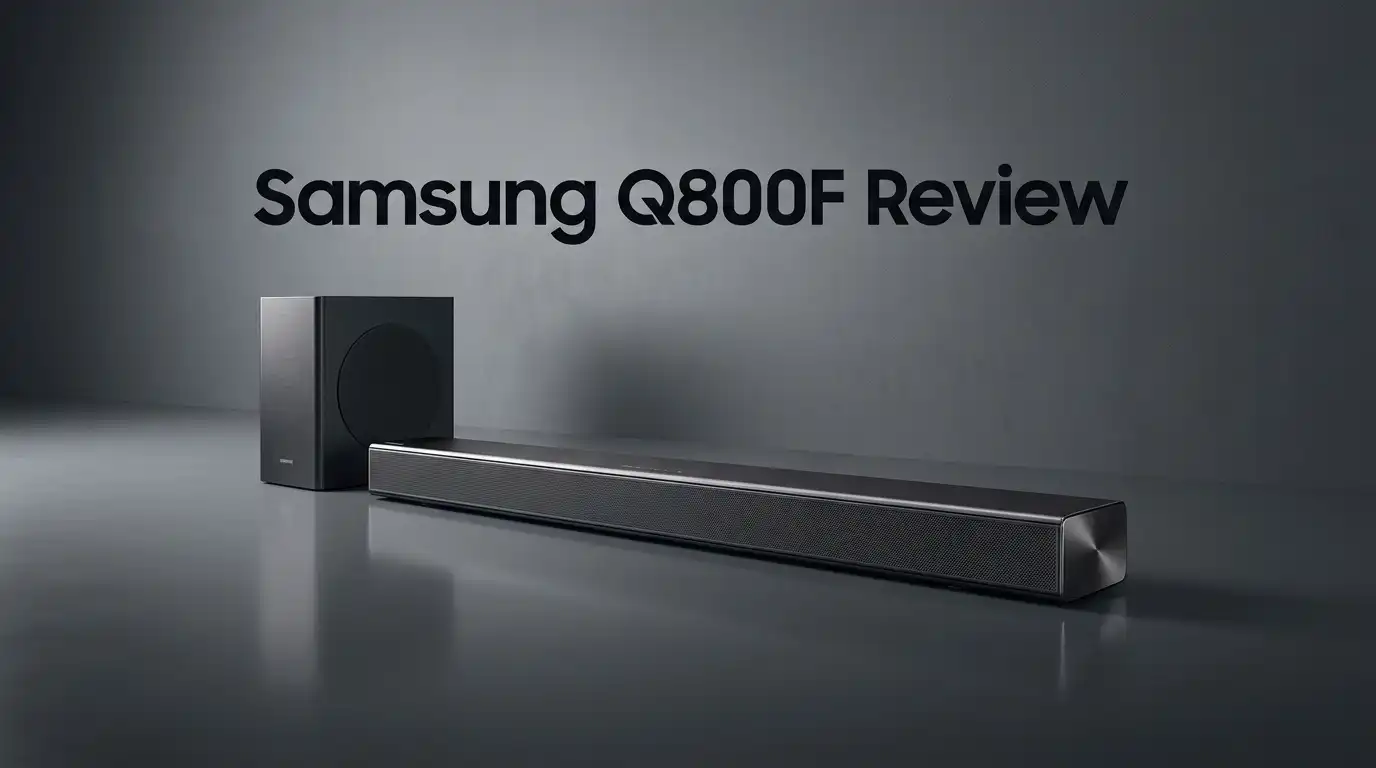
Samsung Q800F Review: Does It Really Work?
Does the Samsung Q800F really deliver true Dolby Atmos magic? That’s the question every home theater fan asks before buying a soundbar.
This 5.1.2 channel soundbar promises big things. It packs 400W of power and physical side and top firing speakers. On paper, it sounds like a home cinema dream.
Samsung also adds Dolby Atmos and DTS:X support here. The brand’s Q-Symphony feature lets this soundbar sync with your Samsung TV speakers too. That combo aims to create a bigger, richer sound picture.
In a Nutshell
- Sound positioning stands out. The soundbar places effects around you with real accuracy. Movies and shows feel more alive because of this.
- Bass hits deep and strong. You get a rich low end that adds punch to action scenes. Music also sounds fuller than expected.
- Overhead effects fall short. The 5.1.2 setup promises height sound, but the actual Atmos experience feels flat. Ceiling bounce effects lack real punch.
- Voices can sound thin. Dialogue in Atmos and 5.1 modes sometimes turns tinny. This affects clarity during conversation heavy scenes.
- Q Symphony adds real value. Pairing this bar with a compatible Samsung TV boosts overall sound quality. Your speakers and TV work as one unit.
- Best suited for space and volume lovers. If you want a wide soundstage and loud output, this bar delivers. But if true Atmos height is your main goal, expect a compromise.
Channel Configuration and Speaker Setup
The Samsung Q800F uses a 5.1.2 channel layout to create its soundfield. This means five main channels (left, center, right, surround left, surround right) plus two height channels for overhead effects.
Physical speaker placement matters here. The soundbar itself houses the front three channels. Side firing speakers handle the surround duties. Top firing drivers point upward to create height effects. This setup avoids the need for separate satellite speakers, which simplifies your installation process.
The 400W power output distributes across all these channels. You get enough energy to fill medium to large rooms. The soundbar can play loud without obvious distortion in standard modes.
How the channels work together determines your actual listening experience. When you play Dolby Atmos content, the system sends height information to those top drivers. In theory, this creates a three dimensional sound bubble around your listening area. In practice, the overhead immersion feels limited compared to true ceiling mounted speakers.
The side speakers excel at creating a wide soundstage. Effects move smoothly across your left and right sides. Panning feels natural and precise. This is where the Q800F truly shines in terms of spatial sound.
The center channel handles dialogue and on screen action. This is critical for movie watching. Voice clarity matters most here, though some users report thinness in certain modes.
Surround channels add ambient sound and directional effects. They work well for creating an enveloping experience without dedicated rear speakers.
Q Symphony integration changes the game if you own a compatible Samsung TV. Your television’s speakers combine with the soundbar’s output. This expands the overall sound field and improves height perception slightly. The TV essentially becomes an additional speaker in your setup.
For best results, position your soundbar at ear level when seated. Mount it on a TV stand or wall bracket. Keep side firing speakers unobstructed. This configuration maximizes the channel separation and spatial effects the Q800F can deliver.

Last update on 2026-09-19 / Affiliate links / Images from Amazon Product Advertising API Some of the links on this website are affiliate links, which means that at no additional cost to you, I earn a commission if you click through and make a purchase. I only recommend products and services that I believe will add value to my readers. Thank you for your support!
Atmos and Surround Sound Performance
The Samsung Q800F claims to deliver genuine Atmos immersion, but reality tells a different story. The 5.1.2 channel setup includes physical top-firing speakers meant to bounce sound off your ceiling. This approach creates overhead effects, yet the actual immersion feels limited compared to what the specs suggest.
Atmos performance falls short of expectations. The soundbar produces overhead effects, but they lack the clarity and impact you’d experience with a true Atmos setup using dedicated ceiling speakers. Height channels feel more like an afterthought than a core feature. Most users report that standard 5.1 surround sound actually sounds more engaging than the Atmos modes.
The side-firing speakers do their job well. They create a wide, expansive soundstage that pulls you into the action. Effects move smoothly from front to back, and the surround channels add genuine ambient texture to movies and games. Directional accuracy remains solid throughout the room.
One notable issue emerges in Atmos and 5.1 modes. Dialogue reproduction turns thin and tinny. Voices lose their natural warmth and body. This becomes distracting during dialogue-heavy scenes, especially in dramatic films. Standard stereo mode handles vocals much better, which creates an odd tradeoff.
The 400W power output distributes across all channels, allowing the Q800F to reach impressive volume levels. Bass extension runs deep, adding real punch to action sequences. The soundbar maintains clarity even at high volumes, though some harshness creeps into midrange frequencies.
Q Symphony integration changes things. If you own a compatible Samsung TV, this feature syncs the soundbar with your television’s speakers. The combined output creates a more immersive field than the soundbar alone can produce. This bonus feature adds genuine value for Samsung TV owners.
The bottom line on surround performance: the Q800F excels at width and bass impact, but Atmos feels underdeveloped. You get a good surround experience, just not the overhead magic the 5.1.2 configuration promises. For true height immersion, you’d need dedicated ceiling speakers or a different approach entirely.
Audio Quality and Frequency Response
The Samsung Q800F delivers solid audio across most content, but its frequency response reveals some interesting trade offs. The soundbar excels in the low end, producing deep bass that makes action sequences feel immersive and punchy. Explosions and impacts carry real weight through the 400W power output.
The midrange and high frequencies tell a different story. Voices sometimes sound thin when you switch to Atmos or 5.1 surround modes. Dialogue clarity suffers in these configurations, making speech occasionally tinny and fatiguing during longer listening sessions. Standard stereo mode handles voices better, which suggests the channel distribution affects how the center channel performs.
The frequency response also shows the limits of the 5.1.2 setup without dedicated satellites. The top firing speakers struggle to create convincing overhead effects. You hear directional sound from above, but it lacks the precision and immersion that true Atmos should deliver. The side speakers compensate by creating an expansive horizontal soundstage that feels genuinely wide.
High frequency extension remains decent overall. The soundbar handles treble without harshness in most scenarios. However, certain movie soundtracks expose weakness in the upper midrange, where some clarity gets lost.
The real strength emerges in bass response and volume capability. The Q800F reaches impressive sound pressure levels while maintaining reasonable clarity at high volumes. This makes it excellent for large rooms where you want genuine impact without distortion.
Q Symphony integration with compatible Samsung TVs adds a meaningful boost to frequency balance. The TV’s speakers blend with the soundbar, filling gaps in the midrange that the soundbar alone cannot address. This feature noticeably improves voice reproduction when enabled.
For gaming and movies with heavy action, the frequency response works well. The emphasis on bass and width suits these content types perfectly. However, if dialogue clarity and precise Atmos overhead effects matter most to you, the Q800F shows its limitations. The audio quality remains good for a soundbar in this category, but it prioritizes impact and volume over finesse.
Top 3 Alternatives
Sony HT-A5000

Last update on 2026-09-19 / Affiliate links / Images from Amazon Product Advertising API Some of the links on this website are affiliate links, which means that at no additional cost to you, I earn a commission if you click through and make a purchase. I only recommend products and services that I believe will add value to my readers. Thank you for your support!
LG SN11RG


Last update on 2026-09-19 / Affiliate links / Images from Amazon Product Advertising API Some of the links on this website are affiliate links, which means that at no additional cost to you, I earn a commission if you click through and make a purchase. I only recommend products and services that I believe will add value to my readers. Thank you for your support!
Bose Smart Soundbar

Last update on 2026-09-19 / Affiliate links / Images from Amazon Product Advertising API Some of the links on this website are affiliate links, which means that at no additional cost to you, I earn a commission if you click through and make a purchase. I only recommend products and services that I believe will add value to my readers. Thank you for your support!
Connectivity and Smart Features
The Samsung Q800F connects to your devices through multiple pathways. You get HDMI eARC, optical digital, Bluetooth, and USB inputs. This variety means you can wire it to your TV, soundbar, or stream wirelessly from your phone.
HDMI eARC stands out as the best connection option. It sends high quality audio directly from your TV to the soundbar with minimal delay. Your TV remote can control the volume too. This simplifies your setup significantly.
Bluetooth connectivity works smoothly for streaming music from smartphones and tablets. The connection stays stable within normal room distances. Switching between devices happens quickly without dropouts.
The Q800F includes Samsung’s SmartThings app for wireless control. You adjust volume, switch inputs, and toggle sound modes from your phone. The app responds fast and feels intuitive to navigate.
Q Symphony integration deserves special mention here. If you own a compatible Samsung TV, this feature syncs the soundbar with your television’s speakers. The TV’s audio combines with the soundbar for a fuller sound experience. This only works with certain Samsung models, so check compatibility first.
Voice assistant support appears limited on this model. You cannot control it directly with Alexa or Google Assistant. Manual adjustments through the remote or app remain your primary options.
The soundbar supports both Dolby Atmos and DTS:X formats. Your streaming apps and Blu ray players can send these advanced audio signals to the Q800F. However, the actual immersion falls short of what premium models deliver, as covered in the surround sound section.
Firmware updates happen wirelessly when available. Samsung pushes improvements directly to your soundbar without manual intervention needed.
The connectivity suite feels complete for most users. HDMI eARC provides the cleanest experience, while Bluetooth handles casual listening. Q Symphony owners gain an extra dimension if their TV qualifies. The app control adds convenience, though voice commands would enhance the smart features further.
Design and Installation
The Samsung Q800F sits as a compact soundbar that fits most entertainment setups without major hassle. Its physical design includes side and top firing speakers built directly into the unit. You won’t need separate satellite boxes cluttering your room.
The soundbar measures approximately 65 inches wide, making it suitable for most TV stands. The build quality feels solid, with a sleek black finish that blends into most living rooms. The front panel houses touch controls for quick adjustments without reaching for a remote.
Installation takes just minutes. You can place the Q800F on a TV stand or mount it on a wall using the included bracket. The cable management stays simple with just an HDMI eARC connection to your TV and a power cord needed for operation. Wireless connectivity through Bluetooth eliminates the need for additional cables if you prefer streaming from mobile devices.
The 5.1.2 channel setup means the soundbar handles front left, center, and right channels. Side firing drivers create the surround effect without extra boxes. Top firing speakers attempt to deliver overhead sound for Atmos content. This all in one approach simplifies your setup, though it comes with acoustic trade offs.
Connection options remain straightforward. HDMI eARC provides the cleanest audio path from your TV to the soundbar. Optical audio works as a backup if your TV lacks eARC support. Bluetooth connectivity streams music from phones and tablets without wired connections.
The SmartThings app lets you control the soundbar from your smartphone. Volume adjustments and sound mode switching happen wirelessly through the app. Q Symphony integration with compatible Samsung TVs automatically syncs audio playback for enhanced sound.
One practical consideration: the lack of dedicated satellite speakers means all audio processing happens within the main unit. This design choice keeps your setup minimal but limits how the soundbar can distribute overhead effects. The physical constraints of a single bar create acoustic limitations that separate units could overcome.
Pros and Cons
Pros
- Deep bass extension and powerful volume output make action movies and gaming sound impressive
- Physical side and top firing speakers create a spacious soundstage with precise sound positioning
- Q Symphony integration with Samsung TVs noticeably improves overall frequency balance and clarity
- Multiple connectivity options including HDMI eARC and Bluetooth offer flexibility for different devices
- Compact 65 inch width fits most TV stands without requiring dedicated satellite speakers
Cons
- Atmos performance feels underwhelming despite the 5.1.2 channel configuration and overhead speakers
- Voice reproduction sounds tinny and thin when playing content in Atmos or 5.1 modes
- Lack of dedicated satellites limits the overhead immersion you’d expect from a 5.1.2 setup
- All audio processing happens in the main unit, which constrains the spatial effects for immersive formats
Who Should Buy It
The Samsung Q800F works best for viewers who prioritize deep bass and powerful volume over immersive overhead effects. If you watch action movies, play video games, or enjoy music with strong low end, this soundbar delivers impressive results.
Gamers benefit significantly from the precise sound positioning and expansive soundstage. You’ll hear footsteps and directional audio cues clearly during competitive gameplay. The high volume capability ensures you catch every explosion and impact without distortion.
Movie fans should know what they’re getting. The Q800F excels with standard surround sound content and traditional 5.1 mixes. However, if you specifically want immersive Atmos experiences with overhead effects, this soundbar disappoints. The overhead speakers exist but don’t create convincing height channels.
Samsung TV owners gain an extra advantage through Q Symphony integration. This feature combines your TV’s speakers with the soundbar for better overall sound quality. The frequency balance improves noticeably, making dialogue clearer and music richer.
Compact space constraints make this soundbar ideal for most living rooms. The 65 inch width fits standard TV stands without needing separate satellite speakers. You avoid cluttering your entertainment setup with additional components.
Music listeners get solid performance from stereo content. Bluetooth connectivity works smoothly for streaming from your phone or tablet. The soundbar handles various music genres well, though voice reproduction can sound thin in certain modes.
Streaming enthusiasts appreciate the multiple connectivity options. HDMI eARC provides the best audio quality from your TV. Bluetooth offers flexibility for wireless music playback from different devices.
Skip this soundbar if you demand authentic Atmos immersion or pristine voice clarity in all modes. The tinny voice reproduction in Atmos and 5.1 modes frustrates dialogue focused content. If overhead immersion matters most to you, consider alternatives that prioritize height channels more effectively.
The Q800F suits buyers who want a capable all rounder without satellite speakers cluttering their space. You get strong bass, impressive volume, and solid surround sound performance. Just manage expectations about overhead effects and voice quality in specific modes.
Final Verdict
The Samsung Q800F asks a simple question. Does it deliver real Atmos sound? The honest answer sits somewhere in the middle.
Bass lovers and gamers will feel satisfied. The soundbar throws deep low end and handles loud action scenes with ease. Sound positioning stays sharp during fast paced games.
But true overhead immersion remains elusive. The 5.1.2 setup promises height channels, yet the ceiling effect feels flat compared to true Atmos systems. Voices can turn thin during Atmos or 5.1 playback, which pulls attention away from dialogue heavy scenes.
If you already own a Samsung TV, Q Symphony adds real value. It blends TV speakers with the soundbar for fuller sound. This feature alone can tip the decision in favor of the Q800F for Samsung households.
Should you upgrade from the Q800C? The differences feel minor. Both share similar strengths and similar Atmos limitations. Skip the upgrade unless you need newer connectivity options.
Looking at competitors helps clarify the picture. The Samsung HW-Q910D offers a more convincing height effect for viewers who truly want cinematic overhead sound. The JBL Bar 500 and Hisense AX5140Q also compete well in this same overall category, though each brings its own trade offs in soundstage width and bass depth.
Final thought: the Q800F suits practical buyers. It fits people who want strong bass, loud volume, and simple setup. It does not suit buyers chasing authentic Atmos realism or crystal clear voice reproduction in every mode.
Think about your priorities before deciding. Do you want raw power and easy installation? Or do you want precise, layered overhead sound that mimics a real cinema? The Q800F answers the first question well. It leaves the second question only partly answered.
For most everyday viewers, that tradeoff still makes sense.
Frequently Asked Questions
Does the Samsung Q800F deliver real Atmos sound?
The Q800F has physical top-firing speakers and supports Dolby Atmos, but the overhead immersion feels underwhelming. The 5.1.2 channel setup should create convincing height effects, yet many users report that Atmos content doesn’t deliver the immersive experience they expect. The soundbar excels at side-to-side positioning and front soundstage width, but overhead effects remain subtle.
If authentic overhead immersion is your main goal, this soundbar may disappoint you.
Why does voice sound tinny in Atmos mode?
Voice reproduction becomes thin and tinny when you switch to Atmos or 5.1 surround modes. This happens because the soundbar redistributes audio across multiple channels, which can thin out dialogue frequencies. Standard stereo mode handles voices much more naturally.
If clear dialogue matters to you, test this soundbar with your favorite shows before committing.
Should I choose the Q800F or the Q800C?
The differences between these two models feel minor. Both deliver strong bass and powerful volume output. The Q800F doesn’t offer enough performance improvements to justify upgrading if you already own the Q800C.
Stick with the Q800C unless you want the latest model year features.
Does Q Symphony really improve performance?
Yes. If you own a Samsung TV, Q Symphony integration noticeably enhances frequency balance and overall clarity. The soundbar and TV work together to fill gaps in the audio spectrum. Samsung TV owners get a genuine advantage here that other soundbar owners won’t experience.
This feature alone makes the Q800F more appealing for Samsung households.
Who should buy the Samsung Q800F?
Bass lovers and gamers will feel satisfied with this soundbar. The precise sound positioning and expansive soundstage shine during gaming sessions and action movies. Deep bass extension and high volume capability make entertainment sound impressive.
Skip it if you demand pristine voice clarity or true overhead Atmos immersion.

Hello everyone my name is Alenya and i am a gadget discovering Enthusiast 🐻🐻