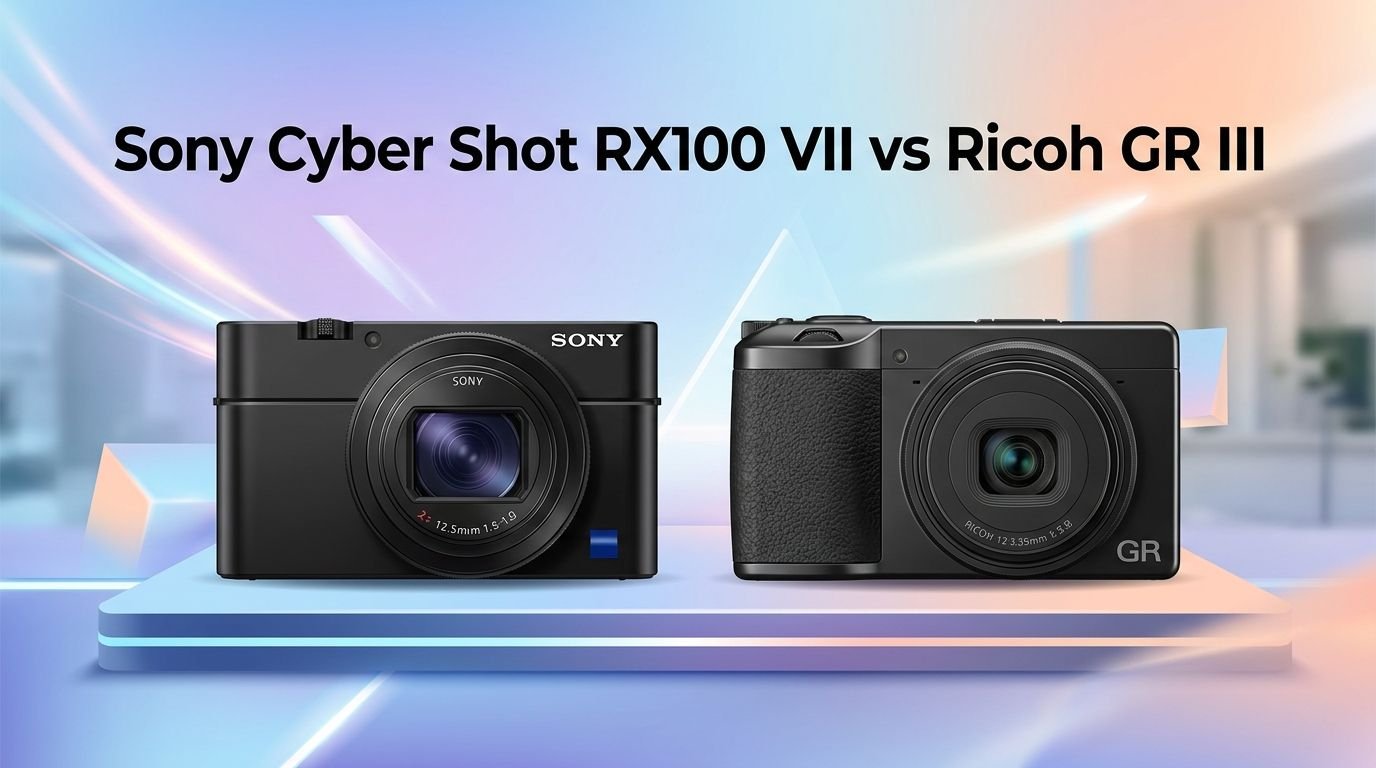
Sony Cyber Shot RX100 VII vs Ricoh GR III: Which to Buy?
You want a premium compact camera that fits in your pocket. Two names keep coming up: the Sony Cyber Shot RX100 VII and the Ricoh GR III. Both cameras promise high quality images in a small body. Both cost a pretty penny. But they serve very different types of photographers.
The Sony RX100 VII packs a 24 to 200mm zoom lens and shoots 4K video with serious autofocus power. The Ricoh GR III carries a fixed 28mm lens on an APS-C sensor and delivers stunning street photography results. One is a zoom powerhouse. The other is a minimalist’s dream.
So which camera should you buy? The answer depends on what you shoot, how you shoot, and what you value most. This detailed comparison breaks down every angle.
Key Takeaways:
- The Sony RX100 VII uses a 1 inch sensor with a 24 to 200mm zoom lens, making it one of the most versatile pocket cameras available. It handles everything from wide angle landscapes to telephoto portraits. If you want a single camera for travel that covers many focal lengths, the Sony is the stronger choice.
- The Ricoh GR III features a larger APS-C sensor paired with a fixed 28mm f/2.8 lens. This combination delivers better low light performance and more natural background blur. Street photographers and minimalists love this camera for its simplicity and image quality.
- Autofocus on the Sony RX100 VII is far more advanced, with 357 phase detection points and real time tracking. The Ricoh GR III uses a contrast detection system that works well but struggles with fast moving subjects.
- Video shooters should lean toward the Sony, which records 4K footage with image stabilization and a microphone jack. The Ricoh GR III maxes out at 1080p and offers limited video features.
- The Ricoh GR III is smaller and lighter at just 257 grams. The Sony RX100 VII weighs 302 grams. Both fit in a jacket pocket, but the Ricoh disappears more easily into a pants pocket.
- Price points are similar, but value depends on your priorities. The Sony offers more features per dollar for general use. The Ricoh offers superior image quality per dollar for dedicated still photography.
Sony Cyber Shot RX100 VII: A Complete Overview

The Sony Cyber Shot RX100 VII launched in 2019 as the seventh generation of Sony’s popular RX100 line. It builds on years of refinement. Sony packed alpha series autofocus technology into this tiny body. The result is a compact camera that performs like a much larger system.
The RX100 VII uses a 20.1 megapixel 1 inch stacked CMOS sensor with a BIONZ X processor. The stacked design allows faster readout speeds. This means less rolling shutter in video and faster burst shooting. You get 20 frames per second with autofocus and auto exposure tracking. That is impressive for any camera, let alone one that fits in your pocket.
The Zeiss Vario Sonnar T lens* covers 24 to 200mm (equivalent) with an aperture range of f/2.8 at wide to f/4.5 at telephoto. This zoom range handles most shooting situations. You can capture wide landscapes, then zoom in to frame a distant subject without changing your position.
Sony also included a pop up electronic viewfinder (EVF) and a tilting LCD touchscreen. The EVF is small but usable, especially in bright sunlight when the rear screen washes out. The tilting screen flips up for selfies and vlogging. A microphone jack adds flexibility for content creators.
Pros:
- Incredible 24 to 200mm zoom range in a pocket body
- 20 fps burst shooting with blackout free live view
- Real time tracking and Eye AF for people and animals
- 4K video with S Log3, microphone jack, and active stabilization
- Pop up EVF and tilting touchscreen
Cons:
- 1 inch sensor limits low light performance compared to larger sensors
- Battery life is modest at roughly 260 shots per charge
- Small body can feel cramped for users with larger hands
- Premium price tag for a compact camera
Ricoh GR III: A Complete Overview

The Ricoh GR III continues a long tradition of compact cameras built for serious photographers. The GR series has been a favorite among street photographers for decades. This version, released in 2019, brings modern sensor technology into the classic formula.
The GR III features a 24.2 megapixel APS-C CMOS sensor. This is the same sensor size found in many interchangeable lens cameras. Paired with the GR Engine 6 processor, it produces detailed images with rich color and strong dynamic range. The larger sensor gives it a clear advantage in low light shooting and depth of field control.
The fixed 28mm f/2.8 GR lens is a custom design built specifically for this camera. Ricoh engineers optimized it for edge to edge sharpness. There is no zoom. You compose by moving your feet. This sounds limiting, but many photographers find it liberating. A fixed focal length forces creative composition.
Ricoh included 3 axis sensor shift image stabilization, which is unusual for a camera this small. It compensates for about 4 stops of shake. This helps in low light handheld shooting. The camera also has a touch enabled 3 inch LCD screen on the back. There is no viewfinder of any kind.
The body is remarkably small at 109 x 62 x 33mm and weighs just 257 grams. It fits easily into a front jeans pocket. The magnesium alloy build feels solid despite the tiny size.
Pros:
- APS-C sensor delivers excellent image quality and dynamic range
- Razor sharp 28mm f/2.8 fixed lens
- 3 axis image stabilization for handheld low light shooting
- Extremely compact and lightweight body
- Beautiful JPEG color profiles and film simulations
Cons:
- No zoom lens limits versatility
- No electronic or optical viewfinder
- Battery life is poor at roughly 200 shots per charge
- Autofocus can hunt in low light and struggles with moving subjects
- Limited video capabilities at 1080p only
Sensor Size and Image Quality Compared
Sensor size is one of the biggest differences between these two cameras. The Ricoh GR III uses an APS-C sensor that measures about 23.5 x 15.6mm. The Sony RX100 VII uses a 1 inch sensor that measures 13.2 x 8.8mm. The GR III’s sensor is roughly 2.7 times larger in area.
This size difference matters. A larger sensor captures more light. It produces images with less noise at high ISO settings. The GR III delivers cleaner files at ISO 3200 and above. You can push it to ISO 6400 and still get usable results. The RX100 VII starts showing visible noise at ISO 1600 and above.
Dynamic range also favors the Ricoh. The GR III holds more detail in shadows and highlights. If you shoot in RAW and edit your photos, you will notice more flexibility in the GR III’s files. You can recover underexposed shadows without introducing excessive noise.
Color depth is another area where the larger sensor shines. The GR III produces richer, more nuanced color gradations. This is especially visible in skin tones and subtle natural colors.
The Sony RX100 VII is no slouch, though. At base ISO, it produces sharp and detailed 20 megapixel images. The Zeiss lens renders beautiful colors and contrast. For web sharing, social media, and prints up to about 11 x 14 inches, the RX100 VII delivers excellent results.
The bottom line: if image quality is your top priority, the Ricoh GR III wins. If you need zoom versatility with good enough image quality, the Sony holds its own.
Lens Performance: Zoom Versatility vs Fixed Focal Sharpness
The lens is where these cameras differ most dramatically. The Sony RX100 VII carries a Zeiss 24 to 200mm equivalent zoom. The Ricoh GR III has a fixed 28mm f/2.8 prime. Each approach has clear strengths and weaknesses.
The Sony’s zoom range is genuinely impressive for a pocket camera. You go from a wide 24mm perspective to a solid 200mm telephoto. This covers portraits, sports from a distance, wildlife, architecture, and wide landscapes. You rarely find yourself wishing for a different lens. The optical quality is good throughout the range, with sharpness peaking between 24mm and 100mm.
The aperture does narrow as you zoom in. At 200mm, you are working at f/4.5. This limits low light telephoto shooting and reduces background blur at longer focal lengths. Still, having 200mm reach in your pocket is a remarkable achievement.
The Ricoh’s 28mm f/2.8 lens is a different philosophy. Ricoh designed this lens from scratch for the GR III’s sensor. It is sharper than the Sony’s zoom at any focal length. Corner to corner resolution is excellent even at f/2.8. There is minimal distortion and controlled chromatic aberration.
The fixed f/2.8 aperture also lets in more light than the Sony at equivalent focal lengths (the Sony is f/2.8 only at 24mm). For low light street photography, this matters. A brighter lens means faster shutter speeds and lower ISO values.
Choosing between them is simple. Do you want flexibility or peak optical quality? The Sony gives you the most capable zoom on a pocket camera. The Ricoh gives you one of the sharpest compact camera lenses ever made.
Autofocus Systems: Speed, Accuracy, and Tracking
The autofocus gap between these cameras is significant. The Sony RX100 VII uses a hybrid system with 357 phase detection points and 425 contrast detection points. The Ricoh GR III relies on contrast detection AF with 9 to 25 selectable points.
Sony brought its flagship alpha camera AF technology to the RX100 VII. It locks focus in as fast as 0.02 seconds. Real time tracking follows subjects across the frame using color, pattern, and distance data. Real time Eye AF works for both humans and animals. This means you can shoot action, sports, pets, and fast moving children with confidence.
Burst shooting at 20 fps with continuous autofocus makes the RX100 VII act like a mini sports camera. It can track a running dog or a cyclist and keep them in sharp focus frame after frame.
The Ricoh GR III takes a more old school approach. Its contrast detection system is accurate but slower. It works well for still subjects and street photography at moderate distances. Ricoh included Snap Focus mode, which pre sets the focus to a fixed distance. This is a classic street photography technique. You pick a distance like 2.5 meters, and the camera focuses instantly to that point when you press the shutter.
Snap Focus is actually faster than any autofocus system because there is zero hunting. But it requires skill and practice. You need to judge distances accurately.
For general purpose use, the Sony’s autofocus is far superior. For dedicated street photographers who learn Snap Focus and zone focusing, the Ricoh works beautifully despite its simpler system.
Video Capabilities: A Clear Winner
Video is one category where the Sony RX100 VII dominates. It records 4K at 30 fps with full sensor readout. This produces sharp, detailed footage with minimal moiré. You also get 1080p at 120 fps for smooth slow motion.
Sony included professional video features like S Log2 and S Log3 gamma profiles. These flat color profiles capture maximum dynamic range for color grading in post production. The active mode stabilization smooths handheld walking footage. A 3.5mm microphone jack lets you connect an external microphone for better audio.
The RX100 VII also supports HLG (Hybrid Log Gamma) for HDR video output. Interval shooting lets you create time lapse sequences in camera. Video autofocus uses the same real time tracking system as stills, so it follows subjects smoothly.
The Ricoh GR III is minimal in the video department. It shoots 1080p at 60 fps maximum. There is no 4K recording. There is no microphone jack. There is no Log profile. Image stabilization in video mode is basic. The GR III was designed as a stills camera first, and its video features reflect that.
If video matters to you at all, the Sony is the obvious choice. The Ricoh should only be considered if you shoot stills exclusively or treat video as an afterthought.
Build Quality and Ergonomics
Both cameras feel premium in hand, but they offer very different experiences. The Sony RX100 VII has a smooth, flat body made from aluminum. It looks sleek but can feel slippery without a grip. Sony sells an optional adhesive grip, and many owners add one immediately.
The controls are small and tightly packed. The rear dial, mode dial, and function buttons work well once you memorize the layout. The pop up EVF is a nice touch for bright daylight shooting. The tilting screen flips up 180 degrees for selfies and down for overhead shots.
The Ricoh GR III has a more textured body with a small but effective built in grip. It feels more secure in hand despite its smaller size. The controls are simple and intuitive. A dedicated ADJ lever on the back gives quick access to frequently used settings.
The Ricoh lacks a viewfinder entirely. You compose everything through the 3 inch rear LCD. In bright sunlight, this can be challenging. Ricoh offers an optional external viewfinder, but it adds bulk and cost.
Both cameras have magnesium alloy construction and feel durable. Neither is weather sealed. The Ricoh’s smaller size makes it easier to carry daily. The Sony’s extra features (EVF, tilting screen, mic jack) make it more capable in varied shooting situations.
Battery Life and Daily Usability
Battery life is a weakness for both cameras. The Sony RX100 VII is rated for approximately 260 shots per charge using the CIPA standard. Real world use varies, but most users report getting 200 to 300 shots on a full battery depending on shooting habits.
The Ricoh GR III fares worse. Ricoh rates it at roughly 200 shots per charge. This is below average even for compact cameras. Heavy use of the LCD, image stabilization, and Wi-Fi drains the battery faster. Many GR III owners carry a second battery as standard practice.
Both cameras charge via USB. The Sony uses Micro USB while the Ricoh uses USB C. You can top off either camera from a power bank while traveling. This partially offsets the limited battery capacity.
In terms of startup time and responsiveness, both cameras perform well. The Sony powers on in about 1.3 seconds. The Ricoh is similarly fast. Shot to shot speeds are quick on both. The Sony’s buffer is deeper for burst shooting thanks to the stacked sensor design.
Wi-Fi and Bluetooth connectivity exists on both cameras. You can transfer images to your phone and use remote shooting apps. The Sony’s Imaging Edge app and the Ricoh’s Image Sync app both work, though neither is considered excellent by users.
For all day shooting without battery anxiety, carry spare batteries for either camera. The Sony gives you a slight edge in total shots per charge.
Street Photography: Where the Ricoh GR III Shines
The Ricoh GR III is one of the best street photography cameras ever made. Its tiny size makes it invisible. People do not react to it the way they react to larger cameras. You can raise it, snap a shot, and lower it before anyone notices.
The 28mm focal length is the classic street photography perspective. It captures the subject and their environment. It forces you to get close, which creates more intimate and engaging images. Legendary photographers like Garry Winogrand and William Klein used 28mm extensively.
Snap Focus is a game changer for street work. Set it to 1.5 or 2.5 meters, and the camera focuses to that distance instantly. No hunting. No delay. Combined with f/5.6 or f/8 and the APS-C sensor’s depth of field, you get a deep zone of sharpness. This technique lets you shoot from the hip without looking through a screen.
The GR III also produces beautiful black and white JPEGs straight from the camera. The built in Positive Film and High Contrast Black and White modes are beloved by the GR community. Many photographers shoot JPEG only on this camera because the processing is so good.
The Sony RX100 VII can do street photography too. Its wider 24mm setting works well for street scenes. But the camera is larger, the lens protrudes when powered on, and the autofocus system, while faster, is overkill for most street situations. The Ricoh’s simplicity and size give it a clear advantage on the streets.
Travel Photography: Where the Sony RX100 VII Excels
For travel photography, the Sony RX100 VII is hard to beat. The 24 to 200mm zoom means you can photograph almost anything without carrying extra lenses or cameras. Wide shots of cathedrals, medium shots of markets, and tight shots of distant details are all possible from one device.
The tilting screen is useful for shooting over crowds or at low angles without lying on the ground. The EVF helps you compose carefully in bright tropical sunlight. 4K video lets you capture cinematic travel footage alongside your stills.
The real time tracking autofocus keeps up with fast moving subjects. Street performers, animals, and active children stay in focus even at 20 fps. This is a level of action capture that the Ricoh cannot match.
The Sony also handles portraits better at the telephoto end. A 200mm equivalent focal length compresses backgrounds and flatters facial features. The f/4.5 aperture at 200mm still provides some background separation for headshots.
The Ricoh GR III is a fine travel camera if you enjoy the 28mm perspective and focus on documentary style photography. But most travelers want zoom flexibility. They encounter varied subjects and distances throughout a trip. The Sony covers those situations more completely.
If you are packing one camera for a two week vacation, the Sony RX100 VII is the safer and more versatile choice.
Price, Value, and Who Should Buy Which Camera
Both cameras sit in the premium compact camera segment. The Sony RX100 VII typically sells for around $1,300 to $1,500 new. The Ricoh GR III retails for approximately $900 to $1,000 new, though stock fluctuations have pushed prices higher at times due to strong demand.
The Sony costs more but includes more features. The zoom lens, EVF, tilting screen, 4K video, and advanced autofocus justify the higher price for general purpose shooters. You get a complete camera system in a pocketable form.
The Ricoh costs less but delivers superior image quality from its larger sensor. If you value stills quality, simplicity, and portability above all else, the GR III offers excellent value. It does fewer things, but it does them exceptionally well.
Buy the Sony RX100 VII if you: want one camera that handles everything, shoot video often, photograph action or sports, travel frequently, or want maximum versatility in minimum size.
Buy the Ricoh GR III if you: love street photography, prefer a fixed wide angle lens, prioritize image quality over features, want the smallest possible serious camera, or enjoy a minimalist shooting experience.
Neither camera is a bad choice. They simply serve different photographers with different priorities.
Ricoh GR III vs Sony RX100 VII: The Final Verdict
Choosing between the Sony Cyber Shot RX100 VII and the Ricoh GR III comes down to your photographic identity. These cameras represent two distinct philosophies about what a pocket camera should be.
The Sony RX100 VII is the Swiss army knife. It handles stills, video, action, portraits, landscapes, and everything in between. Its zoom range, autofocus system, and video features make it one of the most capable compact cameras available. It appeals to the photographer who wants one device that does it all.
The Ricoh GR III is the scalpel. It does one thing and does it better than almost any other compact camera. Its APS-C sensor and 28mm prime lens produce images that rival much larger camera systems. It appeals to the photographer who values quality, simplicity, and artistic intention.
If you are still undecided, ask yourself one question: do you zoom often? If yes, get the Sony. If you are comfortable with a single wide angle focal length and want the best possible image quality from a pocket camera, get the Ricoh.
Both cameras remain excellent choices in 2026. They have proven their worth over years of use by photographers around the world.
Frequently Asked Questions
Is the Sony RX100 VII worth the price over the Ricoh GR III?
The Sony RX100 VII costs more and offers more features. The zoom lens, 4K video, EVF, and advanced autofocus justify the price for photographers who need versatility. If you only shoot stills at wide angles, the Ricoh GR III offers better image quality for less money. Your shooting style determines which camera delivers better value.
Can the Ricoh GR III shoot good video?
The Ricoh GR III records 1080p video at up to 60 fps. The quality is decent for casual clips. However, it lacks 4K recording, a microphone jack, and advanced video features. If video is important to your workflow, the Sony RX100 VII is a much better option.
Which camera has better image quality?
The Ricoh GR III produces better image quality overall. Its larger APS-C sensor captures more light, delivers lower noise at high ISO, and offers wider dynamic range. The Sony RX100 VII has good image quality for a 1 inch sensor camera, but it cannot match the GR III’s output at a pixel level.
Is the Ricoh GR III good for beginners?
The Ricoh GR III can work for beginners, but it has a learning curve. The fixed 28mm lens requires you to physically move closer or farther from subjects. There is no viewfinder. The menu system is straightforward once you learn it. Beginners who enjoy learning photography fundamentals will grow with this camera.
Which camera is better for vlogging?
The Sony RX100 VII is far better for vlogging. Its tilting screen flips up so you can see yourself. The microphone jack allows external audio. 4K video and active stabilization produce smooth, high quality footage. The Ricoh GR III lacks all of these features and is not suitable for dedicated vlogging.
How long do these cameras last on a single charge?
The Sony RX100 VII lasts about 260 shots per charge. The Ricoh GR III lasts about 200 shots per charge. Both numbers come from CIPA testing standards. Real world results vary based on LCD use, image stabilization, and wireless features. Carrying a spare battery is recommended for both cameras.