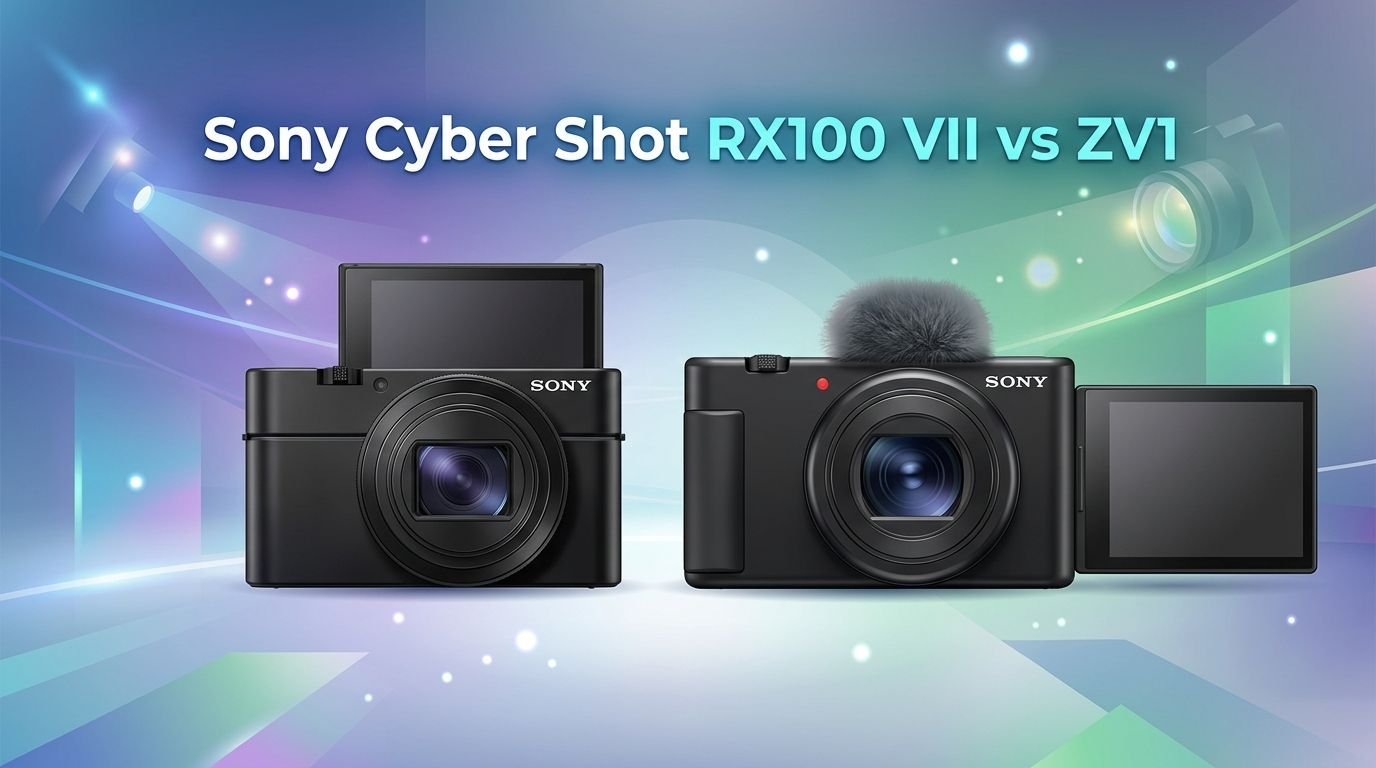
Sony Cyber Shot RX100 VII vs ZV1: Battle of the Best
You want a small Sony camera that delivers big results. The Sony RX100 VII and the Sony ZV-1 sit at the top of the compact camera world, and they share a surprising amount of DNA. Both pack a 20.1MP 1 inch sensor. Both shoot 4K video. Both fit in a jacket pocket.
But they serve very different types of shooters. The RX100 VII leans toward photography with its impressive 24 to 200mm zoom range and built in electronic viewfinder.
The ZV-1 targets vloggers and content creators with a wider f/1.8 aperture, a directional three capsule microphone, and a side flip out screen.
Key Takeaways
- Both cameras share a 20.1MP 1 inch sensor, which means raw image quality is very similar between the two. You will get sharp photos and clean 4K video from either camera.
- The RX100 VII offers a much longer zoom range at 24 to 200mm, while the ZV-1 covers only 24 to 70mm. If you need telephoto reach for travel, wildlife, or sports, the RX100 VII wins here by a wide margin.
- The ZV-1 has a faster lens at f/1.8 to f/2.8, compared to f/2.8 to f/4.5 on the RX100 VII. This means the ZV-1 performs better in low light and produces smoother background blur for portrait style shots and talking head videos.
- The ZV-1 is built for video creators with a superior built in directional microphone, a side flip out screen for selfie recording, and a dedicated background defocus button. The RX100 VII lacks all of these features.
- The RX100 VII includes a pop up electronic viewfinder and a built in flash, which the ZV-1 does not have. Photographers will appreciate these extras for outdoor shooting and studio work.
- Price is a major factor. The RX100 VII retails for around $1,498, while the ZV-1 typically sells for around $748 to $798. That is nearly double the cost for the RX100 VII, which makes the ZV-1 a strong value pick for most buyers.
Sony RX100 VII: A Complete Overview

The Sony RX100 VII launched in August 2019 as the flagship of Sony’s legendary RX100 compact camera line. It packs technology borrowed from Sony’s professional Alpha a9 mirrorless camera. This includes Real Time Tracking autofocus and a blazing fast 20 fps burst shooting speed with autofocus and auto exposure.
The camera uses a 1 inch stacked CMOS sensor with DRAM chip. This sensor design allows incredibly fast readout speeds. It reduces rolling shutter distortion in video and enables the blackout free shooting experience during burst mode.
The ZEISS Vario Sonnar T* lens covers a 24 to 200mm equivalent focal range with an 8x optical zoom. This makes the RX100 VII one of the most versatile compact cameras ever made. You can go from wide angle landscapes to zoomed in wildlife shots without changing lenses or cameras.
Build quality is premium with an all metal body. The camera weighs just 302 grams and measures 101.6 x 58.1 x 42.8mm. It fits easily in a pants pocket or small bag.
Pros:
- Impressive 24 to 200mm zoom range in a pocket sized body
- 20 fps burst shooting with continuous autofocus
- Built in pop up electronic viewfinder for bright daylight shooting
- Built in flash for quick fill light
- 357 phase detection AF points with Real Time Tracking
Cons:
- High retail price at around $1,498
- Slower f/2.8 to f/4.5 aperture limits low light performance
- No side flip out screen for vlogging
- Average built in microphone quality
- Battery life rated at only 260 shots per charge
Sony ZV-1: A Complete Overview

The Sony ZV-1 arrived in June 2020 as Sony’s first camera designed specifically for vloggers and content creators. Sony took the proven 1 inch sensor platform and wrapped it in a body optimized for video first workflows.
The standout feature is the built in three capsule directional microphone with an included wind screen. This microphone captures clear audio and focuses on sounds coming from in front of the camera. It is a huge upgrade over the basic microphone found in the RX100 VII.
The ZV-1 uses a 24 to 70mm f/1.8 to f/2.8 ZEISS lens. The zoom range is shorter than the RX100 VII, but the wider maximum aperture lets in significantly more light. This produces better low light footage and creates a more pronounced background blur that looks cinematic on video.
A side flip out touchscreen makes self recording easy. You can see yourself while filming, which is essential for solo vloggers. The camera also has a dedicated background defocus button that instantly blurs or sharpens the background with one press.
Pros:
- Excellent built in directional microphone with wind screen included
- Fast f/1.8 to f/2.8 lens for great low light and bokeh
- Side flip out screen perfect for vlogging
- Background defocus button for instant cinematic look
- Much lower price at around $748 to $798
Cons:
- Limited 24 to 70mm zoom range
- No electronic viewfinder
- No built in flash
- Slower burst shooting speed at 24 fps
- Slightly less advanced autofocus with 315 AF points versus 357
Image Quality Comparison
Both cameras deliver nearly identical still image quality because they share the same 20.1MP 1 inch sensor size. Photos from either camera show excellent detail, accurate colors, and good dynamic range for a compact camera.
The RX100 VII has a slight edge in certain situations. Its longer 200mm reach lets you capture subjects that the ZV-1 simply cannot reach. For travel photography, street photography, and candid moments, that extra zoom makes a real difference.
The ZV-1 fights back with its faster aperture. At f/1.8, it collects roughly two stops more light than the RX100 VII at f/2.8. This produces cleaner images in dim environments. It also creates a shallower depth of field that separates subjects from backgrounds more effectively.
RAW files from both cameras respond well to editing. You can push shadows, recover highlights, and adjust white balance with similar flexibility. Neither camera has a clear advantage in RAW processing latitude.
For casual photography and social media posting, you will not see a meaningful difference between these two cameras. The sensor is the heart of image quality, and both cameras share that heart.
Video Performance
This is where the ZV-1 pulls ahead for most video creators. Sony designed the ZV-1 from the ground up as a video tool. It shows in the details.
Both cameras record 4K UHD video at 30fps and 1080p at 120fps for slow motion. The codec options and bitrates are similar. Video sharpness and color science look nearly identical because the sensor and processor are so closely related.
The ZV-1 offers a few important video advantages. Its Active SteadyShot stabilization is slightly more effective than the RX100 VII for handheld walking shots. The side flip out screen lets you monitor your framing during selfie style recording. The dedicated recording indicator light on the front tells you at a glance if the camera is rolling.
The ZV-1 also supports S Log2 and S Log3 gamma profiles for flat recording that gives editors more color grading flexibility. The RX100 VII supports these as well, but the ZV-1’s wider aperture gives colorists more to work with in post production.
Both cameras suffer from a recording time limit and can overheat during extended 4K sessions. This is a common limitation of compact cameras with small bodies. Neither camera is ideal for long form recording sessions.
Autofocus System
The autofocus systems on both cameras are excellent and among the best in the compact camera class. Sony’s Real Time Tracking and Real Time Eye AF technology appear on both models.
The RX100 VII uses 357 phase detection AF points paired with 425 contrast detection areas. The ZV-1 uses 315 phase detection AF points with 425 contrast detection areas. In practice, this numerical difference is barely noticeable.
Both cameras lock onto eyes with impressive speed and accuracy. Whether you are photographing people, pets, or recording video of a moving subject, the autofocus sticks to the target reliably.
The RX100 VII has a slight advantage in burst shooting autofocus. Its 20 fps blackout free mode tracks fast moving subjects with exceptional precision. This makes it a better choice for action, sports, and wildlife photography.
The ZV-1 has a unique Product Showcase Setting that shifts focus from a face to an object held up in front of the camera. This feature is perfect for review style videos where you want to show products to the viewer. The RX100 VII does not have this feature.
Lens and Zoom Range
The lens is the single biggest hardware difference between these two cameras. Each camera targets a completely different use case with its lens choice.
The RX100 VII features a ZEISS Vario Sonnar T 24 to 200mm equivalent lens* with f/2.8 to f/4.5 aperture. This 8.3x optical zoom covers everything from wide landscapes to distant subjects. It is remarkably versatile for a camera this small.
The ZV-1 features a ZEISS Vario Sonnar T 24 to 70mm equivalent lens* with f/1.8 to f/2.8 aperture. The 2.9x zoom range is much shorter. But the wider aperture at every focal length is the trade off Sony made to benefit video shooters.
If you photograph birds, sports, or travel subjects at a distance, the RX100 VII is the clear choice. No compact camera in this size class matches its zoom reach.
If you record talking head videos, vlogs, interviews, or indoor content, the ZV-1’s wider aperture and shorter zoom are actually better. You get smoother bokeh, better low light performance, and a focal range that covers the most common vlogging distances.
Audio Quality
Audio quality is one area where the ZV-1 dominates completely. Sony equipped this camera with a purpose built three capsule directional microphone. It captures clear, forward facing audio that sounds significantly better than most compact cameras.
The included wind screen (a small furry attachment) reduces wind noise during outdoor recording. This is a thoughtful accessory that saves you from buying a separate wind muff. The RX100 VII has no such accessory or equivalent microphone quality.
The RX100 VII’s built in microphone is adequate for casual clips. But it picks up more ambient noise and does not isolate the speaker’s voice as well. For any serious video work, you would need an external microphone with the RX100 VII.
Both cameras have a 3.5mm microphone input for connecting an external mic. This is great news for creators who use lavalier microphones or shotgun microphones. Both cameras handle external audio sources without issue.
If audio matters to your content, the ZV-1 gives you a much better starting point right out of the box.
Screen and Viewfinder
The screen design differs significantly between these cameras, and your preference here depends on how you shoot.
The RX100 VII has a tilting LCD screen that flips up about 180 degrees for selfie framing. It also tilts downward for overhead shots. The screen is a 3 inch touchscreen with 921,600 dots of resolution.
The ZV-1 uses a side flip out LCD screen that swings to the side of the camera body. This design keeps the screen visible even when you mount the camera on a tripod with a microphone attached on top. The RX100 VII’s tilting screen can get blocked by accessories mounted on the hot shoe.
The RX100 VII has one major advantage here. It includes a pop up electronic viewfinder (EVF). This small OLED viewfinder is essential for bright daylight shooting when the LCD screen becomes hard to see. The ZV-1 has no viewfinder at all.
For photographers who shoot in bright sunlight, the EVF on the RX100 VII is a genuine benefit. For vloggers who need to see themselves on screen, the ZV-1’s side flip out design is more practical.
Build Quality and Design
Both cameras share Sony’s premium compact camera build standards. They feel solid in the hand and use quality materials throughout.
The RX100 VII has an all metal body that feels slightly more premium. It measures 101.6 x 58.1 x 42.8mm and weighs 302 grams. The design is sleek and minimalist, fitting the RX100 line’s tradition of pocketable elegance.
The ZV-1 has a body that mixes metal and high quality plastic. It measures 105.5 x 60.0 x 43.5mm and weighs 294 grams. Sony added a larger grip area on the front, which makes one handed recording more comfortable and secure.
The ZV-1 also features a tally light on the front that glows red during recording. This small but useful indicator confirms at a glance that you are capturing footage. The RX100 VII does not have this feature.
Both cameras use the same NP BX1 battery. Battery life is rated at roughly 260 shots per charge on both models. For extended shooting sessions, carrying a spare battery is highly recommended.
Price and Value
Price is where the decision gets very interesting. The RX100 VII costs nearly double what the ZV-1 costs. That is a significant gap for two cameras with the same sensor.
The RX100 VII retails at approximately $1,498 on Amazon. This high price reflects the longer zoom lens, built in EVF, built in flash, and the premium RX100 brand positioning.
The ZV-1 retails at approximately $748 to $798 on Amazon. You get the same sensor, better audio, a faster lens, and a more video friendly design for roughly half the price.
For video creators and vloggers, the ZV-1 offers exceptional value. You save hundreds of dollars while getting a camera that is actually better suited for content creation. The money you save could go toward a good tripod, lighting, or an external microphone.
For photographers who need zoom range and a viewfinder, the RX100 VII justifies its higher cost. The 24 to 200mm lens alone is worth a premium for travel and versatile shooting.
Who Should Buy the Sony RX100 VII?
The RX100 VII is the better choice for photographers first, videographers second. If you want a single compact camera that handles almost any photography situation, this is it.
Travel photographers will love the 24 to 200mm range. You can shoot wide cityscapes and then zoom into architectural details without switching gear. The built in EVF helps you compose shots in bright tropical sunlight.
Sports and action shooters benefit from the 20 fps burst mode. The blackout free shooting experience keeps your eye on the action. Combined with Real Time Tracking, you can follow fast subjects with confidence.
Street photographers appreciate the discreet size and silent electronic shutter. The RX100 VII looks like a tourist camera, which makes candid shooting less intimidating.
If your budget allows for it and you value photographic versatility above all else, the RX100 VII is the right pick.
Who Should Buy the Sony ZV-1?
The ZV-1 is the better choice for content creators, vloggers, and video first shooters. Sony built this camera to solve problems that vloggers face every day.
YouTube creators will appreciate the flip out screen, excellent built in microphone, and background defocus button. These features speed up your workflow and reduce the need for extra accessories.
Live streamers can use the ZV-1 as a USB webcam for high quality video calls and streams. The image quality crushes any standard webcam on the market.
Podcast hosts and interviewers benefit from the directional microphone and clean audio chain. The ZV-1 captures clear voice audio without a complex setup.
Budget conscious buyers get a premium Sony 1 inch sensor experience at a much lower price. If you do not need 200mm zoom or an electronic viewfinder, the ZV-1 delivers more relevant features for less money.
Final Verdict: Sony RX100 VII vs ZV-1
The choice between these cameras comes down to one simple question. Do you shoot more photos or more video?
Pick the RX100 VII if you want the ultimate pocket photography tool. Its 24 to 200mm zoom, pop up viewfinder, and fast burst mode make it a photographic powerhouse in a tiny body. Accept the higher price and slower aperture as trade offs for unmatched versatility.
Pick the ZV-1 if video is your primary output. Its faster lens, better microphone, flip out screen, and lower price make it the smarter buy for anyone who creates video content. Accept the shorter zoom range as a trade off for superior video features.
Both cameras are excellent. Neither choice is wrong. The best camera is the one that matches how you actually shoot.
Frequently Asked Questions
Is the Sony ZV-1 the same sensor as the RX100 VII?
Yes. Both cameras use a 20.1MP 1 inch stacked CMOS sensor with DRAM chip. The sensor produces nearly identical image quality on both models. The main differences come from the lens, body design, and software features rather than the sensor itself.
Can the Sony ZV-1 replace the RX100 VII for photography?
The ZV-1 takes excellent photos. However, it cannot match the RX100 VII’s 24 to 200mm zoom range or its pop up electronic viewfinder. For casual photography and social media, the ZV-1 works great. For serious travel or action photography, the RX100 VII is a better fit.
Does the Sony RX100 VII have a microphone input?
Yes. The RX100 VII has a 3.5mm microphone jack for connecting external microphones. This is the same input found on the ZV-1. However, the ZV-1’s built in microphone is significantly better, so you may not need an external mic with the ZV-1.
Which camera is better for YouTube videos?
The Sony ZV-1 is better for YouTube content in most cases. It has a superior built in microphone, a side flip out screen for self recording, a background defocus button, and a product showcase autofocus mode. These features directly address the needs of YouTube creators.
Is the Sony RX100 VII worth the extra cost over the ZV-1?
It depends on your needs. The RX100 VII costs roughly $700 more than the ZV-1. That premium buys you a much longer zoom lens, an electronic viewfinder, and a built in flash. If you need those features, the extra cost is justified. If you primarily shoot video, the ZV-1 offers better value.
Do both cameras shoot 4K video?
Yes. Both the RX100 VII and the ZV-1 record 4K UHD video at 30fps and 1080p at 120fps for slow motion. Video quality is very similar between the two cameras due to the shared sensor platform.