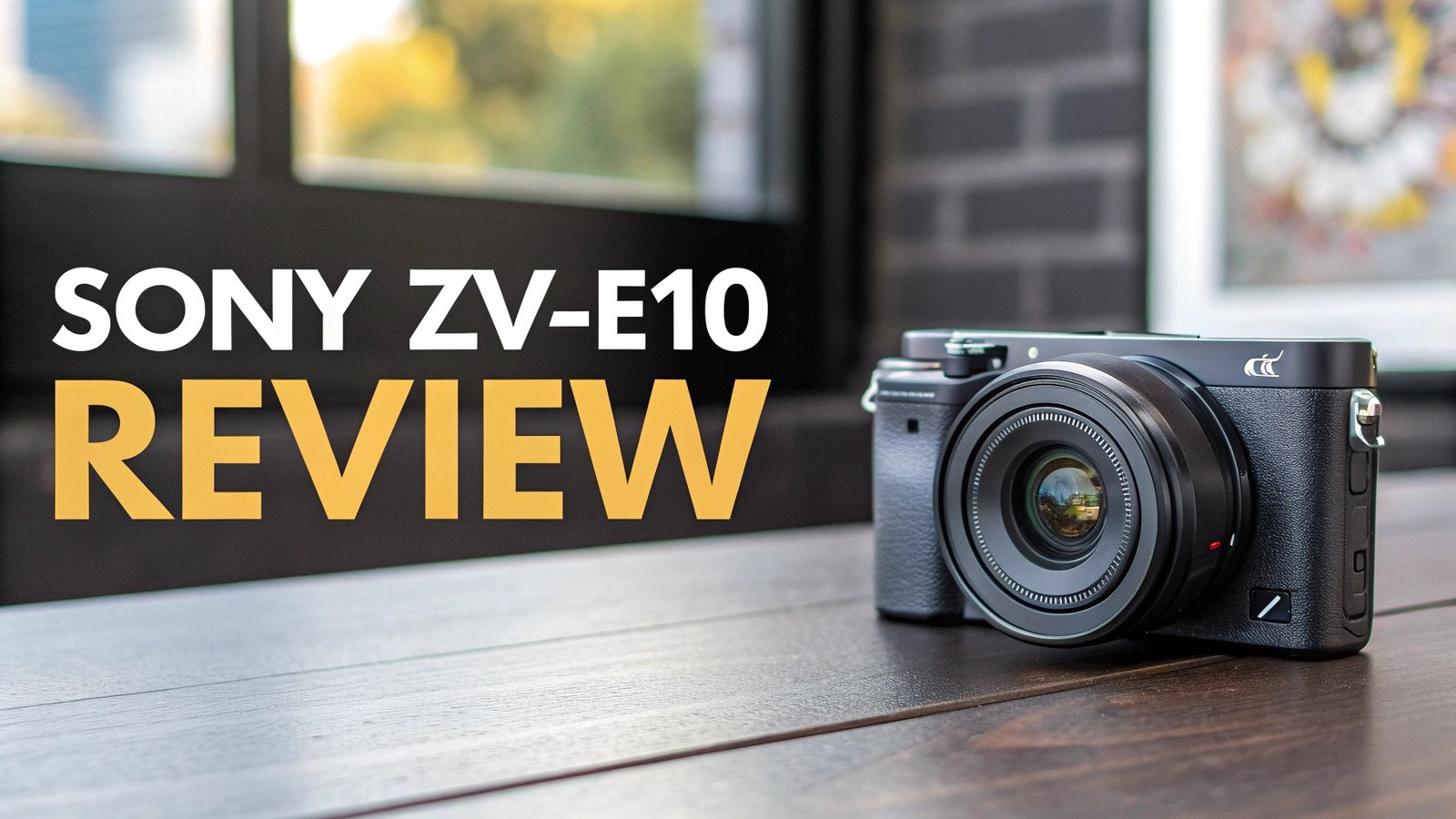
Sony ZV-E10 Review: The Ultimate Vlogging Camera
The Sony ZV-E10 stands as one of the most popular vlogging cameras on the market today. This compact mirrorless camera combines professional features with user-friendly design elements that make it perfect for content creators, YouTubers, and social media enthusiasts.
Whether you’re just starting your content creation journey or looking to upgrade your current setup, this comprehensive review will help you understand everything about the Sony ZV-E10 and its capabilities.
Key Takeaways:
- Professional Video Quality: The camera delivers 4K video recording at 30fps with exceptional image quality thanks to its 24.2MP APS-C sensor and advanced image processing capabilities
- Creator-Focused Features: Built-in product showcase mode, background defocus button, and flip-out screen make it incredibly easy to create professional-looking vlogs and social media content
- Excellent Autofocus System: The 425-point fast hybrid autofocus with real-time eye detection ensures your face stays sharp and in focus during video recordings
- Interchangeable Lens System: Unlike fixed-lens cameras, the ZV-E10 accepts Sony E-mount lenses, giving you creative flexibility to achieve different looks and styles
- Compact and Lightweight Design: Weighing just 343 grams, this camera is portable enough for daily vlogging and travel content creation without causing fatigue
- Built-in Audio Features: The camera includes a 3-capsule microphone with wind screen and directional audio recording modes for better sound quality

What is the Sony ZV-E10
The Sony ZV-E10 represents Sony’s dedicated approach to vlogging cameras. Released in 2021, this camera takes the proven technology from Sony’s Alpha series and packages it specifically for content creators. The camera features a 24.2-megapixel APS-C Exmor CMOS sensor paired with Sony’s BIONZ X image processor, delivering professional image quality in a compact form factor.
What sets the ZV-E10 apart from traditional cameras is its vlog-specific features. The camera includes a fully articulating touchscreen that flips out to face forward, making it easy to frame your shots when recording yourself. The product showcase mode automatically shifts focus from your face to objects you hold up to the camera, perfect for unboxing videos and product reviews.
The camera body measures just 115.2 x 64.2 x 44.8mm, making it one of the most portable vlogging cameras available. Despite its compact size, the ZV-E10 doesn’t compromise on image quality or features, offering the same sensor technology found in much larger and more expensive cameras.
Design and Build Quality
The Sony ZV-E10 features a modern and ergonomic design that prioritizes both form and function. The camera body is constructed from high-quality plastic materials that feel solid and durable while keeping the overall weight down. The textured grip on the front provides a secure hold, even during extended shooting sessions.
One of the most notable design elements is the fully articulating LCD screen. This 3-inch touchscreen flips out 180 degrees, allowing you to see yourself while recording. The screen is bright and clear, making it easy to monitor your shots even in bright outdoor conditions. The touch functionality adds convenience for setting focus points and navigating menus quickly.
The camera’s button layout is intuitive and accessible. The dedicated record button is prominently placed and easy to reach while holding the camera. The Background Defocus button provides instant access to bokeh effects, while the Product Showcase button makes it simple to shift focus for product demonstrations. These thoughtful design elements show Sony’s understanding of what content creators need.
The hot shoe mount on top accepts external microphones and LED lights, expanding your creative possibilities. The camera also includes multiple connection ports, including USB-C for charging and data transfer, micro HDMI for external recording, and a 3.5mm microphone input for professional audio equipment.
Image Quality and Sensor Performance

The heart of the ZV-E10 is its 24.2MP APS-C Exmor CMOS sensor, the same technology used in Sony’s higher-end Alpha cameras. This sensor delivers exceptional image quality with excellent dynamic range and color reproduction. Images appear sharp and detailed with natural-looking colors that require minimal post-processing.
The camera’s ISO performance is impressive for its class. The native ISO range extends from 100 to 32,000, with usable results up to ISO 6400 for most shooting conditions. Low-light performance is particularly strong, with minimal noise and good detail retention even when shooting in challenging lighting conditions.
Color science in the ZV-E10 produces vibrant yet natural-looking images. Skin tones appear accurate and pleasing, which is crucial for vloggers who are often the main subject of their videos. The camera offers various picture profiles including S-Log2 for advanced users who want maximum flexibility in post-production.
The autofocus system contributes significantly to image quality by ensuring sharp focus in various shooting scenarios. The camera’s ability to track subjects and maintain focus during movement makes it excellent for active vlogging and dynamic content creation.
Top 3 Alternatives for Sony ZV-E10
While the Sony ZV-E10 is an excellent choice, several alternatives offer different advantages depending on your specific needs and budget.

The Canon EOS M50 Mark II provides similar vlogging features with Canon’s renowned color science and user-friendly interface. This camera offers 4K video recording and a flip-out screen, making it a direct competitor to the ZV-E10.

The Panasonic Lumix G100 focuses specifically on vlogging with built-in audio tracking and excellent image stabilization. Its micro four-thirds sensor provides good image quality while maintaining a compact form factor.

The Sony ZV-E10 II represents the newest iteration with improved features including a 26MP sensor, better autofocus, and enhanced video capabilities. This upgraded model offers significant improvements over the original ZV-E10.
Video Recording Capabilities
The Sony ZV-E10 excels in video recording, offering 4K resolution at 30fps with full pixel readout and no pixel binning. This results in sharp, detailed video footage that looks professional straight out of the camera. The camera also supports Full HD recording at up to 120fps, enabling smooth slow-motion footage for creative content.
Video quality is consistently excellent across different lighting conditions. The camera handles exposure changes smoothly, and the active image stabilization helps reduce camera shake for handheld shooting. While not as advanced as gimbal stabilization, the built-in stabilization is sufficient for most vlogging scenarios.
The ZV-E10 includes several video-specific features that make content creation easier. The product showcase mode automatically shifts focus when you bring objects close to the camera, perfect for unboxing videos and product reviews. The background defocus function instantly creates cinematic bokeh effects with the press of a button.
Recording formats include XAVC S and AVCHD, providing flexibility for different workflow requirements. The camera can record continuously for extended periods, making it suitable for long-form content and livestreaming applications.
Autofocus System and Performance

The Sony ZV-E10 features Sony’s advanced 425-point Fast Hybrid AF system, combining phase-detection and contrast-detection autofocus for fast and accurate focusing. This system covers approximately 84% of the image area, ensuring subjects remain in focus even when positioned off-center.
Real-time Eye AF is particularly impressive, automatically detecting and tracking human eyes in both photo and video modes. This feature is invaluable for vloggers, ensuring their eyes remain sharp and in focus throughout their recordings. The system works reliably even when subjects move around the frame or temporarily look away from the camera.
Subject tracking performance is excellent, with the camera maintaining focus on moving subjects with high accuracy. The AF sensitivity ranges from EV-3 to EV 20, allowing for reliable autofocus even in low-light conditions. The silent focusing operation is beneficial for video recording, as it doesn’t interfere with audio recording.
The touch focus functionality adds convenience, allowing users to set focus points by simply touching the LCD screen. Combined with the fast autofocus system, this makes it easy to quickly adjust focus during recording or between shots.
Audio Quality and Built-in Microphone
Audio quality is crucial for vlogging, and the Sony ZV-E10 delivers excellent performance in this area. The camera features a 3-capsule directional microphone built into the top of the camera body. This microphone system provides clear audio recording with good directionality, focusing on the user’s voice while reducing background noise.
The wind screen accessory included with the camera significantly improves audio quality when shooting outdoors. This furry windscreen effectively reduces wind noise without muffling the audio quality. The audio recording levels can be adjusted manually or set to automatic, providing flexibility for different shooting scenarios.
External microphone support is available through the 3.5mm microphone input jack. This allows users to connect professional microphones for even better audio quality. The camera automatically switches to external microphone input when a microphone is connected, making the process seamless.
The audio monitoring capabilities include level meters displayed on the LCD screen, helping users monitor recording levels in real-time. The camera also supports audio recording formats including linear PCM for maximum quality, ensuring professional results for serious content creators.
Battery Life and Power Management
The Sony ZV-E10 uses the NP-FW50 battery, which provides moderate battery life for its size and capabilities. Under typical usage conditions, users can expect approximately 440 shots per charge when taking photos, or about 75 minutes of continuous 4K video recording.
Power management features help extend battery life during extended shooting sessions. The camera includes power-saving modes that automatically turn off the display and enter standby mode when not in use. Users can customize these settings to balance convenience with battery conservation.
USB-C charging adds significant convenience, allowing users to charge the battery while it’s in the camera using a standard USB-C cable. This feature is particularly useful for travelers who can charge their camera using portable power banks or laptop chargers. The camera can also operate while charging, enabling extended recording sessions or livestreaming applications.
For professional use or extended shooting sessions, investing in additional batteries is recommended. The compact size of the NP-FW50 battery makes it easy to carry multiple spare batteries without adding significant weight to your camera bag.
Lens Compatibility and Ecosystem

One of the ZV-E10’s greatest strengths is its compatibility with Sony’s extensive E-mount lens ecosystem. This interchangeable lens system provides access to dozens of lenses ranging from ultra-wide angle to super-telephoto, giving content creators incredible creative flexibility.
The kit lens (16-50mm f/3.5-5.6 OSS) provides a good starting point for most vlogging scenarios. This lens offers optical image stabilization and covers a useful focal length range equivalent to 24-75mm in full-frame terms. The lens is compact and lightweight, maintaining the camera’s portability advantage.
Popular lens options for vlogging include the Sony 11mm f/1.8 for ultra-wide vlogs, the 35mm f/1.8 OSS for natural-looking footage with good low-light performance, and the 18-135mm f/3.5-5.6 OSS for versatile zoom range. Third-party manufacturers like Sigma and Tamron also offer excellent affordable lens options for the E-mount system.
The APS-C sensor provides a 1.5x crop factor compared to full-frame, which affects the effective focal length of lenses. This crop factor can be advantageous for telephoto work while requiring wider lenses for expansive shots.
User Interface and Ease of Use
The Sony ZV-E10 features an intuitive user interface designed with content creators in mind. The menu system is well-organized with logical groupings that make it easy to find specific settings. The touchscreen interface adds modern convenience, allowing users to navigate menus and adjust settings with simple taps and swipes.
Custom buttons can be programmed with frequently used functions, speeding up workflow during shooting. The Fn (Function) menu provides quick access to commonly adjusted settings like ISO, white balance, and focus modes without diving deep into the main menu system.
The mode dial includes dedicated positions for video recording, making it simple to switch between photo and video modes. The dedicated record button is prominently positioned and provides tactile feedback, ensuring users can start and stop recording reliably.
Help guides are built into the camera, providing explanations of various features and functions directly on the LCD screen. This feature is particularly helpful for beginners who are learning to use advanced camera features for the first time.
Connectivity and Sharing Options
Modern content creators need seamless connectivity options, and the ZV-E10 delivers with built-in Wi-Fi and Bluetooth capabilities. The Wi-Fi connection enables wireless transfer of photos and videos to smartphones and tablets using Sony’s Imaging Edge Mobile app. This app provides remote control functionality, allowing users to adjust camera settings and trigger recording from their phone.
Bluetooth connectivity maintains a low-power connection between the camera and mobile devices, enabling automatic location data recording and quick connection establishment. This feature is particularly useful for travel vloggers who want to geotag their content automatically.
The USB-C port supports fast data transfer when connecting directly to computers. The camera can also function as a webcam when connected to a computer via USB, making it excellent for livestreaming and video conferencing applications. This feature became particularly valuable during the increase in remote work and content creation.
HDMI output allows connection to external recording devices or monitors for professional video production workflows. The clean HDMI output provides an uncompressed video signal without camera overlays, ideal for professional recording setups.
Performance in Different Shooting Scenarios
The Sony ZV-E10 performs exceptionally well across various shooting scenarios commonly encountered by content creators. Indoor vlogging benefits from the camera’s excellent low-light performance and accurate autofocus system. The flip-out screen makes it easy to frame shots when recording yourself, while the built-in microphone captures clear audio.
Outdoor shooting showcases the camera’s dynamic range and color reproduction capabilities. The active image stabilization helps maintain smooth footage when walking or moving, though more aggressive stabilization may require additional equipment. The camera handles bright sunlight well, with the screen remaining visible for monitoring shots.
Travel content creation is where the ZV-E10 truly shines. Its compact size and lightweight design make it easy to carry all day without fatigue. The interchangeable lens system allows creators to adapt to different shooting situations, from wide landscape shots to intimate portrait work.
Product review videos benefit from the dedicated product showcase mode, which automatically shifts focus when objects are brought close to the camera. This feature eliminates the need for manual focus adjustment, streamlining the review process and ensuring products are always properly highlighted.
Value for Money and Final Verdict

The Sony ZV-E10 represents excellent value in the vlogging camera market. Priced competitively compared to similar offerings from Canon and Panasonic, the ZV-E10 provides professional-level features at an accessible price point. The combination of image quality, ease of use, and vlog-specific features makes it an attractive option for both beginners and experienced content creators.
Long-term value is enhanced by the camera’s compatibility with Sony’s extensive lens ecosystem. As creators develop their skills and expand their content types, they can invest in additional lenses rather than replacing the entire camera system. This upgrade path provides excellent return on investment over time.
The camera’s build quality and reliability ensure it can withstand regular use and travel. Sony’s reputation for durable electronics gives confidence that the ZV-E10 will continue performing well over many years of use.
Professional features like S-Log2 recording, comprehensive manual controls, and excellent autofocus performance make the ZV-E10 suitable for serious content creation while remaining accessible to beginners. This versatility is rare in cameras at this price point.
Accessories and Add-ons Worth Considering

To maximize the Sony ZV-E10’s potential, several accessories can enhance your content creation experience. A quality tripod or grip is essential for stable shots and comfortable handheld recording. Sony’s own GP-VPT2BT wireless shooting grip provides both tripod functionality and remote control capabilities.
External microphones can significantly improve audio quality beyond the capable built-in microphone. Popular options include the Rode VideoMic Me-L for mobile connectivity or the Sony ECM-B1M shotgun microphone for professional audio recording.
Additional batteries and a dual battery charger are practically essential for extended shooting sessions. The NP-FW50 batteries are relatively small, so having spares ensures you won’t miss important shots. High-speed memory cards are also crucial for reliable 4K video recording without dropped frames.
Lens filters including UV filters for protection and ND filters for creative exposure control can enhance your footage quality. A camera bag or strap designed specifically for the ZV-E10 helps protect your investment while keeping it easily accessible for spontaneous content creation.
Frequently Asked Questions
Is the Sony ZV-E10 good for beginners?
Yes, the Sony ZV-E10 is excellent for beginners. The camera features automatic modes that handle technical settings while providing manual controls for users who want to learn advanced techniques. The intuitive interface and helpful guides built into the camera make it easy for newcomers to start creating professional-looking content immediately.
Can the Sony ZV-E10 shoot in low light?
The ZV-E10 performs well in low-light conditions thanks to its large APS-C sensor and excellent high-ISO performance. The camera maintains good image quality up to ISO 6400, with acceptable results even at higher ISO settings. The fast autofocus system continues working reliably in dim conditions.
How long can the Sony ZV-E10 record video continuously?
The camera can record 4K video continuously for approximately 75 minutes on a single battery charge, limited primarily by battery life rather than recording time limits. The camera includes thermal management to prevent overheating during extended recording sessions, making it suitable for long-form content creation.
Does the Sony ZV-E10 have image stabilization?
Yes, the ZV-E10 features Active SteadyShot image stabilization for video recording. While not as advanced as in-body stabilization found in higher-end cameras, it effectively reduces camera shake for handheld shooting. Many compatible lenses also include optical stabilization for additional shake reduction.
Can I use the Sony ZV-E10 as a webcam?
Absolutely! The ZV-E10 can function as a high-quality webcam when connected to a computer via USB-C. This feature provides significantly better video quality than built-in laptop cameras and is perfect for livestreaming, video conferencing, or online content creation.
What memory cards work with the Sony ZV-E10?
The camera accepts SD, SDHC, and SDXC memory cards. For 4K video recording, it’s recommended to use UHS-I U3 cards or faster to ensure reliable recording without dropped frames. Cards with read speeds of at least 90MB/s provide optimal performance for both photo and video applications.