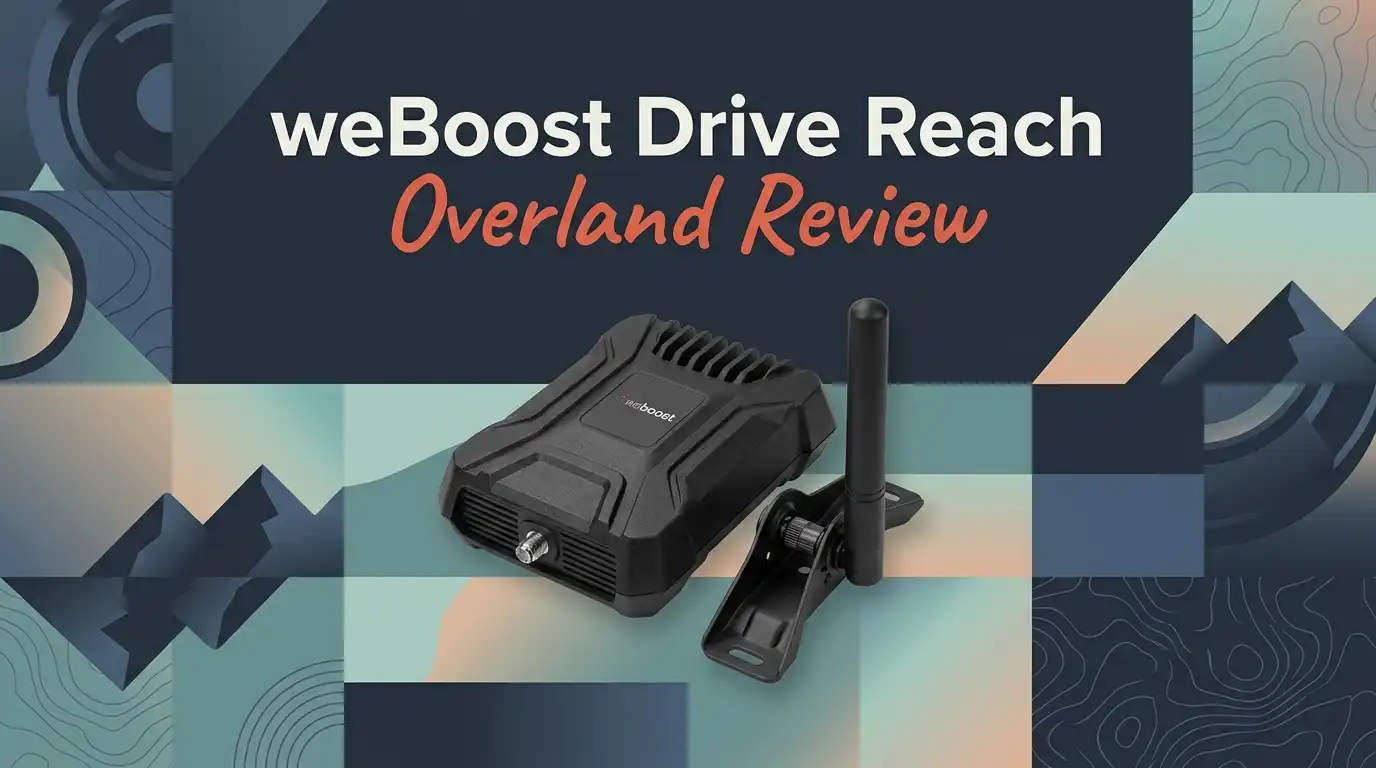
weBoost Drive Reach Overland Review 2026: Worth it?
You drop into a canyon, your phone flips to “No Service,” and the group chat dies. That single moment is why off-road drivers buy a signal booster.
The weBoost Drive Reach Overland promises to turn one faint bar into a usable connection on the trail. This review tests that promise against real specs, real install steps, and real owner feedback for 2026.
I focused on what matters to overlanders: build quality, antenna performance, install effort, and honest limits. No hype. Just whether this booster earns its $549 price on a roof rack.
In a Nutshell
- Maximum legal power: The Overland hits 50 dB max gain, the strongest boost the FCC allows in a vehicle. You cannot legally buy a stronger in-cabin booster.
- Built for abuse: The outside antenna carries a MIL-STD-810H rating and IP66 weather resistance. It survives mud, hail, dust, and constant washboard vibration.
- Real-world gain: Owners report a one to three bar improvement in fringe areas. Field testers turned weak LTE into a stable 5G lock in forests.
- Folding antenna mount: The hinge folds flat for garages, car washes, and low branches. It clamps to T-slot racks, poles, or flat surfaces with no drilling.
- No dead-zone magic: This booster amplifies existing signal only. Zero bars in means zero bars out. It is not a satellite replacement.
- Best for serious rigs: Ideal for overlanders, rural workers, and backcountry travelers. Casual commuters in strong-signal cities will not see the value.

Last update on 2026-07-19 / Affiliate links / Images from Amazon Product Advertising API Some of the links on this website are affiliate links, which means that at no additional cost to you, I earn a commission if you click through and make a purchase. I only recommend products and services that I believe will add value to my readers. Thank you for your support!
What Is the weBoost Drive Reach Overland
The Drive Reach Overland is a three-part cellular amplifier built for off-road vehicles. An outside antenna grabs faint tower signal. The booster unit strengthens it. An inside antenna rebroadcasts that signal to your phone.
weBoost markets it as the first booster made specifically for off-road adventure. In plain terms, it takes the proven Drive Reach electronics and pairs them with a rugged, folding OTR-style antenna. The unit weighs 1.8 lbs and measures 6 x 4.5 x 1.5 inches, small enough to tuck behind a seat or under a console.
It works with all U.S. carriers, including Verizon, AT&T, and T-Mobile. There are no subscriptions and no monthly fees. You buy it once. weBoost backs it with a 2-year warranty and a 30-day money-back guarantee, which removes most of the buyer’s risk.
The Specs That Actually Matter
Numbers tell the real story here. The Overland delivers 50 dB max gain, the legal ceiling for vehicle boosters. That headroom matters most in fringe zones where every decibel counts.
It runs on 12V at 1.8A and uses SMA Male and Female connectors. The frequency coverage spans Bands 12/17, 13, 5, 4, and 25/2, covering the 700, 850, 1700/2100, and 1900 MHz ranges. That range supports 4G LTE and 5G across the major networks.
The standout spec is the antenna. Its 2.4 to 3.8 dBi gain pulls more tower signal than the standard magnetic antenna on the base Drive Reach. More antenna gain means more raw signal reaches the booster before amplification even begins.
One spec note for buyers: weBoost claims up to 32X stronger signal and up to 90% fewer dropped calls. Treat those as ceilings, not averages. Your results depend on how close the nearest tower sits.
How It Performs on the Trail
Field testing is where claims meet dirt. In desert conditions, testers consistently boosted weak signal by three bars. In one widely known dead zone, the rugged antenna produced three stable bars and a clear call.
Forest performance surprised reviewers. The high-gain antenna boosted signal by a steady four bars in tree cover. At one point it converted three bars of LTE into a full 5G connection, which is a strong result under canopy.
The hard limit shows in box canyons and deep terrain. When the surrounding rock blocks all tower line-of-sight, even this antenna struggles to hold usable signal. The physics do not bend.
In urban dead spots, the difference between this antenna and a basic magnetic one shrinks. City towers sit close, so the extra antenna gain matters less. The Overland earns its keep where towers are far away, not where they are simply blocked by a building.
Top 3 Alternatives for weBoost Drive Reach Overland

Last update on 2026-07-19 / Affiliate links / Images from Amazon Product Advertising API Some of the links on this website are affiliate links, which means that at no additional cost to you, I earn a commission if you click through and make a purchase. I only recommend products and services that I believe will add value to my readers. Thank you for your support!
weBoost Drive Reach

Last update on 2026-07-19 / Affiliate links / Images from Amazon Product Advertising API Some of the links on this website are affiliate links, which means that at no additional cost to you, I earn a commission if you click through and make a purchase. I only recommend products and services that I believe will add value to my readers. Thank you for your support!
weBoost Drive Reach RV II

Last update on 2026-07-19 / Affiliate links / Images from Amazon Product Advertising API Some of the links on this website are affiliate links, which means that at no additional cost to you, I earn a commission if you click through and make a purchase. I only recommend products and services that I believe will add value to my readers. Thank you for your support!
SureCall Fusion2Go Max
The Unboxing Experience
The box arrives heavier than expected, mostly from the antenna and mast. Inside you find the booster unit, the folding outside antenna, the inside antenna, coax cable, the 13-inch mast extension, mounting hardware, and a 12V power plug.
Everything is bagged and labeled cleanly. weBoost includes a printed quick-start card, but the free weBoost app does the heavy lifting with video guides. First impressions of build quality are genuinely good for the price tier.
The folding mount feels solid in hand. The hinge has real resistance, not flimsy plastic play. The stabilizer arm locks the antenna upright or flat, and you feel that lock engage. This is hardware built to ride rough roads, not a desk gadget.
Texture, Feel, and Build Quality
This is hardware, not skincare, so “texture” means the physical feel of the parts. The antenna mast has a spring-loaded base that flexes on impact. Hit a branch and it bends instead of snapping.
The booster housing is matte and dense. It does not creak or rattle when you flex it. The cable casing resists kinking, which protects signal flow over long runs through a vehicle frame.
The clamps deserve a mention. They include non-slip rubber pads sized for 1.0 to 1.25 inch tubes. On a roll bar or ladder rack, they grip without scratching. The whole kit feels engineered for vibration, not just for looks.
Installation and Setup
weBoost claims a 30 to 45 minute install. That holds true for most rigs. One field reviewer finished in under an hour in a home garage with zero problems.
The mount offers three no-drill options: slide into a T-slot rack, clamp to a pole or roll bar, or bolt to a flat surface. This flexibility is the Overland’s real install advantage over older boosters that demanded drilling.
The app walks you through antenna positioning step by step. Keep the inside antenna and outside antenna far apart to avoid feedback, also called oscillation. A solid green light means full power. Red means the antennas sit too close and the booster cut power to protect itself.
One honest gripe carries over from the Drive Reach line: the power switch sits on the 12V plug. That is convenient for plug-and-play users but annoying for anyone hardwiring the unit who still wants an easy off switch.
Honest Downsides and Who Should Skip It
Last update on 2026-07-19 / Affiliate links / Images from Amazon Product Advertising API Some of the links on this website are affiliate links, which means that at no additional cost to you, I earn a commission if you click through and make a purchase. I only recommend products and services that I believe will add value to my readers. Thank you for your support!
Time for the flaws. First, it cannot create signal. If your phone shows zero bars from every tower, this booster does nothing. That single fact disappoints buyers who expect satellite-style coverage.
Second, the phone placement requirement is real. You must keep your phone within 12 to 24 inches of the inside antenna. In weak zones, you may need it within inches. That cramps how you use your device while driving.
Third, the price. At $549, it costs more than the standard Drive Reach. You pay a premium for the rugged folding antenna and the off-road rating.
Who should skip it? City commuters with decent coverage will not notice enough gain to justify the cost. Remote campers who park in true dead zones need Starlink, not a booster. The Overland is for travelers in fringe and rural areas who have faint signal worth amplifying.
How It Compares to the Standard Drive Reach
These two share the same booster electronics and the same 50 dB gain. The difference is entirely the antenna and the mount.
The base Drive Reach ships with a magnetic antenna meant for a car roof. It performs well in urban and roadside use. The Overland swaps that for a high-gain folding antenna rated for off-road abuse.
In cities, the two perform almost identically because towers sit close. In forests and deserts, the Overland’s antenna pulls clearly ahead, adding extra bars where the magnetic antenna falls short.
So the choice is simple. If your phone lives mostly on highways and in towns, the standard Drive Reach saves money. If your rig spends real time on trails and backcountry routes, the Overland’s antenna justifies the upgrade.
Value, Warranty, and Long-Term Ownership
At $549 with no subscription, the Overland is a one-time investment. Compared to monthly satellite plans, it pays for itself fast if you only need cellular amplification.
The 2-year warranty covers workmanship and material defects. The 30-day money-back guarantee lets you test it on your own routes risk-free. weBoost also offers U.S.-based support, and the products are assembled in St. George, Utah.
One ownership note: failure to use a surge-protected power source can void the warranty, so wire it carefully. Owners report the antenna holds up extremely well over multi-day backcountry trips, which matters more than any lab spec.
After months of real use, the consensus is consistent. It works as advertised, sometimes better, and the rugged build survives the punishment. The value depends entirely on where you drive. For the right user, it is an easy recommendation.
Final Verdict
The weBoost Drive Reach Overland does exactly what it claims and nothing it does not. It amplifies weak signal with maximum legal power and survives serious off-road conditions thanks to its MIL-STD-810H antenna.
It earns a strong recommendation for overlanders, rural workers, and backcountry travelers who routinely face fringe coverage. It is the wrong tool for city drivers with good signal or campers stuck in true dead zones.
If your adventures live where towers are distant but present, this booster turns frustration into a usable connection. For that specific buyer, it is worth it.
Expert FAQs
Does the weBoost Drive Reach Overland work in areas with no signal?
No. It amplifies existing signal only. If every nearby tower gives you zero bars, the booster has nothing to work with. It shines in fringe areas where you have faint or unstable signal worth strengthening.
Do I need Starlink if I have the Drive Reach Overland?
They solve different problems. The Overland boosts weak cellular signal with no monthly fee and works under clouds and trees. Starlink delivers internet in complete dead zones but needs open sky and a subscription. Many travelers use both, the booster while driving and Starlink at camp.
Does it work with Verizon, AT&T, and T-Mobile?
Yes. It is a multi-carrier booster covering all U.S. networks, including Verizon, AT&T, T-Mobile, and over 90 regional carriers. It amplifies 4G LTE and 5G for any cell-connected device with no pairing or app required for the signal itself.
How long does installation take?
Most installs take 30 to 45 minutes. The folding mount offers three no-drill options, and the free weBoost app guides each step. One field reviewer finished in under an hour with no issues.
Can I fold the antenna down for a garage?
Yes. The antenna sits on a hinged folding bracket that rotates 180 degrees. Fold it flat for garages, car washes, and low branches. A stabilizer arm locks it in either position. Note it only works when standing upright.
Why is my booster light red?
A red light means the inside and outside antennas sit too close and create feedback. The booster cuts power to protect itself. Unplug it, increase the distance between antennas, and reconnect. A solid green light confirms full power.
Where should I place my phone for the best boost?
Keep your phone within 12 to 24 inches of the inside antenna. In very weak areas, move it within a few inches. Mount the inside antenna wherever your phone normally rides, such as a dash cradle or console.
Disclosure: This content is part of an Amazon Creator Connections campaign, meaning I earn a commission from qualifying purchases.
Using these links costs you nothing extra but directly supports my blog and future content.

Hello everyone my name is Alenya and i am a gadget discovering Enthusiast 🐻🐻