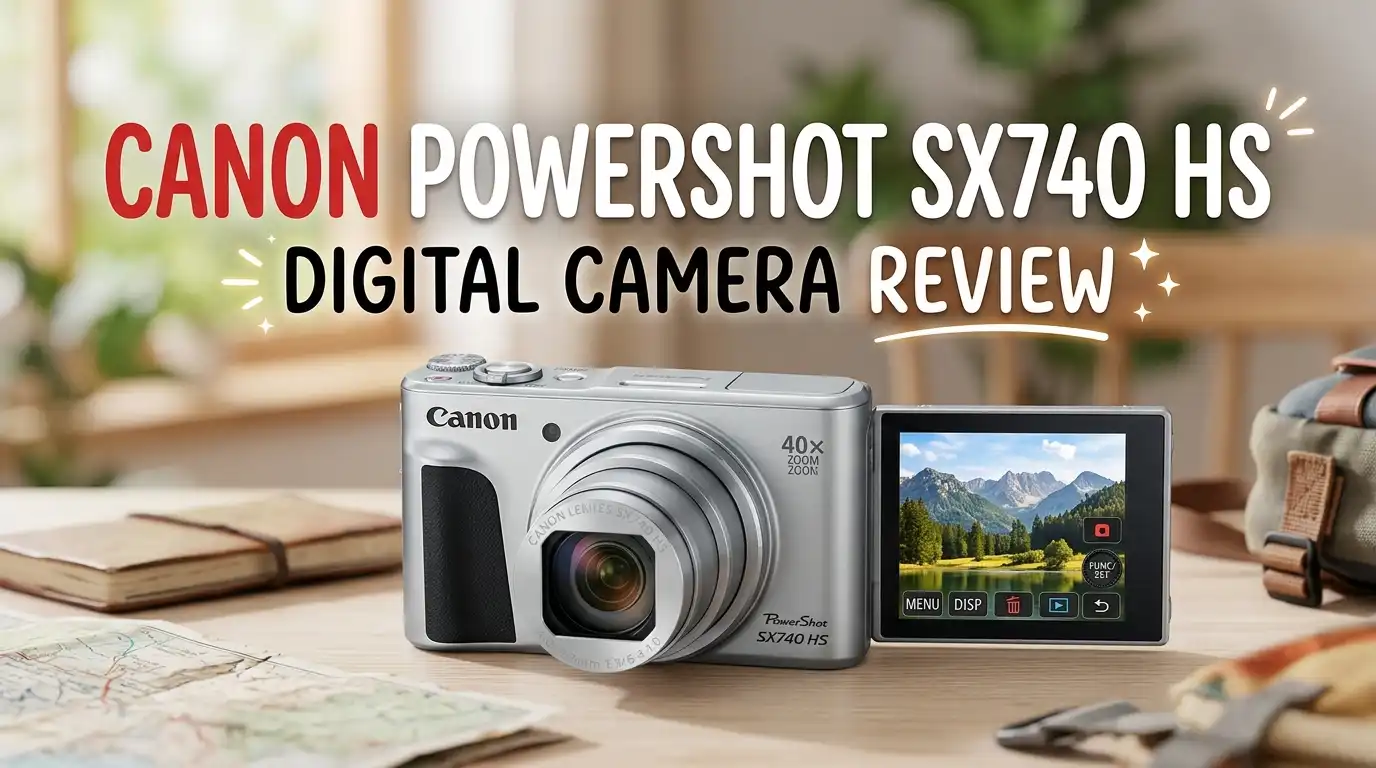
Canon PowerShot SX740 HS Digital Camera Review 2026
The Canon PowerShot SX740 HS keeps showing up on travel packing lists, even years after its launch. People still want a small camera that zooms far, shoots 4K, and slips into a jacket pocket. Smartphones do a lot, but they cannot match a 40x optical zoom on a stadium seat or a wildlife trail.
This review breaks down what the SX740 HS does well, what it struggles with, and who should buy it in 2026. You will read about real performance, honest weak points, and the unboxing experience.
You will also see three solid alternatives if this Canon does not match your needs. By the end, you will know if this little zoom monster fits your photography style.
Key Takeaways:
- Massive 40x optical zoom covers a 24mm to 960mm range, which is rare in any pocket camera and perfect for travel, sports, and wildlife.
- The 20.3MP CMOS sensor with DIGIC 8 processor delivers sharp daylight photos, but the small 1/2.3 inch sensor struggles in low light.
- 4K UHD video at 30fps plus 4K time lapse mode give you modern video features in a tiny body.
- The tilting 3 inch LCD flips up 180 degrees for easy selfies and vlog framing, though there is no touchscreen.
- Wi-Fi and Bluetooth make image transfer to your phone fast and almost automatic through the Canon Camera Connect app.
- Battery life is short at around 265 shots per charge, so a spare NB-13L battery is almost a required purchase.
What Is the Canon PowerShot SX740 HS?
The Canon PowerShot SX740 HS is a compact superzoom point and shoot camera. Canon designed it for travelers, casual shooters, and family memory keepers. It packs a long zoom lens into a body that fits in a pocket or small purse.
The camera uses a 20.3 megapixel 1/2.3 inch CMOS sensor paired with the DIGIC 8 image processor. This combo handles fast continuous shooting at 10 frames per second and clean 4K video. The sensor is small, which is the trade off for the huge zoom range.
You get full manual controls through PASM modes, plus easy auto modes for beginners. The flip up screen helps with selfies and vlog shots. The body weighs only 299 grams with battery and card, so it travels light.
Canon released this model in 2018, but it remains a strong seller because few rivals offer a true 40x zoom in this size class. The mix of long reach, 4K video, and pocket size keeps it relevant in 2026.
Unboxing the Canon PowerShot SX740 HS

Last update on 2026-09-19 / Affiliate links / Images from Amazon Product Advertising API Some of the links on this website are affiliate links, which means that at no additional cost to you, I earn a commission if you click through and make a purchase. I only recommend products and services that I believe will add value to my readers. Thank you for your support!
Opening the box feels simple and clean. Canon ships the camera in a small white retail box with a clear product photo on the front. Inside, the camera sits in a molded tray, well protected and easy to lift out.
The standard kit includes the PowerShot SX740 HS body, NB-13L battery pack, CB-2LH battery charger, and a WS-800 wrist strap. You also get a printed quick start guide and warranty paperwork. Canon does not include a memory card, so plan to buy a UHS-I SD card with at least 64GB and V30 speed for 4K video.
Many Amazon bundle listings add extras. You may receive a small carrying case, microfiber cloth, and a basic 32GB SD card depending on the seller. These bundles often cost only a little more than the base kit and save a separate trip.
The first impression is positive. The metal top plate feels cool and solid. The lens barrel extends smoothly when you press the power button. Setup takes about five minutes, including pairing the camera with your phone through the Canon Camera Connect app. You will be ready to shoot before the battery hits its first full charge.
Design and Build Quality
The SX740 HS keeps a clean, modern point and shoot shape with a slight grip bump on the front. Canon offers it in silver and black, both with a brushed metal finish on the top. The body measures around 110 x 64 x 40 mm.
The build feels better than the price suggests. The top plate uses real metal, while the rest of the body is a sturdy polycarbonate. Buttons click with confidence, and the mode dial turns with a firm detent. There is no rubber grip, which makes the camera a bit slippery in sweaty hands.
The tilting LCD hinges upward 180 degrees for selfies and vlogging. The screen does not flip sideways or face down, so overhead shots are harder. The lens cap is built into the lens, so you never lose it.
You will find the zoom rocker around the shutter button, a movie record button on the back, and a small thumb wheel for quick setting changes. The layout is friendly to one handed shooting. No viewfinder, no hot shoe, and no touchscreen are the main design compromises in this size class.
Top 3 Alternative for Canon PowerShot SX740 HS


Last update on 2026-09-19 / Affiliate links / Images from Amazon Product Advertising API Some of the links on this website are affiliate links, which means that at no additional cost to you, I earn a commission if you click through and make a purchase. I only recommend products and services that I believe will add value to my readers. Thank you for your support!
Panasonic LUMIX ZS99

Last update on 2026-09-19 / Affiliate links / Images from Amazon Product Advertising API Some of the links on this website are affiliate links, which means that at no additional cost to you, I earn a commission if you click through and make a purchase. I only recommend products and services that I believe will add value to my readers. Thank you for your support!
Sony DSC-HX99

Last update on 2026-09-19 / Affiliate links / Images from Amazon Product Advertising API Some of the links on this website are affiliate links, which means that at no additional cost to you, I earn a commission if you click through and make a purchase. I only recommend products and services that I believe will add value to my readers. Thank you for your support!
Panasonic LUMIX ZS80
Image Quality and Sensor Performance
The 20.3MP 1/2.3 inch sensor produces sharp, colorful photos in good light. Daylight landscapes show strong detail at the wide end and pleasing Canon color science straight out of the camera. Skin tones look natural without heavy editing.
Push the ISO past 800, and noise becomes very visible. The small sensor cannot match a 1 inch sensor or a phone with computational photography in dim rooms. ISO 1600 is usable for web sharing, but ISO 3200 looks soft and grainy. Shoot in good light whenever possible.
The lens delivers a 24 to 960mm equivalent range, which is the headline feature of this camera. Sharpness is best from 24mm to about 200mm. Beyond 600mm, images soften and contrast drops, especially in haze. Optical Image Stabilizer with Zoom Framing Assist helps you hold the long end steady.
The camera shoots only JPEG, no RAW files. This limits how much you can recover shadows or fix white balance later. Casual shooters will not miss RAW, but enthusiasts may feel boxed in. Auto white balance is reliable, and the picture styles offer enough variety for everyday shooting.
4K Video and Vlogging Performance
The SX740 HS records 4K UHD video at 30fps with a usable bitrate. Footage looks crisp on a TV, with good color and contrast in daylight. You also get Full HD at 60fps for smoother motion in slower scenes.
A unique feature is 4K time lapse mode. The camera builds the time lapse in camera, so you can share it right away. Sunset clouds, busy streets, and cooking scenes all look clean in this mode. No external mic input is a real limit for serious vloggers, since you must rely on the built in stereo mics.
The flip up screen makes self recording easy. You frame yourself, hit record, and go. Image stabilization works well for handheld walking shots, though some warping appears at the long zoom. Vlog shooters often use a small gimbal or stick for smoother motion.
Autofocus during video is contrast based, not phase detect. It hunts a bit when subjects move quickly toward the camera. For static talking head clips and travel B roll, focus stays accurate. Battery life during 4K recording is short, around 80 minutes per charge, so carry a spare for long shoots.
Zoom Range and Optical Stabilization
The 40x optical zoom is the main reason most people buy this camera. Going from a 24mm wide angle to a 960mm super telephoto in one pocket sized body still feels like magic. No phone in 2026 can match this reach with true optical zoom.
You can pull birds out of distant trees, fill the frame with a stadium player, or capture the moon with surprising detail. The lens uses Canon Optical Image Stabilizer technology with multiple modes. At full zoom, the OIS gives you about 3 to 4 stops of help, which is enough for handheld shots in bright light.
The Zoom Framing Assist button is a smart helper. When you lose your subject at full zoom, you press the button and the lens pulls back wider. You reframe, release the button, and zoom back in fast. This feature alone makes long zoom shooting much less frustrating.
ZoomPlus mode digitally extends the reach to about 80x. Image quality drops, but for distant subjects shared on social media, the result is acceptable. Pure digital zoom goes even further, though we recommend you stop at the 40x optical limit for clean photos.
Autofocus and Continuous Shooting Speed
The SX740 HS offers 10 frames per second continuous shooting with focus locked on the first frame. With AF tracking active, the burst drops to about 7.4fps. Buffer depth is small, so the camera slows down after about 10 JPEGs at full speed.
Autofocus uses a contrast detection system with face detection. In bright light, focus locks in less than a second on still subjects. The system is less confident in low light or low contrast scenes, where it sometimes hunts before settling.
Tracking moving subjects is the weak area. Kids running, pets playing, or a fast cyclist will challenge the camera. For predictable motion, like a sports player on a field, the camera does a fair job. For chaotic motion, expect some misses.
The camera adds practical scene modes such as sports, portrait, and panning. Panning mode adds motion blur to the background while keeping a moving subject sharp. This is a fun creative tool that few compacts offer. For wildlife and bird photography, prefocus on a likely path and use burst mode for the best results.
Connectivity and the Canon Camera Connect App
Wireless features are strong on this camera. Built in Wi-Fi and Bluetooth Low Energy keep your phone paired with the camera at all times. The Canon Camera Connect app handles transfers, remote shooting, and GPS tagging through your phone.
The first pairing takes a few minutes. After that, the camera wakes up the connection automatically when you open the app. You can browse photos on the camera, mark favorites, and pull them to your phone in seconds. JPEG transfer is fast, while 4K video files take longer.
Remote shooting is handy for group photos, tripod shots, and self portraits. The app shows a live view from the camera and lets you adjust zoom, exposure, and focus. There is a slight lag, but the feature works well in practice.
Auto image transfer sends new photos to your phone in the background. You can also send images straight to a Canon PIXMA printer over Wi-Fi. The micro HDMI port and micro USB port handle wired needs, though the USB port is the older micro B type, not USB C. Plan your charging cables accordingly.
Battery Life and Storage
Battery life is the biggest weak point of this camera. The NB-13L battery is rated at about 265 shots per charge under CIPA testing. Real world use, with zooming and reviewing photos, often gives 200 to 220 shots.
For a full day of travel shooting, one spare battery is a must. Two spares are smart for a wedding, a sports event, or an all day hike. Genuine Canon NB-13L batteries cost more than third party options, but Canon batteries last longer over time.
The camera takes a standard SD, SDHC, or SDXC card. For 4K video, you need a UHS-I card rated U3 or V30. A 64GB card holds about 90 minutes of 4K footage or thousands of JPEG photos. 128GB is the sweet spot for most travelers.
Charging happens through the supplied external charger, not in the camera. This means you cannot charge while shooting. A USB power bank does not help unless you buy a separate USB charging accessory. Plan your charging breaks at meal stops or hotel rooms.
What the Canon SX740 HS Does Not Do Well
Honest reviews list real weak points, so here are the clear limits of this camera. First, low light photography is poor. The small sensor produces noisy images indoors, at concerts, or after sunset. If you shoot mostly in dim spaces, look at a 1 inch sensor camera instead.
Second, there is no touchscreen and no viewfinder. The lack of a touchscreen means menu changes need the directional pad. The lack of a viewfinder makes bright outdoor framing hard, since the LCD washes out in direct sun.
Third, no microphone input limits video work. Built in mics pick up zoom motor noise and wind. Vloggers who need clean audio must record sound on a phone or recorder and sync later.
Fourth, the camera does not shoot RAW files. Editing flexibility is limited to JPEG. Fifth, there is a small shutter lag in full auto mode that can cost you a perfect moment with kids or pets. Finally, the older micro USB port and short battery life feel dated next to newer compacts. Know these limits before you buy.
Who Should Buy the Canon PowerShot SX740 HS
This camera fits a clear set of users. Travelers who want long zoom in a small body are the top match. You can shoot the Eiffel Tower wide and a distant gargoyle close, all from the same spot. Cruise passengers, safari guests, and city walkers love this feature.
Parents at sports games and school plays also benefit from the 40x reach. You can sit in cheap seats and still pull tight shots of your kid on the field or stage. The fast 10fps burst helps capture the winning goal or the bow at the end.
Beginner photographers and gift buyers find this camera friendly. Auto mode does the work, and the menus stay simple. The flip up screen makes self portraits easy for teens and casual social media users.
This camera is not for serious low light shooters, professional vloggers, or RAW enthusiasts. If you need clean ISO 6400, microphone input, or full manual video controls, look at a mirrorless camera or a 1 inch sensor compact. Match the tool to the job, and the SX740 HS rewards you when its strengths fit your needs.
Frequently Asked Questions
Is the Canon PowerShot SX740 HS still worth buying in 2026?
Yes, if you want a true 40x optical zoom in a pocket camera. Few new cameras offer this reach in this size. Just accept the small sensor limits in low light.
Does the Canon SX740 HS shoot RAW photos?
No, the SX740 HS records only JPEG files. If RAW is important to you, look at a Canon G7 X Mark III or a Sony RX100 series camera.
How long does the battery last on the Canon SX740 HS?
Canon rates the battery at about 265 shots per charge. Real world use gives 200 to 220 shots. Carry at least one spare NB-13L battery for a full day of shooting.
Can the Canon SX740 HS connect to a smartphone?
Yes, it uses Wi-Fi and Bluetooth to pair with the Canon Camera Connect app. You can transfer photos, shoot remotely, and add GPS data from your phone.
Does the Canon SX740 HS have a touchscreen?
No, the 3 inch LCD tilts up but does not support touch input. You make menu changes with the rear directional pad and buttons.
Is the Canon SX740 HS good for vlogging?
It works for casual vlogging thanks to the flip up screen and 4K video. Serious vloggers will miss the microphone input and stronger autofocus tracking found on newer cameras.

Hello everyone my name is Alenya and i am a gadget discovering Enthusiast 🐻🐻