Bose TV Speaker Review 2026: Worth Buying?
Are you tired of straining to hear dialogue on your TV? Do you want better sound without a bulky speaker setup taking over your living room?
The Bose TV Speaker promises to fix both problems in one sleek, compact package. This small soundbar has been one of the best-selling soundbars on Amazon for years. But does it still hold up in 2026?
In this review, we break down everything you need to know. We cover the sound quality, design, setup process, and real-world performance. We also talk about the things this speaker does not do well.
Key Takeaways:
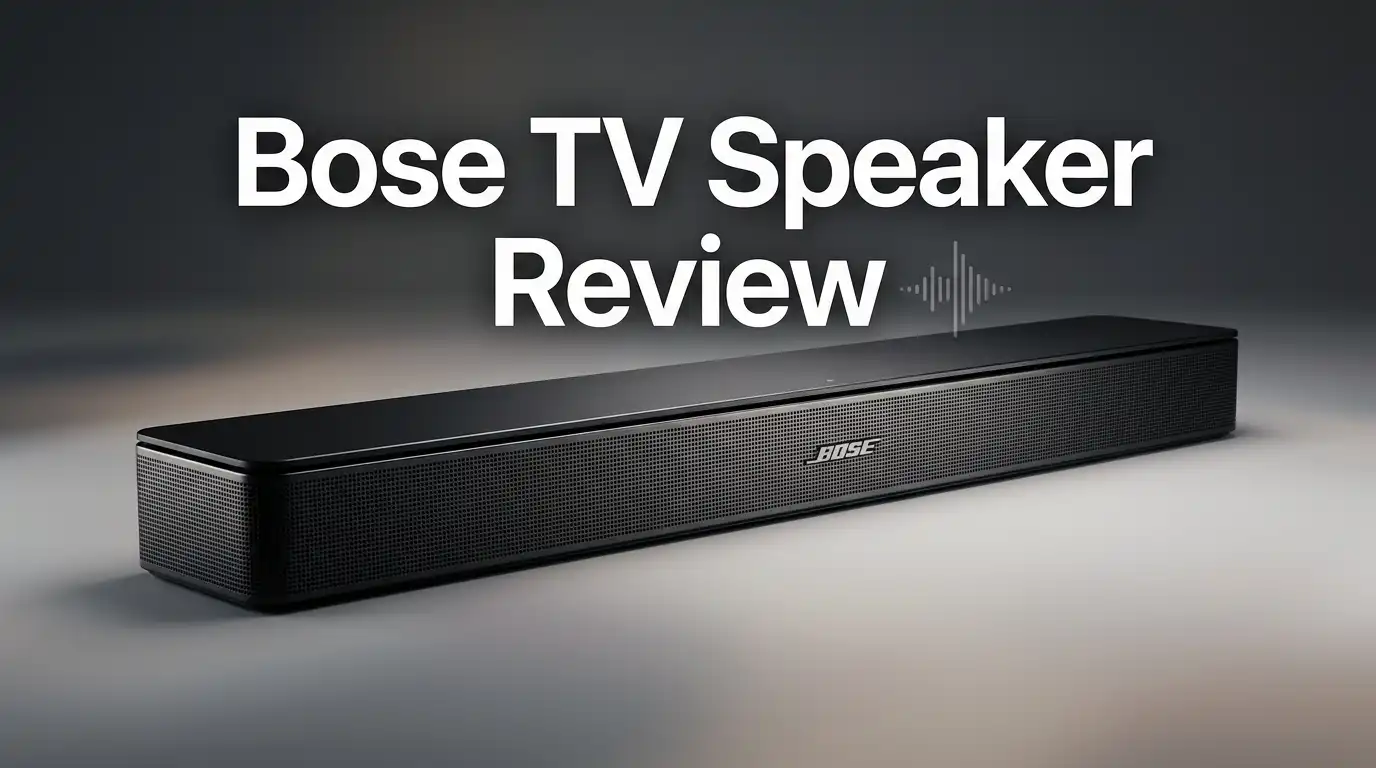
- The Bose TV Speaker is a compact 2.0 channel soundbar that measures just 23.4 inches wide and weighs only 4.34 pounds. It fits under most TVs without blocking the screen or the IR sensor.
- Dialogue Mode is the standout feature. This mode analyzes audio in real time and lifts vocal frequencies. It makes speech much easier to hear during movies, news, and TV shows. This is a huge benefit for anyone who struggles with unclear dialogue.
- Setup takes under five minutes. You connect the speaker to your TV with the included optical cable or an HDMI ARC connection. There is no app required and no complicated pairing process.
- Bluetooth 4.2 lets you stream music from your phone, tablet, or laptop. You can use the soundbar as a standalone music speaker when you are not watching TV.
- Bass performance is surprisingly good for its size, but it will not replace a dedicated subwoofer. Deep rumbles in action movies and intense music may feel thin compared to larger systems.
- It lacks Wi-Fi, surround sound, and smart assistant support. If you want Alexa, Google Assistant, or multi-room audio, this speaker does not offer those features. It focuses on simplicity above all.
Bose TV Speaker: Design and Build Quality


Last update on 2026-09-19 / Affiliate links / Images from Amazon Product Advertising API Some of the links on this website are affiliate links, which means that at no additional cost to you, I earn a commission if you click through and make a purchase. I only recommend products and services that I believe will add value to my readers. Thank you for your support!
The Bose TV Speaker has a clean, minimalist design. It uses a combination of metal and plastic materials. The top grille is wrapped in a fine mesh fabric. The overall look is understated and modern.
The speaker measures 2.21 inches tall, 23.38 inches wide, and 4.02 inches deep. It weighs just 4.34 pounds. This makes it one of the most compact soundbars you can buy from a major brand.
The low profile means it sits neatly in front of your TV. It will not block the bottom edge of your screen on most TV stands. You can also wall mount it if you prefer. Bose sells a wall mount bracket separately.
Build quality feels solid. The speaker does not flex or creak when you pick it up. The rubber feet on the bottom prevent it from sliding around on your TV stand. The overall finish looks premium, even though this is one of the more affordable Bose products.
One small note: the glossy plastic ends on each side of the speaker attract fingerprints. You will need to wipe them down from time to time. This is a minor cosmetic issue, but it is worth noting.
Unboxing Experience: What’s Inside the Box
Opening the Bose TV Speaker box is straightforward. Bose keeps things simple here. Inside the box, you will find the Bose TV Speaker itself, a remote control with a battery pre-installed, an optical audio cable, a power cord, and a Quick Start Guide.
The packaging uses molded cardboard inserts to protect the speaker during shipping. Everything is neatly arranged and easy to find. There is no excessive plastic wrap or wasteful padding.
The remote control is small and slim. It has a clean layout with buttons for power, volume, input selection, Bluetooth, bass boost, and Dialogue Mode. The buttons have a good click feel. The remote feels lightweight but not cheap.
One thing missing from the box is an HDMI cable. Bose includes only an optical cable. If you want to use the HDMI ARC connection, you will need to supply your own HDMI cable. This is a small inconvenience, especially for a product at this price point.
The Quick Start Guide uses illustrations instead of long text blocks. Most people can set up the speaker in under five minutes just by following the pictures. Bose clearly thought about ease of use here.
Sound Quality: How Does the Bose TV Speaker Perform?
Sound quality is where this speaker earns its reputation. The Bose TV Speaker delivers clear, balanced audio that is a significant upgrade over built-in TV speakers. Voices sound natural and present. Background music and sound effects have good separation.
The speaker uses two angled full-range drivers that project sound outward. This creates a wider soundstage than you might expect from a bar this size. Dialogue sits front and center in the mix. This makes it ideal for TV shows, news broadcasts, and movies with heavy dialogue.
Mid-range frequencies are the speaker’s strong point. Vocals, acoustic instruments, and sound effects in the midrange come through with clarity. High frequencies are smooth without being harsh or sibilant.
Bass response is decent but limited. The Bose TV Speaker produces some low-end warmth, and the bass boost button adds a noticeable bump. However, it cannot reproduce deep sub-bass. Action movie explosions and bass-heavy music will lack that chest-thumping impact.
For casual TV watching and moderate music listening, the sound quality is very good for the price. But if you are an audiophile or want a home theater experience, this speaker will leave you wanting more. You can add a Bose Bass Module 500 for deeper bass, but that adds significant cost to the setup.
Top 3 Alternatives for Bose TV Speaker
1. Sonos Ray

Last update on 2026-09-19 / Affiliate links / Images from Amazon Product Advertising API Some of the links on this website are affiliate links, which means that at no additional cost to you, I earn a commission if you click through and make a purchase. I only recommend products and services that I believe will add value to my readers. Thank you for your support!
2. JBL Bar 2.0 All-in-One (MK2)

Last update on 2026-09-19 / Affiliate links / Images from Amazon Product Advertising API Some of the links on this website are affiliate links, which means that at no additional cost to you, I earn a commission if you click through and make a purchase. I only recommend products and services that I believe will add value to my readers. Thank you for your support!
3. Yamaha SR-B30A

Last update on 2026-09-19 / Affiliate links / Images from Amazon Product Advertising API Some of the links on this website are affiliate links, which means that at no additional cost to you, I earn a commission if you click through and make a purchase. I only recommend products and services that I believe will add value to my readers. Thank you for your support!
Dialogue Mode: The Feature That Sets It Apart
The Dialogue Mode is one of the best features of the Bose TV Speaker. You activate it by pressing a single button on the remote. A small LED on the speaker lights up to confirm it is active.
This mode analyzes the audio signal in real time. It identifies vocal frequencies and boosts them above other sounds. The result is noticeably clearer speech. You can hear whispered lines in dramas. You can follow fast-paced news anchors with ease.
Many users report that Dialogue Mode is the main reason they bought this speaker. Older adults and people with hearing difficulties find it especially helpful. It reduces the need to constantly adjust the volume during loud action scenes or quiet conversations.
However, Dialogue Mode is not perfect. Some users notice a slight reduction in overall sound richness when it is active. The bass and surround effects get pulled back to make room for boosted vocals. This trade-off is acceptable for dialogue-heavy content but may annoy you during music or action-packed scenes.
You can toggle Dialogue Mode on and off quickly. So the best approach is to turn it on for talk shows and dramas, then switch it off for concerts or action movies. The flexibility is a plus.
Bluetooth Connectivity: Streaming Music and Podcasts
The Bose TV Speaker includes Bluetooth 4.2 for wireless audio streaming. You press the Bluetooth button on the remote, and the speaker enters pairing mode. Your phone, tablet, or laptop can then connect in seconds.
Once paired, you can stream music from Spotify, Apple Music, YouTube Music, or any other app. The speaker remembers previously paired devices. Reconnecting is fast and hassle-free after the initial setup.
Sound quality over Bluetooth is solid. Music sounds warm and balanced. The speaker handles pop, rock, jazz, and podcasts with ease. However, it does not support advanced Bluetooth codecs like aptX or AAC. This means audiophile-grade wireless audio is not available here.
Bluetooth range is typical for this class. You can expect a stable connection up to about 30 feet in an open room. Walls and obstacles will reduce that range. Occasional dropouts can happen if you walk too far from the speaker.
One limitation is that the Bose TV Speaker does not support multi-device pairing. Only one device can connect at a time. If someone else wants to play music, you must disconnect your device first. This can be mildly frustrating in a shared household.
Setup and Installation: Quick and Easy
Setting up the Bose TV Speaker is refreshingly simple. You do not need an app. You do not need a Wi-Fi network. You just connect the speaker to your TV and plug in the power cord.
The primary connection method is the included optical audio cable. You plug one end into the speaker and the other into the optical output on your TV. The speaker auto-detects the signal and starts playing audio immediately.
If your TV has an HDMI ARC port, you can use that instead. HDMI ARC allows you to control the speaker volume with your TV remote through CEC (Consumer Electronics Control). This eliminates the need for a second remote. Many users prefer this method for its convenience.
There is also a 3.5mm auxiliary input on the back. This lets you connect older devices, headphone jacks, or other audio sources directly to the speaker.
Wall mounting is straightforward. Bose offers a dedicated wall mount bracket. The speaker has threaded inserts on the bottom for secure attachment. The slim profile makes it look great on a wall below your TV.
The entire setup process takes less than five minutes. This is one of the fastest soundbar setups on the market. Bose clearly designed this product for people who want better sound without any technical hassle.
Remote Control: Simple and Functional
The Bose TV Speaker remote is a slim, compact unit. It fits comfortably in one hand. The layout is clean, with clearly labeled buttons for every key function.
You get dedicated buttons for power, volume up and down, source selection, Bluetooth, bass toggle, and Dialogue Mode. Each button has a distinct size and shape. You can tell them apart by touch alone in a dark room.
The remote uses a CR2032 battery that comes pre-installed. Battery life is long. Most users report going a year or more before needing a replacement. The battery compartment on the back slides open easily.
One downside is that this is an infrared (IR) remote. You must point it at the speaker for commands to register. If the speaker is hidden inside a cabinet or behind an obstacle, the remote may not work reliably.
There is no companion app for this speaker. All settings and adjustments happen through the remote. This is a strength for people who dislike fiddling with apps. But it also means you cannot fine-tune EQ settings, adjust specific frequency bands, or save custom presets.
Bass Performance: Good but Not Great
The Bose TV Speaker delivers respectable bass for its size. The two internal drivers produce a low-end response that adds warmth to movies and music. The bass boost button on the remote gives an extra kick when you want it.
For TV shows, podcasts, and casual music listening, the bass is more than adequate. You hear a pleasant fullness that built-in TV speakers simply cannot match. Acoustic music, vocal tracks, and jazz recordings sound rich and engaging.
However, the bass falls short during demanding content. Action movies with deep explosions, EDM tracks, and hip-hop music reveal the speaker’s limitations. The sub-bass frequencies below 80Hz are mostly absent. You will not feel any physical rumble or vibration.
Bose offers the Bass Module 500 as an optional add-on. This wireless subwoofer pairs with the TV Speaker and fills in those missing low frequencies. But the Bass Module 500 costs nearly as much as the speaker itself. The combined price pushes you into territory where more capable soundbar systems compete.
If deep, powerful bass is a priority for you, the Bose TV Speaker alone will disappoint. It was designed for vocal clarity first, bass second. Understanding this priority helps set realistic expectations.
HDMI ARC vs. Optical: Which Connection Should You Use?
The Bose TV Speaker supports two main connections: HDMI ARC and optical audio. Both deliver high-quality sound, but they differ in convenience and features.
HDMI ARC (Audio Return Channel) sends audio from your TV to the speaker through a single HDMI cable. The big advantage is CEC support. CEC lets your TV remote control the speaker’s volume and power. You do not need a separate remote for the soundbar. This creates a seamless one-remote experience.
Optical audio uses the included toslink cable. It delivers a reliable digital audio signal. However, optical does not support CEC. You will need the Bose remote to control volume and settings separately from your TV remote.
In most cases, HDMI ARC is the better choice. It simplifies your setup and reduces remote clutter. However, some older TVs have HDMI ports without ARC support. In that case, optical is your only digital option.
The Bose TV Speaker does not support HDMI eARC. This means it cannot pass through lossless audio formats like Dolby TrueHD or DTS-HD Master Audio. For most TV content and streaming services, this is not a problem. Standard Dolby Digital and PCM stereo work fine over regular ARC.
If you use a gaming console or Blu-ray player, check if your TV passes audio through ARC correctly. Some TVs require specific settings to enable ARC output.
What the Bose TV Speaker Does NOT Do Well
No product is perfect. The Bose TV Speaker has clear limitations that you should consider before buying.
It does not support Wi-Fi. There is no way to connect the speaker to your home network. This means no multi-room audio, no firmware updates over the air, and no voice assistant integration. Competitors like the Sonos Ray offer Wi-Fi and multi-room support at a similar price.
There is no surround sound. The Bose TV Speaker is a 2.0 channel system. It cannot create virtual surround effects or Dolby Atmos. If you want an immersive audio experience, you need a different soundbar.
The Bluetooth version is outdated. Bluetooth 4.2 works fine, but it lacks features found in Bluetooth 5.0 and newer. You miss out on improved range, lower latency, and better audio codecs.
No EQ customization exists. You cannot adjust treble, midrange, or bass individually. The only audio tweaks are the bass boost button and Dialogue Mode. Power users will find this limiting.
It does not include an HDMI cable. For a speaker that supports HDMI ARC, the absence of an included HDMI cable feels like an oversight.
These shortcomings do not make it a bad speaker. They make it a simple, focused product. Bose made deliberate choices to keep the price down and the user experience uncomplicated.
Who Should Buy the Bose TV Speaker?
The Bose TV Speaker is ideal for specific types of buyers. Understanding who this product serves best will help you decide.
Older adults and anyone with hearing difficulties will love the Dialogue Mode. It makes TV speech dramatically easier to understand. Many buyers report purchasing this speaker specifically for elderly family members. The simple remote and easy setup make it accessible to non-technical users.
Apartment dwellers and people with small rooms will appreciate the compact size. This speaker does not need a subwoofer or rear speakers. It fits on narrow TV stands and does not dominate small spaces.
Budget-conscious Bose fans get the brand’s audio quality at a lower price point. The Bose TV Speaker costs significantly less than the Bose Smart Soundbar 600 or the Bose Smart Ultra Soundbar. It delivers the signature Bose clarity at a fraction of the price.
People who hate complicated tech will enjoy the plug-and-play setup. No apps, no Wi-Fi passwords, no firmware updates. You connect one cable and start listening.
This speaker is not ideal for home theater enthusiasts, gamers who want surround sound, or audiophiles who demand deep bass and detailed frequency control. Those buyers should look at higher-end options.
Bose TV Speaker vs. Built-In TV Speakers
Last update on 2026-09-19 / Affiliate links / Images from Amazon Product Advertising API Some of the links on this website are affiliate links, which means that at no additional cost to you, I earn a commission if you click through and make a purchase. I only recommend products and services that I believe will add value to my readers. Thank you for your support!
If you are wondering whether the upgrade is worth it, the answer is a clear yes. The difference between built-in TV speakers and the Bose TV Speaker is dramatic.
Most modern TVs have thin panels. This leaves very little room for quality speakers inside the chassis. Built-in speakers produce thin, tinny sound. They struggle with dialogue clarity. They lack bass entirely. Many people compensate by turning the volume way up, which makes loud scenes unbearable.
The Bose TV Speaker fixes these problems immediately. Dialogue becomes crisp and centered. Music gains warmth and dimension. Sound effects have more presence and detail. You will hear things in your favorite shows that you missed before.
The volume range is also much wider. The Bose TV Speaker gets plenty loud for a living room or bedroom. At high volumes, it maintains clarity without distortion. Built-in TV speakers often distort at higher volumes.
You also gain Bluetooth connectivity, which your TV speakers likely do not offer. This turns your TV setup into a music listening station as well.
For the price, the Bose TV Speaker delivers a meaningful, noticeable upgrade that you will appreciate every single day.
Power Output and Volume Capability
The Bose TV Speaker delivers 35 watts of total power output. This does not sound like a lot on paper. But Bose is known for extracting maximum performance from modest hardware.
In a typical living room, 35 watts provides more than enough volume. You can fill a medium-sized room without pushing the speaker to its limits. Dialogue remains clear even at higher volumes. There is minimal distortion across the volume range.
At very high volumes, the speaker does show some strain. The bass becomes slightly compressed. The overall sound loses some of its openness. This happens near the maximum volume setting, which most people will never reach during normal use.
For bedrooms, offices, and small apartments, the volume is excellent. For large open-plan living areas or outdoor use, you may find it falls short. The speaker works best in rooms under 300 square feet.
Power efficiency is good. The speaker draws minimal electricity during standby. The auto-sleep feature turns the speaker off after a period of inactivity. This saves energy and extends the life of internal components.
Durability and Long-Term Reliability
Bose products have a strong reputation for lasting a long time. The Bose TV Speaker continues this trend. The build quality supports years of daily use without issues.
The metal grille protects the internal drivers from dust and accidental contact. The rubber feet prevent scratches on your furniture. The power cable connection is secure and does not wiggle loose over time.
Long-term user reports suggest the speaker performs consistently over multiple years. Sound quality does not degrade. The remote control remains responsive. Bluetooth pairing stays reliable.
Bose offers a one-year limited warranty on this product. Some users wish this were longer, given the price point. However, Bose customer support has a good reputation for handling issues even outside the warranty period.
One concern from some owners is the optical cable connection loosening slightly over time. This can cause intermittent audio dropouts. A simple fix is to reseat the cable or switch to HDMI ARC for a more secure connection.
Overall, the Bose TV Speaker is a reliable, well-built product that should serve you well for three to five years or more with normal use.
Final Verdict: Should You Buy the Bose TV Speaker in 2026?
The Bose TV Speaker remains a solid choice for people who want simple, clear, and better TV audio. It does exactly what it promises. It improves dialogue clarity. It adds warmth and fullness to TV sound. It sets up in minutes.
The speaker is not a home theater replacement. It does not have surround sound, Wi-Fi, or smart assistant support. The bass is good but not deep. The Bluetooth version is aging. These are real trade-offs.
But if your main goal is to hear your TV clearly without buying a complex sound system, the Bose TV Speaker delivers. The Dialogue Mode alone justifies the purchase for many buyers. The compact design fits anywhere. The brand reliability gives you confidence in your purchase.
In 2026, this speaker competes well against newer alternatives. It may not have the latest features, but it nails the basics. Sometimes, simple and effective is exactly what you need.
Frequently Asked Questions
Does the Bose TV Speaker support Dolby Atmos?
No, the Bose TV Speaker does not support Dolby Atmos. It is a 2.0 channel soundbar that plays standard stereo and Dolby Digital audio. If you need Dolby Atmos support, consider the Bose Smart Ultra Soundbar or the Yamaha SR-B30A.
Can I add a subwoofer to the Bose TV Speaker?
Yes, the Bose TV Speaker has a 3.5mm subwoofer output. It is compatible with the Bose Bass Module 500. The subwoofer connects wirelessly after initial pairing. This adds deeper bass to movies and music.
Does the Bose TV Speaker work with a wall-mounted TV?
Yes, you can wall mount the Bose TV Speaker using the Bose wall mount bracket. The bracket is sold separately. The speaker’s slim profile looks great mounted directly below a wall-mounted TV.
Can I use the Bose TV Speaker with a projector?
Yes, you can connect the Bose TV Speaker to any device with an optical audio output, HDMI ARC port, or 3.5mm headphone jack. Most projectors have at least one of these outputs.
Does the Bose TV Speaker turn on automatically with my TV?
Yes, if you use the HDMI ARC connection and enable CEC on your TV. The speaker will power on and off with your TV automatically. This feature does not work with the optical cable connection.
Is the Bose TV Speaker loud enough for a large room?
The Bose TV Speaker works best in small to medium-sized rooms. It delivers 35 watts of power, which fills rooms under 300 square feet comfortably. For large open-plan spaces, you may want a more powerful soundbar.

Hello everyone my name is Alenya and i am a gadget discovering Enthusiast 🐻🐻