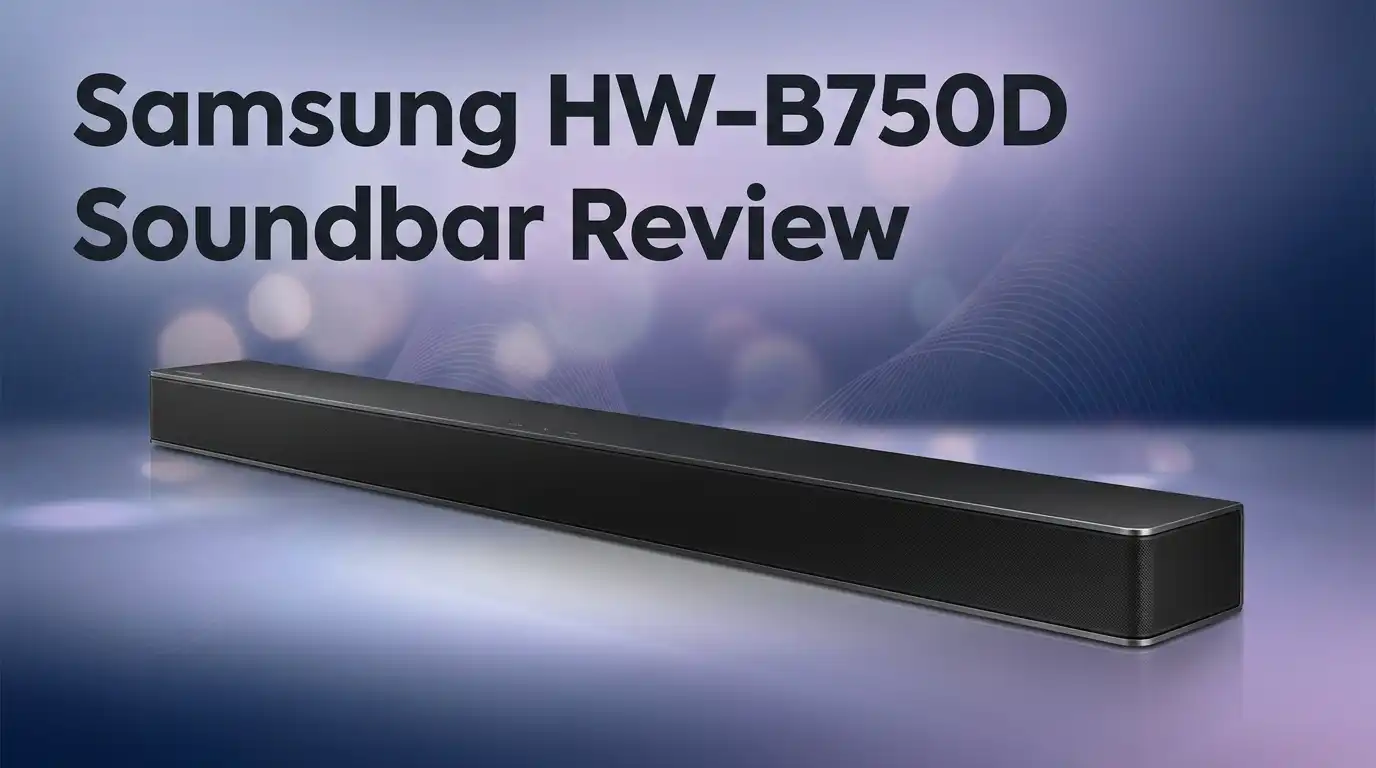
Samsung HW-B750D Soundbar Review: Worth It?
Do you want a soundbar that fills your room with rich sound? The Samsung HW-B750D often comes up in searches for home theater upgrades. But one big question keeps popping up: does it really support Dolby Atmos?
Let’s clear the air right away. This soundbar does not offer true Dolby Atmos support. It skips up-firing drivers, which are key for that immersive overhead effect.
So why do people still ask about it? The B750D packs a 5.1 channel setup with a wireless subwoofer. It also uses side-firing drivers to widen the soundstage. These features create a spacious feel, even without Atmos.
This soundbar shines in other ways too. It offers crisp dialogue clarity and handy sound tools like Bass Boost. Setup is simple, and latency stays low for smooth playback.
In a Nutshell
- No Dolby Atmos here. The B750D relies on DTS Virtual:X to fake height effects. It does not use real up-firing drivers.
- Dialogue clarity stands out. Voices sound crisp and clear in movies and shows. You will not strain to hear conversations.
- Setup feels simple. You can connect this soundbar and start watching within minutes. No complicated steps get in your way.
- Sound tools add value. The graphic EQ lets you fine tune audio to your taste. Bass Boost and Adaptive Sound adjust output based on content.
- Connectivity stays basic. Bluetooth is your only wireless option. This soundbar also skips smart features like voice assistants.
- Side-firing drivers widen the soundstage. Your room feels fuller during action scenes. Still, this is not the same as genuine height sound.
The bottom line? This soundbar delivers solid performance for everyday viewing. Just do not expect real Atmos immersion from this model.
Channel Configuration and Speaker Setup
The Samsung HW-B750D uses a 5.1 channel layout that spreads sound across your room. You get a center channel, left and right channels, two surround channels, and a wireless subwoofer. This setup creates depth without needing ceiling speakers.
Setting it up takes minutes. The soundbar connects to your TV via HDMI or optical cable. The subwoofer pairs wirelessly to the main unit. You don’t need special tools or technical knowledge to get started. Most people finish the entire process in under ten minutes.
The side-firing drivers deserve attention here. These speakers angle sound toward your room’s walls rather than straight ahead. This creates a wider soundstage during action scenes and music playback. Your living room feels more immersive without adding extra speakers in corners or on shelves.
Speaker placement matters for this model. Position the soundbar directly under or above your TV for best results. Keep the subwoofer within ten feet of the main unit for reliable wireless connection. Avoid placing it in enclosed cabinets where sound gets trapped. Open spaces around the soundbar let the side-firing drivers work properly.
The center channel deserves praise for dialogue handling. Voices stay clear and centered on your screen during movies and TV shows. You won’t struggle to understand what characters say, even during quiet scenes. This matters most if you watch lots of films or dramas.
Customization options help you adjust the sound. The graphic EQ lets you boost bass, treble, or midrange frequencies. Bass Boost mode adds extra low-end punch for action films. Adaptive Sound automatically adjusts audio based on what you’re watching. These tools give you control without overwhelming complexity.
Bluetooth connectivity keeps things simple but limited. You can stream music from your phone or tablet wirelessly. However, you won’t find WiFi, AirPlay, or other modern wireless standards. This works fine if you mostly use the soundbar for TV viewing rather than streaming services.

Last update on 2026-07-27 / Affiliate links / Images from Amazon Product Advertising API Some of the links on this website are affiliate links, which means that at no additional cost to you, I earn a commission if you click through and make a purchase. I only recommend products and services that I believe will add value to my readers. Thank you for your support!
Audio Codec Support and Surround Sound Technology
The Samsung HW-B750D handles audio codecs in a straightforward way. This soundbar supports Dolby Digital 5.1 and DTS Virtual:X, which gives you solid codec coverage for most content you’ll watch.
Here’s what matters most. Dolby Digital 5.1 works with nearly every streaming service and broadcast. Your movies, TV shows, and games all use this codec. The B750D decodes it without any issues. You get clean, reliable sound from standard sources.
DTS Virtual:X is where this soundbar gets creative. This technology simulates height effects without actual up firing drivers. It takes regular surround sound and stretches it upward. The effect feels immersive during action sequences. Many viewers notice a wider, more spacious soundstage when DTS Virtual:X kicks in.
The lack of true Dolby Atmos is the real limitation here. Atmos requires dedicated height channels or up firing drivers. The B750D has neither. If you own Atmos content on streaming services, this soundbar won’t deliver those overhead sounds. That’s important to know upfront.
What the B750D does well is process standard surround formats. The 5.1 channel setup means you get left, center, right, and two surround channels. The subwoofer handles low frequencies separately. This arrangement works perfectly for traditional movie soundtracks.
Adaptive Sound adds another layer of usefulness. This feature detects what you’re watching and adjusts the audio profile automatically. Sports content sounds different from movies. Dialogue heavy shows get a boost to the center channel. You don’t need to manually switch settings.
The graphic EQ gives you manual control too. You can boost or cut specific frequency ranges. Want punchier bass? Increase the low end. Need clearer dialogue? Lift the midrange. This flexibility helps you customize the sound to your room and preferences.
For everyday viewing, the B750D’s codec support hits the mark. You won’t get cutting edge Atmos technology, but you will get reliable, well executed surround sound that works with virtually all your content.
Sound Quality and Dialogue Clarity
The Samsung HW-B750D delivers impressive dialogue clarity that makes voices pop on screen. The center channel handles speech with precision, so you hear every word in movies and TV shows without straining to understand.
Dialogue reproduction stands out as a key strength here. The soundbar focuses audio energy on the center, where most dialogue happens. This means actors’ voices stay crisp and clear even during action sequences with background noise.
The graphic EQ gives you control over how dialogue sounds in your room. You can boost midrange frequencies where human voices live, or dial back bass if it muddles speech. This flexibility helps you customize the audio to match your preferences and room acoustics.
DTS Virtual:X adds spatial dimension to dialogue scenes. While it doesn’t create true height effects like Dolby Atmos would, it spreads dialogue across the soundstage more naturally. Conversations feel less flat and more immersive than basic stereo.
The side-firing drivers contribute to dialogue clarity by preventing sound from feeling boxed in at the center. Your ears perceive voices as coming from a wider area, which feels more natural when watching films. This wider soundstage makes dialogue feel like it’s happening in front of you rather than coming from a narrow speaker.
Adaptive Sound technology helps too. This feature automatically adjusts audio levels based on what you’re watching. During quiet dialogue scenes, the soundbar maintains clarity without forcing you to turn up the volume and blast you during loud moments.
Low latency playback means dialogue syncs perfectly with actor lip movements. You won’t notice audio lag or feel like someone’s dubbed the movie. This sync matters more than people realize when evaluating how natural dialogue sounds.
The 5.1 channel configuration keeps dialogue anchored in the center while surrounds add context. This separation prevents dialogue from getting lost in background effects. You get a clear voice priority without sacrificing immersion.
Top 3 Alternatives
Sony HT-A5000

Last update on 2026-07-27 / Affiliate links / Images from Amazon Product Advertising API Some of the links on this website are affiliate links, which means that at no additional cost to you, I earn a commission if you click through and make a purchase. I only recommend products and services that I believe will add value to my readers. Thank you for your support!
The Sony HT-A5000 brings spatial audio to your living room with genuine Dolby Atmos support. This soundbar creates a three-dimensional sound field that lifts audio above your head. You hear dialogue from actors, effects from above, and music that wraps around you.
LG SN11RG


Last update on 2026-08-01 / Affiliate links / Images from Amazon Product Advertising API Some of the links on this website are affiliate links, which means that at no additional cost to you, I earn a commission if you click through and make a purchase. I only recommend products and services that I believe will add value to my readers. Thank you for your support!
LG’s SN11RG delivers Dolby Atmos with a sleek design that fits any entertainment setup. The soundbar works with your TV through a single HDMI connection. Upward-firing speakers create height channels that make action scenes feel immersive.
Bose Smart Soundbar

Last update on 2026-07-27 / Affiliate links / Images from Amazon Product Advertising API Some of the links on this website are affiliate links, which means that at no additional cost to you, I earn a commission if you click through and make a purchase. I only recommend products and services that I believe will add value to my readers. Thank you for your support!
Bose’s Smart Soundbar focuses on clarity and speech intelligibility alongside Dolby Atmos support. Dialogue stays crisp even during action sequences. The soundbar learns your listening preferences and adjusts automatically over time.
Connectivity and Wireless Options
The Samsung HW-B750D keeps wireless connectivity simple and straightforward. You get Bluetooth support as your main wireless option, which works well for pairing phones, tablets, and laptops quickly. Connection happens in seconds without complicated setup steps.
The soundbar connects to your TV through two wired options. You can use HDMI for a direct connection, or optical audio cable if HDMI isn’t available. Both methods work reliably and reduce wireless interference that sometimes affects sound quality.
Here’s what matters about this model’s wireless approach. Bluetooth-only connectivity means you won’t find Wi-Fi, AirPlay, or Spotify Connect built in. This keeps the feature set focused but limits how you stream music from certain apps. If you rely on wireless music streaming services, you’ll need to use Bluetooth from your phone instead.
The wireless subwoofer deserves attention here. It connects wirelessly to the soundbar, so you skip messy cables running across your room. Setup takes just a few moments, and the connection stays stable during normal use. You won’t experience dropouts or lag during movies or music.
Low latency playback stands out as a real strength. Dialogue and sound effects sync perfectly with what you see on screen, even over wireless connections. This matters most when watching shows and movies where lip sync problems become obvious and annoying.
The lack of smart features keeps things simple but also limited. You won’t find voice control, app integration, or advanced wireless options here. The B750D focuses on core connectivity without extra bells and whistles.
For living rooms where you mainly watch TV and occasionally use Bluetooth for music, this wireless setup works well. The wired HDMI or optical connection to your TV remains your primary link. Bluetooth fills in for occasional phone or tablet use. The wireless subwoofer eliminates cable clutter behind your entertainment center. If you need extensive wireless streaming options or smart home integration, you’ll want to look elsewhere.
Setup, Controls, and Smart Features
The Samsung HW-B750D keeps setup refreshingly simple. You connect the soundbar to your TV using either HDMI or optical cable. The wireless subwoofer pairs automatically, so you skip the complicated pairing process many soundbars require.
Physical controls sit on top of the soundbar unit. You get dedicated buttons for power, volume, and input selection. A small LED display shows your current settings. The remote offers basic navigation without overwhelming you with options.
The control menu focuses on what actually matters. Bass Boost lets you increase low frequencies with one toggle. Adaptive Sound automatically adjusts the audio based on what you’re watching, whether that’s movies, sports, or news. You don’t need to manually switch between presets constantly.
The graphic EQ gives you serious control over sound shaping. You can boost or cut specific frequency ranges independently. This means you can compensate for your room’s acoustics without professional calibration tools. The interface displays frequency bands clearly, making adjustments intuitive.
Smart features remain minimal here, which keeps things straightforward. The B750D doesn’t include voice assistants or app control. You won’t find room correction software or wireless multi room audio. This soundbar focuses purely on TV audio performance rather than becoming a smart home hub.
Bluetooth connectivity provides basic wireless music streaming. You can play audio from your phone or tablet, though the connection lacks advanced codecs. The wireless range stays reliable within your living room without dropouts.
The low latency mode ensures dialogue stays synchronized with on screen lips. This matters when you’re watching shows where timing feels off. You can toggle this on or off depending on your content.
Overall, the setup and controls prioritize simplicity over complexity. New users won’t feel intimidated by overwhelming menus. Experienced audio enthusiasts get enough manual control through the graphic EQ and sound modes. The B750D rewards you for keeping expectations realistic about what a 5.1 soundbar can do without Atmos technology.
Pros and Cons
Pros
- Exceptional center channel clarity makes voices stand out during movies and shows
- Bass Boost and Adaptive Sound features let you customize audio to match different content types
- Side-firing drivers create a wider soundstage that prevents audio from feeling cramped
- Graphic EQ gives you manual control to shape sound exactly how you want it in your room
- Setup process is straightforward with minimal configuration needed
Cons
- No Dolby Atmos support means no height channel effects or overhead sound
- Missing up-firing drivers limits spatial audio capabilities compared to premium models
- Bluetooth only for wireless connectivity, so no WiFi or advanced streaming options
- No room correction technology to automatically adapt sound to your space’s acoustics
Who Should Buy It
The Samsung HW-B750D works best for viewers who want clear dialogue without extra complexity. This soundbar excels when your main goal is watching TV shows and movies with excellent voice clarity.
Movie and TV enthusiasts benefit most here. The center channel reproduction keeps dialogue crisp and easy to follow. If you watch a lot of content where understanding every word matters, this soundbar delivers that performance consistently.
People who prefer simple setups find real value in this model. You connect it to your TV with a cable, pair the wireless subwoofer, and you’re done. No apps to download. No network configuration. No confusing menus to navigate through.
Casual music listeners who use Bluetooth occasionally fit this profile too. The soundbar plays music through Bluetooth without lag or sync issues. You won’t use it as your primary music system, but it handles background music streaming well enough.
Gamers appreciate the low latency mode here. If you play games on your TV and dialogue needs to match character movements, this feature keeps everything synchronized. The delay stays minimal, which matters for competitive gaming and action sequences.
People living in standard living rooms without high ceilings should consider this option. The side-firing drivers create a wider soundstage that works well in typical spaces. You get surround sound effects without needing height channels or overhead speakers.
Buyers who want graphic EQ control find exactly what they need. You can adjust frequencies manually to match your room’s acoustics. This hands-on approach appeals to people who like tweaking their audio setup.
The B750D is not for you if you demand Dolby Atmos or immersive height effects. Skip this model if you need advanced smart features or WiFi streaming. If you want premium spatial audio with up-firing drivers, look elsewhere.
This soundbar suits straightforward users who prioritize clear voices, easy setup, and reliable wireless performance over cutting-edge features.
Final Verdict
Let’s answer the big question. The Samsung HW-B750D does not deliver real Dolby Atmos. If you came here searching for overhead sound, this model won’t give you that experience.
That said, the B750D still earns its place in many homes. It focuses on doing a few things very well instead of chasing every feature trend.
Dialogue clarity remains its strongest selling point. Shows, movies, and news broadcasts sound crisp and easy to follow. This matters more to everyday viewers than height channels ever will.
Think about your actual viewing habits before deciding. Do you watch mostly TV shows and casual movies? Then missing Atmos support won’t affect your daily experience much.
Gamers and streaming fans also get solid value here. Low latency playback keeps audio synced with action on screen, which matters more than spatial effects during fast gameplay.
The sound customization tools add real flexibility too. You can shape audio output based on room size or content type using the built in EQ options.
However, some buyers should look elsewhere. If immersive height effects define your movie night experience, this soundbar will disappoint you.
Home theater enthusiasts chasing cinema level immersion need a different model. Those seeking true 3D audio positioning should explore soundbars with dedicated up firing drivers instead.
The core question gets a clear answer: no, this isn’t an Atmos soundbar. Samsung markets it around DTS Virtual:X processing, which simulates some spatial width but never recreates genuine overhead sound.
Judge this product for what it actually offers, not what its name might suggest. It delivers dependable performance for straightforward home entertainment setups.
Buyers wanting simplicity, strong dialogue reproduction, and functional bass enhancement will find good value here. Those craving cinematic immersion with height channels should search for Atmos certified alternatives instead.
Match your expectations to the product’s actual strengths, and the HW-B750D becomes a smart, practical addition to any standard living room setup.
Frequently Asked Questions
Does the Samsung B750D have real Dolby Atmos?
No, it does not. The B750D uses DTS Virtual:X instead, which creates a wider soundstage through side-firing drivers. Atmos requires up-firing speakers to send sound overhead, and this model lacks that feature entirely. If you need true height channels and 3D audio positioning, you’ll need a different soundbar.
What makes the dialogue sound so clear on this model?
The 5.1 channel setup puts a dedicated center channel front and center. This channel handles most speech and vocals in movies and TV shows. The result is crisp, easy-to-follow dialogue without mumbling or unclear words. You’ll notice this benefit immediately when watching dialogue-heavy content like dramas or news programs.
Can I use this soundbar with my smart home system?
The B750D connects only through Bluetooth wireless connectivity. It does not support WiFi, AirPlay, or other smart streaming protocols. This keeps the setup simple but limits integration with smart home ecosystems. You’ll need to connect your source device directly via Bluetooth each time.
What sound customization options are available?
The soundbar includes a graphic EQ tool and Adaptive Sound features. You can manually adjust frequencies to match your room’s acoustics without needing professional calibration. Bass Boost lets you add extra low end for movies. These tools give you real control over how your audio sounds in your specific space.
Who should skip this soundbar?
Home theater enthusiasts seeking cinema level immersion should look elsewhere. People who demand Dolby Atmos or immersive height effects won’t find them here. Buyers wanting WiFi streaming and smart features need a different model.

Hello everyone my name is Alenya and i am a gadget discovering Enthusiast 🐻🐻