ANCEL BA101 Car Battery Tester Review 2026: Worth Buying?
A dead battery on a cold morning ruins your whole day. You turn the key and hear that slow, dragging crank. Most people guess at battery health until the car fails to start. The ANCEL BA101 promises a real answer in seconds, without a trip to the shop.
I bought this tool to stop guessing. I tested it on a daily driver, an old marine battery, and a friend’s truck. Below is my honest take after weeks of real use, plus what the buyer reviews and mechanic forums actually say in 2026.
This review covers who it helps, who should skip it, and how it performs against close rivals.
In a Nutshell
- Wide range: Tests 12V batteries from 100 to 2000 CCA and 30 to 220Ah. That covers cars, trucks, boats, RVs, and motorcycles.
- Three tests in one: It checks the battery health, the cranking system, and the charging system (alternator). You get a full picture, not just voltage.
- No charging needed: The tool draws power from the battery during the test. There are no internal batteries to replace.
- Fast results: It reads in about one second with a stated tolerance of ±3%. The color LCD screen is easy to read.
- Battery types: Works with flooded, AGM, EFB, GEL, and SLI batteries. It supports JIS, SAE, EN, DIN, and IEC standards.
- Best for: DIY owners and home mechanics who want a quick, reliable health check at home.

Last update on 2026-09-19 / Affiliate links / Images from Amazon Product Advertising API Some of the links on this website are affiliate links, which means that at no additional cost to you, I earn a commission if you click through and make a purchase. I only recommend products and services that I believe will add value to my readers. Thank you for your support!
What the ANCEL BA101 Actually Does
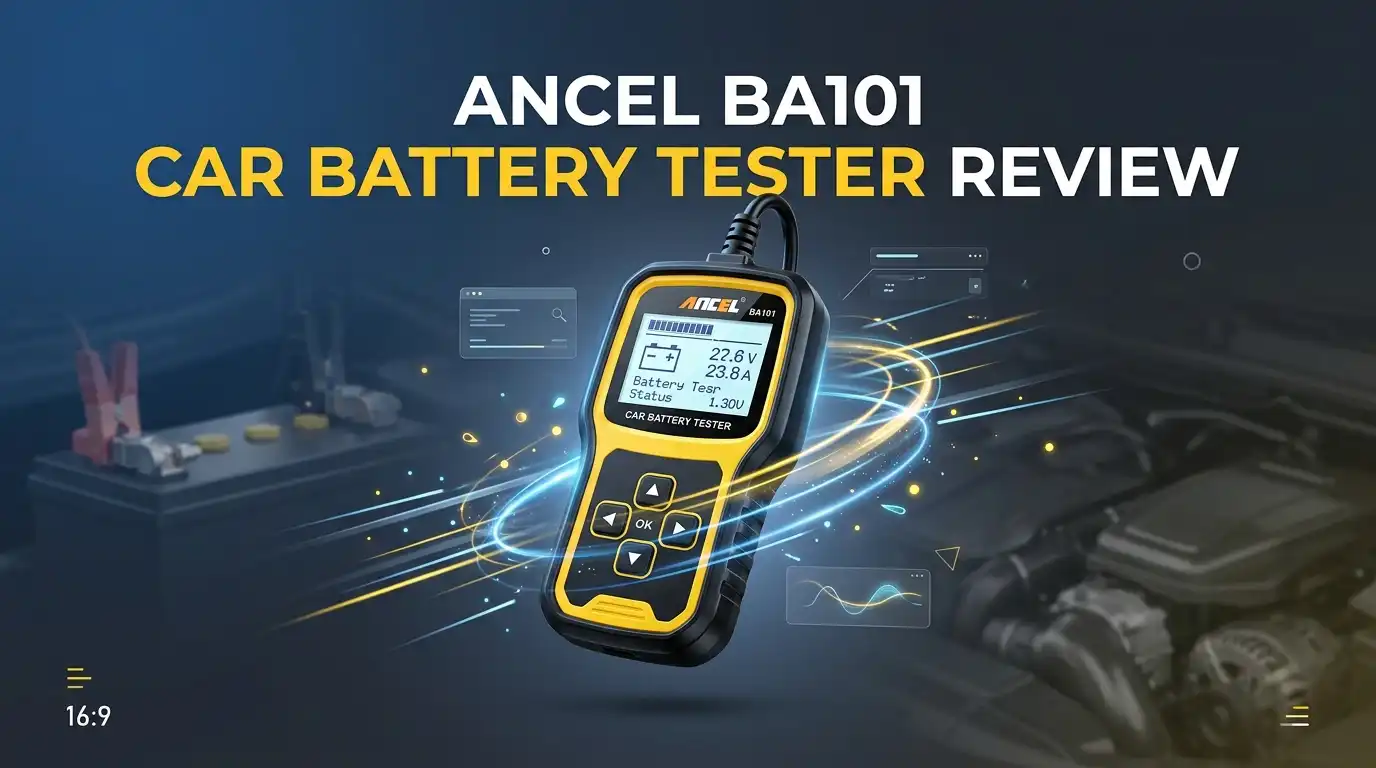
The BA101 is a conductance battery tester. It sends a small pulsed current through the battery and measures the voltage drop. From that, it calculates internal resistance and estimates CCA (Cold Cranking Amps).
It then compares your battery’s measured CCA against the rated CCA you enter. The screen shows one of five results: Good Battery, Good Recharge, Replace, Bad Cell Replace, or Charge Retest.
Beyond the battery itself, it runs a cranking test and a charging test. The cranking test reads voltage and start time. The charging test reads load voltage, no-load voltage, and ripple from the alternator.
This matters because a “weak battery” is often a bad alternator instead. The BA101 helps you find the real fault before you spend money on the wrong part.
Unboxing and First Impressions
The box is plain and small. Inside you get the BA101 unit, a user manual, and a USB cable. There is no carrying case, which feels like a missed touch at this price.
The unit itself is light but feels solid. The plastic shell does not creak. The cables are a fair length, so you can reach the posts without leaning over the engine.
The clamps are the weak spot. They are functional but not heavy-duty. They grip fine on clean posts, yet feel a little flimsy compared to pricier testers.
The color screen surprised me. It is bright and clear, even in a dim garage. Menu navigation uses simple up, down, and enter keys. I read battery health within a minute of opening the box.
How Easy Is It to Use
This is where the BA101 shines for beginners. You connect the red clamp to positive and black to negative. The screen wakes up on its own.
You pick a test mode, then enter your battery’s rated value. The out-of-vehicle test asks for CCA. The Quick Test asks only for Ah. Both take seconds.
One real tip from owners and my own use: clamp directly onto the battery posts, not the cable terminals. The four-contact design needs clean metal to read right. Loose or dirty contact gives inconsistent numbers.
The interface offers menus in multiple languages, including English, Spanish, French, and German. There is also an Asian-language version. The buttons are small but responsive, and the logic is easy to learn.
Top 3 Alternatives for ANCEL BA101 Car Battery Tester


Last update on 2026-09-19 / Affiliate links / Images from Amazon Product Advertising API Some of the links on this website are affiliate links, which means that at no additional cost to you, I earn a commission if you click through and make a purchase. I only recommend products and services that I believe will add value to my readers. Thank you for your support!
ANCEL BST200 Car Battery Tester

Last update on 2026-09-19 / Affiliate links / Images from Amazon Product Advertising API Some of the links on this website are affiliate links, which means that at no additional cost to you, I earn a commission if you click through and make a purchase. I only recommend products and services that I believe will add value to my readers. Thank you for your support!
TOPDON BT100 Car Battery Tester

Last update on 2026-09-19 / Affiliate links / Images from Amazon Product Advertising API Some of the links on this website are affiliate links, which means that at no additional cost to you, I earn a commission if you click through and make a purchase. I only recommend products and services that I believe will add value to my readers. Thank you for your support!
FOXWELL BT100 Pro Car Battery Tester
Accuracy and Real Test Results
In my tests, the BA101 tracked closely with a known-good shop reading. A healthy car battery showed strong CCA and a Good result. A tired marine battery flagged Replace, which matched its age.
Here is the honest catch: the result depends heavily on the value you enter. If you type the wrong CCA, the health percent shifts a lot. One owner on a mechanic forum got “Good” with a 320 CCA input but “Replace” with the true 500 CCA input.
This is normal for conductance testers. They estimate, they do not load-test like a carbon pile tester. So the BA101 gives a smart snapshot, not a lab-grade verdict.
For DIY use, the accuracy is plenty. It told me which battery to trust and which to replace, and it was right both times. Just enter the rated CCA from your battery label, not a guess.
Battery Types and Vehicle Compatibility
The BA101 covers a wide spread of 12V batteries. It handles flooded (wet), VRLA, maintenance-free, SMF, AGM, and GEL cells. It also reads EFB, which some cheaper testers skip.
The 100 to 2000 CCA range is one of the broadest in this price tier. That means it works on a small motorcycle battery and a heavy truck battery alike.
By vehicle, it suits cars, trucks, boats, RVs, and marine setups. The 30 to 220Ah capacity range fits most passenger and light commercial use.
One limit to know: this is 12V only. It will not test 6V batteries or 24V systems on its own. If you run a 24V truck or golf cart packs, this is not your tool.
The Charging and Cranking System Tests
Many buyers forget the BA101 does more than test the battery. The cranking test measures how the battery performs during an actual engine start. It reads start voltage and cranking time.
The charging test checks your alternator. It reports loaded and unloaded voltage plus ripple. High ripple points to failing diodes in the alternator.
I find these tests the real value of the tool. A battery can pass yet still die because a weak alternator never recharges it fully on the road.
Running all three tests gives you a chain of clues. You learn if the fault is the battery, the starter draw, or the charging output. That saves a guess-and-replace cycle that wastes money.
Build Quality and Durability
The main unit holds up well. After weeks of garage use, the screen and buttons still work with no fade or lag. The housing shrugs off normal handling.
The cables and clamps are the area to watch. The wires are not the thick gauge you see on professional testers. The clamps grip fine but feel light.
For occasional home use, this build is fine and fair for the price. If you plan daily shop use across dozens of cars, the clamps may wear sooner than a pro-grade tool.
There is a USB port for printing test data to a Windows laptop. Note the maker’s warning: the screen turns white when USB is connected. That is normal, not a defect. Many home users never touch this feature.
Who Should Skip the ANCEL BA101
Last update on 2026-09-19 / Affiliate links / Images from Amazon Product Advertising API Some of the links on this website are affiliate links, which means that at no additional cost to you, I earn a commission if you click through and make a purchase. I only recommend products and services that I believe will add value to my readers. Thank you for your support!
This tool is not for everyone. Professional shops doing constant high-volume testing may want a Midtronics-grade unit with sturdier clamps and load testing.
If you need a true load test to catch sulfation, the BA101 will not satisfy you. Conductance testers can pass a sulfated battery that a carbon pile would fail. For that depth, you need different gear.
Owners with 24V or 6V systems should look elsewhere, since this is 12V only. Same goes for anyone wanting a fully plug-and-play tool with no input. You must enter the rated CCA or Ah for an accurate read.
Finally, if flimsy clamps annoy you, factor that in. The unit is great value, but the clamps feel basic. For most DIY owners, none of this is a dealbreaker.
ANCEL BA101 Versus the Competition
The BA101 sits in a crowded field. Its biggest edge is the 2000 CCA ceiling and the color screen, which many rivals lack at this price.
The ANCEL BST200 is the in-house sibling. It tops out lower at 1100 CCA but adds reinforced clamps. If you want a sturdier grip on smaller batteries, it is worth a look.
The TOPDON BT100 matches the 100 to 2000 CCA range and is a strong seller. Reviewers praise its accuracy against far pricier testers. It is the closest direct rival.
The FOXWELL BT100 Pro leans on high-accuracy conductance tech but caps near 1100 CCA. For DIY users testing high-CCA truck batteries, the BA101 still holds the range advantage.
My Honest Verdict
After weeks of use, the ANCEL BA101 earns its spot in my toolbox. It is fast, easy, and reads the whole electrical chain, not just voltage.
The result depends on the value you type, so read your battery label and clamp onto clean posts. Do that, and the readings are reliable for home use. It correctly called every battery I tested.
It is not a pro load tester, and the clamps are basic. But for the price, you get battery, cranking, and charging tests in one simple unit.
If you are a DIY owner or weekend mechanic who wants to stop guessing, this tool delivers. It is a smart buy that pays for itself the first time it saves you a wrong part.
Frequently Asked Questions
Does the ANCEL BA101 need batteries or charging?
No. The BA101 draws its power from the battery you are testing. It turns on once you connect it to the posts. There are no internal batteries to buy or replace, which is a nice convenience.
Can the BA101 test AGM and EFB batteries?
Yes. It supports AGM, EFB, GEL, flooded, and maintenance-free 12V batteries. This wide support is a real strength. Many budget testers skip EFB, so the BA101 covers modern start-stop car batteries that others miss.
Why do the Quick Test and out-of-vehicle test give different results?
The two modes ask for different inputs. The Quick Test uses Ah and estimates CCA. The out-of-vehicle test uses your real rated CCA. The CCA test is usually more trustworthy, since you enter the true value from your battery label.
Is the ANCEL BA101 accurate enough to trust?
For home and DIY use, yes. It tracks closely with shop tools when you enter the correct CCA. It is a conductance tester, so it estimates rather than load-tests. It will not catch sulfation as well as a carbon pile tester.
Can it test the alternator and starter too?
Yes. The BA101 runs a charging system test and a cranking system test. It reads alternator voltage and ripple, plus crank voltage and time. This helps you find whether the fault is the battery, the starter draw, or the alternator.
Does the ANCEL BA101 work on 24V or 6V systems?
No. The BA101 is a 12V only tester. It will not read 6V batteries or 24V systems. If you have a 24V truck or special battery packs, you need a different tool built for those voltages.
Disclosure: This content is part of an Amazon Creator Connections campaign, meaning I earn a commission from qualifying purchases. Using these links costs you nothing extra but directly supports my blog and future content.

Hello everyone my name is Alenya and i am a gadget discovering Enthusiast 🐻🐻