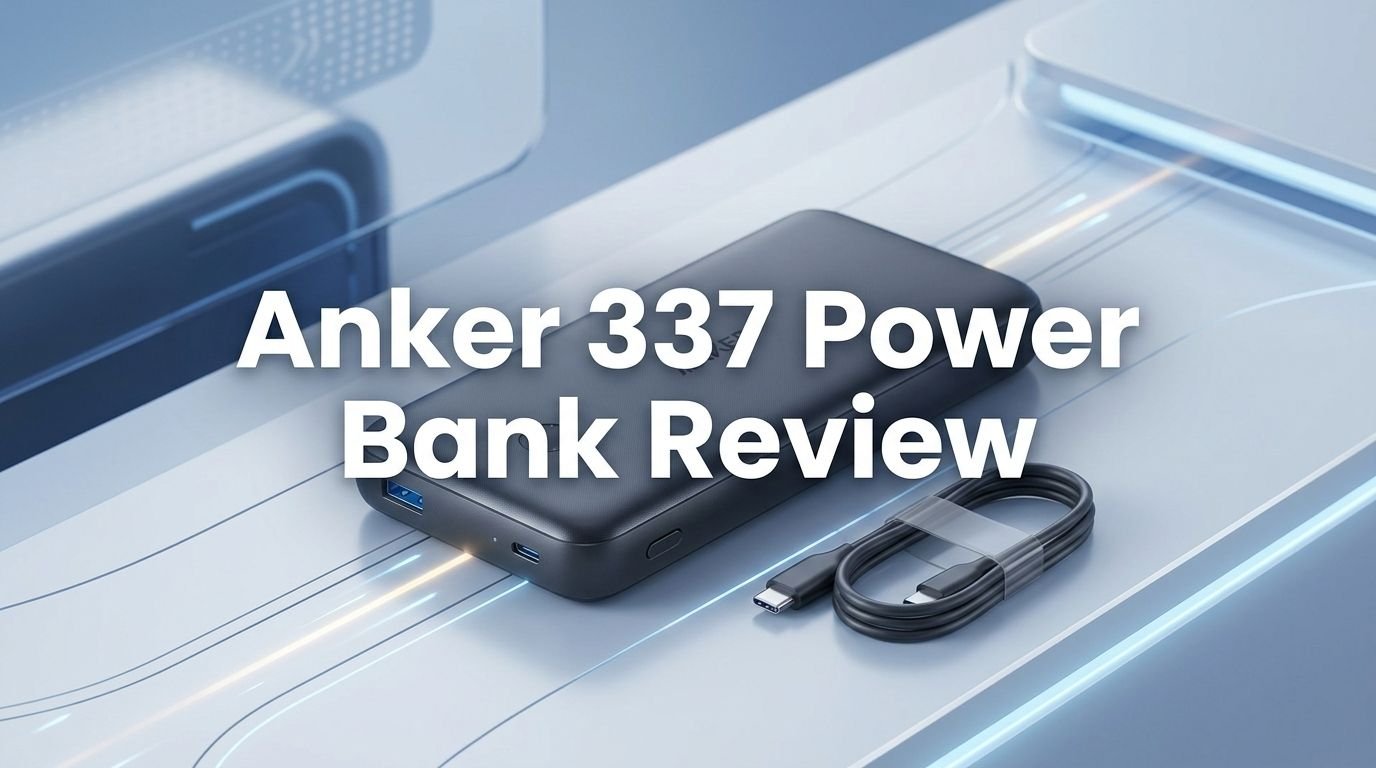
Anker 337 Power Bank Review 2026: Is It Worth It?
Are you tired of your phone dying in the middle of the day? Do you need a portable charger that can keep all your devices running for an entire week?
The Anker 337 Power Bank (PowerCore 26K) has been a fan favorite for years. It packs a massive 26,800mAh battery into a compact body. It charges most phones over six times on a single charge.
But here’s the big question. Does it still hold up in 2026? With so many newer power banks flooding the market, you need to know if this classic portable charger is still a smart buy.
Key Takeaways:
- Massive 26,800mAh capacity gives you enough juice to charge most smartphones over six times and tablets at least twice. This makes it ideal for long trips, camping, and heavy daily use.
- Three USB-A output ports let you charge up to three devices at the same time. Each port delivers up to 3A output, and the total combined output reaches 6A.
- Dual Micro USB input ports allow double speed recharging. A full recharge takes about 6 to 6.5 hours with two 2A chargers plugged in at the same time.
- Anker’s PowerIQ and VoltageBoost technology automatically detects your device and delivers the fastest safe charging speed. This works well with iPhones, iPads, Samsung phones, and most Android devices.
- Flight approved and TSA friendly with a 96.48Wh rating, the Anker 337 stays under the 100Wh limit. You can carry it on any commercial flight without issues.
- No USB-C port is the biggest downside in 2026. The power bank uses only Micro USB for input and USB-A for output. This limits its use with modern USB-C devices that need faster protocols.

Last update on 2026-09-19 / Affiliate links / Images from Amazon Product Advertising API Some of the links on this website are affiliate links, which means that at no additional cost to you, I earn a commission if you click through and make a purchase. I only recommend products and services that I believe will add value to my readers. Thank you for your support!
Anker 337 Power Bank (PowerCore 26K): Full Overview
The Anker 337 Power Bank, also known as the PowerCore 26K, is a high capacity portable charger from Anker. Anker is the world’s number one mobile charging brand by retail sales value for five consecutive years. That brand trust matters a lot.
This power bank carries model number A1277. It features a 26,800mAh lithium ion battery. That is one of the largest capacities you will find in a portable charger at this price point. It measures 7 x 3.1 x 0.9 inches and weighs about 17.5 ounces (495 grams).
The device offers three USB-A output ports. Each port uses Anker’s PowerIQ technology. You also get two Micro USB input ports for faster recharging. The matte black finish looks clean and professional.
Anker includes two Micro USB cables in the box. However, the wall charger is not included. You will need your own adapter. The LED indicator on the front shows the remaining battery level.
Overall, this power bank targets users who need raw capacity above everything else. It works best for travelers, campers, students, and anyone who spends long hours away from a power outlet.
Battery Capacity and Real World Performance
The 26,800mAh battery is the star feature of the Anker 337. On paper, that number looks impressive. But what does it mean in real use?
In practice, portable chargers deliver about 60% to 70% of their stated capacity to your devices. The rest goes to energy conversion and heat loss. So you can expect roughly 16,000 to 18,700mAh of usable power from the Anker 337.
That still translates to five to six full charges for most modern smartphones. If you own an iPhone 15 or Samsung Galaxy S24, you can expect about five complete charges. Tablets like the iPad Air can get about two full charges from this power bank.
For weekend camping trips, the Anker 337 can easily last four to five days without needing a recharge. Many users report charging their phone and camera batteries every night for several days straight.
The consistent output remains stable throughout the discharge cycle. Your fifth charge will feel almost as fast as your first charge. That reliability is a hallmark of Anker’s battery technology.
Charging Speed and Output Ports
The Anker 337 features three USB-A output ports. Each port can deliver a maximum of 5V/3A (15W). The total combined output across all three ports is 5V/6A (30W).
Each port uses PowerIQ technology. This is Anker’s proprietary smart charging system. It detects what device you plug in. Then it adjusts the voltage and current to deliver the fastest safe speed.
VoltageBoost is the other technology at play here. It compensates for cable resistance. This means you get closer to the advertised speed even with longer or cheaper cables.
You can charge three devices at the same time. The power bank distributes current across all active ports. If you charge one device alone, it gets the full 3A. Two devices might get 3A and 2A respectively.
However, there is no Quick Charge or USB Power Delivery support. If your phone supports 25W or 45W fast charging, the Anker 337 will not deliver those speeds. It maxes out at 15W per port. For many people, this is plenty fast. But power users with the latest flagships may find it slow.
Top 3 Alternatives for Anker 337 Power Bank
1. Anker 325 Power Bank (PowerCore Essential 20K)

Last update on 2026-09-19 / Affiliate links / Images from Amazon Product Advertising API Some of the links on this website are affiliate links, which means that at no additional cost to you, I earn a commission if you click through and make a purchase. I only recommend products and services that I believe will add value to my readers. Thank you for your support!
2. INIU Portable Charger 22.5W 20000mAh USB C Power Bank

Last update on 2026-09-19 / Affiliate links / Images from Amazon Product Advertising API Some of the links on this website are affiliate links, which means that at no additional cost to you, I earn a commission if you click through and make a purchase. I only recommend products and services that I believe will add value to my readers. Thank you for your support!
3. Baseus 20000mAh Compact Portable Charger 45W


Last update on 2026-07-04 / Affiliate links / Images from Amazon Product Advertising API Some of the links on this website are affiliate links, which means that at no additional cost to you, I earn a commission if you click through and make a purchase. I only recommend products and services that I believe will add value to my readers. Thank you for your support!
Recharging Speed and Dual Input Design
One of the smartest design choices on the Anker 337 is the dual Micro USB input system. Most power banks at this capacity take 10 to 12 hours to recharge. The Anker 337 cuts that time roughly in half.
You get two Micro USB input ports. Each accepts up to 5V/2A. When you use both ports at the same time with two separate cables and chargers, you get a combined 4A input. This brings the full recharge time down to about 6 to 6.5 hours.
If you use only one input port, expect about 11 to 12 hours for a full recharge. That is a huge difference. The dual input system is clearly the way to go.
The catch? You need two wall chargers and two Micro USB cables. Anker includes two cables in the box. But you must supply your own wall adapters. A dual port USB wall charger works perfectly here.
Pro tip: Charge the Anker 337 overnight. Plug in both cables before bed. By morning, you will have a full 26,800mAh ready to go. This routine works well for travelers preparing for a long day.
Build Quality and Design
The Anker 337 has a solid, premium feel in hand. The outer shell uses a matte black plastic finish. It resists fingerprints and scratches well. The material feels durable enough for daily use.
At 7 x 3.1 x 0.9 inches, the power bank is about the size of a large smartphone. It is thicker than most phones though. The weight of 17.5 ounces is noticeable. You will feel it in your backpack or jacket pocket.
The LED power indicator sits on the top face. It uses four small LEDs to show battery level in 25% increments. A simple button press activates the display. It is a basic system, but it works without confusion.
All ports are grouped on one end of the device. This keeps cable management clean. The rounded edges make it comfortable to hold. There are no sharp corners or rough seams.
The overall build quality matches what you expect from Anker. It feels like a product that can survive being tossed into a bag every day. No creaking, no flex, no cheap materials. For a budget power bank, the construction quality is impressive.
Portability and Travel Friendliness
The Anker 337 is flight approved. Its battery capacity of 96.48Wh falls under the TSA’s 100Wh limit for carry on luggage. You can bring it on any commercial flight without problems.
However, portability is relative. At nearly 500 grams, this is not a power bank you will forget is in your pocket. It is best suited for a backpack, purse, or travel bag. If you want something for a quick jog or light walk, a smaller 10,000mAh option would serve you better.
For road trips and camping, the Anker 337 shines. The large capacity means fewer recharges. You can power multiple devices for days without finding an outlet. Many outdoor enthusiasts praise this power bank for exactly this reason.
The compact rectangular shape fits into most bag pockets without trouble. It slides into laptop compartments, side pockets, and organizer pouches. The flat profile prevents it from rolling around.
International travelers will appreciate that the power bank works with any USB wall charger worldwide. Just pack the right plug adapter for your destination. The Anker 337 handles 100V to 240V input through standard USB adapters.
PowerIQ and VoltageBoost Technology Explained
PowerIQ is Anker’s proprietary charging detection technology. It identifies your connected device automatically. Then it adjusts the output current to match that device’s maximum safe charging speed.
This means your iPhone gets the right current. Your Samsung gets the right current. Your iPad gets the right current. You do not need to worry about using the wrong port or the wrong cable. PowerIQ handles everything.
VoltageBoost works alongside PowerIQ. It solves a common problem with portable chargers. Cheap or long cables create resistance. This resistance lowers the actual voltage reaching your device. VoltageBoost compensates for that loss.
The result is faster, more consistent charging regardless of cable quality. Your device charges at near maximum speed even with a three foot Micro USB cable.
Together, these two technologies deliver what Anker calls Charge Faster Technology. It is not the same as Qualcomm Quick Charge or USB Power Delivery. But it does optimize standard USB-A charging to its fullest potential.
In real terms, most phones will charge at about 10W to 15W through the Anker 337. That is solid performance for a USB-A only power bank. Most users will see their phone go from 0% to 50% in about 45 to 60 minutes.
Safety Features and MultiProtect System
Anker builds all its power banks with a MultiProtect safety system. The Anker 337 includes multiple layers of protection for both the power bank and your connected devices.
The system covers surge protection, short circuit protection, over charge protection, over discharge protection, over current protection, and temperature control. Each layer works independently. If one system detects a problem, it shuts down the affected circuit.
Temperature control is especially important in a 26,800mAh power bank. Large batteries generate heat during charging and discharging. The Anker 337 manages heat well. It gets warm during heavy use, but never uncomfortably hot.
The foreign object detection feature prevents damage if metal objects touch the charging contacts. This is a small but meaningful safety addition.
Anker has sold over 200 million products globally. Their safety track record is strong. The MultiProtect system has been refined across years of product development. You can trust this power bank with your expensive devices.
Note: Anker did issue a recall for certain PowerCore models in recent years due to a battery cell supplier issue. The Anker 337 (model A1277) was not part of the major 2025 recall. Always check Anker’s official recall page for the latest information.
Who Should Buy the Anker 337 Power Bank?
The Anker 337 is perfect for specific types of users. Understanding who benefits most from this power bank helps you decide if it is the right pick.
Frequent travelers will love the massive capacity. One full charge lasts for days. The TSA approved rating means no hassle at airport security. It is a set it and forget it travel companion.
Campers and outdoor enthusiasts are another ideal group. If you spend weekends off the grid, the Anker 337 keeps your phone, GPS, headlamp, and camera topped up. Several users on hiking forums recommend it as a reliable trail companion.
Students benefit from the three USB ports. Charge your phone, tablet, and earbuds at the same time between classes. The large capacity means you only need to charge the power bank once or twice per week.
Budget conscious shoppers get excellent value here. The Anker 337 remains one of the most affordable high capacity power banks on the market. You get reliable Anker quality without paying premium prices.
However, if you need fast USB-C charging, PD support, or a lightweight design, this power bank is not for you. It serves a different purpose. Raw capacity and reliability are its strengths.
The Biggest Drawback: No USB-C Port
Let’s address the elephant in the room. The Anker 337 does not have a USB-C port. In 2026, this is a significant limitation.
Most new smartphones, tablets, laptops, and accessories use USB-C. The Anker 337 relies entirely on Micro USB for input and USB-A for output. You will need a USB-A to USB-C cable to charge modern phones.
This means no USB Power Delivery (PD) support. You cannot fast charge an iPhone 15, Samsung Galaxy S24, or any USB-C device at their maximum speed. The power bank caps out at 15W per port through USB-A.
Recharging the power bank itself also requires Micro USB cables. In a world where USB-C is becoming universal, carrying extra Micro USB cables feels inconvenient.
For many casual users, this limitation does not matter much. A 15W charge still fills your phone in about two hours. But if you rely on 25W or 45W fast charging daily, the Anker 337 will feel noticeably slower.
This single drawback is the main reason some buyers choose newer alternatives. If USB-C is a must, look at the Anker 325 or Baseus 20000mAh options listed above.
Anker 337 vs. Newer Anker Power Banks
How does the Anker 337 compare to Anker’s own newer models? Let’s break it down.
The Anker 325 Power Bank (PowerCore Essential 20K) offers 20,000mAh with USB-C input and output. It supports 15W charging and costs about the same. You lose 6,800mAh of capacity but gain USB-C compatibility.
The Anker Zolo 20,000mAh steps things up with 30W fast charging and a built in USB-C cable. It is lighter and more portable. However, it has lower total capacity than the 337.
The Anker Prime 26,250mAh is the premium option. It delivers up to 300W max output with USB-C and USB-A ports. It supports laptops. But it costs three to four times more than the Anker 337.
The Anker 337 wins on raw capacity per dollar. No other Anker power bank gives you 26,800mAh at this price point. If maximum battery storage is your priority, the 337 remains the best value in the lineup.
But if you value modern ports and fast charging, the newer models are clearly better. The technology gap between the 337 and current Anker products is real. Your choice depends on what matters most to you.
Price and Value for Money
The Anker 337 Power Bank typically sells for around $30 to $40 on Amazon. At that price, you get 26,800mAh of capacity from a trusted global brand. That works out to roughly $1.12 to $1.50 per 1,000mAh.
Compare that to premium power banks that charge $80 to $120 for 20,000 to 25,000mAh. The Anker 337 offers exceptional value on a cost per milliamp hour basis.
The package includes the power bank itself, two Micro USB cables, a travel pouch, and a welcome guide. Anker also provides an 18 month warranty with the option to extend it through their website.
Anker’s customer support is well regarded. They have a dedicated support line and email system. If anything goes wrong within the warranty period, replacements are usually handled quickly.
For budget shoppers, the Anker 337 is hard to beat. You get reliable performance, proven safety features, and massive capacity at a fraction of what competitors charge. The missing USB-C port is the only factor that reduces its 2026 value proposition.
Pros and Cons of the Anker 337 Power Bank
Pros:
The 26,800mAh capacity is enormous for a portable charger at this price. Three USB-A ports let you charge multiple devices at once. The dual Micro USB input cuts recharge time in half. Anker’s PowerIQ and VoltageBoost deliver optimized charging for every device. The build quality is solid and durable. It is TSA approved for air travel. The price point is very affordable.
Cons:
The lack of USB-C is the biggest weakness in 2026. No USB Power Delivery or Quick Charge support limits fast charging. The 17.5 ounce weight is heavy compared to newer alternatives. Micro USB input feels outdated. The LED indicator is basic with only four levels. No wireless charging support exists.
The pros clearly outweigh the cons for users who prioritize capacity and affordability. But the cons are significant for users who want modern charging technology.
Final Verdict: Should You Buy the Anker 337 Power Bank in 2026?
Last update on 2026-09-19 / Affiliate links / Images from Amazon Product Advertising API Some of the links on this website are affiliate links, which means that at no additional cost to you, I earn a commission if you click through and make a purchase. I only recommend products and services that I believe will add value to my readers. Thank you for your support!
The Anker 337 Power Bank (PowerCore 26K) is still a solid choice in 2026 for the right buyer. It delivers unmatched battery capacity at a budget friendly price. Anker’s brand reliability and safety features add peace of mind.
If you need a power bank for camping, travel, emergencies, or heavy daily use, the Anker 337 delivers. It charges most phones five to six times. It handles tablets and multiple devices without breaking a sweat.
The lack of USB-C is its biggest weakness. If modern port compatibility and fast charging matter to you, consider the Anker 325 or Baseus 20000mAh as alternatives.
But if raw power and value are your top priorities, the Anker 337 remains one of the best deals in portable charging. It has earned its place as a long standing favorite for good reason.
Our Rating: 4 out of 5 stars.
Frequently Asked Questions
How long does the Anker 337 Power Bank take to fully recharge?
The Anker 337 takes about 6 to 6.5 hours to fully recharge when you use both Micro USB input ports at the same time. Each port needs a 5V/2A charger. If you use only one input port, the recharge time doubles to about 11 to 12 hours. The dual input system is the best way to keep recharge times manageable.
Can you take the Anker 337 Power Bank on a plane?
Yes. The Anker 337 is TSA approved for air travel. Its battery capacity is rated at 96.48Wh. The TSA allows portable chargers under 100Wh in carry on luggage. You cannot put it in checked baggage. Always carry it in your hand luggage or personal bag for security compliance.
Does the Anker 337 Power Bank have USB-C?
No. The Anker 337 does not have a USB-C port. It uses Micro USB for input and USB-A for output. You will need a USB-A to USB-C cable to charge modern devices. There is no USB Power Delivery or Quick Charge support.
How many times can the Anker 337 charge an iPhone?
The Anker 337 can charge most iPhones about five to six times. The exact number depends on your iPhone model and battery health. Newer iPhones with larger batteries may get four to five charges. Older models with smaller batteries may get six or more.
Is the Anker 337 Power Bank worth buying in 2026?
The Anker 337 is worth buying if you prioritize large capacity and affordable pricing. It is ideal for travelers, campers, and budget shoppers. However, if you need USB-C fast charging or a lighter design, newer alternatives offer better features for similar prices.
What devices are compatible with the Anker 337 Power Bank?
The Anker 337 works with iPhones, Samsung phones, Android devices, iPads, tablets, Kindles, Bluetooth headphones, and most USB powered devices. It is not compatible with iPod Nano, iPod Classic, or very low power devices with input below 50mA like some Bluetooth earbuds and GPS trackers.

Hello everyone my name is Alenya and i am a gadget discovering Enthusiast 🐻🐻