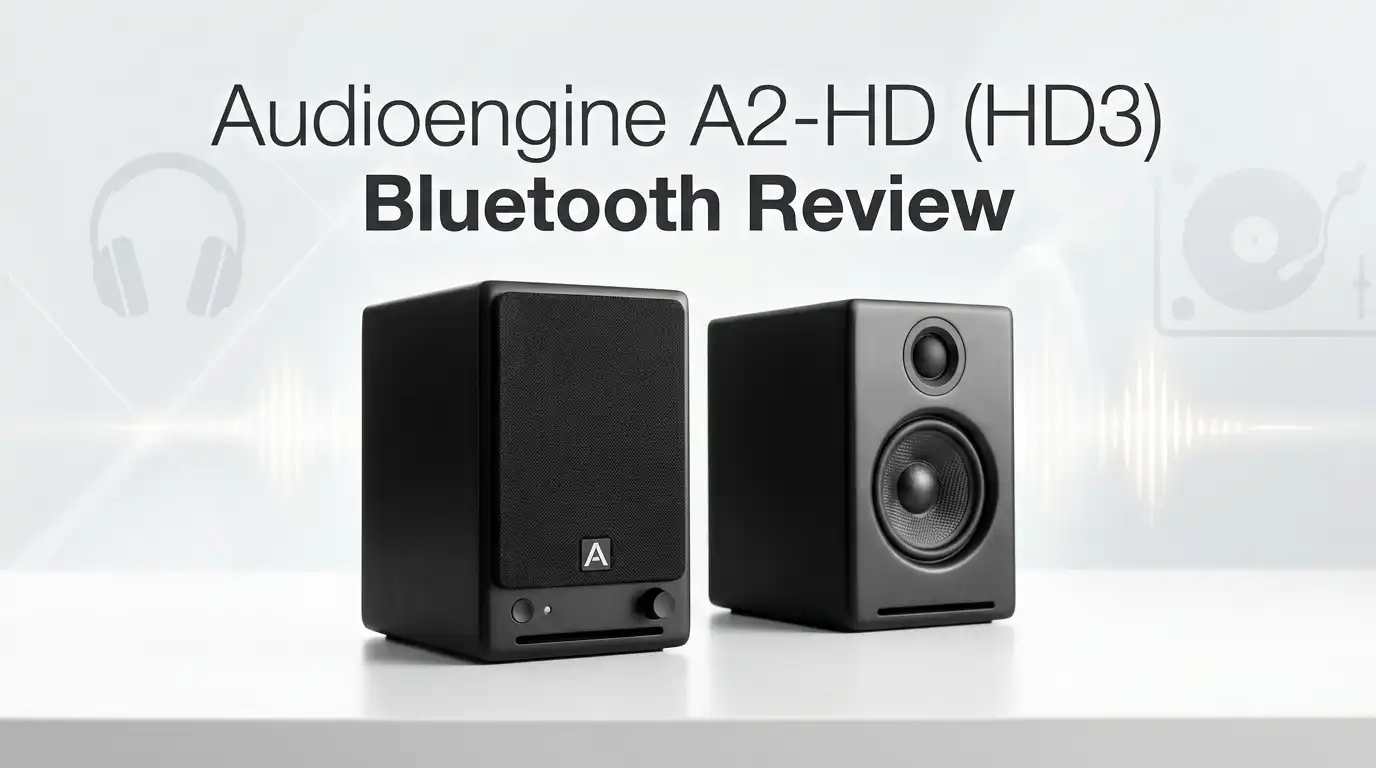
Audioengine A2-HD (HD3) Bluetooth Review 2026: Worth Buying?
Your desk deserves real stereo sound, not a tinny single speaker pretending to be enough. The Audioengine A2-HD (HD3) solves the messy compromise between cluttered home theater rigs and weak laptop audio.
These compact powered speakers fit beside a monitor, plug into almost anything, and stream over Bluetooth.
They target desktop listeners who want clean, refined audio in a small footprint. This review covers the real strengths, the honest weaknesses, and who should skip them.
In a Nutshell
- Surprisingly big sound from a tiny 2.75″ Kevlar woofer and 3/4″ silk dome tweeter. The soundstage feels wider than the cabinet size suggests.
- Bluetooth 5.3 with aptX-HD lets you stream from a phone or laptop wirelessly, with a built-in DAC that cleans up USB audio from your computer.
- Best for small rooms and near-field listening. Desk users, dorm dwellers, and office workers benefit most.
- Weak deep bass is the main flaw. Frequency response stops around 65 Hz, so bass lovers need a subwoofer.
- Premium build and looks, with walnut, black, or white finishes and brushed aluminum accents.
- Not very loud at peak, so they cannot fill a large living room. The 60W peak rating is modest in practice.
What You Actually Get in the Box

Last update on 2026-08-29 / Affiliate links / Images from Amazon Product Advertising API Some of the links on this website are affiliate links, which means that at no additional cost to you, I earn a commission if you click through and make a purchase. I only recommend products and services that I believe will add value to my readers. Thank you for your support!
Unboxing feels reassuringly premium. The full-color box holds top and bottom foam layers that grip each speaker firmly. Both speakers and cables sit inside soft cloth pouches.
Inside you find the two HD3 speakers, a power cable, a USB-to-MicroUSB cable, a 3.5mm aux cable, stereo interconnect cables, and a signal extender aerial. The kit is complete, so you plug in and play the same day.
The cloth bags are a small touch that signals care. They protect the wood finish during shipping and storage.
Design and Build Quality
The HD3 looks like a shrunken high-end bookshelf speaker. The walnut and cherry wood finishes feel warm and genuine, while the brushed aluminum strip adds contrast. These belong on a nice desk.
The left speaker holds the volume knob and a headphone jack on the front. That headphone output is handy for late-night listening without unplugging anything.
At roughly 6 inches tall, each cabinet is dense and solid. The matching 1/4″ thread on the base lets you mount them on stands if you prefer.
Sound Quality in Real Listening
The sound is refined and balanced rather than punchy. Mids are clean, treble is crisp, and the whole spectrum above 65 Hz comes through clearly. For their size, the output genuinely impresses.
Vocals sit slightly behind instruments, feeling a touch veiled at times. Sibilance stays controlled, so long sessions do not fatigue your ears.
These are not bass cannons. The small woofers cannot move much air, so kick drums feel polite. Listeners who crave thump will want the matching S6 or S8 subwoofer.
Top 3 Alternatives for Audioengine HD3
If the HD3 is not the right fit, these three are worth a close look.

Last update on 2026-08-28 / Affiliate links / Images from Amazon Product Advertising API Some of the links on this website are affiliate links, which means that at no additional cost to you, I earn a commission if you click through and make a purchase. I only recommend products and services that I believe will add value to my readers. Thank you for your support!
Audioengine A2+ Wireless

Last update on 2026-08-28 / Affiliate links / Images from Amazon Product Advertising API Some of the links on this website are affiliate links, which means that at no additional cost to you, I earn a commission if you click through and make a purchase. I only recommend products and services that I believe will add value to my readers. Thank you for your support!
Kanto YU2 Powered Desktop Speakers

Last update on 2026-08-28 / Affiliate links / Images from Amazon Product Advertising API Some of the links on this website are affiliate links, which means that at no additional cost to you, I earn a commission if you click through and make a purchase. I only recommend products and services that I believe will add value to my readers. Thank you for your support!
Edifier R1280DBs Active Bluetooth Bookshelf Speakers
Bluetooth Performance and Range
Bluetooth setup is fast and stable. Pairing takes seconds, and the aptX-HD codec delivers a clear wireless stream from compatible phones and laptops.
The advertised 100-foot range holds up indoors, though walls cut it down as expected. For desk use within a single room, dropouts are rare.
Honest note: wired sound beats wireless here. Over the line-in or USB, the soundstage opens up and detail sharpens. Bluetooth is convenient, but it is the second-best way to listen.
Connectivity and Input Options
This is where the HD3 earns its keep. You get RCA inputs, a 3.5mm aux input, and USB feeding the internal DAC. There is also an RCA output for a subwoofer.
That mix means one set of speakers handles your computer, phone, turntable preamp, and console without extra gear. A tidy desk stays tidy.
The USB DAC is the quiet hero. It bypasses your computer’s noisy onboard audio and produces a cleaner signal with less hiss.
Setup and Daily Use
Getting started is simple. Connect the two speakers with the included wire, plug in power, choose your source, and turn the knob. No app, no fuss.
The front volume knob and headphone jack make daily control easy. You never reach behind the cabinet for routine tasks.
One small gripe: the power switch sits on the back, which is mildly awkward on a deep desk. Most owners just leave the speakers on standby.
Who These Speakers Are For
The HD3 suits desk-based listeners above all. If you work or game within a few feet of your screen, the near-field clarity is excellent.
They also fit small apartments, dorm rooms, and offices where space is tight and big speakers feel like overkill. The looks add to the appeal.
Vinyl hobbyists with a phono preamp will like the RCA input and the honest, detailed midrange these speakers deliver.
Who Should Skip the HD3
Be honest with yourself before buying. Bass-heavy music fans who love hip-hop or EDM will feel let down without a subwoofer. The low end simply is not there.
People who want to fill a large room or throw a party should look elsewhere. These speakers run out of headroom at higher volumes and were never built for crowds.
Budget shoppers may also hesitate. At their price, cheaper rivals offer more bass per dollar, even if they cannot match the build or refinement.
HD3 Versus the A2+ Wireless
Last update on 2026-08-29 / Affiliate links / Images from Amazon Product Advertising API Some of the links on this website are affiliate links, which means that at no additional cost to you, I earn a commission if you click through and make a purchase. I only recommend products and services that I believe will add value to my readers. Thank you for your support!
These two Audioengine models confuse a lot of buyers. The A2+ is the more affordable sibling and shares much of the same DNA.
The HD3 sounds more detailed and offers slightly better bass, plus the front headphone jack and volume knob. The A2+ keeps its controls on the back.
If you want the cleaner, more refined option and the nicer finishes, the HD3 wins. If you want to save money and still get great sound, the A2+ is a smart pick.
Final Verdict
The Audioengine A2-HD (HD3) is a polished, beautifully built pair of desktop speakers with rich connectivity and clear, fatigue-free sound. For near-field listening, they punch above their size.
The trade-offs are limited deep bass and modest maximum volume. Accept those, and you get one of the most enjoyable small-speaker experiences available in 2026.
For desk and small-room use, they earn a strong recommendation, especially paired with a subwoofer if bass matters to you.
Frequently Asked Questions
Do the Audioengine HD3 need a subwoofer?
Not strictly, but bass fans will want one. The speakers handle most music well above 65 Hz. For deep bass in hip-hop or electronic tracks, the matching S6 or S8 sub fills the gap nicely through the RCA output.
Is the HD3 good for gaming?
Yes, for desk gaming. The clear mids and treble make footsteps and dialogue easy to hear. Explosions lack deep rumble without a subwoofer, but positional clarity is excellent for competitive play.
Can I connect a turntable to the HD3?
Yes, if your turntable has a built-in phono preamp or you add an external one. Plug it into the RCA input. The detailed midrange suits vinyl listening very well.
Does Bluetooth sound as good as the wired connection?
Almost, but not quite. AptX-HD Bluetooth sounds great for casual listening. The USB or line-in connection opens up the soundstage and adds clarity, so use a cable for critical listening.
Are the HD3 loud enough for a large room?
No. They are tuned for near-field and small-room use. At maximum volume they struggle to fill bigger spaces, so a living room or party setting is not their strength.
What is the difference between the HD3 and the A2-HD?
They are the same product. Audioengine markets this model under both names, sometimes calling it the A2-HD or the HD3 Next Gen. Specs and features are identical.
Disclosure: This content is part of an Amazon Creator Connections campaign, meaning I earn a commission from qualifying purchases.
Using these links costs you nothing extra but directly supports my blog and future content.

Hello everyone my name is Alenya and i am a gadget discovering Enthusiast 🐻🐻