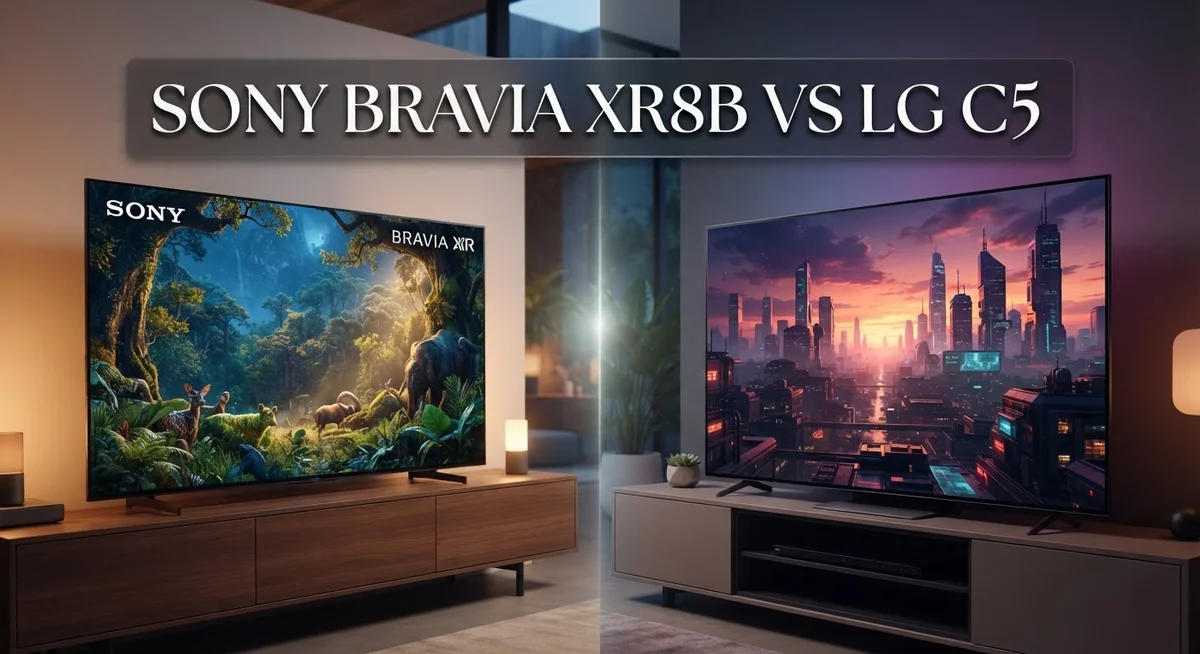
Sony Bravia XR8B vs LG C5: Worth the Hype?
Picking a new OLED TV can feel tricky. Two big names stand out this year: the Sony Bravia XR8B and the LG C5.
Both TVs deliver stunning 4K OLED pictures. But they take different paths to get there.
The Sony Bravia XR8B focuses on picture realism. It offers excellent upscaling and natural skin tones for every scene.
Quick Comparison: SONY Bravia XR8B vs LG C5
| Feature | SONY Bravia XR8B | LG C5 |
|---|---|---|
| Screen Sizes | 55″/65″ | 55″-77″ |
| Refresh Rate | Native 120Hz | Up to 144Hz |
| HDMI 2.1 Ports | 2x HDMI 2.1 | 4x HDMI 2.1 |
| VRR Support | VRR | G-SYNC/FreeSync |
| Processor | Cognitive Processor XR | AI Gen8 processor |
| Brightness | Lower brightness | Brighter SDR/HDR |
| Picture Quality Focus | Realism, upscaling | Color accuracy, gaming |
| Smart Platform | Google TV | webOS (implied) |
SONY Bravia XR8B Review

Last update on 2026-09-19 / Affiliate links / Images from Amazon Product Advertising API Some of the links on this website are affiliate links, which means that at no additional cost to you, I earn a commission if you click through and make a purchase. I only recommend products and services that I believe will add value to my readers. Thank you for your support!
The Sony Bravia XR8B is a 55″ or 65″ OLED TV built for viewers who care about picture accuracy and content upscaling. It uses Google TV as its smart platform and delivers native 120Hz refresh rates across both sizes.
This TV shines when you watch lower-quality content or streaming services. The XR8B’s upscaling engine intelligently enhances older footage, making DVDs and compressed streams look sharper and more detailed than they should.
You get exceptional contrast and true blacks without blooming or halo effects around bright objects. Skin tones appear natural and lifelike, which matters for movies, shows, and sports where realism counts most.
The design feels solid, and the picture quality suits bright and dark rooms equally well. However, direct reflections can distract, and you only get 2 HDMI 2.1 ports instead of more.
Pros
- Superior upscaling makes lower-quality content look impressive
- Excellent contrast ratio with perfect, clean blacks
- Natural skin tone rendering and realistic overall picture quality
- Solid build and consistent performance in any room lighting
Cons
- Only 2 HDMI 2.1 ports limits multi-device setup options
- Direct reflections on screen can be distracting
- Lower brightness levels than competing models
LG C5 Review

Last update on 2026-10-14 / Affiliate links / Images from Amazon Product Advertising API Some of the links on this website are affiliate links, which means that at no additional cost to you, I earn a commission if you click through and make a purchase. I only recommend products and services that I believe will add value to my readers. Thank you for your support!
The LG C5 is a 55″ to 77″ OLED TV built for gamers and anyone who watches in bright rooms. This TV prioritizes brightness and gaming performance over everything else, making it a solid choice if you want vibrant HDR images and smooth gameplay.
The standout feature is its 144Hz refresh rate and all 4 HDMI 2.1 ports fully active. You get G-SYNC and FreeSync support, which means zero lag and tear-free gaming on PlayStation, Xbox, and PC setups.
Picture quality shines in bright spaces where the LG C5 outperforms most competitors. The AI Gen8 processor handles color accuracy well, and the contrast remains impressive even with direct light nearby.
Build quality feels premium across all screen sizes. Real-world performance stays consistent whether you’re streaming movies, playing games, or working from home.
Pros
- Brighter in both SDR and HDR modes, perfect for daylit rooms
- All 4 HDMI 2.1 ports support 4K at 120fps gaming
- 144Hz refresh rate with low input lag for competitive gaming
- Superior color accuracy and vibrant HDR performance
Cons
- Direct light sources become visible on screen in certain scenes
- HDR can look too dark due to contrast prioritization over accuracy
- Minimal upgrades compared to the previous C4 model
Head to Head: Key Differences
The Sony Bravia XR8B and LG C5 take different approaches to OLED excellence. The Sony prioritizes picture realism and upscaling, while the LG focuses on brightness and gaming performance.
Brightness and Room Lighting
The LG C5 wins here with noticeably higher brightness in both SDR and HDR modes. If your living room gets lots of natural light, the LG handles reflections and daytime viewing much better than the Sony.
The Sony Bravia XR8B produces darker, more cinema-like images. Direct sunlight can create distracting reflections on its screen, making it less ideal for bright rooms.
Content Quality and Upscaling
The Sony excels at making lower-quality streaming content look sharp and detailed. Its upscaling engine transforms compressed video into something closer to native 4K quality.
The LG C5 handles native 4K content beautifully but doesn’t match the Sony’s upscaling prowess. If you watch lots of compressed streaming services, the Sony gives you a noticeable upgrade.
Gaming and HDMI Ports
The LG C5 is the clear gaming champion with 144Hz refresh rate and all 4 HDMI 2.1 ports fully functional. Competitive gamers get low input lag and maximum flexibility for multiple gaming devices.
The Sony Bravia XR8B only has 2 active HDMI 2.1 ports. Serious gamers will feel limited if they want to connect multiple high frame rate sources simultaneously.
Picture Realism
The Sony delivers more natural skin tones and realistic colors across all content types. The LG C5 sometimes pushes contrast too aggressively, making HDR appear overly dark despite excellent technical performance.
Choose the Sony for upscaling and accurate colors. Pick the LG C5 for brightness, gaming, and bright room performance.
Which One Should You Buy
The LG C5 takes the win here. It offers brighter visuals, more advanced gaming features, and better color accuracy overall.
With all four HDMI 2.1 ports and up to 144Hz refresh rate, it stands out as the more versatile and future-proof choice.
Still, the Sony Bravia XR8B holds its own for viewers who value picture realism above all else.
Best for each buyer
- Sony Bravia XR8B: Viewers who prioritize picture realism, natural skin tones, and superior upscaling of lower-quality content in controlled lighting environments.
- LG C5: Gamers and users in bright rooms who want higher refresh rates, more HDMI 2.1 connectivity, and greater overall brightness.
Frequently Asked Questions
Which TV handles streaming content better?
The Sony Bravia XR8B wins for streaming. Its upscaling engine transforms lower-quality streams into sharp, detailed images.
If you watch Netflix, YouTube, or other compressed content regularly, the Sony delivers noticeably cleaner pictures.
The LG C5 handles native 4K content beautifully. However, it doesn’t match the Sony’s ability to enhance lower-resolution material.
Is the LG C5 really better for gaming?
Yes, absolutely. The LG C5 offers 144Hz refresh rate and all 4 HDMI 2.1 ports fully active.
This means zero compromises when connecting multiple gaming devices.
The Sony has only 2 HDMI 2.1 ports. For serious gamers with multiple consoles or PC setups, the LG’s extra ports matter.
The LG also delivers lower input lag for competitive play.
Which TV looks better in a bright room?
The LG C5 shines in daylit spaces. It produces noticeably brighter images in both SDR and HDR modes.
Direct sunlight won’t wash out your picture like it does on other OLEDs.
The Sony performs better in dark rooms. Its darker, cinema-like image quality excels when ambient light stays low.
Bright rooms expose its reflective screen more.
What if I care most about realistic picture quality?
Choose the Sony Bravia XR8B. It renders natural skin tones and realistic colors across all content types.
The contrast feels perfect without blooming or distortion.
The LG C5 prioritizes brightness and gaming features. This sometimes means sacrificing the pure realism the Sony delivers.
Both are excellent, but the Sony edges ahead for pure picture accuracy.

Hello everyone my name is Alenya and i am a gadget discovering Enthusiast 🐻🐻