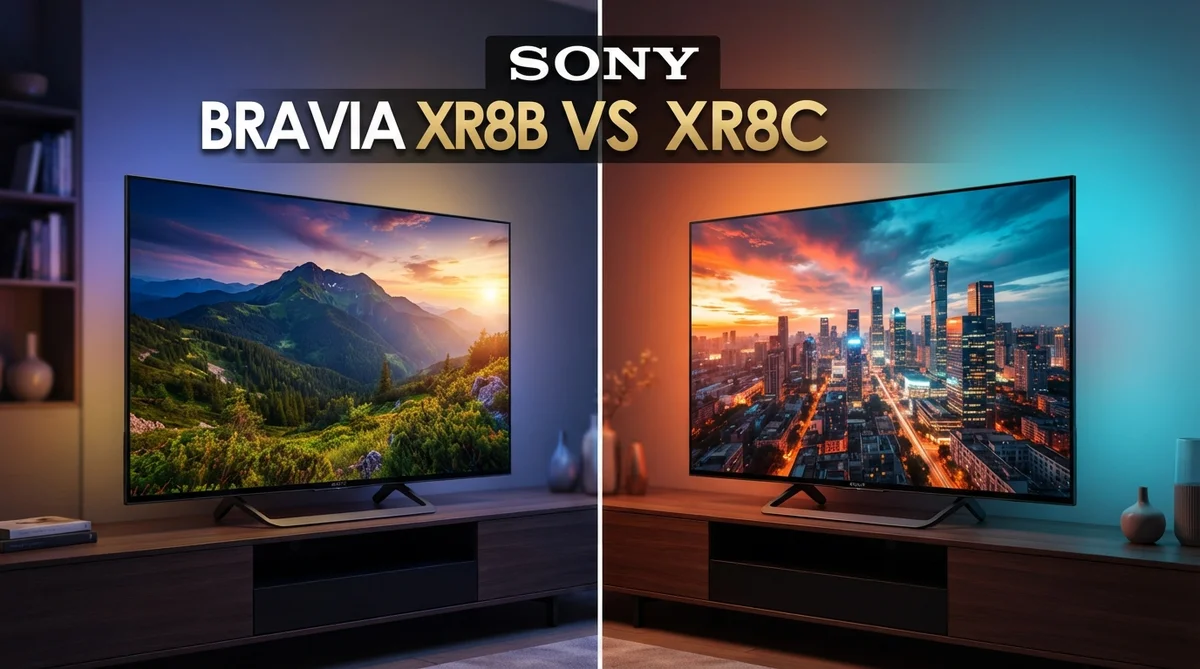
Sony Bravia XR8B vs XR8C: Live Up To The Hype?
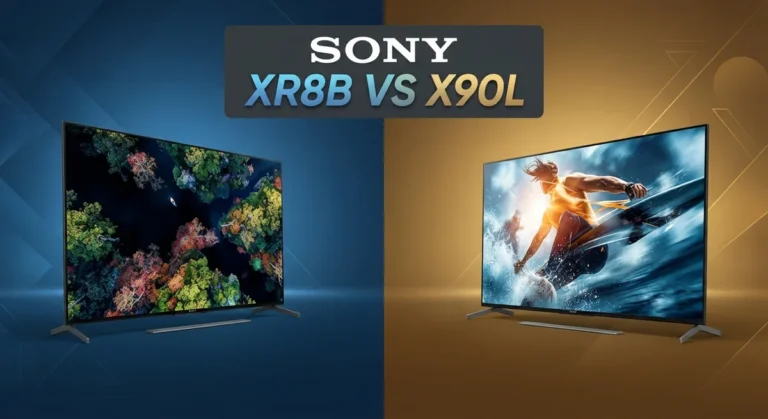
Picking between two great OLED TVs can feel tricky. The Sony Bravia XR8B and Sony Bravia XR8C both promise stunning 4K visuals and smooth performance.
Both TVs share the same processor and panel technology. This makes them look similar on paper.
But key differences set them apart. The XR8C brings an AI contrast booster for richer blacks and better shadow detail.
The XR8B focuses on gaming with its native 120Hz panel and HDMI 2.1 ports.
Quick Comparison: SONY Bravia XR8B vs SONY XR8C
| Feature | SONY Bravia XR8B | SONY XR8C |
|---|---|---|
| Screen Sizes | 55″/65″ OLED | 55″/65″ OLED |
| Resolution | 4K (3840×2160) | 4K (3840×2160) |
| Refresh Rate | 120Hz native panel | 120Hz |
| HDMI Ports | HDMI 2.1 (2 ports) | HDMI 2.1 (2 ports) |
| AI Contrast Booster | Not included | Included, major upgrade |
| Contrast Performance | Inferior contrast | Near-infinite, perfect blacks |
| Built-in Audio | Not specified | 50W built-in audio |
| Best Use Case | Gaming-focused users | Premium home theater/movies |
SONY Bravia XR8B Review

Last update on 2026-09-19 / Affiliate links / Images from Amazon Product Advertising API Some of the links on this website are affiliate links, which means that at no additional cost to you, I earn a commission if you click through and make a purchase. I only recommend products and services that I believe will add value to my readers. Thank you for your support!
The Sony Bravia XR8B is a 55″ or 65″ OLED TV built for gamers who want fast refresh rates and low-input lag. This model delivers native 120Hz performance and includes two HDMI 2.1 ports to handle 4K gaming at 120fps without compromise.
The standout feature is its gaming-first architecture. You get Variable Refresh Rate (VRR) support and a responsive panel that minimizes motion blur during fast-paced action scenes.
The OLED panel produces true blacks and vibrant colors across movies, shows, and games alike.
Build quality is solid with a clean design that fits modern living rooms. The stand placement feels stable, and the overall construction matches Sony’s premium standards.
Real-world performance shines when you connect next-gen consoles or high-end graphics cards.
One trade-off: the XR8B lacks the AI contrast booster found in its sibling model. This means shadow detail and overall contrast performance sit below what you might see in other premium OLED options.
For pure gaming fans, this trade-off is acceptable.
Pros
- Native 120Hz panel delivers smooth, responsive gaming without stuttering
- Two HDMI 2.1 ports support 4K@120fps for PlayStation 5 and Xbox Series X
- OLED technology creates perfect blacks and exceptional color accuracy
- VRR support reduces screen tearing during gameplay
Cons
- No AI contrast booster limits shadow detail compared to competing models
- Only two HDMI 2.1 ports may feel limiting for users with multiple devices
- Contrast performance lags behind higher-tier Sony OLED TVs
SONY XR8C Review

Last update on 2026-09-21 / Affiliate links / Images from Amazon Product Advertising API Some of the links on this website are affiliate links, which means that at no additional cost to you, I earn a commission if you click through and make a purchase. I only recommend products and services that I believe will add value to my readers. Thank you for your support!
The Sony Bravia XR8C is a 55″ or 65″ OLED TV built for home theater fans who want premium picture quality above all else. This model suits users who prioritize movies, shows, and cinematic experiences over gaming performance.
The standout feature is its AI contrast booster, which delivers near-infinite contrast ratios and perfect blacks. Shadow detail remains crisp and visible, making dark scenes feel immersive and lifelike.
Color calibration comes studio-calibrated straight from the box, so you get accurate tones without manual tweaking. The 50W built-in audio system handles dialogue and effects well, reducing the need for external speakers.
Build quality is solid with a clean design that fits modern living rooms. Real-world performance shines when watching 4K movies or streaming premium content in dark rooms.
Pros
- AI contrast booster significantly improves picture quality and shadow detail
- Near-infinite contrast ratio with perfect blacks for cinematic viewing
- Studio-calibrated color modes deliver accurate, professional-grade picture out of the box
- 50W built-in audio system handles movies and shows without external speakers
Cons
- Only 2 HDMI 2.1 ports limits simultaneous high-bandwidth device connections
- Noticeable stutter reported by some users during specific content
- Stand feet placement may not fit all TV stands or wall configurations
Head to Head: Key Differences
Both the XR8B and XR8C share identical processors and OLED panels, but one critical feature separates them: the AI contrast booster.
The XR8C’s AI contrast booster is the game changer. This feature detects content and adjusts contrast in real time, delivering near-infinite contrast ratios and perfect blacks that make movies feel cinematic.
The XR8B lacks this technology entirely, which means its contrast performance lags noticeably behind.
Shadow detail reveals the practical impact. On the XR8C, dark scenes show texture and depth because the AI booster lifts shadow information without washing out blacks.
The XR8B displays the same scene with flatter, less detailed shadows.
Color calibration differs too. The XR8C arrives with studio-calibrated modes that deliver professional-grade accuracy straight from the box.
The XR8B requires manual color adjustments if you want similar precision.
Gaming performance slightly favors the XR8B. Both TVs support HDMI 2.1 with 4K at 120fps, but the XR8B’s gaming architecture prioritizes low input lag and smooth response times.
The XR8C handles gaming well, though some users report occasional stutter.
Audio capacity separates daily experience. The XR8C includes 50W built in audio, making it ready for standalone movie watching.
The XR8B offers standard audio that may require external speakers.
Connectivity is identical on both models. Each TV provides 2 HDMI 2.1 ports, which limits simultaneous 4K 120fps device connections.
Choose the XR8B if gaming dominates your TV time. Pick the XR8C if you watch movies and shows regularly and want the best picture quality possible.
The XR8C is the all around superior choice for most households.
Which One Should You Buy
The Sony Bravia XR8C takes the win here. It uses the same panel and processor as the XR8B, but its AI contrast booster adds near-infinite contrast and richer shadow detail.
Colors also look more accurate on the XR8C. This makes it the stronger all-around performer for most viewers.
The XR8B still holds its own for a specific type of buyer. Its native 120Hz refresh rate and HDMI 2.1 support make it a solid pick for gaming.
Best for each buyer – Sony Bravia XR8B: Best for gaming-focused users who want native 120Hz refresh rates and HDMI 2.1 for high-frame-rate console or PC play. – Sony Bravia XR8C: Best for home theater fans and movie lovers who want the sharpest picture, deepest contrast, and truest colors.
Frequently Asked Questions
Which TV is better for gaming?
The Sony Bravia XR8B wins here. It has a native 120Hz panel that delivers smooth, responsive gameplay without stuttering.
The XR8B also includes HDMI 2.1 ports (2 of them) for 4K@120fps gaming without compromise.
The XR8C handles gaming well too, but some users report occasional stutter during fast-paced scenes. If gaming is your main focus, the XR8B is the safer choice.
What makes the XR8C picture quality better?
The AI contrast booster is the key difference. This technology gives the XR8C near-infinite contrast ratios and perfect blacks that make scenes look more cinematic.
The XR8B lacks this feature entirely. This means darker scenes on the XR8B appear flatter with less shadow detail.
You’ll notice the difference most when watching movies in dark rooms.
Do both TVs have the same panel?
Yes. Both the XR8B and XR8C use identical OLED panels and processors.
The main separation comes from the XR8C’s AI contrast booster, which enhances what the panel can already do.
This explains why they perform similarly in some areas but diverge significantly in contrast performance and shadow detail.
Which one needs color calibration out of the box?
The XR8C comes studio-calibrated, so colors are accurate right away. You get professional-grade picture quality without manual tweaking.
The XR8B requires manual color adjustments if you want similar precision. This adds extra setup time for home theater enthusiasts.
Who should buy each model?
Choose the XR8B if you game frequently and want the smoothest 120Hz experience. Choose the XR8C if you prioritize movie watching and want superior contrast, blacks, and shadow detail with minimal setup.

Hello everyone my name is Alenya and i am a gadget discovering Enthusiast 🐻🐻