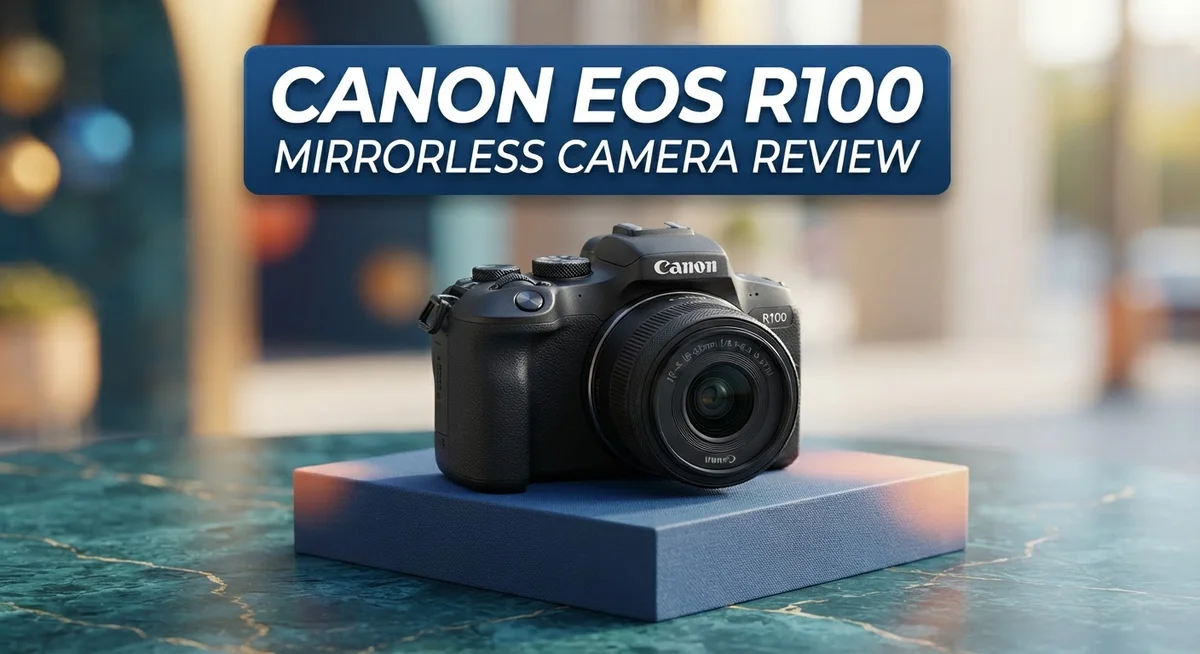
Canon EOS R100 Mirrorless Camera Review 2026: Features, Performance, and Value
Are you searching for a simple way to enter the world of mirrorless cameras? The Canon EOS R100 might be the answer you need.
This camera brings Canon’s trusted color science to beginners. It keeps things simple with an easy to use design.
The R100 packs a 24MP sensor for sharp, clear photos. It also gives you access to the full RF mount lens ecosystem. That means room to grow as your skills improve.
In a Nutshell
- Compact and lightweight build. It fits easily in a bag. You can carry it anywhere without extra weight.
- Access to the RF lens ecosystem. This opens doors to many lenses as you grow. Your gear can evolve with your skills.
- Slow burst shooting speed. Fast action shots may blur. It suits still subjects better than sports or wildlife.
- Cropped 4K video mode. Video framing changes when you switch to 4K. This affects wide shots and vlogging angles.
- Moderate video quality overall. It handles basic clips well. Serious videographers may find it limiting.
- Fewer features than the R10 or R50. Those models offer more controls and better screens. The R100 keeps things simple for new users.
This camera suits beginners who want solid photos. It works best for people who focus on stills over video. Think of it as a stepping stone into the Canon system.
Sensor and Image Quality
The 24MP sensor inside the EOS R100 captures images with solid detail and clarity. This resolution works well for most photography situations, from portraits to landscapes. You get sharp files that hold up nicely when you print or display them online.
Canon’s color science shines through in every shot. The camera produces warm, natural skin tones that photographers love. Colors feel balanced and pleasing right out of the camera, which means less time editing in post production.
Low light performance is decent for an entry level camera. The sensor handles ISO sensitivity reasonably well up to moderate levels. Noise becomes visible at higher ISOs, but this is normal for cameras in this class. You can still get usable shots in dimly lit rooms or outdoor evening scenes.
Dynamic range lets you capture detail in both bright skies and shadow areas. The sensor preserves highlight information nicely, so blown out skies are less of a problem. Shadow areas retain texture and color, giving you more flexibility during editing.
The fixed, non touch screen limits your shooting options compared to newer models. You cannot flip the display around or tap to focus, which some photographers miss. The screen itself is clear and bright enough for framing and reviewing images.
Video quality takes a step back from the photo performance. The camera records 1080p footage smoothly, but 4K comes with a crop that narrows your field of view. Video autofocus works, though it can hunt occasionally during scene changes. If video matters to you, the R10 or R50 offer better options.
The lack of in body image stabilization means you need steady hands or a tripod for slower shutter speeds. Pairing the camera with stabilized lenses helps reduce blur in handheld shots.
Overall, image quality matches what you expect from a 24MP APS C sensor. The camera delivers sharp, pleasing photos with excellent colors. Video remains a secondary feature rather than a main strength, so keep that in mind if moving footage is important to your work.

Last update on 2026-10-12 / Affiliate links / Images from Amazon Product Advertising API Some of the links on this website are affiliate links, which means that at no additional cost to you, I earn a commission if you click through and make a purchase. I only recommend products and services that I believe will add value to my readers. Thank you for your support!
Design and Build Quality
The Canon EOS R100 feels solid in your hands. Its compact body weighs just enough to feel substantial without becoming a burden during long shooting sessions. The magnesium alloy construction gives you confidence that this camera can handle regular use.
The grip sits comfortably on your palm. Your fingers naturally find the right position without any awkward stretching. The buttons are well spaced and easy to reach, even when wearing gloves. The shutter button has a satisfying click that gives clear feedback.
The back panel features a fixed LCD screen instead of a touchscreen. This means you navigate menus using directional buttons and a control dial. Some photographers prefer this traditional approach, while others find it slower than swiping and tapping. The screen itself is bright enough for outdoor shooting, though you may need to shield it from direct sunlight.
The RF mount sits cleanly on the camera body. This connection is solid and reliable, with a satisfying click when you attach lenses. The mount feels durable and won’t loosen over time with regular lens changes. You get access to Canon’s growing RF lens collection without any adapters.
The camera body has minimal weatherproofing. This means you should avoid heavy rain or dusty environments. Casual outdoor shooting works fine, but you won’t have the sealing found on professional models. The build quality remains consistent across all surfaces.
The overall design prioritizes simplicity. You won’t find extra buttons or switches cluttering the exterior. Everything serves a clear purpose. The layout feels intuitive for beginners who are just learning camera controls.
The size makes it perfect for travel and everyday carry. It fits easily into a camera bag without taking up much space. The lightweight nature means your neck won’t tire quickly when shooting with a strap. This portability is one of the R100’s strongest design advantages, making it an excellent companion for photographers who move around frequently.
Video Capabilities and Performance
The Canon EOS R100 captures video at 1080p with smooth frame rates, making it suitable for vlogging and casual content creation. The footage quality remains consistent across various lighting conditions, though you’ll notice it sits below what higher tier models deliver.
The camera records 4K video, but with a crop applied to the frame. This means you lose some of your field of view compared to full frame 4K recording. Most users find the 1080p mode more practical for everyday shooting anyway.
One significant limitation stands out: the absence of in body image stabilization (IBIS). Without IBIS, you must compensate through other methods. A tripod becomes your best friend for slower shutter speeds. Alternatively, you can increase your ISO or use faster lenses to maintain handheld stability. This requirement does restrict your creative freedom somewhat.
Autofocus performance during video recording works well. The camera tracks moving subjects smoothly, and focus transitions feel natural. You won’t experience jarring jumps between subjects, which matters for professional looking clips.
The fixed LCD screen limits your shooting angles during video work. You cannot flip or tilt the display to frame shots from unusual positions. This makes overhead shots or low angle recording more challenging than with articulating screens.
Audio recording capabilities are basic. The built in microphone captures sound adequately for casual videos, but external microphone support through the 3.5mm jack opens better options for improved audio quality. Many creators pair this camera with a wireless microphone system for cleaner sound.
Video stabilization in post production becomes essential when you lack in body stabilization. Software tools can reduce shake, though they consume processing power and sometimes crop your footage further.
The R100 handles sustained video recording without overheating issues during typical shooting sessions. Battery life during video drains faster than still photography, so carrying spare batteries makes sense for longer shoots.
For beginners exploring video creation, the R100 provides a solid foundation. You gain access to Canon’s color science and the RF lens ecosystem, both advantages for growing your skills. The video limitations won’t hold back your learning process.
Top 3 Alternatives
Nikon Z30 Mirrorless

Last update on 2026-10-12 / Affiliate links / Images from Amazon Product Advertising API Some of the links on this website are affiliate links, which means that at no additional cost to you, I earn a commission if you click through and make a purchase. I only recommend products and services that I believe will add value to my readers. Thank you for your support!
The Nikon Z30 offers excellent video performance for content creators. This camera delivers sharp 4K footage with smooth autofocus tracking. The articulating screen flips out, making it perfect for vlogging and self-recording.
Battery life runs longer than many competitors. The ergonomic grip feels comfortable during extended shooting sessions. You’ll appreciate the lightweight design when carrying it all day. The autofocus system locks onto subjects quickly and rarely loses track.
Sony Alpha a6400

Last update on 2026-10-12 / Affiliate links / Images from Amazon Product Advertising API Some of the links on this website are affiliate links, which means that at no additional cost to you, I earn a commission if you click through and make a purchase. I only recommend products and services that I believe will add value to my readers. Thank you for your support!
Sony’s a6400 stands out with its lightning-fast autofocus. The camera tracks moving subjects with impressive accuracy. Real-time eye-tracking keeps faces sharp even when your subject moves around.
The compact body fits easily into bags and backpacks. Image quality produces vibrant colors straight from the camera. The flip screen rotates for creative angles and overhead shots. You get solid battery performance for a full day of shooting.
Fujifilm X-S10 Mirrorless

Last update on 2026-10-12 / Affiliate links / Images from Amazon Product Advertising API Some of the links on this website are affiliate links, which means that at no additional cost to you, I earn a commission if you click through and make a purchase. I only recommend products and services that I believe will add value to my readers. Thank you for your support!
The X-S10 brings beautiful film simulations that mimic classic Fujifilm stocks. Colors look rich and pleasing without heavy editing. The retro design appeals to photographers who love classic camera aesthetics.
Autofocus performance handles most situations well. The camera captures excellent stills with fine detail. Weather sealing protects against light rain and dust. The compact size makes it ideal for travel photography. You’ll find the menu system intuitive and easy to navigate.
Each camera serves different needs. Choose the Nikon Z30 for video work. Pick the Sony a6400 for fast autofocus and tracking. Select the Fujifilm X-S10 for color science and compact design.
RF Mount Ecosystem and Lens Options
The Canon EOS R100 connects you to the RF mount ecosystem, which opens doors to a growing collection of lenses. Canon has invested heavily in RF lens development, so your options expand each year.
The RF mount offers native lenses designed specifically for mirrorless cameras. These lenses deliver faster autofocus and sharper optical performance compared to adapted options. Canon produces RF lenses across all focal lengths and price points, from ultra wide angles to telephoto zooms.
You can mount EF and EF S lenses using Canon’s control ring adapter. This adapter lets you access Canon’s massive DSLR lens library. The adapter works smoothly, though adapted lenses don’t gain autofocus speed improvements that native RF glass provides.
Popular RF lens choices for the EOS R100 include the RF 24 1.8 macro, which delivers excellent sharpness and works great for everyday shooting. The RF 35 1.8 macro offers a natural focal length perfect for portraits and street photography. Both lenses weigh very little and feel balanced on this compact camera body.
The RF 18 45mm kit zoom comes bundled with many R100 packages. This lens covers a useful range for beginners learning composition. It performs adequately in good light but struggles in dim indoor spaces due to its variable aperture.
For zoom range, the RF 24 105mm f4 provides versatility without changing lenses constantly. This lens suits travel and hybrid shooting situations where you shoot both photos and video.
Canon’s RF mount lenses tend toward premium pricing compared to older EF options. However, the optical quality justifies the investment. Native RF lenses use advanced coatings and designs that minimize aberrations and maximize contrast.
The ecosystem continues growing. Canon regularly announces new RF lenses covering specialty needs like macro work, ultra wide coverage, and fast primes for low light.
Your R100 body gives you access to this expanding system. Whether you stick with RF glass or mix in adapted EF lenses, you have real flexibility. The mount choice matters less than finding lenses that match your shooting style and creative vision.
Display, Controls, and User Interface
The Canon EOS R100 keeps things straightforward with its display and control layout. You get a fixed LCD screen that shows you what the sensor captures, but it doesn’t respond to touch. This means you navigate menus using the physical buttons and dial on the back of the camera.
The screen itself measures 3 inches and displays 1.04 million dots. Image clarity looks sharp, making it easy to review your shots and check focus before you press the shutter. The fixed position works fine for most shooting situations, though you lose the flexibility that articulating screens offer for awkward angles or low ground shots.
Button placement feels intuitive once you spend time with the camera. The mode dial sits on top, letting you switch between automatic, semi automatic, and manual exposure modes quickly. The four way directional pad sits below the LCD, giving you access to focus points and menu navigation without reaching far from your grip.
Canon included a small joystick on the back that lets you move the autofocus point around the frame. This control feels responsive and speeds up your workflow when you need to shift focus between subjects. The shutter button has a satisfying half press point that locks exposure and focus before you take the shot.
Menu structure follows Canon’s standard layout, so owners of other EOS cameras will recognize the organization immediately. New users might need a few minutes to find specific settings, but the logic makes sense. The camera includes helpful on screen guides for key functions.
One thing to note: the absence of a touchscreen means slower menu navigation compared to competitors with touch displays. You’ll spend more time pressing buttons to reach buried settings. For video work, the fixed screen limits your ability to frame shots from unusual positions without using external monitors.
Overall, the display and controls prioritize simplicity and reliability. You get what you need without unnecessary complexity, making this camera welcoming for beginners and straightforward for experienced photographers switching from DSLRs.
Pros and Cons
Pros
- Most affordable EOS R body on the market right now
- Produces sharp images with Canon’s signature warm color science
- Gives you access to the growing RF mount lens ecosystem
- Compact and lightweight design makes it easy to carry everywhere
- Autofocus works smoothly during both photos and video recording
Cons
- No in body image stabilization means you need a tripod or steady hands for video
- Fixed LCD screen cannot rotate or tilt, limiting creative shooting angles
- Burst shooting speed lags behind competitors in the same class
- 4K video comes with a crop applied to the frame, reducing your field of view
- Fewer advanced features compared to the R10 and R50 models
Who Should Buy It
The Canon EOS R100 works best for specific types of photographers. Let’s break down who should seriously consider this camera.
Beginners entering mirrorless photography will find this an excellent starting point. You get a real mirrorless experience without overwhelming complexity. The straightforward menu system and intuitive button layout help you focus on learning composition instead of fighting the camera.
Travel photographers and content creators appreciate the compact, lightweight body. This camera fits easily into a backpack or small camera bag. You can carry it all day without shoulder strain, making it ideal for vlogging, travel blogs, or casual photography adventures.
Canon EOS users upgrading from DSLRs benefit from the RF mount switch. Your existing EF and EF S lenses work with Canon’s control ring adapter. You maintain compatibility while gaining access to newer RF mount glass as your collection grows.
Video enthusiasts on a learning curve should know what to expect. The camera handles 1080p smoothly and captures decent footage for YouTube or social media. However, the cropped 4K and moderate video quality mean this isn’t for professional videography. If you need cinema grade output, look elsewhere.
Hobbyists who want sharp images get exactly that. The 24MP sensor produces clean, detailed photos with Canon’s warm color science. Image quality rivals cameras costing significantly more.
People who dislike touchscreens won’t mind the fixed LCD. The joystick navigation feels responsive and reliable for those who prefer traditional button controls.
This camera is NOT ideal for photographers needing fast burst shooting or advanced autofocus tracking. Sports and wildlife shooters should explore other options. Similarly, if you require in body image stabilization for handheld video, the R100 requires external support like tripods or gimbals.
The R100 shines when paired with realistic expectations. It’s a genuine mirrorless camera that delivers on fundamentals. Choose it if you value simplicity, portability, and solid image quality over advanced features.
Final Verdict
The Canon EOS R100 stands as a solid entry point into Canon’s mirrorless lineup. It delivers reliable image quality without overwhelming new users with features they don’t need yet.
When you stack it against the Canon EOS R50 or Canon EOS R10, those models offer touchscreens, faster burst rates, and better video specs. This camera trades those extras for simplicity.
That tradeoff makes sense for certain buyers. If you’re stepping away from a used Nikon D3400 or an older Sony NEX body, the R100 feels like a natural upgrade path.
You get access to Canon’s RF mount system, which means your lens choices grow as your skills grow. This matters more than people realize when picking a first mirrorless camera.
Simplicity is the real theme here. Fewer menus, fewer buttons, and fewer decisions let you focus on learning photography basics instead of fighting with settings.
That said, this camera won’t satisfy everyone. Sports shooters, wildlife photographers, and serious video creators will hit walls quickly due to the limitations already covered.
For those users, spending a bit more on the R10 or R50 makes more sense long term. They offer room to grow without needing a second upgrade soon after buying.
But for someone who wants clean photos, a lightweight body, and genuine Canon color science, the R100 delivers exactly that. It doesn’t try to be everything, and that focus is its biggest strength.
Think of this camera as a stepping stone rather than a destination. It teaches you the fundamentals of exposure, composition, and framing without unnecessary distractions.
If your photography needs stay simple, this camera will likely stay relevant for years. If you sense yourself wanting more control soon, consider starting one tier higher instead.
Either way, the R100 proves that Canon still knows how to build a camera that respects beginners without talking down to them.
Frequently Asked Questions
Does the Canon EOS R100 have image stabilization?
No, the R100 lacks in-body image stabilization (IBIS). You’ll need to use a tripod for video or keep your hands very steady when shooting handheld. Some RF mount lenses do include optical stabilization, which can help reduce blur. This is one area where the R50 and R10 pull ahead.
Can you use older Canon lenses on the R100?
Not directly. The R100 uses the RF mount, which is designed for newer Canon mirrorless lenses. If you own EF or EF-S lenses from a DSLR, you can use an adapter to mount them. The adapter works, but autofocus may be slower than with native RF lenses.
Is the touchscreen a real limitation?
The fixed, non-touch LCD is something to consider. You can’t tap to focus or swipe through menus like on newer models. If you’ve used a touchscreen camera before, this feels like a step backward. For basic shooting, though, the buttons and dial work just fine.
What kind of video can the R100 actually record?
The camera shoots 1080p video smoothly without crop. For 4K, you get a crop applied to the sensor, which narrows your field of view. The overall video quality is decent for learning, but it’s not ideal if you’re serious about filmmaking. Video autofocus during recording performs well enough for casual content.
Who should actually buy this camera?
The R100 makes sense for beginners stepping into mirrorless photography or travelers who value portability. If you already shoot Canon DSLRs, the RF mount switch feels natural. Skip this model if you need fast burst shooting or advanced tracking autofocus.

Hello everyone my name is Alenya and i am a gadget discovering Enthusiast 🐻🐻