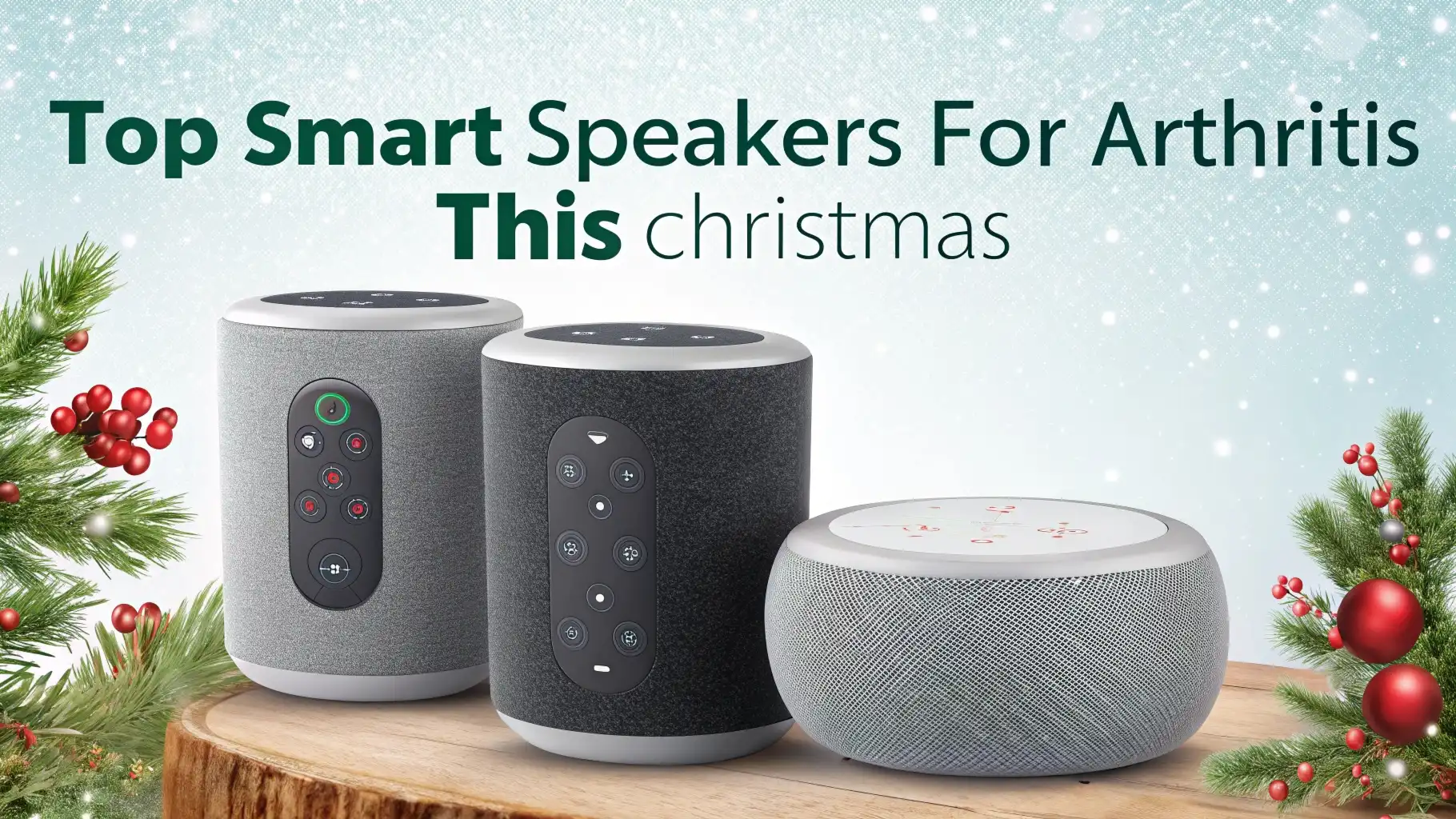
5 Top Smart Speakers for Arthritis This Christmas
Living with arthritis can make everyday tasks challenging. Simple actions like pressing buttons or turning knobs become difficult when your hands hurt.
Voice-activated smart speakers offer a solution. These devices let you control your home, play music, make calls, and get information without lifting a finger. You just need to speak.
This Christmas 2026, smart speakers have become more accessible than ever. They understand natural speech better. They respond faster.

Key Takeaways:
- Complete hands-free operation means you never need to press buttons or use touchscreens for basic functions. Simply speak your command and the device responds instantly.
- Voice recognition technology has improved dramatically in 2026 models, understanding different accents, speech patterns, and even quiet voices better than ever before.
- Smart home integration allows control of lights, thermostats, locks, and appliances through simple voice commands, eliminating the need to physically operate switches or controls.
- Video calling capabilities in display models enable you to see family and friends without holding a phone or tablet, perfect when hand strength is limited.
- Medication reminders and health tracking features help manage daily routines through voice commands, ensuring you never miss important health tasks.
- Prices range from budget-friendly options under $60 to premium models around $220, giving you choices that fit different needs and budgets while all offering excellent accessibility features.
Amazon Echo Show 8: Best Overall for Visual Support


Last update on 2026-08-28 / Affiliate links / Images from Amazon Product Advertising API Some of the links on this website are affiliate links, which means that at no additional cost to you, I earn a commission if you click through and make a purchase. I only recommend products and services that I believe will add value to my readers. Thank you for your support!
The Echo Show 8 combines voice control with a clear 8-inch display. This combination works perfectly for people with arthritis. You get hands-free operation plus visual feedback. The screen shows what Alexa is doing. You can see recipes while cooking. View photos from family. Watch video calls without holding anything.
The spatial audio technology delivers clear sound from any angle. You don’t need to position yourself perfectly. Alexa hears you from across the room. Even with background noise. Even if you speak softly because of pain or fatigue.
Setting up smart home devices through the Echo Show 8 is simple. The screen guides you through each step. Once connected, you control lights, thermostats, and door locks with your voice alone. No reaching for light switches. No twisting thermostat knobs. Just speak.
Pros:
Visual display provides confirmation of commands
Built-in smart home hub eliminates need for additional devices
Auto-framing camera keeps you centered during video calls
Large buttons available for backup control when needed
Spatial audio works from multiple angles
Cons:
Higher price point than basic speakers
Takes up more counter space
Privacy concerns with camera require adjustment
Screen brightness may need adjustment in dark rooms
Amazon Echo Dot: Budget-Friendly Voice Assistant

Last update on 2026-08-31 / Affiliate links / Images from Amazon Product Advertising API Some of the links on this website are affiliate links, which means that at no additional cost to you, I earn a commission if you click through and make a purchase. I only recommend products and services that I believe will add value to my readers. Thank you for your support!
The Echo Dot proves you don’t need to spend much for excellent voice control. This compact speaker packs impressive sound quality into a small package. It fits anywhere. Bedroom nightstand. Kitchen counter. Living room shelf. Take your pick.
Alexa responds quickly to voice commands. Natural language processing means you don’t need to memorize exact phrases. Ask questions normally. Make requests conversationally. Alexa understands and helps.
The Echo Dot serves as your personal assistant throughout the day. Set multiple medication reminders. Create shopping lists by speaking items. Get weather updates before deciding what to wear. Check news headlines. Play audiobooks. Stream music. All without touching anything.
Smart home control works identically to expensive models. Connect compatible lights, plugs, and devices. Control everything with simple voice commands. The Echo Dot manages your home just as well as its bigger siblings.
Pros:
Extremely affordable entry point
Compact size fits anywhere
Full Alexa functionality included
Low power consumption
Multiple color options match decor
Cons:
Smaller speaker limits audio quality for music
No display for visual feedback
Less bass compared to larger models
Microphone may struggle with very quiet voices
Amazon Echo Show 5: Compact Display Option

Last update on 2026-08-31 / Affiliate links / Images from Amazon Product Advertising API Some of the links on this website are affiliate links, which means that at no additional cost to you, I earn a commission if you click through and make a purchase. I only recommend products and services that I believe will add value to my readers. Thank you for your support!
The Echo Show 5 offers a middle ground. Smaller than the Echo Show 8. More affordable. Still includes a display. The 5.5-inch screen shows enough information without dominating your space.
This model excels as a bedside companion. The display dims automatically at night. Voice control lets you set alarms without fumbling with buttons. Check the time with a glance. Start your morning routine by asking Alexa to read your schedule.
Video calling works smoothly on the smaller screen. Perfect for quick check-ins with family. The camera quality remains excellent. The microphone picks up your voice clearly even from bed. When arthritis makes morning movements painful, staying connected becomes easier.
Music playback has improved significantly in this generation. Double the bass compared to the previous model. Clearer vocals. Better overall sound. Enough volume to fill a bedroom or small kitchen comfortably.
Pros:
Balanced price and features
Perfect size for nightstands
Touch backup option available
Sunrise alarm feature helps mornings
Camera shutter for privacy
Cons:
Screen smaller for vision-impaired users
Speaker less powerful than Show 8
Limited viewing angle compared to larger display
Stand sold separately for adjustable positioning
Amazon Echo Studio: Premium Audio Experience

Last update on 2026-08-31 / Affiliate links / Images from Amazon Product Advertising API Some of the links on this website are affiliate links, which means that at no additional cost to you, I earn a commission if you click through and make a purchase. I only recommend products and services that I believe will add value to my readers. Thank you for your support!
The Echo Studio targets music lovers with arthritis. Exceptional sound quality sets this speaker apart. Five directional speakers deliver immersive audio. Dolby Atmos support creates three-dimensional soundscapes. Music sounds rich and detailed.
Automatic room adaptation technology analyzes your space. The Echo Studio adjusts its sound output accordingly. Optimal audio regardless of where you place it. This matters when arthritis limits where you can physically put things.
Voice control works flawlessly even during loud music playback. Advanced microphones filter background noise. Alexa hears your commands over the music. You don’t need to shout. You don’t need to pause the song. Just speak normally.
All standard Echo features remain available. Smart home control. Reminders. Information requests. Shopping lists. The Studio handles everything. The superior audio simply enhances the experience. Especially for those who spend significant time at home.
Pros:
Outstanding audio quality for music
Spatial audio technology
Smart home hub included
Automatic sound optimization
Supports high-resolution audio streaming
Cons:
Premium price point
Overkill for basic voice assistant needs
Larger than basic Echo models
More complex setup for audiophile features
Amazon Echo Dot Max: Enhanced Sound in Compact Form

Last update on 2026-08-28 / Affiliate links / Images from Amazon Product Advertising API Some of the links on this website are affiliate links, which means that at no additional cost to you, I earn a commission if you click through and make a purchase. I only recommend products and services that I believe will add value to my readers. Thank you for your support!
The Echo Dot Max bridges the gap between the basic Dot and larger Echo speakers. Room-filling sound from a compact device. Better bass response. Clearer highs. Louder maximum volume. All while maintaining the small footprint.
The built-in smart home hub eliminates extra devices. Connect Zigbee and Matter compatible products directly. No additional bridges needed. Fewer devices to manage. Simpler setup. Less clutter. Everything in one unit.
Voice recognition performs exceptionally well. Multiple microphones capture your voice accurately. Works across rooms. Understands various accents. Responds to quiet speech. Reliable performance when you need assistance.
Medication management becomes straightforward. Set multiple daily reminders. Alexa announces them clearly. You confirm by voice. Create recurring reminders for regular medications. One-time alerts for as-needed doses. All managed entirely by speaking.
Pros:
Significantly better audio than standard Dot
Integrated smart home hub
Compact size maintained
All Alexa features included
Good value for features offered
Cons:
More expensive than basic Dot
Still lacks display
Not as powerful as full-size Echo
Limited color options
Understanding Voice Control Benefits for Arthritis
Voice-activated technology transforms daily life when hand function is limited. No gripping. No twisting. No pressing. Your voice does the work. This fundamental shift matters enormously for arthritis management.
Morning routines become easier. Wake up and ask Alexa to turn on lights. No reaching for switches. Request the weather forecast while still in bed. Start coffee brewing through a connected coffee maker. All before your joints have warmed up.
Throughout the day, voice control reduces repetitive hand movements. These movements often trigger arthritis flare-ups. Controlling lights by voice instead of flipping switches. Adjusting temperature without turning dials. Playing music without pressing buttons. Each avoided movement helps.
Staying connected with family becomes simpler. Voice-activated calling means no holding phones. No typing messages. Just speak to make calls. Send messages through voice dictation. Video calls keep you visible without hand fatigue from holding devices.
Key Features That Matter for Accessibility
Voice recognition accuracy stands as the most critical feature. Smart speakers must understand speech clearly. Different accents. Varying volumes. Natural phrasing. The 2026 models excel here. They process natural language effectively. You speak normally. They respond appropriately.
Response speed impacts usability significantly. Delays frustrate users. Modern smart speakers respond almost instantly. Ask a question. Get an answer in seconds. Request an action. Watch it happen immediately. This quick feedback confirms the device heard you correctly.
Multi-room audio capability extends convenience throughout your home. Set up speakers in different rooms. Play the same music everywhere. Or different audio in each space. Control everything with your voice from anywhere. No walking to each room to adjust settings.
Smart home integration expands what voice control achieves. Connect lights, thermostats, locks, cameras, and appliances. Control everything hands-free. The ecosystem grows with your needs. Add devices gradually as you discover what helps most.
Setting Up Your Smart Speaker for Arthritis Needs
Initial setup requires a smartphone or tablet. Have someone help if needed. The process takes minutes. Download the Amazon Alexa app. Plug in your speaker. Follow the on-screen instructions. The app guides you through each step clearly.
Connect to your WiFi network. This enables internet access for all features. Speak your WiFi password or have your helper type it. Once connected, your smart speaker is ready for basic functions immediately.
Customize wake word options if “Alexa” feels awkward. Choose “Amazon,” “Echo,” or “Computer” instead. Pick what feels natural to say. You’ll use this word constantly. Make it comfortable.
Adjust microphone sensitivity if the speaker struggles to hear you. The settings let you increase sensitivity. Helpful if you speak quietly due to breathing limitations or pain.
Smart Home Devices That Work Best With Voice Control
Smart light bulbs offer the most immediate benefit. Replace regular bulbs with smart versions. Control them through your speaker. “Alexa, turn on bedroom light.” “Alexa, dim living room to 50%.” Never touch a switch again. Particularly valuable when getting up at night.
Smart plugs make any device voice-controllable. Plug a lamp into a smart plug. Control that lamp by voice. Works with fans, heaters, coffee makers, and more. Inexpensive way to expand voice control throughout your home.
Smart thermostats eliminate painful dial twisting. Adjust temperature from bed. From your chair. From anywhere. “Alexa, set temperature to 72 degrees.” Done. No getting up. No joint stress.
Smart locks provide security without keys. Unlock doors by voice when inside. Check lock status from anywhere. Some models integrate with video doorbells. See and speak to visitors without opening the door.
Managing Daily Tasks Through Voice Commands
Shopping lists become effortless to maintain. Think of something you need. Tell Alexa immediately. “Alexa, add milk to shopping list.” No writing. No typing. Access your list on your phone when shopping. Never forget items again.
Timers and alarms handle multiple tasks simultaneously. Cooking multiple dishes? Set separate timers. “Alexa, set a 20-minute timer for chicken.” “Alexa, set a 45-minute timer for potatoes.” Each timer named and tracked separately.
Calendar management keeps appointments organized. Add events by voice. “Alexa, add doctor appointment Thursday at 2 PM.” Check your schedule. “Alexa, what’s on my calendar today?” Get reminders before events. Stay organized without writing.
Weather updates help plan your day. Morning weather affects clothing choices and activity planning. “Alexa, what’s the weather today?” Get detailed forecasts. Check conditions before going out.
Medication Reminders and Health Management
Medication reminders prove invaluable for complex health routines. Set recurring reminders for each medication. Specify exact times. “Alexa, remind me to take blood pressure medication at 8 AM daily.” Never miss a dose.
Multiple reminders work simultaneously. Morning medications. Afternoon supplements. Evening prescriptions. Alexa tracks them all. Announces each one at the right time. You confirm by voice once you’ve taken it.
Health information access provides quick answers. Ask about symptoms. Request medication information. Get basic health advice. While not replacing medical professionals, quick information helps between appointments.
Exercise reminders encourage movement. Set reminders to stand. To stretch. To perform arthritis-friendly exercises. Regular gentle movement helps manage symptoms. Voice reminders make it happen.
Entertainment Options for Limited Mobility
Music streaming services integrate completely. Amazon Music. Spotify. Apple Music. Pandora. All controlled by voice. “Alexa, play jazz music.” “Alexa, play relaxing piano.” Instant music without touching anything.
Audiobooks provide entertainment without holding books. Physical books become difficult when hands hurt. Audiobooks solve this. “Alexa, read my book.” Resume where you stopped. Enjoy stories without hand strain.
Podcasts offer unlimited content. Educational shows. Comedy. True crime. Whatever interests you. “Alexa, play the latest episode of [podcast name].” Discover new shows. Stay entertained and informed.
Radio stations from around the world stream instantly. Local stations. International broadcasts. Endless variety. “Alexa, play NPR.” “Alexa, play BBC World Service.” No radio needed.
Guided meditation helps manage pain and stress. Request meditation sessions. Choose different lengths. Various focus topics. “Alexa, play a 10-minute meditation.” Wellness support through voice.
Staying Connected With Family and Friends
Drop In feature lets trusted family check on you. They can call your speaker and connect automatically. You can disable this if privacy concerns exist. But many find the instant connection reassuring.
Announcements send voice messages to all Echo devices in your home. Or to family members’ devices elsewhere. “Alexa, announce I need help.” Everyone hears it on their speakers.
Video calls through Echo Show devices maintain visual connection. See grandchildren. Chat with friends. Attend virtual family gatherings. All hands-free. No holding devices. No complicated software.
Voice messaging lets you send recorded messages. “Alexa, send a message to Sarah.” Speak your message. Alexa sends it. Sarah can listen on her Echo or through her phone. Simple asynchronous communication.
Choosing the Right Model for Your Needs
Consider your primary use case first. Need video calling? Choose a Show model. Focused on audio? Consider the Studio. Basic assistance sufficient? The Echo Dot works perfectly.
Evaluate your budget realistically. Prices range from $50 to $220. All models provide excellent accessibility features. Higher prices buy better sound or displays. Not better voice control fundamentals.
Think about placement before purchasing. Small bedroom? Echo Dot or Show 5 fit better. Open living space? Echo Show 8 or Studio make more sense.
Multiple speakers often work better than one expensive unit. Cover more rooms. Hear Alexa everywhere. Total coverage matters more than premium features in one location.
Check compatibility with existing smart home devices. Most work with all Echo speakers. But verify before buying. Ensure your current setup integrates smoothly.
Frequently Asked Questions
Can I control smart speakers if my voice is very quiet or affected by health conditions?
Yes, modern smart speakers handle quiet voices remarkably well. The multiple microphone arrays in 2026 models pick up soft speech effectively. You can also adjust microphone sensitivity in settings. Some users find speaking closer to the device helps initially until the system learns your voice pattern. If voice activation remains challenging, models with displays like the Echo Show series offer touch controls as backup options.
Do I need a monthly subscription to use these smart speakers?
No monthly subscription is required for basic functionality. Voice commands, smart home control, weather, news, and basic skills work without fees. However, music streaming services like Spotify or Amazon Music Unlimited require their own subscriptions. The Alexa Together service for enhanced senior care features costs extra but is not necessary for standard use.
How difficult is it to set up smart home devices with these speakers?
Setup simplicity varies by device brand. Most major smart home products work with Alexa seamlessly. Plug in the device. Open your Alexa app. Say “Alexa, discover devices.” The speaker finds compatible products automatically. The Echo Dot Max and Echo Show 8 include built-in smart home hubs that simplify connecting certain devices even further. Many smart plugs and bulbs connect in under five minutes.
Will these speakers hear me from other rooms or with background noise?
Echo speakers use far-field voice recognition technology with multiple microphones. They hear commands from across typical rooms, even with background noise like TV or music playing. The Echo Studio particularly excels at hearing you during loud audio playback. However, very loud environmental noise or being in a completely different room with doors closed may require raising your voice slightly. Placing speakers centrally in your most-used areas ensures best performance.
Can these devices really help manage arthritis symptoms beyond just convenience?
While smart speakers don’t treat arthritis directly, they significantly reduce daily joint stress. Every avoided button press, switch flip, or knob turn reduces repetitive strain on inflamed joints. This accumulated reduction throughout the day helps prevent flare-ups. Additionally, voice-controlled medication reminders ensure consistent treatment adherence. Exercise and stretching reminders encourage movement that maintains joint flexibility.
What happens if the speaker doesn’t understand my command?
Smart speakers ask for clarification when confused. They might say “Sorry, I didn’t understand that” or “Did you mean…” with suggestions. You simply rephrase your request. The artificial intelligence learns your speech patterns over time, improving accuracy. You can also check the Alexa app to see what the speaker heard versus what you said. This helps identify consistent misunderstandings.
Are there privacy concerns with always-listening devices?
Smart speakers listen for their wake word but don’t record continuously. Once activated by “Alexa,” they send your command to the cloud for processing. You can review and delete voice recordings in the Alexa app. Echo Show models include physical camera shutters. You can mute microphones with physical buttons on all Echo devices. Adjust privacy settings to your comfort level.

Hello everyone my name is Alenya and i am a gadget discovering Enthusiast 🐻🐻