Aiper Scuba S1 Robotic Pool Cleaner review 2026: Worth It?
Pool owners share one universal frustration: spending Saturday mornings dragging hoses, scrubbing walls, and emptying skimmer baskets instead of actually swimming.
The Aiper Scuba S1 promises a cordless fix, claiming to handle the floor, walls, and waterline without you ever touching the water.
After weeks of hands-on testing across a 30,000-gallon in-ground pool, this 2026 review breaks down whether the Scuba S1 truly earns its flagship label, or if its quirks make it a tougher buy than the marketing suggests.
In a Nutshell
- Coverage capacity: Cleans in-ground and above-ground pools up to 1,600 sq. ft. with a four-zone path that includes floor, walls, waterline, and shallow steps above 12 inches.
- Battery runtime: Delivers up to 180 minutes on a single charge, enough for one full multi-mode cycle on most mid-size pools.
- Suction strength: A brushless motor pulls roughly 4,200 GPH, which is competitive with mid-tier cordless rivals but trails premium units.
- Smart navigation: High-precision sensors map the pool shape and reduce repeat passes, though wall-climbing remains its biggest selling point.
- Filtration: Dual-layer fine and ultra-fine baskets trap leaves, algae fragments, and silt without needing a separate fine cartridge swap.
- Best for: Owners with rectangular or oval in-ground pools, light-to-moderate debris, and a tolerance for daily charging.

Last update on 2026-09-19 / Affiliate links / Images from Amazon Product Advertising API Some of the links on this website are affiliate links, which means that at no additional cost to you, I earn a commission if you click through and make a purchase. I only recommend products and services that I believe will add value to my readers. Thank you for your support!
What You Get Inside the Box
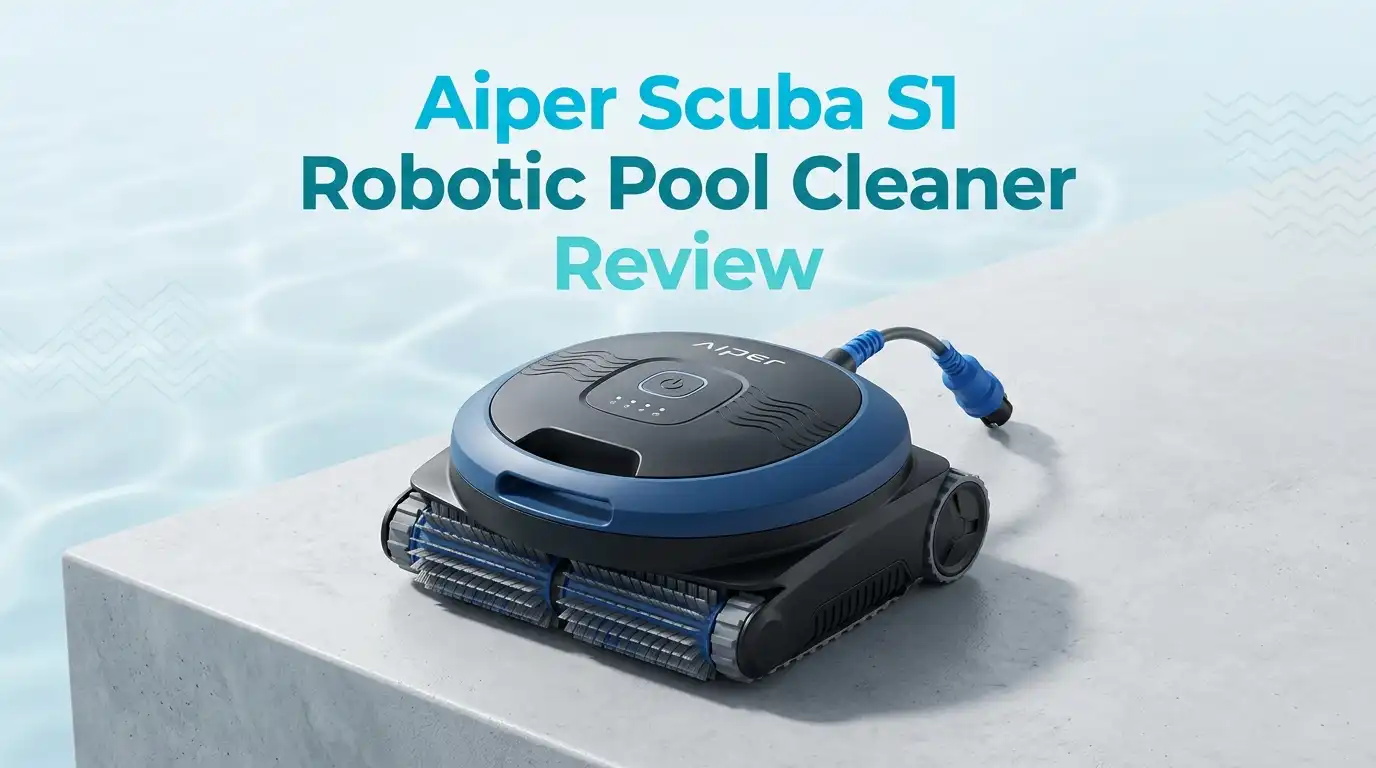
The Scuba S1 arrives in a sturdy double-walled carton with molded foam cradles. Inside you find the robot itself, a charging adapter, a retrieval hook, a quick-start card, and a multilingual manual.
The unit weighs around 19 pounds dry, which feels manageable when lifting it from chest-deep water. There is no caddy or storage bag, so a sunny pool deck quickly becomes its parking spot.
First impressions lean premium. The matte navy shell feels dense, the Caterpillar-style treads grip firmly, and the top handle is wide enough for two-handed retrieval without pinching wet fingers.
Build Quality and Design Notes
The Scuba S1 uses a low-profile chassis with rubberized tracks rather than wheels. This helps it climb tile and pebble-finish walls without slipping, a common failure point with cheaper rivals.
Filter baskets release with a single top latch. You lift, dump, rinse, and reinsert in under a minute. The mesh feels stiffer than the Aiper Seagull line, suggesting better longevity.
One design flaw deserves mention. The charging port sits on the side under a rubber flap that traps water droplets. You must towel it dry before plugging in, or the indicator refuses to switch to charge mode.
Top 3 Alternatives for Aiper Scuba S1

Last update on 2026-09-19 / Affiliate links / Images from Amazon Product Advertising API Some of the links on this website are affiliate links, which means that at no additional cost to you, I earn a commission if you click through and make a purchase. I only recommend products and services that I believe will add value to my readers. Thank you for your support!
Beatbot AquaSense 2

Last update on 2026-06-15 / Affiliate links / Images from Amazon Product Advertising API Some of the links on this website are affiliate links, which means that at no additional cost to you, I earn a commission if you click through and make a purchase. I only recommend products and services that I believe will add value to my readers. Thank you for your support!
WYBOT C1 Cordless Robotic Pool Cleaner

Last update on 2026-09-19 / Affiliate links / Images from Amazon Product Advertising API Some of the links on this website are affiliate links, which means that at no additional cost to you, I earn a commission if you click through and make a purchase. I only recommend products and services that I believe will add value to my readers. Thank you for your support!
Dolphin Nautilus CC Plus Wi-Fi
Setup and First Run
Setup is genuinely simple. Charge the unit for three to four hours, press the power button twice, and lower it into the pool using the included hook. There is no app, no Wi-Fi pairing, and no calibration walk.
The robot sinks under its own weight and begins mapping within ten seconds. You hear a soft hum as the impeller kicks in and the treads engage.
For first-time users this no-fuss launch is a clear advantage. Beginners and renters will appreciate skipping smartphone setup entirely, though tech enthusiasts may miss app scheduling.
Cleaning Performance on the Floor
Floor cleaning is where the S1 shines brightest. On flat pebble-tec and plaster surfaces, it picks up leaves, pine needles, sand, and pollen with a single pass.
The 4,200 GPH suction handles medium debris confidently. Small acorns and twigs the size of a pencil eraser disappear into the basket without clogging.
Larger debris is a different story. Whole oak leaves and palm fronds occasionally jam the intake flap. Heavy-debris pools under tree canopy will still need a manual skim before each cycle for best results.
Wall and Waterline Cleaning
The wall-climb feature works reliably on smooth gunite and tile but struggles on vinyl liner pools with loose seams. Expect the S1 to scale most walls within five minutes of starting.
Waterline scrubbing is the weakest performance area. The robot pauses at the surface, rocks back and forth, and removes light oils and sunscreen film, but it does not match a dedicated waterline scrubber brush.
Heavy bather-load pools with bathtub rings will still need manual brushing every week or two. Treat the waterline mode as maintenance, not deep cleaning.
Battery Life and Charging Reality
Aiper advertises 180 minutes of runtime. In real testing on Floor + Wall + Waterline mode, you get closer to 140 to 160 minutes depending on water temperature and debris load.
Floor-only mode comfortably exceeds three hours, which is enough for back-to-back daily cycles on smaller pools. The charging brick takes three to four hours to refill from empty.
The honest downside is the daily charging chore. Unlike corded units, you cannot just hit a button and walk away. Owners of pools larger than 1,600 sq. ft. will need two cycles to fully clean, doubling the wait.
Filtration and Debris Handling
The dual-layer basket system is genuinely useful. The coarse layer catches leaves while the ultra-fine secondary mesh traps silt, algae spores, and even some sunscreen residue.
Emptying takes under sixty seconds. Open the top, lift the basket, tap it over a trash can, and rinse with a garden hose. No tools required.
One observation worth noting: the fine mesh begins to clog visibly after fifteen to twenty cycles. Plan to replace baskets annually or rinse more aggressively if your pool sees heavy springtime pollen.
Navigation and Smart Path Mapping
The S1 uses high-precision sensors rather than full SLAM mapping. It detects walls, drains, and steps but does not build a persistent floor plan between sessions.
In practice this means the first ten minutes look slightly random as it learns the pool shape. After that the path becomes a clear serpentine grid with minimal overlap.
Free-form and kidney-shaped pools see more redundancy than rectangles. The robot occasionally bumps the same wall three times before turning, which feels inefficient but does not impact cleaning quality.
Honest Downsides and Who Should Skip It
The S1 is not a one-size-fits-all solution. Pools over 1,600 sq. ft. will outpace its battery. Heavy-debris environments under mature trees overwhelm the intake.
Vinyl liner owners report inconsistent wall-climb performance, especially on older liners with bulging seams. The lack of app control disappoints buyers expecting smart-home integration.
Long-term reliability also draws mixed feedback. Some owners report battery issues after twelve to fifteen months, requiring warranty service that takes roughly two weeks of shipping each way. Buyers who want zero maintenance may prefer a corded Dolphin instead.
Real Owner Feedback and Long-Term Use
Forum threads and Amazon reviews paint a consistent picture. Owners with rectangular in-ground gunite pools rate the S1 four to five stars and praise the hands-off weekly experience.
Complaints cluster around three issues: the side charging port collecting water, the battery degrading in year two, and the lack of a parking feature that brings the robot to a retrievable spot.
Despite these gripes, repeat-purchase intent stays high. Most reviewers say they would buy another Aiper unit, though several upgrade to the Scuba S1 Pro or X1 for larger pools.
Value Compared to the Competition
At its current price band, the Scuba S1 sits in the upper-mid tier. It costs more than the WYBOT C1 but significantly less than the Beatbot AquaSense 2.
For most mid-size in-ground pool owners, the value calculation favors the S1. You get true cordless operation, wall climbing, and dual filtration without crossing the $1,000 threshold.
If you have a tiny above-ground pool, the cheaper Aiper Seagull SE is the smarter buy. If you have a 40,000-gallon resort-style pool, look at premium models with surface skimming instead.
Final Verdict
The Aiper Scuba S1 earns a solid recommendation for the right buyer. It cleans well, sets up in minutes, and removes the weekly chore of manual vacuuming. The build quality justifies the price for standard in-ground pools under 1,600 sq. ft.
It is not perfect. The waterline mode underperforms, the charging routine adds friction, and long-term battery health remains a concern flagged by year-two owners.
For pool owners who want cordless convenience without paying flagship money, the S1 hits a genuine sweet spot in 2026.
Frequently Asked Questions
Does the Aiper Scuba S1 work in saltwater pools?
Yes. The Scuba S1 is rated for both chlorine and saltwater systems. The motor seals and tread materials resist salt corrosion, but you should still rinse the unit with fresh water after each cycle to extend basket and seal life.
How long does the battery actually last in real use?
Expect 140 to 180 minutes depending on mode. Floor-only mode stretches past three hours. Combined Floor + Wall + Waterline mode lands closer to 140 minutes in cooler water below 70°F, since lithium cells discharge faster in cold temperatures.
Can it climb vinyl liner pool walls?
Sometimes. Smooth, well-installed liners work fine. Older liners with loose seams or bulges cause the treads to lose grip. Vinyl pool owners should read recent reviews matching their liner age before committing.
Does it have app or Wi-Fi control?
No. The base Scuba S1 uses physical buttons only. If app scheduling matters to you, the Scuba S1 Pro and Scuba X1 offer Bluetooth and Wi-Fi features at a higher price point.
How often should I empty the filter basket?
After every cleaning cycle. The fine mesh clogs noticeably during heavy pollen season, and a clogged basket reduces suction by up to thirty percent. A sixty-second rinse keeps performance consistent.
What is the warranty coverage?
Aiper offers a two-year limited warranty on the main unit and a one-year warranty on the battery. Claims require returning the unit to Aiper’s service center, which adds roughly two weeks of downtime.
Is it safe to leave in the pool when not running?
Aiper recommends removing the unit between cycles. Prolonged chemical exposure shortens seal life and can fade the shell. Daily retrieval with the included hook takes under thirty seconds.
How does it compare to the Aiper Seagull series?
The Scuba S1 is a generational step up. It adds wall climbing, waterline cleaning, smarter navigation, and longer battery life. The Seagull SE remains the better choice for small above-ground pools where wall climbing is unnecessary.

Hello everyone my name is Alenya and i am a gadget discovering Enthusiast 🐻🐻