Bose QuietComfort Ultra Earbuds vs Sony XM5
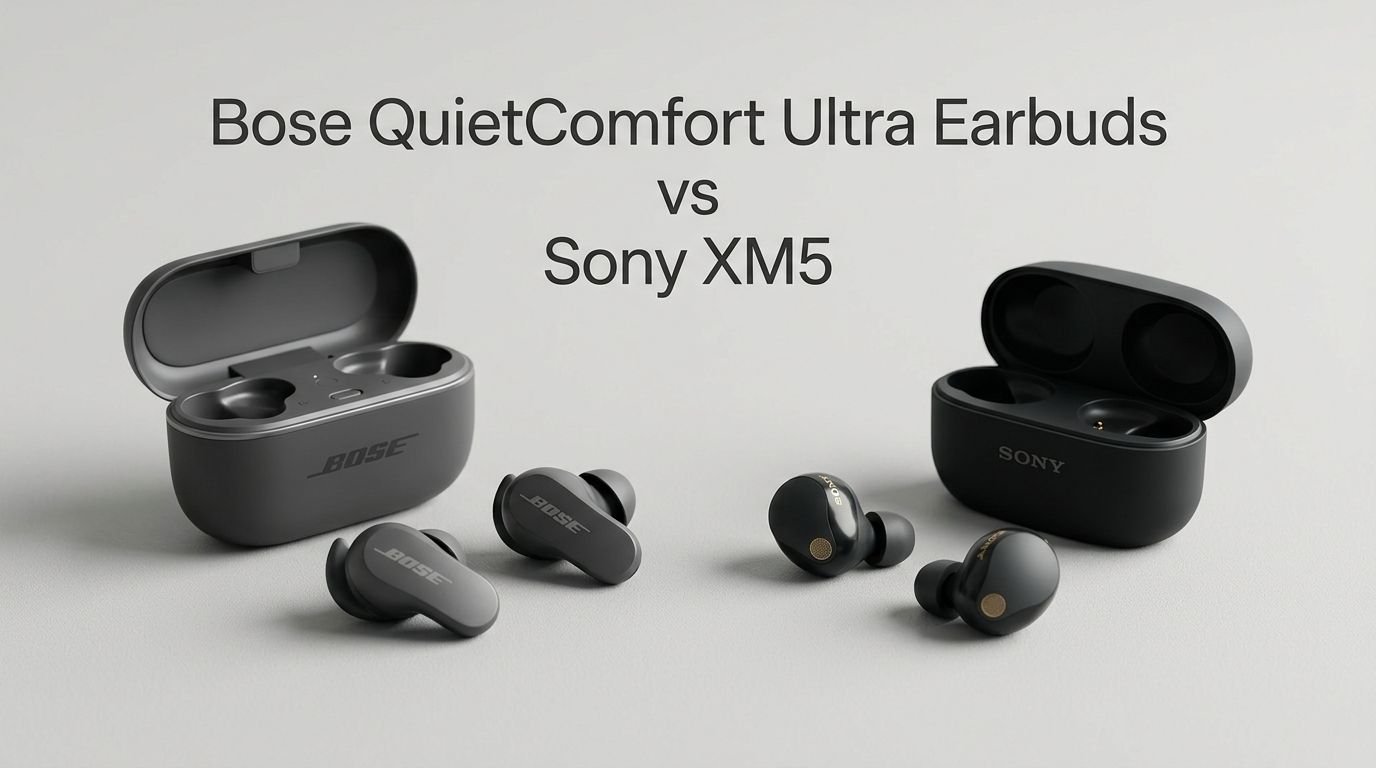
Are you stuck choosing between the Bose QuietComfort Ultra Earbuds and the Sony WF-1000XM5? You are not alone. These two earbuds dominate the premium wireless earbuds market.
Both offer stellar noise cancellation, impressive sound quality, and premium build. But they differ in key areas that could sway your decision. One focuses on deep immersive audio.
The other brings a balanced, detailed sound profile with longer battery life. This head to head comparison will break down every important feature. You will know exactly which pair fits your lifestyle by the end. So let’s get into it.
Key Takeaways
- The Bose QuietComfort Ultra Earbuds offer slightly better active noise cancellation. They can reduce outside noise by approximately 83% to 90%, making them one of the strongest ANC performers in the true wireless segment. The Sony WF-1000XM5 follows closely at around 85%.
- Sony WF-1000XM5 wins the battery life race by a wide margin. You get up to 8 hours of continuous playback with ANC on, compared to 6 hours on the Bose. The Sony charging case also holds more total charge, giving you up to 24 hours total.
- Bose offers a unique Immersive Audio feature with spatial sound. This creates a head tracked, cinema like listening experience. Sony offers spatial audio through compatible apps, but Bose bakes it directly into the earbuds with its own processing chip.
- The Sony WF-1000XM5 supports LDAC for high resolution audio streaming. This codec delivers close to CD quality audio over Bluetooth. The Bose QuietComfort Ultra supports aptX Adaptive, which is also excellent but limited to certain Android devices.
- Both earbuds carry a premium price tag, but the Sony has dropped in street price. The Bose launched at $299 and the Sony at $299.99. However, the Sony WF-1000XM5 can now be found for under $200 at many retailers, making it a stronger value pick.
- Comfort and fit differ between the two. Bose uses stability bands (wing tips) for a secure in ear fit. Sony uses foam ear tips that create a tight seal. Both are comfortable, but the Bose tends to stay more secure during movement.
Bose QuietComfort Ultra Earbuds Overview

Last update on 2026-09-21 / Affiliate links / Images from Amazon Product Advertising API Some of the links on this website are affiliate links, which means that at no additional cost to you, I earn a commission if you click through and make a purchase. I only recommend products and services that I believe will add value to my readers. Thank you for your support!
The Bose QuietComfort Ultra Earbuds launched in late 2023 as Bose’s flagship true wireless option. They feature the company’s CustomTune technology, which scans your ear canal and adjusts sound and ANC performance to match your unique ear shape. This happens every time you put them in.
The earbuds support Bluetooth 5.3 and include aptX Adaptive codec support. They deliver a warm, bass forward sound signature that many listeners enjoy. Bose also introduced its Immersive Audio feature, which uses head tracking to create a spatial listening experience.
The design uses a rounded body with small stability bands that tuck into your ear. They carry an IPX4 water resistance rating. Build quality feels premium and solid.
Pros:
- Industry leading active noise cancellation
- Immersive Audio with head tracking is unique and engaging
- CustomTune adapts sound to your ear shape automatically
- Comfortable and secure fit with stability bands
- Strong call quality with wind reduction
Cons:
- Battery life drops to 4 hours with Immersive Audio on
- No wireless charging on the 1st Gen model
- Higher price point with limited discounts
- The Bose Music app can feel slow at times
- No multipoint Bluetooth connection on 1st Gen
Sony WF-1000XM5 Overview


Last update on 2026-06-09 / Affiliate links / Images from Amazon Product Advertising API Some of the links on this website are affiliate links, which means that at no additional cost to you, I earn a commission if you click through and make a purchase. I only recommend products and services that I believe will add value to my readers. Thank you for your support!
The Sony WF-1000XM5 arrived in mid 2023 as the successor to the popular XM4. Sony made these earbuds 25% smaller and significantly lighter than the previous generation. They pack the Integrated Processor V2 and the new QN2e chip for noise cancellation.
Sound quality leans toward a balanced and detailed profile. You get support for LDAC and LC3 codecs, which enable high resolution audio streaming. The Sony Headphones Connect app provides a full parametric EQ so you can fine tune the sound to your preference.
Sony includes foam ear tips that create a deep seal. The earbuds weigh just 5.9 grams each, making them some of the lightest premium earbuds available. They also support multipoint Bluetooth connection for pairing with two devices at once.
Pros:
- Excellent battery life of up to 8 hours with ANC
- LDAC support for high resolution audio
- Very lightweight and compact design
- Multipoint Bluetooth connection out of the box
- Detailed and balanced sound signature
Cons:
- Foam ear tips may wear out and need replacement
- Fit may not be as secure during intense exercise
- No Immersive Audio or built in spatial sound processing
- IPX4 rating limits use in heavy rain
- Touch controls can be overly sensitive
Sound Quality Comparison
Sound is the most important factor for most buyers. The Bose QuietComfort Ultra Earbuds deliver a warm, bass heavy sound profile. Bass hits deep and full. Mid range vocals sound rich. Highs are smooth but slightly rolled off. The Immersive Audio mode adds a spacious, 3D quality that makes music feel larger.
The Sony WF-1000XM5 produces a more neutral and balanced sound. You hear more detail in the upper frequencies. Vocals sound clear and forward. Bass is present but more controlled compared to the Bose. The LDAC codec adds extra clarity for Android users streaming from services like Tidal or Amazon Music HD.
If you love punchy bass and a fun sound, the Bose is your pick. If you prefer accuracy, detail, and a flatter response, the Sony will please your ears more. Both earbuds allow EQ adjustments through their companion apps.
Active Noise Cancellation
ANC performance is a major selling point for both earbuds. The Bose QuietComfort Ultra leads this category. Bose has years of ANC expertise, and it shows. These earbuds reduce ambient noise by approximately 83% to 90% depending on the frequency. Low frequency sounds like airplane engines and train rumbles get almost completely silenced.
The Sony WF-1000XM5 performs at about 85% noise reduction. That is still very strong. Sony’s Adaptive Sound Control feature automatically adjusts ANC levels based on your activity. It detects walking, sitting, or traveling and adapts accordingly.
Both earbuds offer a transparency or aware mode. The Bose Aware mode sounds natural and lets conversations through clearly. Sony’s Ambient Sound mode also performs well but can occasionally pick up a slight digital artifact. For pure noise cancellation strength, Bose holds a narrow edge.
Battery Life and Charging
Battery life is where the Sony WF-1000XM5 pulls ahead significantly. The Sony delivers up to 8 hours of continuous playback with ANC enabled. Turn off ANC and you get up to 12 hours. The charging case adds another 16 hours, bringing the total to 24 hours or more.
The Bose QuietComfort Ultra Earbuds provide up to 6 hours with ANC active. With Immersive Audio turned on, that number drops to just 4 hours. The charging case provides about 3 additional full charges for a total of around 24 hours.
Sony also offers faster quick charging. A 3 minute charge gives you 60 minutes of playback. Bose provides about 2 hours of playback from a 20 minute charge. If battery life is a top priority, the Sony WF-1000XM5 is the clear winner here.
Comfort and Fit
Comfort matters a lot for earbuds you wear for hours. The Bose QuietComfort Ultra uses a distinctive design with stability bands that hook into the contour of your outer ear. This keeps them locked in place during head movements and light exercise. The earbuds come with three sizes of tips and stability bands.
The Sony WF-1000XM5 uses a more traditional stem free design with foam ear tips. These tips create an excellent seal for both sound isolation and ANC. Sony includes four sizes of foam tips. The earbuds are lighter at 5.9 grams compared to the Bose at roughly 6.3 grams.
For secure fit during movement, the Bose wins. For lightweight comfort during long listening sessions, the Sony has a slight edge. Both earn an IPX4 rating for sweat and light splash resistance.
App Experience and Controls
Both earbuds come with feature rich companion apps. The Bose Music app lets you switch between noise cancellation modes, adjust EQ, and toggle Immersive Audio. The interface is clean but can sometimes feel sluggish. You get limited EQ options with just a few preset adjustments.
The Sony Headphones Connect app offers much more control. You get a full parametric equalizer, Adaptive Sound Control settings, and DSEE Extreme upscaling. You can also customize touch controls and check battery levels. The app runs smoothly on both Android and iOS.
Touch controls work well on both earbuds. The Bose uses swipe and tap gestures on the outer surface. Sony uses tap based controls. Some users report Sony’s touch controls can be overly sensitive, leading to accidental inputs. The Bose controls feel slightly more precise in daily use.
Call Quality and Microphone Performance
Both earbuds handle phone calls well, but there are differences. The Bose QuietComfort Ultra uses an array of microphones combined with wind noise reduction algorithms. Voice clarity is strong even in moderate wind. Callers on the other end report hearing your voice clearly in most environments.
The Sony WF-1000XM5 uses bone conduction sensors alongside its microphones. This helps isolate your voice from background noise. Call quality is very good in quiet settings. However, in windy or very noisy environments, the Bose tends to deliver clearer voice transmission.
For people who take frequent calls outdoors, the Bose is the better pick for microphone performance. For indoor or moderate noise calls, both perform similarly well.
Bluetooth and Connectivity
Connectivity features differ between the two. The Sony WF-1000XM5 supports multipoint Bluetooth, which lets you connect to two devices at the same time. This is useful if you switch between a phone and a laptop throughout the day.
The Bose QuietComfort Ultra (1st Gen) does not support multipoint connection. You need to manually switch between paired devices. The 2nd Gen model released later added this feature. Bose supports Bluetooth 5.3 with aptX Adaptive. Sony uses Bluetooth 5.3 with LDAC and LC3 codecs.
For Android users who value high resolution streaming, Sony’s LDAC support is a big advantage. For Snapdragon device owners, Bose’s aptX Adaptive also delivers excellent quality. Both earbuds pair quickly and maintain stable connections within a standard 30 foot range.
Design and Build Quality
Design is subjective, but both earbuds look and feel premium. The Bose QuietComfort Ultra has a smooth, rounded body with a matte finish. The stability bands add a unique look. The charging case is slightly larger but still pocket friendly.
The Sony WF-1000XM5 has a sleek, minimal design. The matte and glossy finish combination looks sophisticated. Sony’s charging case is noticeably smaller and lighter, making it one of the most compact premium earbud cases on the market.
Both cases charge via USB-C. Sony’s 1st Gen case supports wireless charging. Bose added wireless charging only with the 2nd Gen model. If case size matters to you, the Sony case wins for portability.
Price and Value
Price plays a big role in any purchase decision. The Bose QuietComfort Ultra Earbuds launched at $299. They still sit close to that price at many retailers. Discounts are less frequent.
The Sony WF-1000XM5 launched at $299.99 but has since dropped to around $198 to $228 at major retailers. This significant price drop makes the Sony a much stronger value proposition in 2026. You get flagship level ANC, excellent sound, and longer battery life for less money.
If budget is not a concern, both earbuds justify their price. But if you want the best performance per dollar, the Sony WF-1000XM5 is hard to beat at its current street price.
Which Should You Buy?
The answer depends on your priorities. Choose the Bose QuietComfort Ultra Earbuds if you want the strongest noise cancellation, a secure fit for active use, and the unique Immersive Audio spatial experience. They are ideal for frequent flyers and commuters who want maximum silence.
Choose the Sony WF-1000XM5 if you want longer battery life, a balanced and detailed sound, LDAC support for high resolution audio, and multipoint Bluetooth. They are perfect for all day listeners, audiophiles, and anyone who values versatility.
Both are excellent flagship earbuds. You will not be disappointed with either choice. The Sony offers better value at its current lower price. The Bose offers a more specialized experience with its ANC and spatial audio strengths.
Frequently Asked Questions
Are the Bose QuietComfort Ultra Earbuds better than the Sony WF-1000XM5 for noise cancellation?
Yes, the Bose QuietComfort Ultra Earbuds have a slight edge in noise cancellation. They block approximately 83% to 90% of ambient noise. The Sony WF-1000XM5 blocks around 85%. Both are among the best ANC earbuds available, but Bose consistently scores higher in head to head ANC tests.
Which earbuds have better battery life, Bose QC Ultra or Sony XM5?
The Sony WF-1000XM5 has significantly better battery life. It provides up to 8 hours with ANC on and up to 24 hours total with the case. The Bose provides up to 6 hours with ANC and drops to 4 hours with Immersive Audio enabled. Sony wins this category easily.
Can you use both earbuds with iPhone and Android?
Yes, both earbuds work with iPhone and Android devices. The Sony WF-1000XM5 offers extra benefits on Android with LDAC support for high resolution audio. The Bose QuietComfort Ultra supports aptX Adaptive on compatible Android devices. Core features work fully on both platforms.
Do these earbuds support wireless charging?
The Sony WF-1000XM5 case supports wireless charging out of the box. The Bose QuietComfort Ultra 1st Gen does not support wireless charging. Bose added wireless charging with the 2nd Gen model. Check which generation you are purchasing if wireless charging matters to you.
Are either of these earbuds good for working out?
Both earbuds have an IPX4 rating for sweat and light splash resistance. The Bose offers a more secure fit with its stability bands, making it a better option for workouts with head movement. The Sony can stay in place during moderate exercise but may shift during intense activity. Neither is fully waterproof.
Is the Sony WF-1000XM5 still worth buying in 2026?
Absolutely. The Sony WF-1000XM5 remains one of the best premium earbuds available. Its sound quality, ANC, and battery life still compete with newer releases. The significantly reduced street price of around $198 to $228 makes it an outstanding value in the current market.

Hello everyone my name is Alenya and i am a gadget discovering Enthusiast 🐻🐻