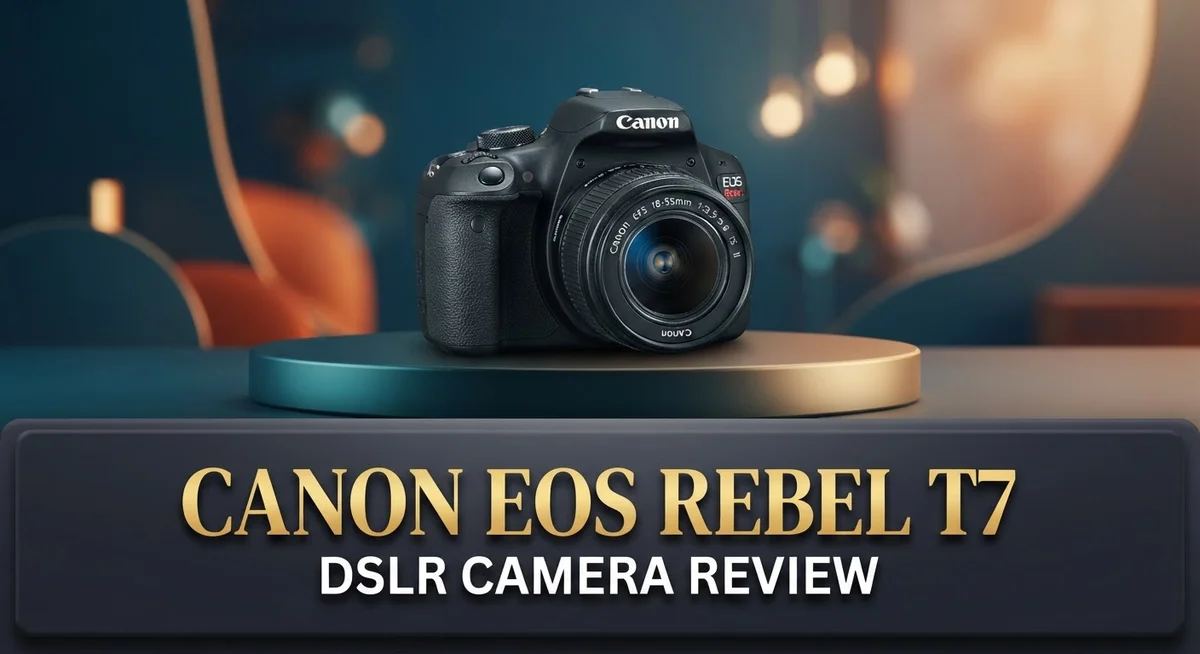
Canon EOS Rebel T7 DSLR Camera Review: Features, Performance, and Value
Want a camera that makes learning photography simple? The Canon EOS Rebel T7 is a popular choice for beginners. It holds the title of a best selling DSLR for good reason.
This camera packs a 24.1MP APS-C sensor. That gives you sharp, detailed photos every time. The DIGIC 4+ processor handles image quality with ease.
You get built in Wi-Fi for quick sharing. Upload your shots straight to your phone or social media. No cables needed.
In a Nutshell
- Reliable Image Quality: The sensor and DIGIC 4+ processor work together to produce sharp, clear photos. This combo handles everyday scenes with ease.
- Autofocus Performance: The focus system tracks moving subjects well in good light. It may struggle a bit in low light or fast action scenes.
- Shooting Speed: This camera shoots at 3 frames per second. This speed works fine for still subjects but limits action photography.
- Display Screen: The fixed LCD screen shows clear detail for reviewing shots. It does not tilt or flip, so some angles feel tricky.
- Processor Age: The DIGIC 4+ chip is older tech compared to newer Canon models. It still gets the job done for basic photography needs.
- User Feedback: Many buyers love this camera for its simplicity and image quality. Some users wish it had more advanced features.
Sensor and Image Quality
The 24.1MP APS-C CMOS sensor sits at the heart of the Rebel T7’s image capture system. This sensor size gives you a nice balance between resolution and light sensitivity. You get enough megapixels to print large photos or crop images without losing detail.
The DIGIC 4+ processor handles all the image data from the sensor. This chip processes colors, exposure, and sharpness in real time. While it’s not the newest processor Canon makes, it still delivers clean, natural looking photos in most conditions.
Low light performance is where this camera shows its limits. The sensor performs well up to ISO 1600 in everyday shooting. Push it to ISO 3200 or higher, and you’ll notice some noise in shadows. The expandable ISO range goes up to 12,800, but that’s best saved for emergencies when you need the shot no matter what.
Color accuracy comes through nicely in daylight scenes. Reds stay vibrant. Greens look natural. Blues don’t shift into purple tones. Indoor shots under artificial light need a bit more care with white balance, but the camera’s auto mode handles most situations.
Dynamic range is solid for an entry level DSLR. You can recover some shadow detail in post processing. Blown out highlights are harder to fix, so watch your exposure in bright conditions.
The fixed LCD screen at 920,000 dots gives you a clear view of your images. You can see focus points and check exposure in real time. The screen doesn’t tilt or flip, so you’re stuck shooting from eye level or waist level without creative angles.
Continuous shooting maxes out at 3 frames per second. This works fine for portraits and landscapes. Fast action sports or wildlife need faster cameras. The buffer can hold several shots before the camera slows down.
Overall, the Rebel T7 produces reliable, sharp images that look great on social media and in small prints. You won’t feel limited by image quality when you’re starting out. The sensor and processor work together smoothly for straightforward photography.

Last update on 2026-10-03 / Affiliate links / Images from Amazon Product Advertising API Some of the links on this website are affiliate links, which means that at no additional cost to you, I earn a commission if you click through and make a purchase. I only recommend products and services that I believe will add value to my readers. Thank you for your support!
Autofocus System and Performance
The Rebel T7 uses a 9-point autofocus system that covers the frame in a basic grid pattern. This setup works well for stationary subjects and general photography. When you’re shooting portraits or landscapes, the focus points spread across the frame to help you compose shots easily.
AI Servo AF is the camera’s continuous autofocus mode. It tracks moving subjects as long as they stay within the focus area. This feature helps when photographing kids, pets, or sports. The system performs best in bright daylight. Indoor or low-light scenes require more patience since focus hunting becomes more common.
The autofocus speed feels snappy on the Rebel T7. You press the shutter button halfway, and the camera locks focus quickly in most situations. The beep confirms focus lock, which gives you confidence before you take the shot. Single-shot AF mode works great for static scenes where your subject doesn’t move.
One limitation is the fixed focus point option. You can’t select individual points as easily as on higher-end models. Instead, you work with the automatic point selection or use the center point. This means less control over exactly where the camera focuses. For beginners, this simplicity is actually helpful.
Real-world performance shows the system handles everyday shooting scenarios well. Backlit subjects sometimes confuse the autofocus, causing slight delays. Fast-moving action can occasionally result in missed focus, especially with kit lenses. Switching to manual focus gives you full control when autofocus struggles.
The 3 frames per second continuous shooting speed pairs with the autofocus system. You can fire multiple shots while tracking a subject, though the AF updates between each frame. This combo works fine for casual action photography.
Overall, the Rebel T7’s autofocus delivers solid performance for entry-level use. It’s not advanced enough for professional sports or wildlife work, but it handles family moments, travel photos, and creative projects without frustration. The system encourages you to learn good focusing techniques early on.
Design, Build, and Ergonomics
The Rebel T7 has a compact, lightweight body that fits comfortably in your hands. Canon designed this camera with beginners in mind, so the grip feels natural even during extended shooting sessions. The rubber texture on the grip provides solid purchase without slipping.
The camera weighs just 450 grams with the battery and memory card. This makes it easy to carry around all day without fatigue. You can toss it in a backpack or camera bag without adding much bulk.
The button layout follows Canon’s standard design. The mode dial sits on top and clicks into place smoothly. All major controls sit within arm’s reach of your right hand, so you won’t fumble around looking for buttons.
The fixed LCD screen measures 3 inches and displays 920,000 dots of resolution. You can view your images clearly and navigate menus without squinting. The screen doesn’t rotate or flip, which some photographers find limiting for awkward angles or selfies.
The camera body feels sturdy despite its entry-level status. The plastic construction is typical for this class of DSLR. It won’t win awards for premium feel, but it holds up well to regular use.
The shutter button has a smooth, two-stage press. The first stage activates autofocus, and the second fires the shot. This tactile feedback helps you develop good shooting habits from the start.
The SD card slot accepts standard memory cards without fuss. The battery compartment opens easily and closes securely. Both access points sit on the camera’s bottom, which is standard practice.
The hot shoe on top accepts external flashes and accessories. This gives you room to expand your setup as your skills grow. The connector feels solid and doesn’t wobble.
Overall, the Rebel T7’s design prioritizes simplicity and ease of use. The camera doesn’t have unnecessary features cluttering the interface. New photographers appreciate this straightforward approach to camera design. The ergonomics support comfortable shooting without overwhelming you with options or complicated controls.
Top 3 Alternatives
Nikon D3500 DSLR

Last update on 2026-09-22 / Affiliate links / Images from Amazon Product Advertising API Some of the links on this website are affiliate links, which means that at no additional cost to you, I earn a commission if you click through and make a purchase. I only recommend products and services that I believe will add value to my readers. Thank you for your support!
The Nikon D3500 brings solid performance to beginner photographers. This camera offers a 24.2-megapixel sensor that captures sharp, detailed images in various lighting conditions. The battery life impresses many users, lasting longer than competing models.
Autofocus performance feels smooth and responsive. The camera includes built-in Wi-Fi for easy photo sharing. The ergonomic design fits comfortably in your hands during extended shooting sessions. Nikon’s extensive lens ecosystem gives you plenty of upgrade options down the road.
Canon EOS M50 Mark II

Last update on 2026-10-03 / Affiliate links / Images from Amazon Product Advertising API Some of the links on this website are affiliate links, which means that at no additional cost to you, I earn a commission if you click through and make a purchase. I only recommend products and services that I believe will add value to my readers. Thank you for your support!
Canon’s mirrorless option delivers excellent video capabilities. The 24.1-megapixel sensor produces vibrant colors and good detail. This camera features a flip-out touchscreen, making vlogging and content creation much easier.
4K video recording opens creative possibilities for modern creators. The compact size makes it ideal for travel and on-the-go shooting. Fast autofocus tracking keeps moving subjects sharp. Canon’s RF-M lens lineup continues growing, offering more choices for photographers wanting to expand their kit.
Sony Alpha a6000

Last update on 2026-10-03 / Affiliate links / Images from Amazon Product Advertising API Some of the links on this website are affiliate links, which means that at no additional cost to you, I earn a commission if you click through and make a purchase. I only recommend products and services that I believe will add value to my readers. Thank you for your support!
Sony’s mirrorless powerhouse packs impressive specs into a lightweight body. The 24.3-megapixel Exmor sensor delivers excellent image quality with accurate colors. Fast autofocus with 179 phase-detection points ensures you rarely miss focus.
The compact design makes this camera perfect for photographers prioritizing portability. Battery life runs shorter than DSLR alternatives, though extra batteries solve this easily. Sony’s extensive lens selection gives you creative freedom. The camera handles both photo and video work capably, making it versatile for different shooting styles.
Connectivity and User Interface
The Rebel T7 keeps things simple when it comes to connecting with other devices. Built-in Wi-Fi lets you send images straight to your smartphone or tablet without cables. You can also upload photos to cloud services or social media directly from the camera menu. The wireless connection works smoothly once you pair it with your phone using Canon’s app.
The camera’s menu system feels intuitive for beginners. Large icons and clear text guide you through settings without confusion. You navigate with a four-way controller and a set button in the center. Most functions sit just two or three menu levels deep, so you won’t get lost searching for options.
The 3.0 inch fixed LCD screen serves as your main interface for reviewing shots and adjusting settings. The 920,000 dot resolution shows enough detail to spot focus issues before you save. The screen tilts slightly but doesn’t rotate, which some users find limiting when shooting from awkward angles. Despite this, the display remains bright enough for outdoor use in most conditions.
Button placement follows Canon’s traditional layout, so switching from other Canon models feels natural. The shutter button sits on top with a smooth two stage press. Control dials on the back let you adjust exposure and other settings without diving into menus. The SD card slot accepts standard memory cards, making file transfers quick and easy.
One useful feature is the hot shoe on top. You can attach external flashes or other Canon accessories to expand the camera’s capabilities. This keeps the base camera lightweight while letting you add tools as your skills grow.
The menu structure avoids overwhelming new photographers. Live View mode lets you compose shots on the LCD screen instead of using the optical viewfinder. This appeals to people coming from smartphones or mirrorless cameras. Overall, the Rebel T7’s interface strikes a good balance between simplicity and functionality for entry-level shooters.
Video Capabilities and Continuous Shooting
The Rebel T7 captures video at 1080p resolution at up to 60 frames per second. This gives you smooth, detailed footage for YouTube vlogs, social media clips, and casual projects. The autofocus system works during video recording, though it can hunt for focus occasionally when subjects move quickly.
Audio recording happens through a built in microphone. For better sound quality, you can attach an external microphone to the hot shoe or use a USB adapter. Wind noise can be noticeable outdoors, so consider a windscreen if you film outside often.
The continuous shooting speed of 3 frames per second limits how many shots you can capture in rapid bursts. This works fine for everyday photography like family gatherings and street scenes. If you shoot fast action sports or wildlife, you may find yourself wishing for faster capture rates. The buffer clears quickly, so you can resume shooting after a brief pause.
Live View mode lets you frame shots on the LCD screen instead of through the viewfinder. Video recording uses Live View automatically, which means you see exactly what the camera will capture. Battery life suffers during extended video sessions, so bring a spare battery if you plan long recording days.
The camera stores video files as MP4s, which work on most computers and phones without conversion. File sizes stay reasonable, so your memory cards won’t fill up too quickly. A Class 10 SD card is recommended for smooth recording without dropped frames.
For entry level creators, the Rebel T7 delivers solid 1080p video performance. The combination of autofocus during recording and straightforward controls makes it approachable for beginners. You won’t get cinema quality footage, but you will get usable content that looks professional enough for online sharing. The 3 fps continuous shooting pairs well with the video capabilities for hybrid photo and video workflows.
Pros and Cons
Pros
- Entry-level DSLR with a 24.1MP sensor that captures sharp images for beginners and casual shooters
- Built-in Wi-Fi lets you share photos instantly to your phone or computer without extra cables
- Compact and lightweight body weighs just 450 grams, making it easy to carry all day
- Compatible with Canon’s extensive EF and EF-S lens library, giving you room to grow your kit
- Sturdy construction and intuitive menu design help new photographers learn quickly
Cons
- 9-point autofocus system feels basic compared to newer entry-level models with faster tracking
- Continuous shooting maxes out at 3 frames per second, limiting action and burst photography
- Fixed LCD screen cannot tilt or rotate, restricting creative angles for video and selfies
- DIGIC 4+ processor is older technology, which may slow down file processing and buffer times
Who Should Buy It
The Canon EOS Rebel T7 fits best with first-time DSLR buyers who want a straightforward camera without overwhelming complexity. If you’re picking up a camera for the first time, this model removes the guesswork. The menu system stays simple, and button placement follows logical patterns.
Casual photographers who shoot everyday moments benefit from this camera’s 24.1MP sensor. Family gatherings, travel snapshots, and social media posts come out sharp and clear. You get high resolution without needing to master advanced settings.
Students and hobbyists find real value here. The Rebel T7 teaches photography fundamentals without forcing you to learn professional workflows. You can grow into the camera as your skills improve.
Content creators starting with basic video work should consider this model. The 1080p video at 60 fps handles YouTube vlogs, TikToks, and simple tutorials. Built-in Wi-Fi makes sharing footage to your phone quick and easy.
Travel enthusiasts appreciate the lightweight body. At just 450 grams, it won’t weigh down your backpack during long trips. You can shoot all day without fatigue.
The Rebel T7 works well for people building their lens collection. Canon’s EF and EF-S mount opens access to hundreds of lenses. You start simple and expand your gear as your interests grow.
However, sports photographers and wildlife shooters should look elsewhere. The 9-point autofocus system and 3 fps continuous shooting won’t keep up with fast-moving subjects. Action photography demands faster performance.
Professional photographers won’t find enough features here. The fixed LCD screen, older processor, and basic autofocus feel limiting for paid work.
If you shoot in extremely low light regularly, consider other options. The ISO range tops out at 6,400 standard, which can struggle in dark venues.
The Rebel T7 shines when you want a camera that works out of the box with minimal learning curve. It rewards curiosity without punishing mistakes. This camera makes photography accessible to everyone stepping into the DSLR world.
Final Verdict
The Canon EOS Rebel T7 stands as a smart starting point for anyone new to photography. Its simple design and trusted brand reputation make it a safe choice for beginners.
This camera shines brightest when you value simplicity over speed. It skips fancy features but delivers steady, reliable results for everyday shooting.
Compared to the Canon Rebel T7i, the T7 lacks advanced autofocus and faster burst rates. Still, it offers a gentler learning curve for someone picking up their first DSLR.
Against the Nikon D3500, the T7 holds its own with a larger lens ecosystem. Canon’s glass selection gives you more room to experiment as skills grow.
The Canon M50 Mark II provides a mirrorless alternative with quicker focusing. However, the T7’s optical viewfinder appeals to shooters who prefer a traditional camera feel.
Think of the T7 as a stepping stone. It teaches core photography skills like exposure, framing, and lighting without overwhelming menus or settings.
This camera suits people who want dependable photos for family events, school projects, or casual outdoor shoots. It handles these tasks without fuss.
Who should skip this model? Fast action shooters and professionals need quicker autofocus and higher frame rates than the T7 offers. Those users should look at higher tier Canon models or mirrorless options instead.
For everyone else, the Rebel T7 remains a trustworthy companion. Its long history as a popular choice speaks to its lasting appeal among new photographers.
In short, the Canon EOS Rebel T7 earns its spot as a reliable first camera. It covers the basics well and leaves room to grow into Canon’s broader lens lineup.
If you want a no fuss introduction to DSLR photography, this camera delivers exactly that. It keeps things simple while still producing sharp, satisfying images.
Frequently Asked Questions
Does the Canon EOS Rebel T7 shoot 4K video?
No, the T7 maxes out at 1080p Full HD video recording. This camera focuses on still photography rather than advanced video features. If you need 4K capability, you’ll want to look at newer entry-level models or upgrade to a higher-tier DSLR.
Can I use older Canon lenses on this camera?
Yes. The T7 uses the Canon EF and EF-S mount, which means you can attach decades of Canon lenses to it. This massive lens library gives you room to grow your photography skills and experiment with different focal lengths without buying a new camera body.
How does the autofocus perform in low light?
The 9-point autofocus system works reasonably well indoors and at dusk, but it’s not the fastest. It can hunt for focus in very dim settings. For consistent low light performance, consider using manual focus or upgrading to a model with more autofocus points and better sensors.
Is the fixed LCD screen a real limitation?
The 3.0″ fixed screen works fine for composing shots and reviewing images. You cannot tilt or flip it like on newer models. If you shoot from awkward angles or do a lot of video work, a tilting screen would help. For standard shooting at eye level, the fixed screen poses no real problem.
Should I buy the T7 in 2024 or wait for something newer?
The T7 remains a solid entry point if you want straightforward DSLR photography today. Newer models offer faster autofocus and better processors, but the T7 still delivers sharp 24.1MP images. Choose based on your needs now, not on waiting for the next release.

Hello everyone my name is Alenya and i am a gadget discovering Enthusiast 🐻🐻