REDTIGER 4K Dash Cam Front Rear Review 2026: Worth It?
Parking-lot dings, hit-and-run drivers, and disputed insurance claims share one thing in common: without video proof, your word rarely wins.
The REDTIGER F7N 4K Front and Rear Dash Cam promises courtroom-grade footage at a sub-$150 price, which sounds almost too good to trust. After weeks of daily driving, highway runs, and overnight parking tests, I sat down to separate the marketing gloss from real-world performance.
This review breaks down the build, the footage, the app, and the quirks no spec sheet mentions, so you know exactly what you are buying before you mount one to your windshield.
In a Nutshell
- 4K front + 1080P rear recording powered by the new Sony STARVIS 2 sensor delivers genuinely readable license plates in daylight and surprisingly clean low-light footage.
- 5.8GHz WiFi transfer at roughly 20MB/s makes phone downloads quick, a clear upgrade over the older 2.4GHz models that frustrated previous buyers.
- Built-in GPS, G-sensor, loop recording, and 24-hour parking mode cover every safety base most drivers need, though parking mode requires the optional hardwire kit.
- 3.18-inch IPS touchscreen simplifies setup, but the menu logic still feels a generation behind Vantrue or VIOFO.
- Best suited for daily commuters, rideshare drivers, and budget-minded car owners who want premium features without paying $300+.
- Skip it if you need true 4K rear recording, three-channel coverage, or polished software, because REDTIGER trims corners in those areas.
What Is the REDTIGER 4K Dash Cam Front Rear

Last update on 2026-09-19 / Affiliate links / Images from Amazon Product Advertising API Some of the links on this website are affiliate links, which means that at no additional cost to you, I earn a commission if you click through and make a purchase. I only recommend products and services that I believe will add value to my readers. Thank you for your support!
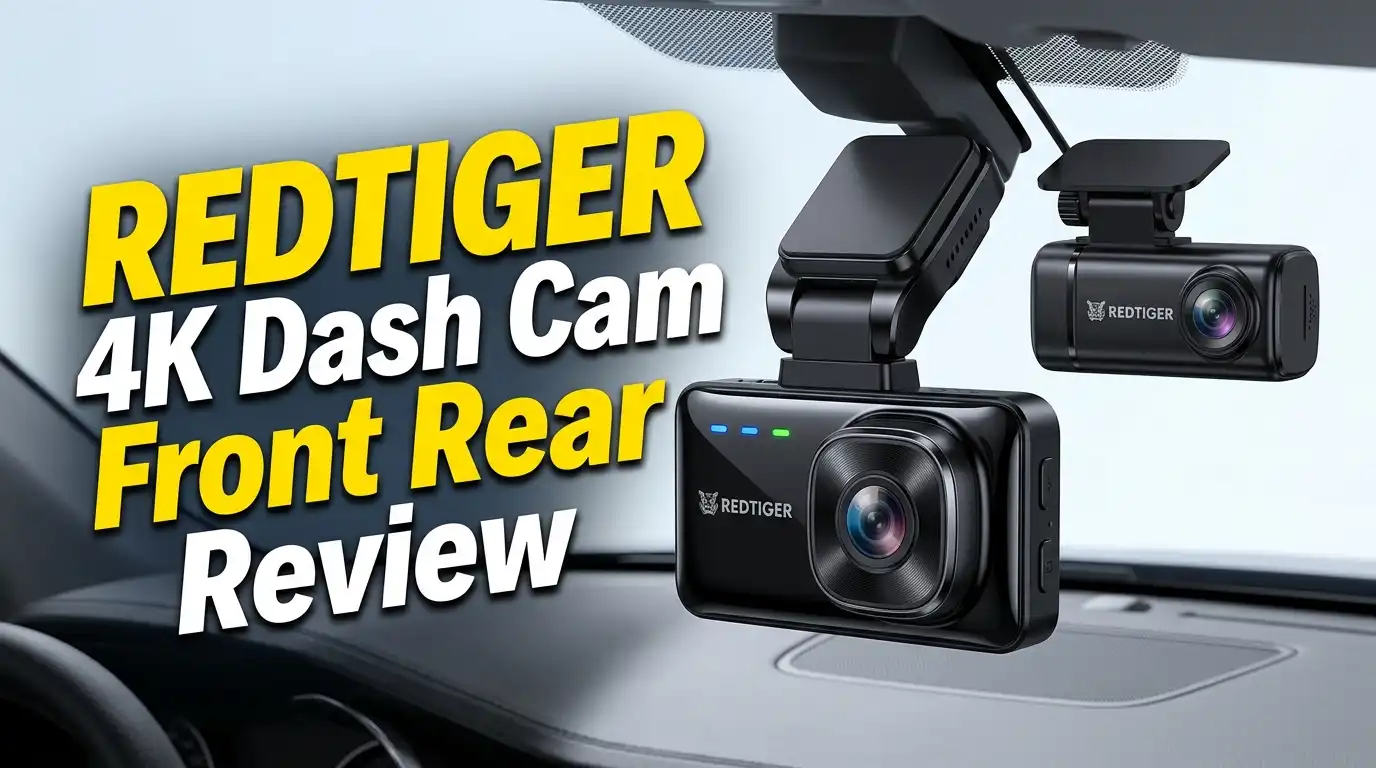
The REDTIGER F7N is a dual-channel dashboard camera aimed at drivers who want 4K front footage and a 1080P rear feed in one tidy package. It uses the latest Sony STARVIS 2 image sensor, a 170° front lens, and a 140° rear lens.
The unit ships with a free 32GB or 128GB microSD card (depending on the bundle), a windshield mount, a long rear-camera cable, and a 12V cigarette adapter. Pricing hovers between $119 and $149 on Amazon, undercutting most STARVIS 2 competitors by a wide margin.
REDTIGER positions this as their flagship two-channel model. It is the value pick for anyone who likes the idea of premium hardware without premium price tags.
Unboxing and First Impressions
The packaging is tidy and frustration-free. Inside the white box you get the front camera, the rear camera, a 20-foot rear cable, the power cable, the windshield mounting plate, a pry tool, and a small instruction booklet.
The front camera feels lighter than it looks. The shell is matte plastic with a glossy screen surround, and the lens housing rotates smoothly without feeling loose. It is compact enough to hide behind a rearview mirror on most sedans.
The rear camera is tiny, almost USB-stick sized, with adhesive backing. The included cable is long enough to reach the hatch of an SUV without splicing, which I appreciated.
Design and Build Quality
The F7N is built around a 3.18-inch IPS touchscreen that wakes instantly when you start the car. Touch response is accurate, though not iPhone-smooth. Tapping deep into menus sometimes feels sluggish by half a second.
The chassis does not creak when squeezed, and the rotating lens holds its angle even on rough roads. After a Texas afternoon parked at 110°F cabin temp, the camera booted normally with no warping or adhesive failure.
I would call the build above average for the price but not in the same league as VIOFO’s aluminum-bodied units. For everyday use, it is more than sturdy enough.
Top 3 Alternative for REDTIGER 4K Dash Cam
If the REDTIGER does not quite fit your needs, these three competitors regularly win head-to-head comparisons in 2026.

Last update on 2026-09-19 / Affiliate links / Images from Amazon Product Advertising API Some of the links on this website are affiliate links, which means that at no additional cost to you, I earn a commission if you click through and make a purchase. I only recommend products and services that I believe will add value to my readers. Thank you for your support!
VIOFO A229 Plus

Last update on 2026-09-19 / Affiliate links / Images from Amazon Product Advertising API Some of the links on this website are affiliate links, which means that at no additional cost to you, I earn a commission if you click through and make a purchase. I only recommend products and services that I believe will add value to my readers. Thank you for your support!
Vantrue N4 Pro S 4K 3 Channel


Last update on 2026-09-19 / Affiliate links / Images from Amazon Product Advertising API Some of the links on this website are affiliate links, which means that at no additional cost to you, I earn a commission if you click through and make a purchase. I only recommend products and services that I believe will add value to my readers. Thank you for your support!
70mai A810 4K Dash Cam
Installation Experience
REDTIGER includes a pry tool and adhesive mount, which keeps the whole job under an hour for most cars. I tucked the power cable along the headliner, down the A-pillar, and under the glove box without needing any extra clips.
The rear camera install took longer because routing the cable across the headliner to a hatchback adds time. Patience pays off here, since a clean install hides every wire.
Power comes from the included 12V plug by default. For parking mode, you must buy the separate REDTIGER hardwire kit (around $25). The plug-and-play wiring is the right choice for casual users, while the hardwire kit fits commuters and rideshare drivers.
Video Quality in Daylight
This is where the STARVIS 2 sensor earns its keep. Daytime 4K footage from the front camera is sharp, color-accurate, and free of the over-saturation that cheaper cams use to fake clarity. License plates two cars ahead at 45 mph remain readable.
WDR balances harsh sun-and-shadow transitions well, especially driving in and out of tunnels. I noticed only minor lens flare when the sun sat directly above the windshield.
The rear 1080P feed is good rather than great. It captures the car directly behind clearly, but reading plates beyond two car-lengths gets tough. This is the single biggest compromise of the F7N for the price.
Night Vision and Low-Light Performance
REDTIGER markets aggressive low-light capability, and the STARVIS 2 sensor with HDR mostly delivers. On a poorly lit suburban road, I could read parked-car plates from about 15 feet away in the front feed.
Highway driving at night looks clean, with controlled headlight glare and minimal noise in shadow areas. The footage is good enough for insurance evidence, which is the realistic bar most buyers care about.
The rear camera struggles more in the dark. Plate clarity drops past 8–10 feet, and bright trailing headlights cause noticeable bloom. Urban drivers will be happier with the night results than rural drivers on pitch-black country roads.
The REDTIGER App and 5.8GHz WiFi
The F7N pairs with the REDTIGER app on iOS and Android over a dedicated 5.8GHz WiFi connection. Setup takes about two minutes, and the connection holds steady within a few feet of the car.
Transfer speeds genuinely impressed me. Pulling a one-minute 4K clip took roughly five seconds, which is competitive with VIOFO’s app speeds. Older REDTIGER models on 2.4GHz were painfully slow, so this upgrade matters.
The app interface is functional, not beautiful. You can preview live, download clips, change settings, and view GPS tracks. Occasional disconnections still happen, but they are rare enough to forgive.
Parking Mode, GPS, and Safety Features
The F7N supports 24-hour parking surveillance through three modes: motion detection, collision detection, and time-lapse. You must add the hardwire kit to access these, which feels like a fair upsell.
Built-in GPS logging stamps every clip with speed and location data, which is invaluable for accident claims and rideshare drivers proving routes. The G-sensor auto-locks footage when it senses a sudden impact.
I tested a small parking-lot bump while parked, and the camera correctly woke up, recorded a 30-second clip, and saved it to a locked folder. The system works as advertised, with one caveat: parking mode can drain a weak battery, so older vehicles should monitor voltage carefully.
Voice Control and Smart Features
The F7N accepts voice commands like “take photo,” “turn off WiFi,” and “turn on recording.” Recognition works about 80% of the time in a quiet cabin and drops sharply with the windows down or music on.
It is a nice extra, not a primary reason to buy. The novelty wore off for me within a week, and I went back to using the touchscreen.
The built-in speaker is loud enough to hear voice prompts on the highway, which beats several competitors that ship with whisper-quiet audio cues.
Honest Downsides and Who Should Skip It
No camera is perfect, and the F7N has real flaws worth flagging. The rear camera resolution caps at 1080P, which feels dated when VIOFO and Vantrue offer 2K or 4K rear options for $50–$100 more.
The app, while improved, is still less polished than competitors. Firmware updates arrive less often than I would like, and the menu system has quirks that take a week to learn.
Some online buyers have flagged long-term reliability concerns, especially around overheating in extreme summer climates. I did not encounter this personally, but the 2-year warranty is reassuring.
Skip this dash cam if you are a professional rideshare driver wanting three-channel coverage, a Tesla owner needing native integration, or a videographer who wants flawless 4K rear footage.
Price, Value, and Final Verdict
At its current Amazon price, the REDTIGER F7N delivers a STARVIS 2 sensor, 4K front recording, 5.8GHz WiFi, GPS, and a touchscreen for less than half what VIOFO charges. That value proposition is hard to argue with.
It is not the absolute best dash cam on the market, but it is the best dash cam for the money in the dual-channel category right now. For daily commuters, parents, and rideshare drivers on a budget, the F7N is an easy recommendation.
I would buy it again for a second household car without hesitation. If you can stretch your budget to a VIOFO A229 Plus, do that. If not, this REDTIGER hits 85% of the experience for 60% of the cost.
Expert FAQs
Does the REDTIGER F7N record both front and rear in 4K?
No. The front camera records in true 4K (3840×2160), while the rear camera records in 1080P Full HD. This is the most common point of confusion in product listings, so adjust your expectations accordingly.
Do I need to buy a memory card separately?
Most current Amazon bundles include a free 32GB or 128GB U3 microSD card preinstalled. The camera supports cards up to 512GB. For 4K recording, I recommend at least 128GB to avoid frequent loop overwrites.
Will parking mode drain my car battery?
It can, especially on older vehicles. Parking mode requires the optional hardwire kit, which includes a low-voltage cutoff to protect your battery. Healthy modern batteries handle 12–24 hours of monitoring without issue.
How is the REDTIGER F7N compared to VIOFO A229 Plus?
The VIOFO A229 Plus offers 2K front and 2K rear with arguably better software polish, while the REDTIGER F7N offers 4K front and 1080P rear at a lower price. Choose VIOFO for balanced dual-resolution; choose REDTIGER for sharper front footage on a budget.
Does the camera work in extreme heat or cold?
The F7N uses a supercapacitor instead of a lithium battery, which handles temperature extremes far better than older dash cams. It is rated for roughly -4°F to 158°F operation, covering nearly all North American climates.
Can I view footage live on my phone?
Yes. The REDTIGER app offers live preview, clip download, and settings management over 5.8GHz WiFi. Transfer speeds reach about 20MB/s, so a one-minute 4K clip downloads in under ten seconds.
Is the REDTIGER F7N good for Uber and Lyft drivers?
It is a solid entry-level rideshare option, offering GPS logging, parking mode, and high-quality forward footage. However, drivers who need in-cabin recording for passenger disputes should consider a three-channel cam like the Vantrue N4 Pro S instead.
How long is the warranty?
REDTIGER includes an 18-month manufacturer warranty, with extensions available through their official site. Customer support is responsive based on community feedback, which is reassuring for a budget brand.

Hello everyone my name is Alenya and i am a gadget discovering Enthusiast 🐻🐻