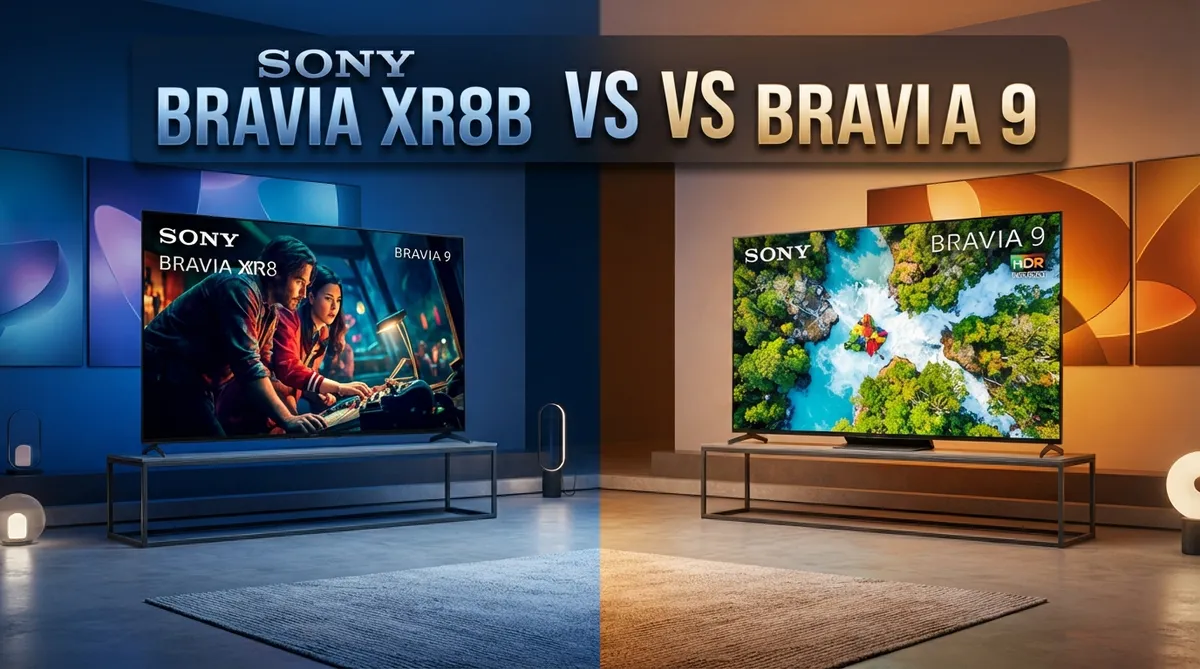
Sony Bravia XR8B vs Bravia 9: Which TV Wins?
Picking a new Sony TV can feel tricky. Two models often top the list: the Sony Bravia XR8B and the Sony Bravia 9.
Both TVs deliver stunning 4K visuals. But they use different display technologies to get there.
The Bravia XR8B uses OLED panels. It offers perfect blacks and rich contrast for dark room viewing.
The Bravia 9 uses Mini-LED QLED technology. It shines in bright rooms and handles reflections better.
Quick Comparison: SONY Bravia XR8B vs SONY Bravia 9
| Feature | SONY Bravia XR8B | SONY Bravia 9 |
|---|---|---|
| Display Type | OLED | Mini-LED QLED |
| Screen Sizes | 55″/65″ | 65″/75″/85″ |
| Refresh Rate | 120Hz native panel | 120Hz |
| HDMI 2.1 Ports | 2 ports at 4K@120fps | Full HDMI 2.1 support |
| Contrast/Blacks | Perfect blacks, no blooming | Deep contrast, minimal blooming |
| Peak Brightness | Lower than Mini-LED | Exceptional brightness |
| Ideal Environment | Dark room, cinematic | Bright rooms, sports/gaming |
| Smart Platform | Google TV | Google TV |
SONY Bravia XR8B Review

Last update on 2026-09-19 / Affiliate links / Images from Amazon Product Advertising API Some of the links on this website are affiliate links, which means that at no additional cost to you, I earn a commission if you click through and make a purchase. I only recommend products and services that I believe will add value to my readers. Thank you for your support!
The Sony Bravia XR8B is a premium OLED television built for viewers who prioritize picture quality in controlled lighting environments. This model comes in 55″ and 65″ sizes and delivers the signature strengths of OLED technology: perfect blacks and infinite contrast ratios.
The standout feature is zero blooming around bright objects. Unlike LED alternatives, the XR8B’s self-emissive pixels turn completely off, so highlights never bleed into dark areas of the screen.
This creates a cinematic viewing experience that feels incredibly lifelike.
Build quality is solid with a sleek stand and minimal bezels. The TV includes Google TV for apps, HDMI 2.1 on two ports for 4K gaming at 120fps, and VRR support for smooth gameplay.
Real-world performance shines with accurate skin tones and color grading that filmmakers appreciate.
The main trade-off: peak brightness sits lower than Mini-LED competitors, and direct reflections can be distracting in bright rooms. This TV thrives in dark or dimly lit spaces.
Pros
- Perfect blacks with no blooming or halo effects around bright content
- Exceptional contrast and color accuracy for film and streaming
- Low input lag and VRR support make gaming responsive
- Self-emissive pixels deliver authentic, lifelike visuals
Cons
- Lower peak brightness than Mini-LED alternatives limits bright room use
- Reflective screen surface can distract in direct sunlight
- Limited to 55″ and 65″ sizes compared to larger competitors
SONY Bravia 9 Review


Last update on 2026-09-21 / Affiliate links / Images from Amazon Product Advertising API Some of the links on this website are affiliate links, which means that at no additional cost to you, I earn a commission if you click through and make a purchase. I only recommend products and services that I believe will add value to my readers. Thank you for your support!
The Sony Bravia 9 is a 65″, 75″, or 85″ Mini-LED QLED television built for rooms with mixed lighting and bright environments. It suits viewers who want vibrant colors, high brightness, and excellent sports or gaming performance.
The standout feature is exceptional brightness paired with minimal blooming. This combination handles reflections far better than traditional OLED panels, making it ideal for living rooms with windows or bright overhead lights.
Build quality feels premium with a clean design and integrated up-firing audio. Real-world performance excels at upscaling lower-quality content and delivering lifelike colors across movies, sports, and games.
The 120Hz refresh rate and HDMI 2.1 support make it a strong gaming TV with VRR and ALLM features built in. Google TV provides smooth streaming and app access without lag.
Pros
- Exceptional brightness and reflection handling for bright rooms
- Deep contrast with minimal blooming compared to standard LED
- Excellent upscaling smooths low-quality streaming content
- Up-firing audio adds immersive sound without extra speakers
Cons
- Mini-LED blooming is still possible compared to pure OLED technology
- Reflections remain a challenge despite brightness advantages
- Not ideal for completely dark rooms where OLED excels
Head to Head: Key Differences
The XR8B and Bravia 9 target different viewing environments. The XR8B thrives in dark rooms where its OLED panel delivers perfect blacks.
The Bravia 9 performs best in bright spaces where its Mini-LED brightness advantage matters most.
Contrast handling separates these two clearly. The XR8B produces zero blooming around bright objects because each pixel emits its own light.
The Bravia 9 uses a backlight system, so some blooming can occur, though it remains minimal compared to standard LED TVs.
Brightness levels favor the Bravia 9 significantly. Mini-LED technology pushes peak brightness much higher, making the Bravia 9 better for rooms with windows or bright ambient light.
The XR8B’s lower peak brightness means reflections can distract viewers in lit environments.
Reflection handling tells an interesting story. You might expect the brighter Bravia 9 to handle reflections better, but both TVs can struggle with direct light sources.
The Bravia 9’s extra brightness helps somewhat, though it’s not a complete solution.
Gaming features are nearly identical on both models. Both support 120Hz refresh rates, HDMI 2.1 connectivity, and variable refresh rate technology.
The Bravia 9 adds up-firing audio, which enhances immersion during gameplay without requiring external speakers.
Content upscaling differs between them. The Bravia 9 excels at smoothing low-quality streaming content and older films.
The XR8B prioritizes accuracy over smoothing, making it better for cinematic content where detail preservation matters.
Room placement is the real deciding factor. Choose the XR8B if you control lighting and watch mostly high-quality films.
Pick the Bravia 9 if your room gets natural light and you watch diverse content including sports and gaming.
Which One Should You Buy
The Sony Bravia 9 takes the win here. It brings exceptional brightness, minimal blooming, and superior upscaling to the table.
This makes it adaptable to more rooms and content types than the OLED-only XR8B.
Still, both TVs shine in their own way. Your final pick depends on your room and viewing habits.
Best for each buyer
- SONY Bravia XR8B: Best for dark room, cinematic viewing where perfect blacks and contrast accuracy matter most.
- SONY Bravia 9: Best for bright or mixed-lighting rooms, sports, gaming, and viewers who want high brightness with strong contrast and upscaling performance.
Frequently Asked Questions
Which TV should I choose if I watch movies in a dark room?
The Sony Bravia XR8B is your best pick here. Its OLED panel delivers perfect blacks with zero blooming around bright highlights.
You get infinite contrast, so dark scenes feel truly immersive. The XR8B’s color accuracy shines in low-light settings too.
The Bravia 9 uses Mini-LED backlighting, which means some blooming can happen. For cinematic content in dark spaces, the XR8B wins every time.
What if my living room gets lots of sunlight?
Go with the Sony Bravia 9. This Mini-LED QLED TV reaches much higher peak brightness levels than the XR8B.
Bright rooms need that extra luminance to fight glare and reflections.
The Bravia 9 handles mixed lighting environments better. You can watch comfortably whether your room has windows open or lamps on.
The XR8B struggles with direct reflections in lit spaces.
Which TV is better for gaming and sports?
The Bravia 9 edges ahead here. Its 120Hz refresh rate, HDMI 2.1 support, VRR, and ALLM features make it a gaming powerhouse.
Sports content looks sharp and responsive.
The XR8B also has these gaming specs, but the Bravia 9’s higher brightness gives you better visibility during fast action. Upscaling is also excellent on the Bravia 9 for lower-quality sports streams.
Can the XR8B handle bright rooms at all?
The XR8B works in moderately lit rooms, but it’s not ideal. Direct reflections become distracting because peak brightness is lower than Mini-LED alternatives.
If you have some control over lighting (blackout curtains, dimmed lamps), the XR8B performs well. For always-bright spaces, the Bravia 9 is the smarter choice.

Hello everyone my name is Alenya and i am a gadget discovering Enthusiast 🐻🐻