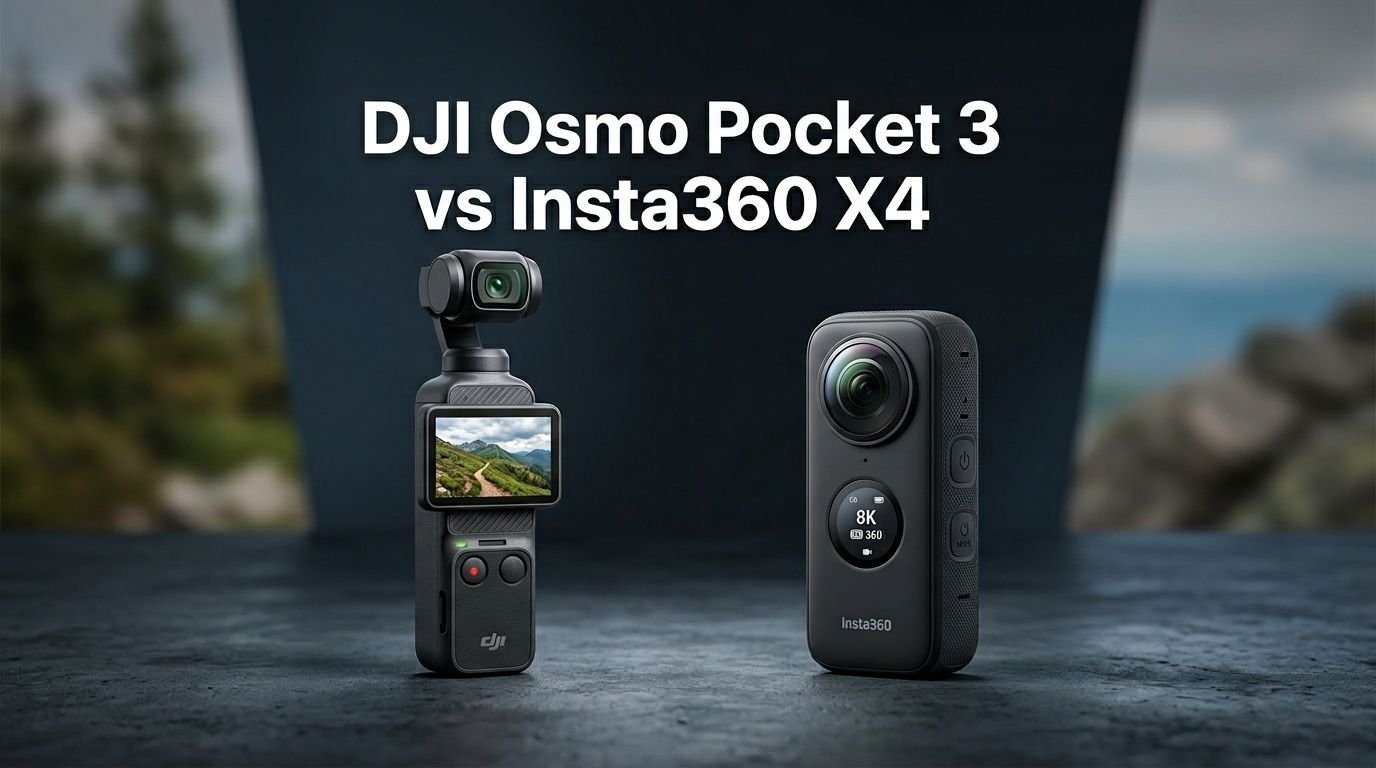
DJI Osmo Pocket 3 vs Insta360 X4: Complete Comparison
Are you stuck between the DJI Osmo Pocket 3 and the Insta360 X4? You are not alone. These two cameras sit at a similar price point, but they serve very different purposes.
One is a gimbal stabilized pocket vlogging camera with a large sensor. The other is a 360 degree action camera that captures everything around you. Picking the right one depends on how you shoot, what you shoot, and where you plan to use it.
This detailed comparison breaks down every important difference between the DJI Osmo Pocket 3 and the Insta360 X4. You will learn about video quality, stabilization, battery life, build quality, software, and much more.
Key Takeaways
- The DJI Osmo Pocket 3 uses a 1 inch CMOS sensor that delivers outstanding image quality, especially in low light. The Insta360 X4 uses two 1/2 inch CMOS sensors to capture full 360 degree footage. These are fundamentally different camera types built for different shooting styles.
- The Insta360 X4 records up to 8K 360 video at 30fps, while the DJI Osmo Pocket 3 tops out at 4K at 120fps. The Pocket 3 offers higher quality per frame, but the X4 gives you freedom to reframe your shot in post production.
- Battery life is close but slightly different. The Pocket 3 offers about 166 minutes of recording on its 1300mAh battery. The X4 provides up to 135 minutes at 5.7K 30fps from its larger 2290mAh battery. Higher resolution modes on the X4 drain the battery faster.
- The Insta360 X4 is waterproof up to 10 meters without a case. The DJI Osmo Pocket 3 is not waterproof and has a delicate gimbal that requires careful handling. If you shoot in rough conditions, the X4 has a clear advantage.
- The Pocket 3 excels at traditional vlogging with its rotatable 2 inch touchscreen, face tracking, and direct to camera shooting. The X4 excels at action sports, creative 360 content, and shots where you want to choose your angle after recording.
- Both cameras cost around $500 for their standard editions, making the choice less about budget and more about your content creation goals.
DJI Osmo Pocket 3 Overview

Last update on 2026-09-19 / Affiliate links / Images from Amazon Product Advertising API Some of the links on this website are affiliate links, which means that at no additional cost to you, I earn a commission if you click through and make a purchase. I only recommend products and services that I believe will add value to my readers. Thank you for your support!
The DJI Osmo Pocket 3 is a compact handheld gimbal camera built for vloggers and content creators. It packs a 1 inch CMOS sensor into a body that weighs just 179 grams. The camera records 4K video at up to 120fps with 10 bit D Log M color support. This gives creators a huge amount of flexibility in color grading.
DJI included a 3 axis mechanical gimbal for buttery smooth stabilization. The 2 inch rotatable touchscreen flips between landscape and portrait modes. This makes it perfect for shooting both YouTube videos and social media reels. ActiveTrack 6.0 keeps subjects in frame automatically.
The camera also supports fast charging, reaching 80% in just 16 minutes. It connects to the DJI Mimo app for remote control and quick editing. The 20mm equivalent lens with an f/2.0 aperture provides a wide enough field of view for selfie style vlogging.
Pros:
- Excellent low light performance with the 1 inch sensor
- 3 axis gimbal provides superior mechanical stabilization
- 4K 120fps slow motion capability
- 10 bit color depth for professional color grading
- Compact size fits in a pocket
- Rotatable screen for quick portrait and landscape switching
Cons:
- Not waterproof or weather sealed
- Fixed 20mm lens with no zoom
- Gimbal is fragile and can break if dropped
- No 360 degree capture ability
- Limited field of view compared to action cameras
Insta360 X4 Overview

Last update on 2026-09-19 / Affiliate links / Images from Amazon Product Advertising API Some of the links on this website are affiliate links, which means that at no additional cost to you, I earn a commission if you click through and make a purchase. I only recommend products and services that I believe will add value to my readers. Thank you for your support!
The Insta360 X4 is a 360 degree action camera that captures everything around you in up to 8K resolution at 30fps. It uses two 1/2 inch CMOS sensors with matching fisheye lenses. The camera stitches footage from both lenses to create a full spherical video.
This camera weighs 203 grams and features a 2.29 inch touchscreen. The 2290mAh battery provides up to 135 minutes of recording at 5.7K 30fps. Insta360 built the X4 to handle tough conditions. It is waterproof up to 10 meters without any extra housing.
The X4 also shoots 72MP photos and supports Active HDR mode for balanced exposure in high contrast scenes. FlowState stabilization keeps footage smooth even during extreme activities. The invisible selfie stick effect makes the stick disappear from 360 footage, creating a unique third person perspective.
Pros:
- Full 360 degree capture lets you reframe shots later
- 8K video resolution for sharp 360 content
- Waterproof to 10 meters without a case
- Invisible selfie stick effect for creative shots
- 72MP photo capability
- Removable lens guards protect the glass
Cons:
- Smaller 1/2 inch sensors produce weaker low light results
- 360 footage requires post processing and reframing
- Large file sizes eat up storage quickly
- Image quality per frame is lower than the Pocket 3
- Learning curve for 360 editing software
- Bulkier than the Pocket 3
Video Quality Comparison
Video quality is where these two cameras show their biggest differences. The DJI Osmo Pocket 3 produces sharper, more detailed footage per frame. Its 1 inch sensor captures more light and more color information. The 4K 120fps mode delivers stunning slow motion with rich detail.
The Insta360 X4 shoots at a higher total resolution of 8K, but that resolution is spread across a full 360 degree sphere. When you reframe a clip down to a standard flat video, the effective resolution drops to around 4K or lower. The per frame sharpness does not match the Pocket 3.
For traditional video content like vlogs, tutorials, or travel films, the Pocket 3 wins on raw image quality. For action sports, immersive content, or situations where you want to choose your framing after the fact, the X4 offers something the Pocket 3 simply cannot do.
Low Light Performance
Low light shooting is a significant factor for many creators. The DJI Osmo Pocket 3 has a clear advantage here. Its 1 inch CMOS sensor collects far more light than the smaller sensors in the X4. The f/2.0 aperture and ISO range of 50 to 6400 allow the Pocket 3 to produce clean, bright footage in dim environments.
The Insta360 X4 struggles more in low light. Its 1/2 inch sensors are much smaller. They generate more noise at higher ISO settings. Indoor footage and nighttime shooting often look grainy on the X4. The Active HDR mode helps with dynamic range but does not fix the fundamental sensor size limitation.
If you frequently shoot at night, indoors, or in poorly lit locations, the Pocket 3 is the better choice by a wide margin. The X4 performs best in bright, outdoor conditions where there is plenty of natural light.
Stabilization
Both cameras offer excellent stabilization, but they achieve it in different ways. The DJI Osmo Pocket 3 uses a 3 axis mechanical gimbal. This physically moves the camera to counteract hand movements. The result is incredibly smooth footage that looks almost like it was shot on a dolly or slider.
The Insta360 X4 relies on FlowState stabilization, which is a software based system. It uses the full 360 degree sphere of footage to digitally stabilize the output. This method is very effective and works well even during intense activities like mountain biking, skiing, or skateboarding.
The gimbal on the Pocket 3 feels more natural and introduces zero digital crop. FlowState on the X4 is impressively smooth but depends on having enough resolution to crop into. For walking vlogs and steady handheld shots, the Pocket 3 feels superior. For extreme sports and high motion activities, the X4 holds its own.
Build Quality and Durability
Last update on 2026-09-19 / Affiliate links / Images from Amazon Product Advertising API Some of the links on this website are affiliate links, which means that at no additional cost to you, I earn a commission if you click through and make a purchase. I only recommend products and services that I believe will add value to my readers. Thank you for your support!
Durability matters, especially if you take your camera outdoors. The Insta360 X4 wins this category. It is waterproof to 10 meters out of the box. The body is solid and built to withstand impacts. Removable lens guards protect the exposed fisheye lenses from scratches and cracks.
The DJI Osmo Pocket 3 is more delicate. The 3 axis gimbal is exposed and can break from a short drop. The camera has no water resistance. You need to treat it carefully, especially around sand, rain, or rough terrain. DJI does not offer a waterproof case for this model.
If you plan to use your camera for hiking, water sports, skiing, or any rugged activity, the X4 is built for that purpose. The Pocket 3 is better suited for controlled environments like city walks, studio setups, and travel vlogging where you can protect the gear.
Software and Editing Experience
Both cameras come with companion apps that handle editing. The DJI Osmo Pocket 3 works with the DJI Mimo app. This app provides basic trimming, filters, and quick sharing options. It also serves as a remote viewfinder and controller for the camera.
The Insta360 X4 pairs with the Insta360 app, which is a much more powerful editing tool. The app lets you reframe 360 footage, add keyframes, apply effects, and export flat video clips. AI powered editing features can automatically select the best angles and create highlight reels.
The X4 editing workflow takes more time because 360 footage needs reframing before it is ready to share. The Pocket 3 produces ready to use clips straight out of the camera. If you prefer fast, simple editing, the Pocket 3 saves time. If you enjoy creative control and post production flexibility, the X4’s software is more capable.
Battery Life
Battery life is close between these two cameras, but the details depend on resolution settings. The DJI Osmo Pocket 3 carries a 1300mAh battery that delivers up to 166 minutes of recording time. It also supports fast charging, reaching 80% in about 16 minutes and full charge in 32 minutes.
The Insta360 X4 has a larger 2290mAh battery but uses more power due to its dual sensors and higher resolution processing. It provides about 135 minutes at 5.7K 30fps and roughly 88 minutes at 8K 30fps. Full charging takes around 55 minutes.
The Pocket 3 offers slightly better real world recording time per charge. The X4 has the advantage of a removable battery, so you can carry spares and swap them on the go. The Pocket 3 battery is built in and cannot be replaced in the field.
Portability and Design
Last update on 2026-09-19 / Affiliate links / Images from Amazon Product Advertising API Some of the links on this website are affiliate links, which means that at no additional cost to you, I earn a commission if you click through and make a purchase. I only recommend products and services that I believe will add value to my readers. Thank you for your support!
The DJI Osmo Pocket 3 is the more portable device. It measures just 139.7 x 42.2 x 33.5mm and weighs 179 grams. It fits comfortably in a jeans pocket or small bag. The slim, stick like design makes it easy to pull out and start recording quickly.
The Insta360 X4 weighs 203 grams and has a wider body at 44 x 123.6 x 37.6mm. It is still compact for what it offers, but it does not slide into a pocket as easily. The protruding lenses on both sides also need protection when stored.
For daily carry and spontaneous shooting, the Pocket 3 feels more convenient. You can grab it with one hand, power it on, and start filming in seconds. The X4 is better suited to planned shoots where you mount it on a selfie stick, helmet, or chest harness.
Best Use Cases for DJI Osmo Pocket 3

Last update on 2026-09-19 / Affiliate links / Images from Amazon Product Advertising API Some of the links on this website are affiliate links, which means that at no additional cost to you, I earn a commission if you click through and make a purchase. I only recommend products and services that I believe will add value to my readers. Thank you for your support!
The Pocket 3 shines in specific scenarios. It is an ideal vlogging camera for YouTube creators who film themselves talking to the camera. The face tracking feature keeps you centered in the frame without a tripod. The large sensor produces footage that looks professional with minimal effort.
Travel vloggers love the Pocket 3 because it captures smooth, cinematic footage while walking through cities, markets, and landscapes. The portrait mode is perfect for Instagram Reels and TikTok content. Content creators who shoot interviews or product reviews also benefit from the Pocket 3’s sharp image and clean audio from its three built in microphones.
This camera also works well for real estate walkthroughs, behind the scenes content, and family videos where image quality and ease of use matter most.
Best Use Cases for Insta360 X4
Last update on 2026-09-19 / Affiliate links / Images from Amazon Product Advertising API Some of the links on this website are affiliate links, which means that at no additional cost to you, I earn a commission if you click through and make a purchase. I only recommend products and services that I believe will add value to my readers. Thank you for your support!
The Insta360 X4 excels in high energy, action packed situations. Mountain bikers, skiers, surfers, and skateboarders use the X4 to capture angles that no traditional camera can achieve. The 360 degree capture means you never miss the shot because the camera records everything.
The invisible selfie stick effect creates a dramatic third person view that looks like a drone shot. This is hugely popular for travel content and adventure videos. The X4 also works well for virtual tours, real estate 360 walkthroughs, and event documentation where you want to capture an entire space.
Group activities and social events benefit from 360 capture too. You can film a dinner party, a hike with friends, or a concert and choose who to focus on later. If your content relies on creative perspectives and post production flexibility, the X4 is the right tool.
Price and Value Comparison
Both cameras are priced similarly. The DJI Osmo Pocket 3 standard edition sells for around $519. The Creator Combo, which includes a DJI Mic 2 wireless transmitter, a wide angle lens, and other accessories, costs about $629.
The Insta360 X4 standard edition retails for approximately $499. Bundle options with accessories like a selfie stick and lens cap are also available at slightly higher prices.
The value depends on what you need. The Pocket 3 gives you better image quality per dollar for traditional video. The X4 gives you an entirely unique shooting experience that no standard camera can replicate. Both represent solid value for their respective categories.
Which Camera Should You Buy?
This decision comes down to your shooting style. Buy the DJI Osmo Pocket 3 if you primarily vlog, create social media content, or shoot in low light. It produces cleaner footage, offers faster workflow, and fits in your pocket. It is the better choice for creators who want high quality traditional video without a complicated editing process.
Buy the Insta360 X4 if you shoot action sports, create immersive content, or want the freedom to choose your angle after recording. It is tougher, waterproof, and gives you creative options that the Pocket 3 cannot match. The 360 degree reframing ability is a game changer for many creators.
Some creators actually own both cameras and use them for different situations. If your budget allows, that is the best approach. If you can only pick one, ask yourself this: Do I need the best image quality, or do I need the most creative flexibility? Your answer will point you to the right camera.
Frequently Asked Questions
Is the DJI Osmo Pocket 3 waterproof?
No, the DJI Osmo Pocket 3 is not waterproof or water resistant. The exposed gimbal and screen are vulnerable to moisture. You should avoid using it in rain, near water, or in dusty environments without protection.
Can the Insta360 X4 shoot regular flat video?
Yes, the Insta360 X4 can shoot single lens mode at up to 4K resolution. This produces a standard wide angle flat video without the need for reframing. However, the image quality in single lens mode does not match the DJI Osmo Pocket 3.
Which camera is better for YouTube vlogs?
The DJI Osmo Pocket 3 is better for YouTube vlogs. Its larger sensor, face tracking, and rotatable screen make it purpose built for talking to the camera. The footage looks sharper and more professional without extra editing.
Does the Insta360 X4 work with a selfie stick?
Yes, the Insta360 X4 works brilliantly with a selfie stick. The stick becomes invisible in 360 footage, creating a floating camera effect. This is one of the X4’s most popular features and produces unique third person perspective shots.
Can I use the DJI Osmo Pocket 3 for action sports?
The Pocket 3 is not ideal for action sports. Its gimbal is fragile and can break during high impact activities. It also lacks water resistance. The Insta360 X4 or a dedicated action camera like a GoPro would serve you better for extreme activities.
Which camera has better battery life?
The DJI Osmo Pocket 3 lasts about 166 minutes per charge. The Insta360 X4 lasts up to 135 minutes at 5.7K. The Pocket 3 has a slight edge in recording time, but the X4 lets you swap batteries, which gives it more total shooting capacity across multiple batteries.

Hello everyone my name is Alenya and i am a gadget discovering Enthusiast 🐻🐻