Meta Quest 3 vs Apple Vision Pro: Which One Is Better?
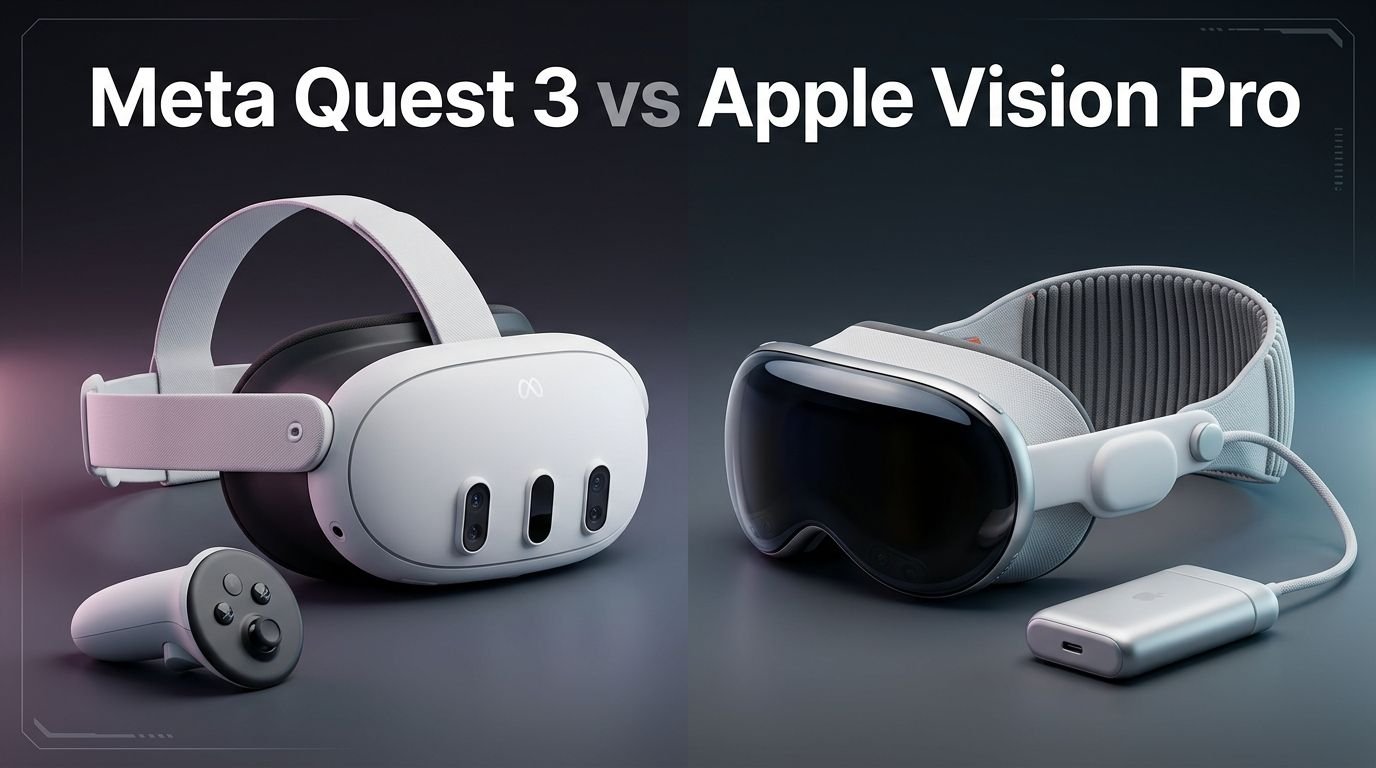
Are you stuck choosing between the Meta Quest 3 and the Apple Vision Pro? You are not alone. These two headsets sit at opposite ends of the mixed reality market. One costs $499. The other costs $3,499.
But price alone does not tell the full story. The Meta Quest 3 delivers a wireless, gaming-focused experience with a massive app library. The Apple Vision Pro offers premium display technology and a spatial computing platform that feels like the future.
This detailed comparison breaks down every important difference. We cover display quality, comfort, performance, app ecosystems, and more. By the end of this post, you will know exactly which headset matches your needs and budget.
Key Takeaways
- The Meta Quest 3 costs $499 for 512GB storage, making it seven times cheaper than the Apple Vision Pro at $3,499. This price gap is the single biggest factor for most buyers. The Quest 3 gives you a complete VR and mixed reality package with controllers included at a price point that most people can afford.
- Apple Vision Pro features 23 million pixels across dual micro-OLED displays. This is far ahead of the Quest 3’s LCD panels with 2064 x 2208 pixels per eye. If display quality matters most to you, the Vision Pro delivers the sharpest image available in any consumer headset today.
- Meta Quest 3 has a much larger gaming library with over 1,000 apps on the Meta Horizon Store. Quest reached a record number of users in 2025, and over 100 titles generated more than $1 million in revenue. The Vision Pro has a growing but smaller selection of spatial apps.
- The Quest 3 is fully wireless and standalone with a battery life of about 2.2 hours. The Apple Vision Pro uses an external battery pack connected by a cable, which limits your freedom of movement during use.
- Apple Vision Pro uses eye tracking and hand gestures as its primary input method. The Quest 3 includes physical Touch Plus controllers and also supports hand tracking. Gamers will generally prefer the tactile feedback of physical controllers.
- Both headsets support mixed reality passthrough, but the Vision Pro’s passthrough camera system produces a noticeably higher fidelity image. The Quest 3’s color passthrough is good for its price but cannot match the clarity Apple delivers.
Meta Quest 3: Overview and Key Features


Last update on 2026-09-21 / Affiliate links / Images from Amazon Product Advertising API Some of the links on this website are affiliate links, which means that at no additional cost to you, I earn a commission if you click through and make a purchase. I only recommend products and services that I believe will add value to my readers. Thank you for your support!
The Meta Quest 3 launched in October 2023. It runs on the Snapdragon XR2 Gen 2 chipset with 8GB of RAM. This gives it double the GPU processing power compared to the Quest 2.
The headset weighs about 515 grams. It uses pancake lenses paired with LCD displays at 2064 x 2208 resolution per eye. You get full color passthrough cameras for mixed reality experiences.
Meta sells the 512GB model for $499. The headset works as a standalone device with no PC or phone required. You can also connect it to a gaming PC with a USB-C cable or wirelessly through Air Link for access to PC VR games.
The Quest 3 ships with two Touch Plus controllers that offer precise tracking. It also supports hand tracking for controller-free use. The Meta Horizon Store gives you access to hundreds of VR games and apps right out of the box.
Pros:
- Affordable $499 price point for the 512GB model
- Fully wireless standalone operation with no external battery
- Huge library of over 1,000 VR games and apps
- Physical controllers included for precise gaming input
- PC VR compatible through Link cable or Air Link
- Lightweight and comfortable for extended sessions
Cons:
- Battery life limited to about 2.2 hours
- LCD display lacks the deep blacks of OLED technology
- Passthrough camera quality is decent but not ultra-sharp
- Plastic build feels less premium than competitors
Apple Vision Pro: Overview and Key Features

Last update on 2026-09-19 / Affiliate links / Images from Amazon Product Advertising API Some of the links on this website are affiliate links, which means that at no additional cost to you, I earn a commission if you click through and make a purchase. I only recommend products and services that I believe will add value to my readers. Thank you for your support!
The Apple Vision Pro entered the market in February 2024. Apple updated it with the M5 chip and a more comfortable Dual Knit Band in a recent refresh. The headset starts at $3,499 for the 256GB model.
The display is the star feature. Apple packed 23 million pixels into dual micro-OLED panels. Each display runs at a resolution of approximately 3660 x 3200 per eye. The result is an incredibly sharp and vibrant image.
The Vision Pro uses an external battery pack connected by cable. This design keeps the headset lighter on your face. The R1 chip handles sensor data in real time, delivering a 12-millisecond photon-to-display latency.
Input relies entirely on eye tracking, hand gestures, and voice commands. There are no physical controllers. The visionOS operating system brings a spatial computing experience that feels natural and intuitive for productivity tasks.
Pros:
- Stunning 23 million pixel micro-OLED display quality
- Best-in-class passthrough for mixed reality use
- Eye tracking and hand gesture input feels futuristic
- Powerful M5 chip handles demanding spatial apps
- Excellent build quality with premium materials
- Deep integration with the Apple ecosystem
Cons:
- Extremely high $3,499 starting price
- External battery pack limits mobility
- Heavier overall setup with the battery cable
- Smaller app library compared to Quest 3
- No physical controllers for gaming
- Limited availability outside Apple Stores
Display Quality and Visual Experience
Display quality is where the Apple Vision Pro pulls far ahead. Its dual micro-OLED panels deliver 23 million total pixels. Colors are rich with 92% DCI-P3 coverage. Black levels are true black because OLED pixels turn off completely.
The Meta Quest 3 uses LCD panels at 2064 x 2208 per eye. The image is sharp and a 30% improvement over the Quest 2. But LCDs cannot match the contrast ratio of OLED technology. Blacks appear gray rather than true black.
The Vision Pro supports refresh rates of 90Hz, 96Hz, 100Hz, and 120Hz. The Quest 3 supports up to 120Hz as well. Both headsets use pancake lens designs that reduce the overall size of the optical stack.
For watching movies, viewing photos, or doing design work, the Vision Pro offers a dramatically better visual experience. For gaming, the Quest 3’s display is more than good enough at its price point.
Mixed Reality and Passthrough Cameras
Both headsets support mixed reality where digital content blends with your real environment. The quality of this experience depends heavily on the passthrough camera system.
The Apple Vision Pro uses a stereoscopic 3D main camera system with high-resolution sensors. The passthrough image is sharp and natural. You can read text on your phone, see facial expressions, and move around your space with confidence.
The Meta Quest 3 features full-color passthrough cameras that represent a big step up from the Quest 2’s grainy black-and-white view. Objects look recognizable, and you can navigate your room easily.
However, the Quest 3’s passthrough still shows noise in low light and some color distortion. The Vision Pro’s passthrough is closer to looking through a pair of sunglasses. This difference matters if you plan to use mixed reality for extended work sessions.
Performance and Processing Power
The Apple Vision Pro runs on the M2 chip (or M5 in the updated model) paired with the dedicated R1 coprocessor. The M2 alone delivers laptop-level performance. The R1 chip processes input from 12 cameras, five sensors, and six microphones in real time.
The Meta Quest 3 uses the Snapdragon XR2 Gen 2 processor with 8GB of RAM. This is a mobile-class chip optimized for VR workloads. It offers double the GPU processing power of the Quest 2.
For VR gaming, the Quest 3’s chip handles most titles at solid frame rates. You will see some graphical compromises compared to PC VR, but the experience is smooth and enjoyable.
The Vision Pro’s processing power supports more demanding spatial apps, multitasking across multiple virtual windows, and high-fidelity 3D rendering. If you need raw computing power, Apple’s silicon is in a different league.
Comfort and Design
Comfort matters a lot for headsets you might wear for hours. The Meta Quest 3 weighs approximately 515 grams. Its compact design sits relatively close to your face. The included strap is basic, but many users upgrade to a third-party elite strap with a battery pack for better weight distribution.
The Apple Vision Pro has a heavier front unit but offloads the battery to an external pack. The updated Dual Knit Band spreads pressure more evenly across your head. Apple also custom-fits the Light Seal to your face shape.
Both headsets use breathable materials on the facial interface. The Quest 3 is easier to pick up and play quickly. The Vision Pro feels more like a precision instrument that requires a proper fitting.
For long sessions, the Vision Pro’s weight distribution and custom fit can feel more comfortable. For short gaming bursts, the Quest 3’s simplicity and lighter weight win out.
Controllers and Input Methods
The Meta Quest 3 ships with Touch Plus controllers. These controllers use infrared tracking and offer thumbsticks, buttons, and triggers. They provide haptic feedback during games. The Quest 3 also supports hand tracking as an alternative input.
The Apple Vision Pro has no physical controllers at all. You interact with visionOS by looking at elements with your eyes, pinching your fingers, and using voice commands. This input system works surprisingly well for browsing, productivity, and media.
For gaming, physical controllers are essential. Shooting games, rhythm games, and action titles all benefit from tactile buttons and precise thumbstick control. This is where the Quest 3 has a clear advantage.
For productivity and media consumption, the Vision Pro’s eye and hand tracking feels natural and eliminates the need to hold anything. Each approach has strengths depending on what you plan to do most.
Gaming and App Ecosystem
The Meta Quest 3 dominates in gaming. The Meta Horizon Store hosts over 1,000 apps and games. Popular titles include Beat Saber, Asgard’s Wrath 2, Batman: Arkham Shadow, Gorilla Tag, and Roblox. Quest reached a record number of active users in 2025.
Over 100 Quest store titles have earned more than $1 million in revenue. Developers actively support the platform because of its large installed user base.
The Apple Vision Pro runs visionOS which offers spatial versions of iPad and iPhone apps. Apple Arcade games work on the headset. Dedicated spatial apps are growing but still limited compared to Meta’s library.
The Vision Pro shines as a productivity and media device. You can place multiple browser windows around your room, watch 3D movies, and use professional creative tools. For pure gaming, the Quest 3 is the far better choice.
Battery Life and Charging
The Meta Quest 3 packs an internal battery rated for approximately 2.2 hours of typical use. You can extend this with external battery pack accessories. Charging happens through a USB-C cable.
The Apple Vision Pro uses an external battery pack that connects to the headset via a proprietary cable. Apple rates battery life at about 2 hours of general use. You can also plug the battery into a wall outlet for unlimited tethered use.
Both headsets offer similar battery life of around 2 hours. The Quest 3’s internal battery keeps things simple and wireless. The Vision Pro’s external battery adds a cable but allows the headset itself to be lighter.
For extended use, both devices benefit from being plugged into power. The Quest 3 can charge while you play through its USB-C port. The Vision Pro can run indefinitely while its battery pack stays connected to an outlet.
Price and Value Comparison
This is the biggest difference between these headsets. The Meta Quest 3 512GB costs $499. It includes two controllers. You get a complete mixed reality and VR gaming system for under $500.
The Apple Vision Pro starts at $3,499 for 256GB. The 512GB model costs $3,700. The 1TB model costs $3,900. No controllers are included because the headset uses hand and eye tracking.
The Quest 3 offers outstanding value for casual and serious VR users. The Vision Pro targets professionals, Apple enthusiasts, and early adopters willing to pay a premium for the best display and spatial computing experience available.
If your budget is the main concern, the Quest 3 is the obvious choice. If you want the absolute best visual fidelity and a premium spatial computing platform, the Vision Pro delivers at a much higher cost.
Who Should Buy the Meta Quest 3?
Last update on 2026-09-21 / Affiliate links / Images from Amazon Product Advertising API Some of the links on this website are affiliate links, which means that at no additional cost to you, I earn a commission if you click through and make a purchase. I only recommend products and services that I believe will add value to my readers. Thank you for your support!
The Quest 3 is ideal for gamers, families, and VR enthusiasts who want a great experience at a reasonable price. If you want to play popular VR titles like Beat Saber, explore social VR apps like Roblox, or enjoy casual mixed reality games, this headset delivers.
It also works well for people new to VR. The wireless design means no complicated setup. The included controllers make interactions intuitive. And the massive app library means you will always find something new to try.
PC VR gamers will also appreciate the Quest 3’s ability to connect to a gaming PC for higher-fidelity experiences. The $499 price makes it accessible to a wide audience.
Who Should Buy the Apple Vision Pro?
The Vision Pro makes sense for professionals, creatives, and productivity-focused users. If you want to work in a spatial environment with multiple virtual monitors, review 3D designs, or watch movies on a massive virtual screen with stunning clarity, this headset excels.
Apple ecosystem users get the most value here. The deep integration with iPhone, iPad, Mac, and iCloud services creates a seamless workflow. Spatial FaceTime, spatial photos, and spatial video playback are unique experiences.
This headset is also for early adopters who want to experience the cutting edge of spatial computing. The display quality and eye-tracking interface genuinely feel like a glimpse of the future. Just be prepared for the premium price.
Final Verdict: Meta Quest 3 vs Apple Vision Pro
The Meta Quest 3 and Apple Vision Pro serve different audiences with different priorities. The Quest 3 wins on value, gaming, portability, and ease of use. The Vision Pro wins on display quality, mixed reality fidelity, build quality, and productivity features.
For most people, the Meta Quest 3 offers the best overall experience for the money. It has a massive game library, wireless freedom, and a price that does not require a second mortgage. The Vision Pro is a remarkable piece of technology, but its $3,499 cost limits its appeal.
If budget is no object and you prioritize display quality and spatial computing, choose the Apple Vision Pro. If you want fun, accessible VR and mixed reality at a fair price, choose the Meta Quest 3. Both headsets represent the best of their respective categories.
FAQs
Is the Meta Quest 3 Worth It in 2026?
Yes. The Meta Quest 3 remains one of the best value headsets on the market. With continued software updates, a growing game library, and regular price promotions, it delivers a premium VR experience for a fraction of what competitors charge. The record-breaking user numbers in 2025 confirm its popularity.
Can the Apple Vision Pro Replace a Monitor?
The Apple Vision Pro can serve as a virtual multi-monitor setup. Many users report using it for focused work sessions with multiple virtual windows. The ultra-sharp display makes text legible and comfortable. However, the 2-hour battery life and weight make it less practical as an all-day monitor replacement without plugging in.
Does the Meta Quest 3 Work Without a PC?
Yes. The Quest 3 is a fully standalone headset. It runs all apps and games directly on the device without a PC, phone, or external hardware. You can optionally connect it to a gaming PC for access to PC VR titles, but it is not required.
Is the Apple Vision Pro Good for Gaming?
The Vision Pro can run Apple Arcade games and some spatial games. But it lacks physical controllers, which limits its appeal for action and rhythm games. The Meta Quest 3 is a much better choice if gaming is your primary use case.
Which Headset Has Better Mixed Reality?
The Apple Vision Pro has superior mixed reality passthrough thanks to its high-resolution camera system. Objects and people look clearer and more natural. The Quest 3’s passthrough is solid and usable but cannot match the Vision Pro’s clarity, especially in low-light conditions.

Hello everyone my name is Alenya and i am a gadget discovering Enthusiast 🐻🐻