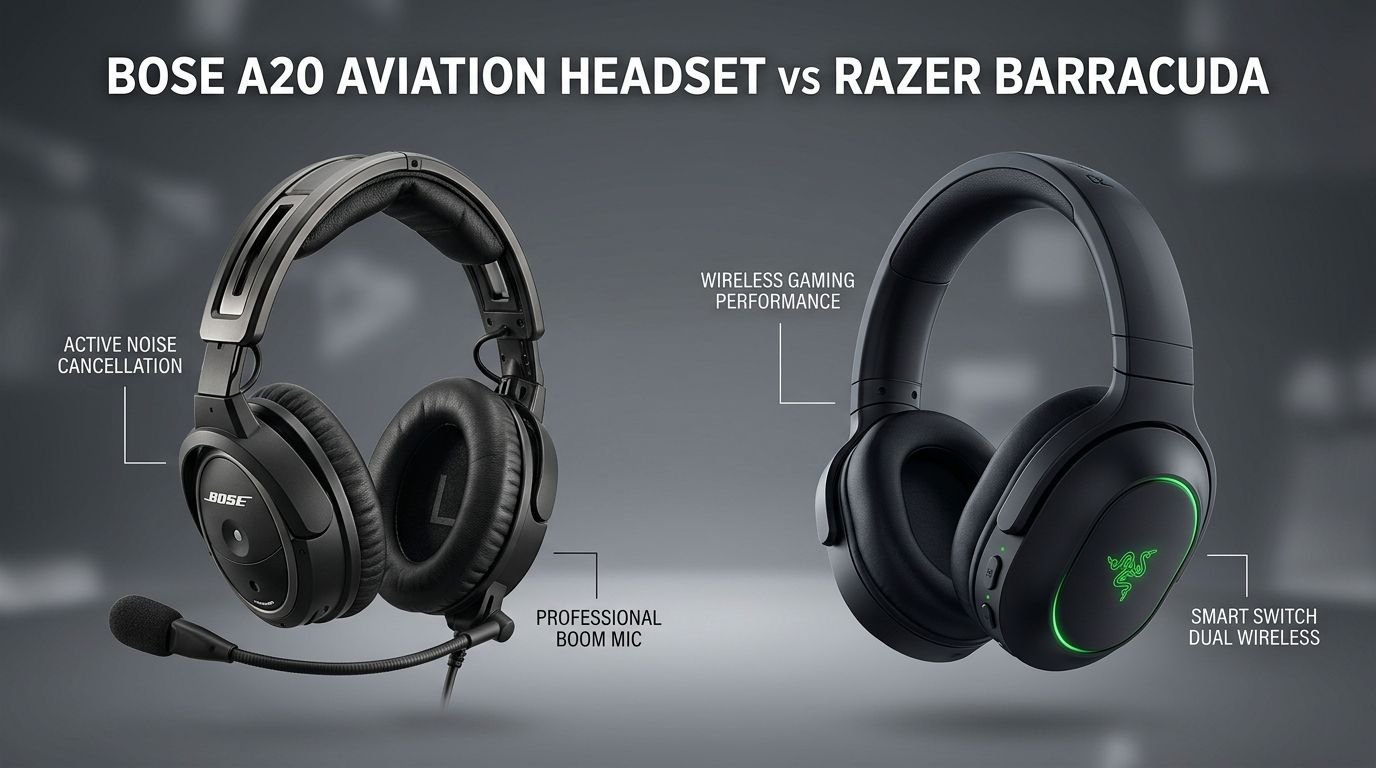
Bose A20 Aviation Headset vs Razer Barracuda
Two headsets. Two completely different worlds. The Bose A20 Aviation Headset is a legendary pilot favorite built for the cockpit.
The Razer Barracuda is a sleek wireless gaming headset made for PC and console play. So why are people comparing them? Because both deliver premium audio, active noise management, and Bluetooth connectivity at serious price points.
Whether you fly planes on weekends or game through the night, choosing the right headset matters. You need comfort for long sessions. You need clear audio that cuts through background noise. And you need a product that justifies its price tag with real performance.
Key Takeaways
- The Bose A20 is a professional aviation headset with FAA TSO C139 certification. It delivers 30% more noise reduction than standard aviation headsets. It weighs only 12 ounces and runs on 2 AA batteries that last over 45 hours. This headset costs around $1,095 and serves a very specific audience: pilots.
- The Razer Barracuda is a dual wireless gaming headset with 2.4GHz and Bluetooth connectivity. It uses 50mm drivers for rich sound. It weighs about 300 grams and offers up to 40 hours of battery life. It retails near $159 and targets gamers who also want a lifestyle headset.
- Noise cancellation works differently on each headset. The Bose A20 uses active noise reduction (ANR) built for cockpit engine noise up to 115 dBC SPL. The Razer Barracuda uses passive noise isolation through its closed back ear cups and memory foam cushions.
- Comfort is a top priority for both brands. The Bose A20 uses minimal clamping force and sheepskin ear cushions for long flights. The Razer Barracuda has breathable memory foam pads and a lightweight frame for extended gaming sessions.
- Connectivity options differ by use case. The Bose A20 uses aviation specific plugs (dual GA, LEMO, or U174) plus Bluetooth. The Razer Barracuda uses a USB C 2.4GHz dongle and Bluetooth 5.2 for multiplatform switching.
- Your choice depends on your primary activity. Pilots need the Bose A20 for its certified noise protection and aviation grade audio clarity. Gamers and commuters get more value from the Razer Barracuda with its versatile wireless options and modern sound profile.
Bose A20 Aviation Headset Overview

Last update on 2026-09-19 / Affiliate links / Images from Amazon Product Advertising API Some of the links on this website are affiliate links, which means that at no additional cost to you, I earn a commission if you click through and make a purchase. I only recommend products and services that I believe will add value to my readers. Thank you for your support!
The Bose A20 Aviation Headset has been a cockpit staple for over a decade. Bose originally launched it to give pilots best in class noise reduction without sacrificing comfort. It holds FAA TSO C139 certification, which means it meets strict federal safety standards for aviation audio equipment.
This headset delivers approximately 30% greater noise reduction than conventional aviation headsets. The active equalization system adjusts audio output based on the noise environment around you. Voices stay clear even at high altitudes with loud engine noise.
The A20 weighs just 12 ounces. That makes it one of the lightest active noise cancelling aviation headsets available today. Pilots who wear headsets for 6 to 10 hours at a time appreciate this low weight and the gentle clamping force Bose engineered into the headband.
Pros:
- Industry leading active noise reduction for cockpit use
- FAA TSO C139 certified for professional aviation
- Only 12 ounces with minimal clamping force
- 45+ hour battery life on 2 AA batteries
- Bluetooth connectivity for phone calls and music
- Customizable audio prioritization between sources
Cons:
- Priced around $1,095, which is expensive even for aviation gear
- Uses aviation specific plugs, limiting everyday use
- No USB or 3.5mm standard audio connections
- Bulky control module on the cable
- Now considered older technology compared to the Bose A30
Razer Barracuda Wireless Headset Overview


Last update on 2026-09-19 / Affiliate links / Images from Amazon Product Advertising API Some of the links on this website are affiliate links, which means that at no additional cost to you, I earn a commission if you click through and make a purchase. I only recommend products and services that I believe will add value to my readers. Thank you for your support!
The Razer Barracuda sits in the middle of Razer’s Barracuda lineup, between the budget Barracuda X and the premium Barracuda Pro. It launched as a hybrid gaming and lifestyle headset. Razer built it for people who game at home and listen to music on the go.
It features 50mm custom tuned drivers that deliver a wide frequency response from 20Hz to 20kHz. The integrated noise cancelling microphones use beamforming technology to pick up your voice while filtering ambient sound. The dual wireless system lets you switch between 2.4GHz and Bluetooth with Razer SmartSwitch.
The headset weighs about 300 grams and uses plush memory foam ear cushions covered in breathable fabric. Battery life reaches up to 40 hours on a single charge through USB C. It supports THX Spatial Audio for immersive directional sound in games.
Pros:
- Dual wireless with 2.4GHz and Bluetooth 5.2
- 50mm drivers with a full 20Hz to 20kHz range
- 40 hour battery life with USB C fast charging
- Integrated beamforming noise cancelling microphone
- THX Spatial Audio support for gaming
- Sleek, modern design suitable for public use
Cons:
- No active noise cancellation on the standard model
- Passive isolation may not block all background noise
- Microphone quality does not match dedicated boom mics
- No 3.5mm wired backup option included
- Clamping force may feel light for some head sizes
- Software customization requires Razer Synapse
Sound Quality Comparison
Sound quality is where these two headsets reveal their completely different design goals. The Bose A20 focuses on voice clarity and noise reduction in high decibel environments. It uses active equalization to keep communications crystal clear even above engine noise levels of 115 dBC SPL.
The Razer Barracuda prioritizes music and gaming audio. Its 50mm drivers produce deeper bass, wider soundstage, and more detail across the frequency spectrum. THX Spatial Audio adds a layer of positional sound that gamers need for competitive play.
If you judge purely on music listening, the Razer Barracuda wins. Its drivers are tuned for entertainment. The Bose A20 was never built for music enjoyment. Its audio profile centers on the human voice range. However, the Bluetooth feature on the A20 does let you stream music with decent quality during flights.
Noise Cancellation and Isolation
The Bose A20 uses active noise reduction (ANR). This is a powered system that generates opposing sound waves to cancel ambient noise. Bose is a pioneer in this technology. The A20 reduces cockpit noise by roughly 30% more than passive headsets. It works at altitudes up to 15,000 feet at full performance.
The Razer Barracuda relies on passive noise isolation. The closed back ear cups and memory foam cushions create a physical seal around your ears. This blocks some external sound but cannot actively cancel low frequency noise like engine rumble or air conditioning hum.
For noisy environments, the Bose A20 is far superior. Its ANR system was built to handle extreme sound pressure levels. The Razer Barracuda works fine for a quiet gaming room or a mildly noisy commute. But it cannot compete with powered noise cancellation in loud settings.
Comfort and Build Quality
Both headsets prioritize comfort because users wear them for long periods. The Bose A20 uses a spring steel headband wrapped in comfortable padding. The ear cushions are made from soft materials that sit gently against the head. At only 12 ounces, the A20 barely registers on your head.
The Razer Barracuda uses a stainless steel and plastic construction. It weighs around 300 grams (about 10.5 ounces). The memory foam ear cushions are covered with breathable fabric. The headband distributes pressure evenly. Most users report good comfort for 3 to 5 hour sessions.
The Bose A20 edges ahead on long session comfort. Its minimal clamping force and featherlight weight make it comfortable for 8+ hour flights. The Razer Barracuda is comfortable too, but some users report that the light clamp lets the headset slip during movement. Both products feel solidly built and durable.
Connectivity Options
The Bose A20 connects through aviation specific plugs. You choose between dual GA plugs, a 6 pin LEMO connector, or a U174 helicopter plug at purchase. It also includes Bluetooth for pairing with phones or tablets. An auxiliary 3.5mm input on the control module accepts external audio sources.
The Razer Barracuda uses a USB C 2.4GHz wireless dongle for low latency gaming connections. It also has Bluetooth 5.2 for mobile devices. Razer SmartSwitch lets you toggle between these two wireless modes with a button press. There is no wired audio jack on this model.
The Bose A20 is limited to aviation environments plus Bluetooth. The Razer Barracuda connects to PCs, PlayStation, Nintendo Switch, Android, and iOS devices. For everyday versatility, the Razer Barracuda offers much broader connectivity. The Bose A20 serves a single professional purpose.
Microphone Performance
Clear voice communication is essential for both products. The Bose A20 uses an electret microphone on a flexible boom arm. This microphone is optimized for aviation radio communication. It delivers clear voice transmission even in extreme noise conditions. Pilots depend on it for safety critical ATC communication.
The Razer Barracuda has an integrated beamforming microphone. There is no boom arm. The mic sits inside the ear cup housing and uses noise cancelling algorithms to isolate your voice. This design keeps the headset looking clean for outdoor use. But integrated mics generally pick up more background noise than boom mics.
For voice clarity in noisy conditions, the Bose A20 wins easily. The boom mic placement near your mouth captures voice directly. The Razer Barracuda mic works well for gaming chat and phone calls in moderate environments. It will struggle in loud public spaces.
Battery Life and Power
The Bose A20 runs on 2 AA alkaline batteries. These last approximately 45 hours under typical general aviation use. The headset continues to function as a passive headset even if the batteries die. You just lose the active noise reduction feature. Battery replacement takes seconds in the cockpit.
The Razer Barracuda has a built in rechargeable battery. It delivers up to 40 hours of use on a single charge. Charging happens through the USB C port. A full charge takes roughly 3 hours. You cannot swap or replace the battery without disassembly.
Both headsets offer excellent battery endurance. The Bose A20 has a slight edge with 45 hours and the convenience of replaceable AA batteries. The Razer Barracuda trades that for a sleeker rechargeable design. Neither headset will leave you scrambling for power during a typical use session.
Price and Value for Money
The Bose A20 Aviation Headset retails at approximately $1,095. That is a premium price. But within the aviation headset market, it competes directly with products from David Clark and Lightspeed. Most pilots consider the Bose A20 a worthwhile long term investment for hearing protection and communication quality.
The Razer Barracuda costs around $159. In the gaming headset market, this places it in the mid range tier. Competitors include the SteelSeries Arctis Nova 7 and the HyperX Cloud III Wireless. The Barracuda offers solid sound and connectivity for its price.
Comparing value between these two products is difficult because they serve different audiences. A pilot cannot use the Razer Barracuda in a cockpit. A gamer has no reason to buy the Bose A20. Each headset delivers strong value within its own market segment.
Who Should Buy the Bose A20?
The Bose A20 is the right choice for private pilots, student pilots, and commercial aviators. If you fly regularly and need certified noise protection, this headset delivers. Its 30% noise reduction advantage keeps your hearing safe over years of cockpit exposure.
Pilots who make long cross country flights will love the comfort. The 12 ounce weight and gentle clamping force prevent headset fatigue. The Bluetooth feature lets you take phone calls or stream audio during cruise without removing your headset.
If you already own an older passive aviation headset and feel fatigued after flights, the Bose A20 is a significant upgrade. The active noise reduction alone justifies the price for anyone who values long term hearing health and clear ATC communication.
Who Should Buy the Razer Barracuda?
The Razer Barracuda fits gamers who want a versatile headset. If you play on PC, PlayStation, and Nintendo Switch, the dual wireless connectivity saves you from buying multiple headsets. The 2.4GHz mode gives you low latency for competitive games. Bluetooth mode works for your phone or tablet.
This headset also works well as a daily commuter headset. Its modern design does not scream “gaming headset.” You can wear it on trains, buses, or at a coffee shop without drawing attention. The 40 hour battery life lasts through a full work week of commuting.
If you want one headset for gaming at home and music on the go, the Razer Barracuda checks both boxes. It does not have active noise cancellation like the Barracuda Pro. But the passive isolation and strong audio quality make it a great mid range pick.
Final Verdict: Bose A20 vs Razer Barracuda
These two headsets do not compete against each other in any traditional sense. The Bose A20 is a specialized aviation tool built for pilots. The Razer Barracuda is a consumer audio device built for gamers and music lovers.
Choose the Bose A20 if you need certified aviation noise reduction, a boom microphone for radio communication, and all day cockpit comfort. It is expensive, but it protects your hearing and keeps communications clear at 10,000 feet.
Choose the Razer Barracuda if you want wireless gaming audio, Bluetooth for your phone, and a sleek look for everyday wear. It delivers excellent sound and connectivity at a fraction of the Bose A20’s price. Both headsets are top performers in their respective categories. The best choice depends entirely on where and how you plan to use it.
Frequently Asked Questions
Can I use the Bose A20 for gaming or music listening?
The Bose A20 has a Bluetooth connection that lets you stream music or audio from a phone. However, its audio profile is tuned for voice communication. It will not deliver the bass response or soundstage that gaming headsets like the Razer Barracuda provide. It also lacks a standard USB or 3.5mm connection for direct PC hookup.
Does the Razer Barracuda have active noise cancellation?
No. The standard Razer Barracuda uses passive noise isolation through its closed ear cups and memory foam cushions. If you want active noise cancellation from Razer, you need the Razer Barracuda Pro, which includes hybrid ANC technology. The standard model blocks some ambient sound but does not actively cancel noise.
How long does each headset last on a single charge?
The Bose A20 lasts approximately 45 hours on 2 AA alkaline batteries. The Razer Barracuda lasts up to 40 hours on its built in rechargeable battery. Both headsets offer excellent endurance for their intended use.
Is the Bose A20 worth the $1,095 price tag?
For pilots, yes. The Bose A20 provides certified noise protection, clear ATC communication, and exceptional comfort for long flights. Hearing damage from cockpit noise is cumulative and permanent. Most active pilots view the A20 as a smart investment in safety and comfort.
Can the Razer Barracuda connect to multiple devices at once?
The Razer Barracuda supports 2.4GHz wireless and Bluetooth 5.2. You can pair it to two devices and use the SmartSwitch button to toggle between them. However, it does not play audio from two sources at the same time. You switch active connections manually.
Which headset is more comfortable for extended use?
The Bose A20 has a slight advantage because of its 12 ounce weight and minimal clamping force. It was built for 8+ hour flights. The Razer Barracuda weighs about 300 grams and feels comfortable for several hours. Both headsets work well for long sessions, but the Bose A20 edges ahead for all day wear.

Hello everyone my name is Alenya and i am a gadget discovering Enthusiast 🐻🐻