
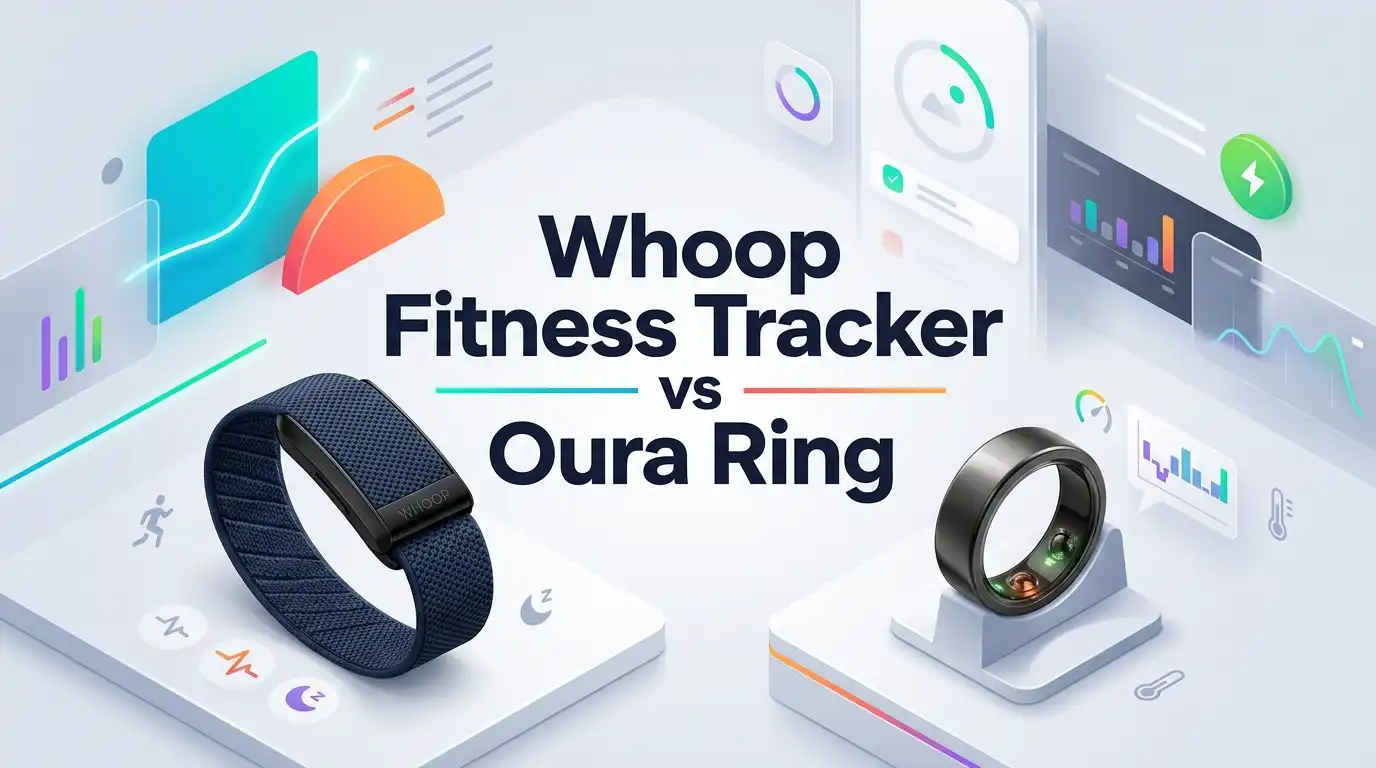
Whoop Fitness Tracker vs Oura Ring: Which Is Best?
Are you stuck choosing between the Whoop fitness tracker and the Oura Ring? You are not alone. These two screenless wearables have taken the health and fitness world by storm. Both promise to track your sleep, recovery, heart rate, and stress without the distraction of a screen. But they do it in very different ways.
One sits on your wrist like a band. The other slides on your finger like a piece of jewelry. One requires a yearly membership that includes the device. The other costs more upfront but has a cheaper monthly fee. So which one should you actually buy in 2026?
This detailed comparison breaks down every feature, cost, and key difference between the Whoop 5.0 and the Oura Ring 4. By the end, you will know exactly which tracker fits your lifestyle, your budget, and your fitness goals. Let’s get into it.
Key Takeaways
- The Whoop 5.0 is a subscription-based wearable. You pay $199 to $359 per year depending on the plan, and the device is included. There is no separate purchase for the tracker itself. This makes it affordable in year one but more expensive over time.
- The Oura Ring 4 starts at $349 as a one-time purchase. It also requires a $5.99 per month or $69.99 per year membership for full app features. Over two or more years, the Oura Ring becomes the more budget-friendly option.
- Both trackers monitor heart rate, HRV, sleep stages, blood oxygen, skin temperature, and stress. The Oura Ring tracks over 50 health metrics, including steps and daily movement. The Whoop focuses more on strain, recovery, and workout intensity.
- Battery life differs significantly. The Whoop 5.0 lasts up to 16.5 days on a single charge. The Oura Ring 4 lasts about 5 to 8 days. Whoop also offers a wireless power pack so you never need to remove the device.
- Design is a major factor. The Oura Ring looks like regular jewelry and blends into any outfit. The Whoop is a wrist or arm band that looks sporty and gym-focused.
- Sleep tracking is a strength for both devices. Studies have validated the accuracy of each tracker for measuring sleep stages. The Oura Ring presents sleep data in a more detailed and visual way. The Whoop offers more prescriptive advice, like bedtime recommendations and sleep debt calculations.
What Is the Whoop Fitness Tracker?

Last update on 2026-09-19 / Affiliate links / Images from Amazon Product Advertising API Some of the links on this website are affiliate links, which means that at no additional cost to you, I earn a commission if you click through and make a purchase. I only recommend products and services that I believe will add value to my readers. Thank you for your support!
The Whoop is a screenless wrist-worn fitness tracker that focuses on recovery, strain, and sleep. The latest version is the Whoop 5.0, launched in May 2025. It does not have a display screen. All your data lives inside the Whoop app on your phone.
Whoop uses photoplethysmography (PPG) sensors, a skin temperature sensor, and an accelerometer to collect data. It tracks heart rate, heart rate variability, respiratory rate, blood oxygen, and stress levels around the clock. The device also calculates a daily Strain Score to show how hard your body worked.
The Whoop 5.0 introduced 14+ days of battery life, a major upgrade from the Whoop 4.0. It also features improved sensors and new health insights like VO2 max estimation and Pace of Aging. You can wear it on your wrist or move it to your bicep with an arm band accessory.
Pros:
- Device is included with subscription, no separate hardware cost
- Up to 16.5 days of battery life
- Wireless power pack lets you charge without removing the band
- Tracks strain, recovery, and sleep in one simple system
- Supports logging of specific exercises like squat and bench press
Cons:
- Requires an ongoing yearly subscription ($199 to $359 per year)
- No step counter built in
- No screen for real-time data viewing
- Sporty design may not suit formal occasions
- Extra band colors and accessories cost more
What Is the Oura Ring?


Last update on 2026-09-19 / Affiliate links / Images from Amazon Product Advertising API Some of the links on this website are affiliate links, which means that at no additional cost to you, I earn a commission if you click through and make a purchase. I only recommend products and services that I believe will add value to my readers. Thank you for your support!
The Oura Ring is a smart ring that tracks sleep, activity, heart rate, stress, and more. The latest model is the Oura Ring 4, released in late 2024. It looks and feels like a regular ring. Most people will not even notice you are wearing a health tracker.
The Oura Ring 4 uses red and green infrared LEDs for heart rate and SpO2 tracking. It also has skin temperature sensors and an accelerometer. The ring tracks over 50 health metrics, including sleep stages, resting heart rate, HRV, breathing rate, daily steps, and women’s health insights like menstrual cycle predictions.
Oura Ring 4 features a fully titanium design with recessed sensors for better comfort. It is water resistant up to 100 meters. Battery life ranges from 5 to 8 days depending on ring size and usage. It comes in six color options and sizes 4 through 15.
Pros:
- Sleek ring design that looks like regular jewelry
- Tracks over 50 health metrics including step count
- Water resistant to 100 meters
- Up to 8 days of battery life
- Lower ongoing subscription cost ($5.99 per month)
Cons:
- Higher upfront cost starting at $349
- Ring may get scratched during weight lifting
- Subscription needed for full app features
- Cannot be worn on the wrist or bicep
- Sizing can be tricky without the sizing kit
Design and Comfort
The design difference between these two trackers is the biggest distinguishing factor. The Whoop 5.0 is a slim wrist band with no screen. You can also move the sensor into a bicep band or even clip it into Whoop-compatible apparel. It weighs very little and feels barely noticeable on your wrist during workouts and sleep.
The Oura Ring 4 is a lightweight titanium ring. It sits on your finger and looks like a piece of jewelry. You can wear it to the gym, to a formal dinner, or to bed without drawing attention. The recessed sensor design makes the interior smooth and comfortable for all-day wear.
If you prefer a sporty and functional look, the Whoop is a solid pick. If you want something discreet and stylish, the Oura Ring wins. Both devices are comfortable enough for 24/7 wear. The choice here comes down to personal style and where you want to wear your tracker.
Sleep Tracking Comparison
Sleep tracking is one of the top reasons people buy these devices. Both the Whoop 5.0 and the Oura Ring 4 measure sleep duration, sleep stages (light, deep, REM), sleep efficiency, and restfulness. Both have been validated by scientific studies for sleep accuracy.
The Oura Ring presents sleep data in a detailed visual format. You see a timeline of your night with each sleep stage mapped out. It also shows your overnight heart rate, HRV, breathing regularity, and SpO2 on one screen. Your daily Sleep Score ranges from 0 to 100.
The Whoop takes a more prescriptive approach to sleep. It tracks sleep debt and recommends ideal bedtimes to help you catch up on rest. It assigns a Sleep Performance percentage that shows how well your actual sleep matches your body’s needs. Both apps make it easy to spot trends over weeks and months.
Health and Recovery Metrics
Both devices give you a daily readiness or recovery score to guide your training. The Oura Ring calls it a Readiness Score. The Whoop calls it a Recovery Score. Each score pulls from your HRV, resting heart rate, sleep quality, and other biometrics.
The Whoop 5.0 also calculates a daily Strain Score. This number shows how much physical and mental stress your body handled that day. It helps you decide if you should push harder or take a rest day. Whoop also tracks Pace of Aging and physiological age for long-term health insights.
The Oura Ring 4 measures your cardiovascular age and cardio capacity over time. It also tracks stress levels throughout the day and graphs them against your recent activity. This makes it easy to see what triggers stress spikes. Both devices are strong recovery trackers, but Whoop leans more toward athletic performance while Oura leans toward holistic wellness.
Fitness and Activity Tracking

Last update on 2026-09-19 / Affiliate links / Images from Amazon Product Advertising API Some of the links on this website are affiliate links, which means that at no additional cost to you, I earn a commission if you click through and make a purchase. I only recommend products and services that I believe will add value to my readers. Thank you for your support!
Neither the Whoop nor the Oura Ring is a traditional fitness tracker with GPS and real-time workout stats on your wrist. They both focus on background health monitoring rather than in-workout coaching.
The Whoop 5.0 supports a wide range of trackable activities. You can log specific strength exercises like back squats and bench presses. It also auto-detects certain workouts. Your Strain Score updates throughout the day based on your heart rate and activity level.
The Oura Ring 4 tracks 40 types of exercises and monitors your daily step count. It records steps, active calories, and total movement. However, lifting weights with a ring on your finger can cause scratches over time. Some users remove the ring during heavy lifting, which means that workout goes untracked.
Pros of Whoop for fitness:
- Logs specific strength training exercises
- No risk of damage during weight lifting
- Strain Score updates in real time
Pros of Oura for fitness:
- Built-in step tracking
- Tracks 40 exercise types
- Daily movement and calorie data
Battery Life and Charging
Battery life is a clear win for the Whoop 5.0. In testing, it lasted up to 16.5 days on a single charge. That is more than double what the Oura Ring offers. The Whoop also comes with a wireless power pack that snaps onto the band. You can recharge the tracker without ever taking it off your wrist.
The Oura Ring 4 lasts between 5 and 8 days depending on your ring size and how many features you use. Charging requires you to remove the ring and place it on a charging dock. A full charge takes about 60 to 80 minutes.
For people who hate removing their tracker, the Whoop is the obvious winner. For those who do not mind a quick weekly charge, the Oura Ring’s battery life is still very respectable compared to most smartwatches.
Subscription and Pricing Breakdown
Pricing is where things get interesting. The Whoop 5.0 operates on a full subscription model. You do not buy the device separately. The three tiers are Whoop One at $199 per year, Whoop Peak at $239 per year, and Whoop Life at $359 per year. The Peak plan includes the Whoop 5.0, a SuperKnit band, and a wireless power pack.
The Oura Ring 4 starts at $349 as a one-time purchase. The app subscription costs $5.99 per month or $69.99 per year. In year one, total cost for an Oura Ring is about $419. In year two, you only pay the $70 subscription fee.
Over two years, Whoop Peak costs $478 while Oura Ring costs about $489. Over three years, Oura drops to $559 while Whoop climbs to $717. The longer you keep the Oura Ring, the more money you save.
Water Resistance
Water resistance differs significantly between these two devices. The Oura Ring 4 is water resistant up to 100 meters. You can wear it in the shower, the pool, and even during recreational diving. There are no concerns about everyday water exposure.
The Whoop 5.0 is water resistant but rated for much shallower depths. It can handle sweat, rain, and quick showers. However, it is not built for extended underwater use like lap swimming at depth.
If you are a swimmer or spend a lot of time in the water, the Oura Ring is the better choice. For regular gym use and daily life, both devices handle moisture just fine.
App Experience and Data Presentation
Both the Whoop app and the Oura app are well-designed and easy to use. They work on both iOS and Android devices. Each app displays your daily scores, trends over time, and detailed breakdowns of sleep, activity, and recovery.
The Oura app tends to be more data-rich and visual. It shows granular details like your overnight heart rate curve, HRV trends, and body temperature fluctuations. The app also features an AI advisor called Oura Advisor that gives personalized health tips.
The Whoop app is more action-oriented. It tells you how much strain to aim for today, what time you should go to bed, and whether your body is recovered enough for a hard workout. The journal feature in Whoop lets you track habits like caffeine, alcohol, and supplements to see how they affect your recovery.
Women’s Health Features
Both devices offer menstrual cycle tracking features. The Oura Ring 4 uses body temperature data to monitor hormone changes and predict cycle phases. It tells you which phase you are in and when your next period is likely to start.
The Whoop 5.0 also tracks your menstrual cycle. It goes a step further with personalized coaching during your cycle. If your recovery drops during certain phases, Whoop may suggest extra rest or a lighter workout day.
Both devices take women’s health seriously. The Oura Ring provides more predictive data based on temperature trends. The Whoop provides more adaptive coaching based on how your cycle affects your performance.
Which One Should You Buy in 2026?

Last update on 2026-09-19 / Affiliate links / Images from Amazon Product Advertising API Some of the links on this website are affiliate links, which means that at no additional cost to you, I earn a commission if you click through and make a purchase. I only recommend products and services that I believe will add value to my readers. Thank you for your support!
The right choice depends on your priorities. If you are an athlete or serious gym-goer who values strain tracking and coaching, the Whoop 5.0 is the better fit. It excels at telling you exactly how hard to push and when to rest.
If you want a discreet tracker that monitors sleep, steps, heart health, and stress without looking like a fitness device, the Oura Ring 4 is the winner. It also saves you money over two or more years of use.
Both devices are excellent. You cannot go wrong with either one. Consider your budget timeline, your style preference, and whether you value athletic coaching or holistic health tracking more.
Frequently Asked Questions
Is Whoop or Oura Ring more accurate for sleep tracking?
Both devices have been validated by scientific studies for sleep accuracy. The Oura Ring tends to detect sleep and wake times automatically. The Whoop may need manual bedtime entry for best results. Most reviewers consider both to be very accurate for consumer-grade trackers.
Can I wear the Oura Ring while lifting weights?
You can wear it during workouts. However, barbells and dumbbells may scratch the titanium surface over time. Some users remove the ring during heavy lifting to prevent damage.
Does the Whoop track steps?
No. The Whoop does not have a built-in step counter. It focuses on heart rate, strain, recovery, and sleep. If step tracking is important to you, the Oura Ring is the better option.
Do both devices require a subscription?
Yes. The Whoop requires a subscription to function at all. The Oura Ring works with basic features without a subscription, but you need the membership for full access to detailed health data and insights.
Which device has better battery life?
The Whoop 5.0 has much better battery life at up to 16.5 days. The Oura Ring 4 lasts 5 to 8 days. Whoop also offers a wireless power pack for on-the-go charging.
Can I swim with the Whoop and Oura Ring?
The Oura Ring 4 is water resistant to 100 meters, making it safe for swimming and diving. The Whoop 5.0 handles sweat and light water exposure but is not rated for deep water activities like lap swimming.

Hello everyone my name is Alenya and i am a gadget discovering Enthusiast 🐻🐻