WHOOP 5.0/MG Activity Tracker Review 2026: Worth It?
You sleep eight hours and still wake up wrecked. You train hard but cannot tell if you are progressing or breaking down.
Most wearables flood you with steps and notifications, yet they fail to answer the single question that matters: am I actually recovering?
The WHOOP 5.0 and its premium sibling, the WHOOP MG, were built for exactly this gap. They skip the screen, skip the buzz, and focus on strain, recovery, sleep, and now medical-grade heart data. After weeks on the wrist, here is the honest breakdown.
In a Nutshell
- Screenless design: The band has no display, which removes distraction and stretches battery life to 14+ days on a single charge.
- Membership-based pricing: You do not buy the hardware outright. Plans start at $199/year (WHOOP One), $239/year (Peak), and $359/year (Life with MG device).
- Health metrics that matter: Heart Rate Variability (HRV), Resting Heart Rate, Respiratory Rate, Sleep Stages, Strain Score, and Recovery % update continuously.
- MG-exclusive features: Medical-grade ECG with AFib screening, Blood Pressure Insights, and Healthspan/WHOOP Age sit only on the MG tier.
- Best for: Serious athletes, biohackers, shift workers, and anyone tracking long-term cardiovascular health.
- Not for: People who want a watch face, music control, GPS on the wrist, or a one-time hardware purchase with no recurring fee.
What Is the WHOOP 5.0/MG

Last update on 2026-09-20 / Affiliate links / Images from Amazon Product Advertising API Some of the links on this website are affiliate links, which means that at no additional cost to you, I earn a commission if you click through and make a purchase. I only recommend products and services that I believe will add value to my readers. Thank you for your support!
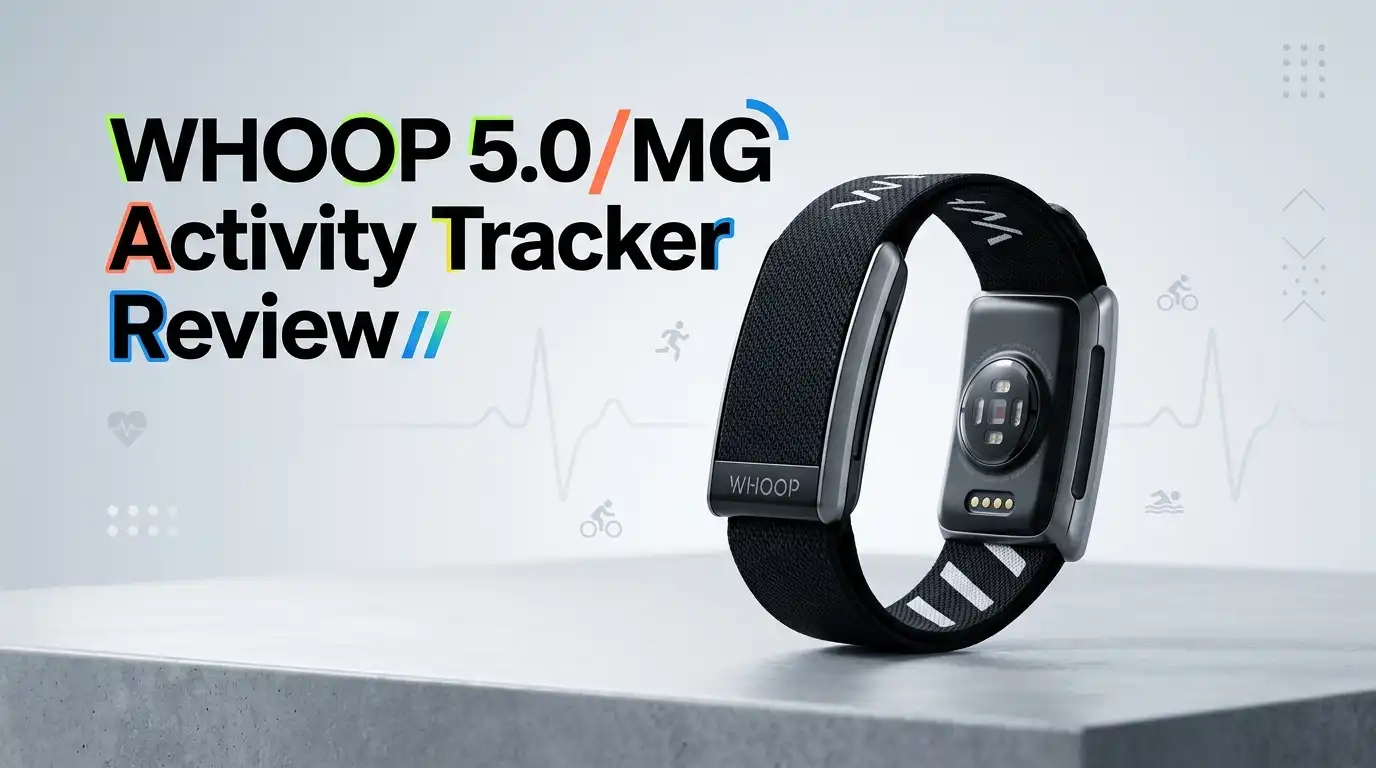
WHOOP is a 24/7 health and performance band that ditches the smartwatch concept entirely. The 5.0 is the standard 2026 model. The MG (Medical Grade) is the same physical sensor stack, unlocked with extra clinical features through software.
Both pull data every second using PPG sensors, skin temperature, and a 3-axis accelerometer. The band stays on your wrist, bicep, or in compatible apparel.
The pitch is simple. Stop counting steps. Start measuring load and recovery. The MG version pushes further into early heart-condition screening, which makes it the first WHOOP that doubles as a soft medical tool.
Unboxing and First Impressions
The box is small, recyclable cardboard, and almost suspiciously light. Inside sits the SuperKnit or CoreKnit band, the sensor module, a battery pack with USB-C, and a quick-start card. No charging dock, no plastic clamshell, no manual the size of a novel.
The sensor itself is smaller and 7% slimmer than the WHOOP 4.0. It clicks into the band with a satisfying snap. The fabric strap feels like a high-end running sock, breathable and soft.
Setup runs through the WHOOP app. You scan a QR code, calibrate with a standard blood pressure cuff if you bought the MG, and you are live in about ten minutes. The whole experience feels premium without being flashy.
Top 3 Alternatives for WHOOP 5.0/MG
If a subscription model or a screenless band is not your style, three trackers cover similar ground with different trade-offs.


Last update on 2026-10-14 / Affiliate links / Images from Amazon Product Advertising API Some of the links on this website are affiliate links, which means that at no additional cost to you, I earn a commission if you click through and make a purchase. I only recommend products and services that I believe will add value to my readers. Thank you for your support!
Oura Ring 4

Last update on 2026-09-19 / Affiliate links / Images from Amazon Product Advertising API Some of the links on this website are affiliate links, which means that at no additional cost to you, I earn a commission if you click through and make a purchase. I only recommend products and services that I believe will add value to my readers. Thank you for your support!
Fitbit Charge 6

Last update on 2026-09-21 / Affiliate links / Images from Amazon Product Advertising API Some of the links on this website are affiliate links, which means that at no additional cost to you, I earn a commission if you click through and make a purchase. I only recommend products and services that I believe will add value to my readers. Thank you for your support!
Garmin Venu 3
Design Build and Comfort
The 5.0 module is roughly the size of a thumb tip and weighs almost nothing once strapped on. The lack of a screen means there is no glass to scratch. You can sleep on it, lift with it, shower with it, and forget it exists.
The SuperKnit band uses a hook-and-loop style closure that does not pinch. I wore it for ten straight nights without a pressure mark. The band dries quickly after sweat, which matters if you train twice a day.
Color options span muted neutrals to bold accents. The MG version ships with a premium leather-and-knit hybrid strap on the Life tier. Bicep sleeves and Any-Wear apparel (boxers, sports bras, leggings with sensor pockets) extend wear locations for people who hate wrist bands.
Battery Life and Charging
This is where WHOOP made the biggest leap. The 5.0/MG promises 14+ days per charge, and in real use I averaged 12 to 13 days with heavy workout logging and continuous skin-temperature tracking.
The PowerPack battery slides onto the sensor while you wear it. No downtime, no removing the device. A full top-up takes about 90 minutes. The PowerPack itself holds roughly 30 days of charge, which is useful for travel.
Compared to the 4.0’s 4-to-5-day battery, this is a meaningful quality-of-life upgrade. You charge it twice a month and stop thinking about it.
Strain Recovery and Sleep Tracking
WHOOP’s core triangle has not changed in concept but the sensor accuracy in 2026 is sharper. Strain Score runs on a 0-21 logarithmic scale and measures cardiovascular load across the full day, not just workouts.
Recovery % is calculated from overnight HRV, resting heart rate, respiratory rate, and sleep performance. A green score above 67% means push. Yellow means hold. Red means back off. After eight weeks, the recommendations correlated tightly with how I actually felt.
Sleep tracking detects naps automatically and breaks the night into light, deep, REM, and awake stages. The new Sleep Performance % factors in your personal need, not a generic eight-hour target. It is the most useful sleep metric I have used on any wearable.
Medical Grade Features on the MG
This is the MG’s reason to exist. The on-demand ECG runs through a finger-touch electrode on the sensor housing. You hold it for 30 seconds and get a clinically-reviewed AFib screening, similar to what Apple Watch and Withings offer.
Blood Pressure Insights is the headline feature. After a one-time cuff calibration, the device estimates daily systolic and diastolic ranges using PPG waveforms, HRV, and pulse transit data. It is not FDA-cleared as a diagnostic tool but is positioned as a trend indicator.
Healthspan and WHOOP Age translate your biometrics into a biological age estimate and pace of aging score. Useful for motivation. Less useful as gospel.
App Experience and Coaching
The WHOOP app is the real product. The home screen shows Recovery, Strain, and Sleep in three rings. Tapping any ring opens deep analytics with weekly and monthly trends.
The WHOOP Coach, an AI assistant trained on your data, answers questions like “why is my recovery low this week” or “how should I train tomorrow”. The responses pull from your actual numbers, not generic advice. It has improved dramatically since the 2023 launch.
Journal entries let you log alcohol, caffeine, supplements, stress, and dozens of other variables. After a month, the app shows which behaviors raise or tank your recovery. This is the feature that changes habits.
Accuracy and Real-World Performance
Heart rate tracking on the 5.0/MG is significantly more accurate than the 4.0, which struggled during weightlifting. Side-by-side with a Polar H10 chest strap during running, cycling, and HIIT, the WHOOP stayed within 2-3 BPM most of the time.
Sleep staging aligned closely with my baseline Oura readings, with WHOOP slightly over-detecting REM. The automatic workout detection picks up runs, rides, and rowing reliably. Strength training still needs manual logging or post-workout confirmation.
The blood pressure feature is the most divisive. It catches daily directional trends well but should not replace a cuff if you have hypertension. Treat it as a wellness signal, not a diagnosis.
Downsides and Who Should Skip It
Be clear-eyed. The subscription model is the biggest hurdle. If you stop paying, the band becomes a paperweight. Over five years, you will spend $1,000 to $1,800 depending on tier.
There is no screen, no GPS chip on the device, no music control, no contactless payments, and no smartphone notifications on the wrist. If you want a smartwatch, this is not it. The wrist GPS pulls from your phone, which is a deal-breaker for runners who train without a phone.
The MG’s medical features are not available in every country due to regional regulations. Some EU and Asian users only get the 5.0 feature set despite paying for the Life tier. Verify availability before purchasing.
Skin reactions are rare but reported. Sensitive-skin users should rotate wrists or use the bicep band to avoid contact rash.
Price and Membership Tiers
WHOOP runs three plans in 2026. WHOOP One ($199/year) gets you the 5.0 device, core analytics, and sleep tracking. WHOOP Peak ($239/year) adds Healthspan, Stress Monitor, Women’s Hormonal Insights, and advanced coaching. WHOOP Life ($359/year) ships the MG device and unlocks ECG and Blood Pressure Insights.
All tiers include 12 months of membership in the upfront cost. Renewals run at the listed annual rate. You can upgrade tiers mid-membership and pay the difference.
Compared to an $899 Apple Watch Ultra 2 or a $549 Garmin Fenix, the year-one cost is competitive. The long-term math depends on whether you stay subscribed.
Final Verdict

Last update on 2026-10-14 / Affiliate links / Images from Amazon Product Advertising API Some of the links on this website are affiliate links, which means that at no additional cost to you, I earn a commission if you click through and make a purchase. I only recommend products and services that I believe will add value to my readers. Thank you for your support!
The WHOOP 5.0 is the best version of the screenless tracker concept yet. Battery, accuracy, and the app have all stepped up. For athletes, recovery-obsessed lifters, and high-performers who want data without distraction, it earns its place.
The WHOOP MG is more interesting and more polarizing. The ECG and Blood Pressure Insights push into territory no other consumer band occupies. If you have a family history of cardiovascular issues or you simply want long-term trend data, the Life tier justifies its premium.
If you hate subscriptions, prefer a watch face, or rarely train hard, buy a Garmin or Fitbit instead.
Expert FAQs
Is the WHOOP MG actually FDA-cleared
The ECG and AFib detection on the MG are FDA-cleared. Blood Pressure Insights is not cleared as a diagnostic device and is marketed as a wellness trend feature. Treat it accordingly.
Can I use WHOOP without a subscription
No. The hardware is locked to membership. Without an active plan, the band stops syncing and the app stops returning insights. This is the single biggest pushback from long-term users.
How accurate is WHOOP for weightlifting
Heart rate accuracy during resistance training has improved on the 5.0 but is still less precise than a chest strap. Strain calculations factor in HR drift during rest periods, which can overestimate or underestimate lifting load.
Does WHOOP 5.0/MG have GPS
There is no onboard GPS chip. The band pulls location data from your phone during synced workouts. For phone-free runs, look at Garmin or Apple Watch.
Is the WHOOP MG worth the upgrade from 4.0
Yes if you want 14-day battery, ECG, blood pressure trends, and Healthspan scoring. The sensor upgrade alone improves accuracy noticeably. Existing members can often upgrade for free or at a discount based on tenure.
How does WHOOP compare to Oura Ring 4
Oura excels at sleep and readiness in a ring form factor. WHOOP wins on workout strain, real-time HR during training, and ECG/BP features on MG. Many athletes wear both. Oura is also a single hardware purchase plus optional subscription.
Can WHOOP detect overtraining
Indirectly, yes. Sustained drops in HRV, elevated resting heart rate, and red Recovery scores across multiple days signal you are pushing too hard. The Coach will flag the pattern and suggest deload days.
What happens if I get wet or swim with it
The band is rated for swimming and showering. The SuperKnit strap dries fast. The MG ECG electrode is sealed. There is no degradation in sensor readings from chlorine or saltwater in my testing.
Is it comfortable to sleep in
Most users adapt within two nights. The lack of a screen means no light, no buzz, no edges pressing into the wrist. Side sleepers report it as the most comfortable wearable they have tried.
Do I need the Life tier or is Peak enough
If you do not care about ECG or blood pressure, Peak ($239/year) delivers 95% of the value. The Healthspan and Stress Monitor features are surprisingly useful. Save the $120 difference unless the medical features matter to you.

Hello everyone my name is Alenya and i am a gadget discovering Enthusiast 🐻🐻