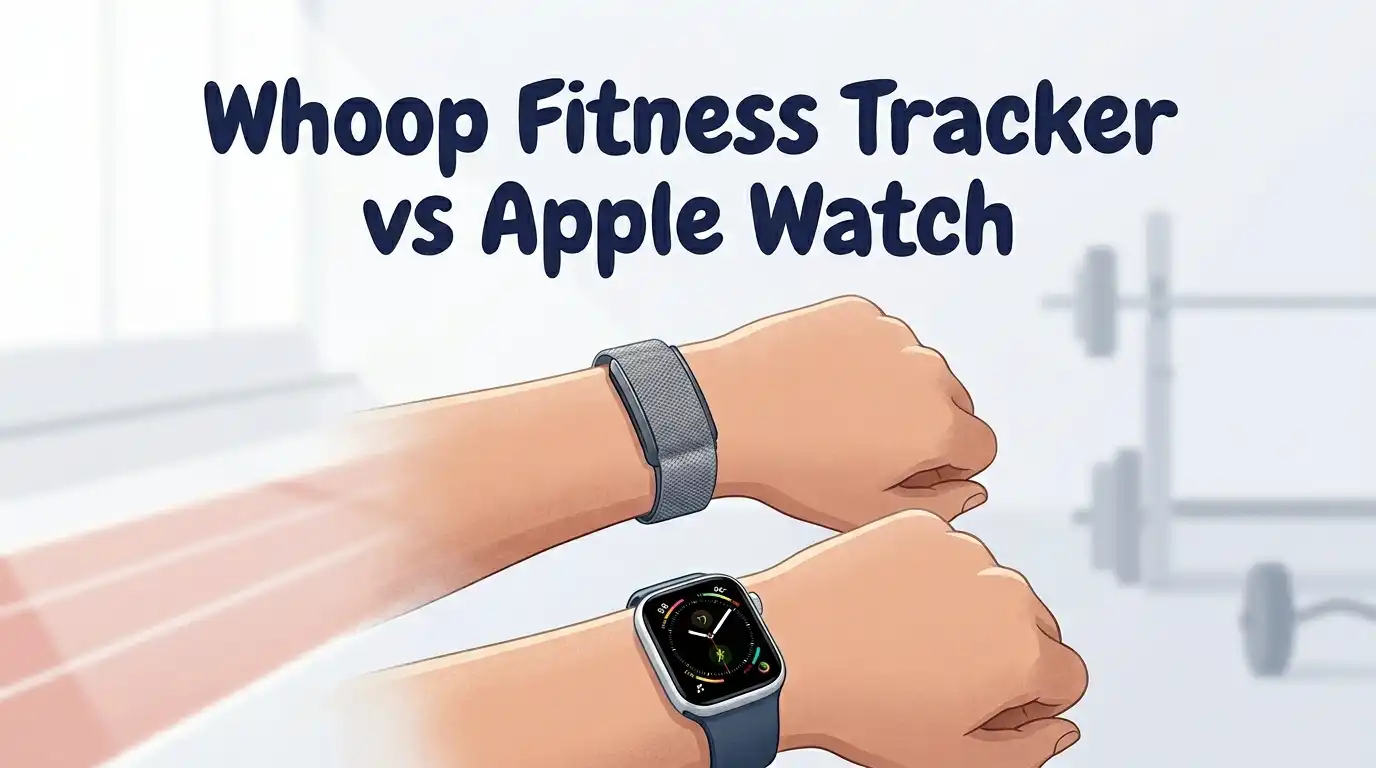
Whoop Fitness Tracker vs Apple Watch in 2026
You want a wearable that helps you get healthier, sleep better, and train smarter. But you are stuck between two very different products.
The Whoop fitness tracker focuses purely on health and recovery data. The Apple Watch does everything from answering calls to tracking your runs. Both sit on your wrist. Both promise better health insights. Yet they serve very different types of users.
This comparison will break down the features, costs, accuracy, and real world performance of the Whoop band and Apple Watch in 2026. You will learn which device fits your lifestyle, your budget, and your fitness goals. By the end, you will know exactly which one deserves a spot on your wrist.
Key Takeaways
- The Whoop is a screenless fitness tracker that focuses entirely on health metrics like recovery, strain, sleep, and heart rate variability. It does not tell time, show notifications, or run apps. The Apple Watch is a full smartwatch with health tracking as one of many features.
- Whoop uses a subscription model starting at $199 per year for the One plan and going up to $359 per year for the Life plan. The Apple Watch Series 10 starts at $399 as a one time purchase with no ongoing fees for its health features.
- Battery life is a clear win for Whoop. The Whoop 5.0 lasts up to 14 days on a single charge. The Apple Watch Series 10 lasts about 18 hours under normal use, which means daily charging is required.
- Apple Watch offers emergency and safety features that Whoop simply cannot match. Fall detection, crash detection, emergency SOS, and satellite connectivity make it a lifesaver in critical situations.
- Whoop excels at recovery coaching and sleep tracking because it stays on your wrist 24/7. Its AI coach gives personalized training advice based on your strain, recovery score, and sleep quality. Apple Watch provides health data but leaves interpretation mostly up to you.
- The Apple Watch works only with iPhones, while Whoop is compatible with both iOS and Android. If you use an Android phone, Whoop is your only option between these two.
What Is the Whoop Fitness Tracker?

Last update on 2026-09-19 / Affiliate links / Images from Amazon Product Advertising API Some of the links on this website are affiliate links, which means that at no additional cost to you, I earn a commission if you click through and make a purchase. I only recommend products and services that I believe will add value to my readers. Thank you for your support!
The Whoop is a screenless wearable built for people who want deep health and fitness data. It does not display the time. It does not show text messages. It has one job: track your body around the clock and tell you what that data means.
The device measures heart rate, heart rate variability, skin temperature, blood oxygen, respiratory rate, and more. It runs all of this through its app to produce three key scores each day. These are your Recovery score, Strain score, and Sleep score. Together, these scores guide your training decisions.
Whoop released the 5.0 model in 2025 with major upgrades. The new sensor offers 14 days of battery life. It also added features like Pace of Aging and Healthspan metrics that estimate your biological age based on your data trends.
Pros:
- Exceptional battery life of up to 14 days
- Deep recovery and strain tracking with actionable daily scores
- AI powered health coach that gives personalized training advice
- Comfortable and lightweight design you can wear 24/7
- Works with both iPhone and Android devices
Cons:
- Requires an ongoing subscription starting at $199 per year
- No screen means you must use your phone for all data
- Cannot track GPS, pace, or distance during workouts on its own
- Limited smartwatch features like no calls, texts, or apps
What Is the Apple Watch?
![Apple Watch Series 10 [GPS 46mm case] Smartwatch with Jet Black Aluminum Case with Black Sport Band - M/L. Fitness Tracker, ECG App, Always-On Retina Display, Water Resistant](https://devicediscoveries.blog/wp-content/plugins/aawp/public/image.php?url=YUhSMGNITTZMeTl0TG0xbFpHbGhMV0Z0WVhwdmJpNWpiMjB2YVcxaFoyVnpMMGt2TXpGRGRXUXlWMjV6ZWt3dVgxTk1NVFl3WHk1cWNHYz18MTc5MTg3MTU5OQ=)

Last update on 2026-09-21 / Affiliate links / Images from Amazon Product Advertising API Some of the links on this website are affiliate links, which means that at no additional cost to you, I earn a commission if you click through and make a purchase. I only recommend products and services that I believe will add value to my readers. Thank you for your support!
The Apple Watch Series 10 is Apple’s latest mainstream smartwatch. It launched in late 2024 with a thinner design, a larger OLED display, and improved health sensors. It starts at $399 for the 42mm GPS model and goes up to $749 for titanium cellular versions.
This device does far more than track fitness. You can take calls, reply to messages, use Apple Pay, stream music, and access thousands of apps. Health tracking includes ECG readings, heart rate monitoring, blood oxygen sensing, temperature tracking, sleep apnea detection, and FDA cleared hypertension alerts.
The Apple Watch also features built in GPS for accurate distance and pace tracking during runs, walks, and cycling. It pairs exclusively with iPhones and runs on watchOS, which receives regular software updates.
Pros:
- Full smartwatch with calls, texts, apps, and Apple Pay
- Built in GPS for accurate distance and pace tracking
- FDA cleared health features including ECG and hypertension alerts
- Emergency SOS, fall detection, and crash detection for safety
- Large always on Retina display for easy reading
Cons:
- Battery lasts only about 18 hours under normal use
- Daily charging can interrupt sleep tracking consistency
- Only compatible with iPhones
- Health data requires more self interpretation compared to Whoop
- Higher upfront cost starting at $399
Design and Comfort
The Whoop 5.0 is a slim, screenless band that wraps around your wrist with a fabric or silicone strap. The sensor module sits flat against your skin. It weighs very little and most users forget they are wearing it. This makes it ideal for sleeping, showering, and intense workouts without any discomfort.
The Apple Watch Series 10 has a larger rectangular display that sits on top of your wrist. Apple made the Series 10 thinner than previous models, but it is still noticeably bulkier than the Whoop. Some users find the watch uncomfortable for sleep tracking because of its size and the need to charge it before bed.
Whoop also offers more versatile wearing options. You can attach the sensor to your bicep, chest, or even clothing using special accessories. The Apple Watch stays on your wrist only. For pure comfort and all day wearability, the Whoop has a clear advantage.
Health and Fitness Tracking
Both devices track similar core metrics. Heart rate, blood oxygen, skin temperature, respiratory rate, and sleep stages appear on both platforms. The difference is how each device processes and presents this data.
Whoop funnels everything into its three daily scores. Your Recovery score tells you how ready your body is to perform. Your Strain score shows how hard you pushed yourself. Your Sleep score evaluates the quality and duration of your rest. These scores work together to give you a clear picture of your overall readiness.
The Apple Watch presents metrics individually in the Health app and Fitness rings. You get Move, Exercise, and Stand goals each day. The watch tracks VO2 max as a Cardio Fitness score. It also uses Training Load to measure cumulative workout effort. However, Apple does not combine these into a single actionable score the way Whoop does.
For athletes who want data driven training decisions, Whoop’s integrated scoring system is more useful. For general fitness users who want a broader view of their health alongside smartwatch features, the Apple Watch delivers more flexibility.
Sleep Tracking Comparison
Sleep tracking is one of the most important areas where these two devices diverge. The Whoop is widely considered one of the best sleep trackers available in 2026. Because of its 14 day battery life, it stays on your wrist every single night without fail.
Whoop tracks sleep stages, time in bed, sleep efficiency, respiratory rate, and disturbances. It uses this data to calculate your Sleep score and factors it into your daily Recovery score. The app even suggests an optimal bedtime based on your recent strain and sleep debt.
The Apple Watch also tracks sleep stages including REM, Core, and Deep sleep. It measures respiratory rate and skin temperature during sleep. However, the 18 hour battery life creates a real problem. Many users need to charge the watch before bed, which means they miss sleep data entirely some nights.
Consistency matters with sleep tracking. Missing even a few nights can throw off trends and menstrual cycle predictions that rely on nightly temperature readings. The Whoop wins here because it simply never needs to come off.
Battery Life and Charging

Last update on 2026-09-19 / Affiliate links / Images from Amazon Product Advertising API Some of the links on this website are affiliate links, which means that at no additional cost to you, I earn a commission if you click through and make a purchase. I only recommend products and services that I believe will add value to my readers. Thank you for your support!
This category is not close. The Whoop 5.0 lasts up to 14 days on a single charge. The Whoop 4.0, included with the One plan, lasts about 5 days. Both models use a slide on battery pack that charges the device while you wear it. You never have to remove the Whoop from your wrist.
The Apple Watch Series 10 lasts about 18 hours with normal use. Apple improved fast charging so you can get 8 hours of sleep tracking from just 8 minutes of charging. But you still need to charge it at least once every day.
For people who travel, camp, or simply dislike daily charging, Whoop’s battery life is a game changer. You can pack for a two week trip without worrying about chargers. The Apple Watch requires nightly charging discipline, and many users will miss tracking windows because of this.
Subscription vs One Time Cost
The pricing models are fundamentally different. Whoop requires an ongoing subscription. Apple Watch is a one time purchase.
Whoop offers three subscription tiers in 2026. The One plan costs $199 per year and includes the Whoop 4.0 band with core metrics. The Peak plan costs $239 per year and includes the Whoop 5.0 with Healthspan and aging insights. The Life plan costs $359 per year and includes the Whoop MG with ECG and AFib detection.
The Apple Watch Series 10 starts at $399 for the base GPS model. There are no subscription fees for any health features. Every sensor and metric is available from day one. Over two years, the Whoop Peak plan costs $478 total. The Apple Watch costs $399 once. Over three years, Whoop costs $717 while the Apple Watch still costs $399.
If you plan to use a wearable for several years, the Apple Watch has a lower total cost. But if you want the Whoop’s specialized coaching without a large upfront investment, the annual subscription spreads the cost out.
Apple Watch Ultra 2: The Premium Option
![Apple Watch Ultra 2 [GPS + Cellular 49mm] Smartwatch with Rugged Titanium Case & Blue/Black Trail Loop S/M. Fitness Tracker, Precision GPS, Action Button, Extra-Long Battery Life](https://devicediscoveries.blog/wp-content/plugins/aawp/public/image.php?url=YUhSMGNITTZMeTl0TG0xbFpHbGhMV0Z0WVhwdmJpNWpiMjB2YVcxaFoyVnpMMGt2TkRGYWNIRk9TVTVFTmt3dVgxTk1NVFl3WHk1cWNHYz18MTc5MTg3MTU5OQ=)
Last update on 2026-09-19 / Affiliate links / Images from Amazon Product Advertising API Some of the links on this website are affiliate links, which means that at no additional cost to you, I earn a commission if you click through and make a purchase. I only recommend products and services that I believe will add value to my readers. Thank you for your support!
The Apple Watch Ultra 2 is Apple’s rugged, performance focused option. It launched at $799 but has dropped below $500 in 2026. It features a larger 49mm titanium case, an action button, and a battery that lasts up to 36 hours on a single charge.
This model is built for endurance athletes, hikers, divers, and outdoor adventurers. It has a more accurate dual frequency GPS, a depth gauge, water temperature sensor, and a louder siren for emergencies. The always on display is brighter at 3000 nits.
For someone choosing between Whoop and Apple Watch specifically for athletic performance, the Ultra 2 closes the battery gap significantly. It also adds precision GPS tracking that Whoop simply cannot offer since it has no GPS at all.
Pros:
- 36 hour battery life bridges the gap with Whoop
- Rugged titanium build for extreme conditions
- Dual frequency GPS for precise outdoor tracking
- 100m water resistance with depth gauge
- Action button for quick workout controls
Cons:
- Still costs around $499 even at discounted prices
- Heavier and larger than both Whoop and standard Apple Watch
- Battery still falls far short of Whoop’s 14 day life
- Only works with iPhones
AI Health Coaching
Whoop introduced an AI health coach that has become one of its strongest features in 2026. The coach uses your accumulated data to deliver personalized advice. It does not wait for you to ask questions. Instead, it proactively notifies you through the app.
For example, the AI coach might warn you that workouts will feel harder due to hormonal changes before your period. It might tell you to take a recovery day after an intense session. It adjusts your recommended bedtime based on your recent strain and sleep debt.
The Apple Watch offers Workout Buddy, an in ear AI trainer that gives real time coaching during workouts. It provides pace updates, heart rate zone cues, and motivational prompts while you run or exercise. This is extremely useful for runners who need live feedback without looking at their wrist.
Whoop’s coach is better for big picture lifestyle guidance. Apple’s coach is better for in the moment workout performance. Both approaches have value, and the best choice depends on whether you want strategic recovery advice or real time exercise coaching.
Smartwatch Features and Daily Use
This is where the Apple Watch dominates. The Whoop has zero smartwatch features. It cannot display the time, show notifications, make payments, or run third party apps. It is purely a health and fitness data collector.
The Apple Watch lets you take phone calls from your wrist. You can reply to texts, use Siri, navigate with Apple Maps, control your smart home devices, and pay for coffee with Apple Pay. It also works as a camera remote, a music controller, and a podcast player.
For many people, these daily conveniences are the primary reason to wear a smartwatch. If you already rely on an Apple Watch for tasks beyond fitness, switching to a Whoop means losing all of that functionality. Some users choose to wear both devices on different wrists to get the best of both worlds.
Safety and Emergency Features
The Apple Watch includes life saving features that Whoop does not have. Fall detection senses hard falls and can automatically call emergency services if you do not respond. Crash detection does the same for car accidents. Emergency SOS lets you contact help by pressing and holding the side button.
Newer Apple Watch models also include satellite connectivity. If you are hiking in an area with no cell service, the watch can send your location to emergency responders. This feature alone could save your life in a backcountry emergency.
Whoop has none of these features. It cannot call anyone. It cannot detect falls or crashes. It has no way to contact emergency services. For solo runners, hikers, cyclists, or anyone concerned about safety, the Apple Watch provides peace of mind that the Whoop simply cannot match.
Who Should Buy the Whoop?
The Whoop is ideal for serious athletes and fitness enthusiasts who want deep, data driven insights into their recovery and training. If you already own a smartphone and do not need another screen on your wrist, the Whoop’s focused approach delivers more actionable health data than any smartwatch.
It is also the better choice for Android users who want a premium wearable in this comparison. The Apple Watch does not work with Android phones at all. Whoop supports both platforms equally.
People who value sleep tracking consistency will also prefer the Whoop. Its long battery life and comfortable design mean you will actually wear it to bed every night. The data quality improves as a result.
Who Should Buy the Apple Watch?
The Apple Watch is best for people who want one device that does everything. If you want fitness tracking, phone calls, messages, navigation, payments, and safety features all in a single wearable, nothing beats the Apple Watch ecosystem.
It is also the smarter pick for runners and outdoor athletes who need real time GPS tracking, pace data, and distance measurements. Whoop cannot provide any of these metrics on its own. The Apple Watch shows this information live on your wrist during every workout.
Anyone who prioritizes safety features should choose the Apple Watch. Fall detection, crash detection, and emergency SOS have genuinely saved lives. If you exercise alone or have health concerns, these features add real value beyond fitness tracking.
Frequently Asked Questions
Can you use Whoop and Apple Watch together?
Yes. Many users wear both devices at the same time. They use the Whoop on one wrist or their bicep for recovery and sleep data. They wear the Apple Watch on the other wrist for smartwatch features and GPS tracking during workouts. This combination gives you the best of both worlds but does come at a higher total cost.
Does the Whoop work without a subscription?
No. The Whoop requires an active subscription to access any data or features in the app. Without a subscription, the hardware is essentially unusable. Plans start at $199 per year for the One tier and go up to $359 per year for the Life tier.
Is the Apple Watch accurate for heart rate tracking?
Yes. Multiple independent tests have shown the Apple Watch to be one of the most accurate wrist based heart rate monitors available. In controlled tests against chest strap monitors, the Apple Watch typically shows only 1 to 3 beats per minute of variance. The Whoop also performs well, with similar accuracy margins in testing.
Which device is better for sleep tracking?
The Whoop is generally considered better for sleep tracking. Its multi day battery life means it stays on your wrist every night. It provides detailed sleep staging, sleep efficiency scores, and personalized bedtime recommendations. The Apple Watch tracks sleep stages too but requires daily charging that often interrupts consistent nightly use.
Is the Whoop worth the subscription cost?
It depends on how you use it. If you train regularly and follow the recovery and strain guidance, the Whoop can genuinely improve your performance and prevent overtraining. If you only exercise casually, the ongoing cost may not justify the investment. The Apple Watch provides solid health tracking without any recurring fees.
Does the Whoop have GPS?
No. The Whoop does not have built in GPS. It cannot track distance, pace, or route maps for outdoor activities. If you need GPS data, you must use your phone or pair with another GPS enabled device. The Apple Watch has built in GPS across all models.

Hello everyone my name is Alenya and i am a gadget discovering Enthusiast 🐻🐻