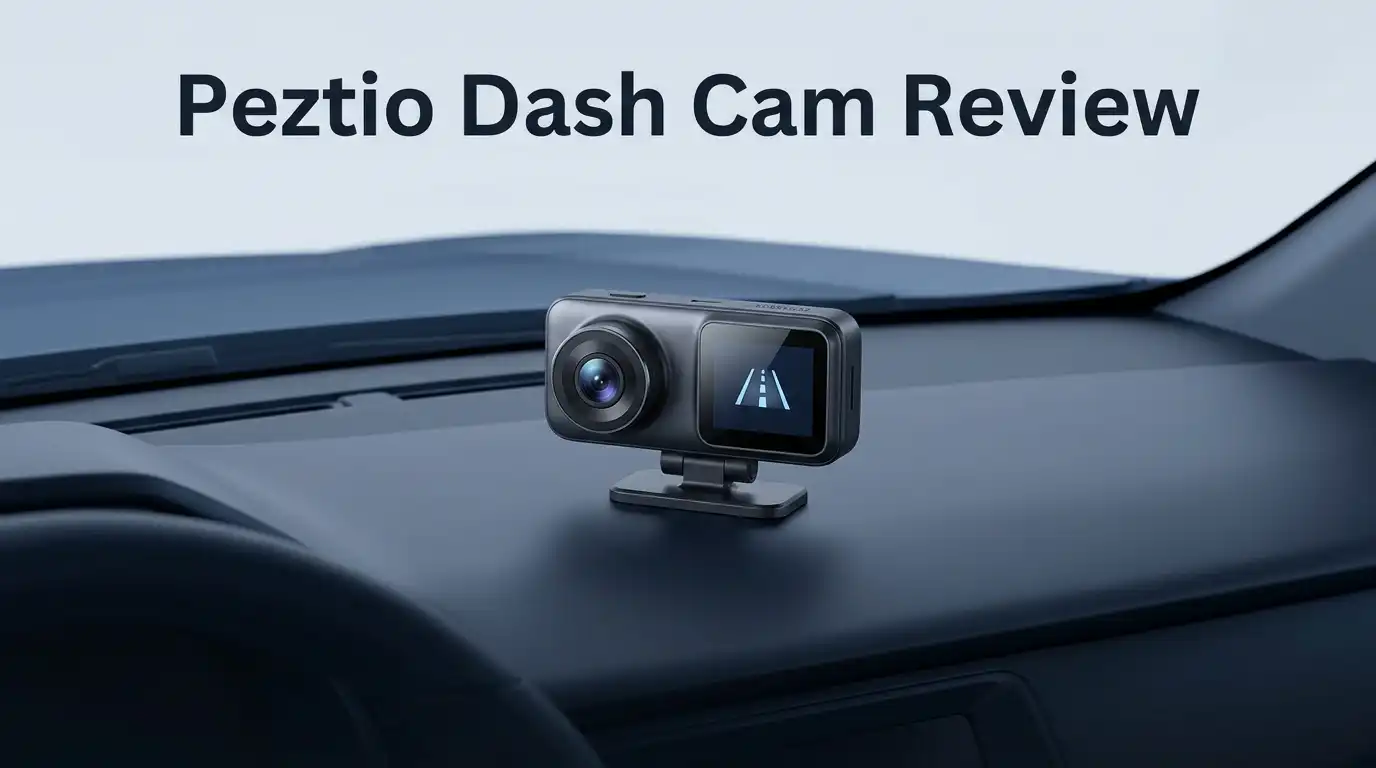
Peztio Dash Cam Review 2026: Worth Buying?
Most drivers buy a dash cam for one reason. They want proof when someone else causes a crash and then rewrites the story at the roadside. The Peztio dash cam sits in the sub $70 bracket that promises 4K front recording, a rear camera, and WiFi transfers for less than a tank of gas.
That price gap raises a fair question. Does a budget camera actually capture a license plate at night, or does it just fill a memory card with blurry evidence nobody can use?
I ran this camera through daily commuting, night driving, a parking lot fender tap, and a full week of summer windshield heat. Here is what held up and what did not.
In a Nutshell
- Resolution is marketing first, physics second. The listing sells 4K 2160P front and 1080P rear, but independent bench testing of Peztio hardware found the 4K output is interpolated rather than native. Recording at 1440p/30fps gives you cleaner motion and nearly identical detail.
- Daytime footage is genuinely usable. Plates read clearly within two to three car lengths in good light, which covers the majority of insurance disputes.
- Night video is the weak link. The GC CMOS sensor with WDR handles lit streets fine, but motion blur smears plates on unlit roads and highways.
- The brand history matters. Peztio was removed from Amazon over incentivized reviews and now sells the same hardware under Navycrest, Galphi, Arifayz, and Affver. Ratings on those listings sit around 4.1 stars across 2,000+ buyers.
- Heat is the documented failure point. Multiple owners report plastic housing warping after summer parking, and the operating ceiling is only 60°C on older units.
- Best suited to cost conscious commuters and rideshare drivers who want basic evidence, not enthusiasts who need forensic clarity.
Peztio 4K Dash Cam Front and Rear

Last update on 2026-07-26 / Affiliate links / Images from Amazon Product Advertising API Some of the links on this website are affiliate links, which means that at no additional cost to you, I earn a commission if you click through and make a purchase. I only recommend products and services that I believe will add value to my readers. Thank you for your support!
The unit I tested ships today under the Navycrest Q7 name, which is the current retail identity of the Peztio front and rear model. Same wedge body, same app, same accessory ecosystem.
Specs on paper look strong for the money. You get a 3 inch IPS screen, 155 to 170 degree field of view, 5GHz WiFi, loop recording, a three axis G sensor, and support for microSD cards up to 256GB.
The rear camera runs at 1080p and connects by a long thin cable that tucks into your headliner. Front resolution tops out at the advertised 4K, though I settled on 1440p after comparing clips side by side.
Real world performance lands where you would expect at this price. It records reliably, it starts with ignition, and it locks impact clips. It does not match a Sony STARVIS 2 sensor for shadow detail, and it never claimed to.
One honest note on the listing itself. As of June 2026 the SD card is no longer included, so budget another $15 to $26 for a proper high endurance card.
Unboxing and What Comes in the Box
The box is small, matte, and unremarkable in a good way. No wasted foam, no glossy sleeve you throw away immediately.
Inside you get the camera, an adhesive windshield mount, a 12 foot rear camera cable, a 12V car charger with a long lead, a plastic trim pry tool, and spare adhesive pads. The pry tool is the quiet hero here since it saves you from scratching your A pillar trim.
The camera itself feels lighter than expected in the hand. It weighs about as much as a deck of cards and the silver plastic has a faint textured finish rather than a soft touch coating.
Screen protection film peels off cleanly. The lens arrives with a plastic cap that pops off with a fingernail.
Setup took me roughly 25 minutes including routing the rear cable along the passenger side trim. First time installers should plan on 45 minutes and a coffee.
Build Quality, Mount, and Cable Routing
Here is where honesty matters more than enthusiasm. The plastics are thin and the seams flex slightly under thumb pressure.
The adhesive mount holds firmly on glass and sits high enough behind the mirror to stay out of your sightline. Removal is a different story since the 3M pad needs heat and patience, so place it correctly the first time.
Lens tilt has a limited range. Owners with steeply raked truck windshields have reported they cannot angle the lens far enough downward to frame the road properly.
The body does not swivel sideways. If you want footage of a driver at your window during a confrontation, this camera will not deliver it.
Cable routing is straightforward on most sedans and crossovers. The power lead is generously long, and the rear cable reached my hatch with a few inches spare.
Fit and finish sit exactly where a $50 to $70 device should sit. Functional, not premium.
Top 3 Alternative for Peztio Dash Cam

Last update on 2026-07-19 / Affiliate links / Images from Amazon Product Advertising API Some of the links on this website are affiliate links, which means that at no additional cost to you, I earn a commission if you click through and make a purchase. I only recommend products and services that I believe will add value to my readers. Thank you for your support!
REDTIGER F7NP 4K Dash Cam Front and Rear

Last update on 2026-07-19 / Affiliate links / Images from Amazon Product Advertising API Some of the links on this website are affiliate links, which means that at no additional cost to you, I earn a commission if you click through and make a purchase. I only recommend products and services that I believe will add value to my readers. Thank you for your support!
VANTRUE N4 3 Channel Dash Cam

Last update on 2026-07-26 / Affiliate links / Images from Amazon Product Advertising API Some of the links on this website are affiliate links, which means that at no additional cost to you, I earn a commission if you click through and make a purchase. I only recommend products and services that I believe will add value to my readers. Thank you for your support!
70mai Dash Cam A510 Front and Rear
Daytime Video Quality Tested
Daylight is where this camera earns its keep. Footage looks sharp, colors stay natural, and exposure adjusts quickly when you exit a tunnel or parking garage.
I could read plates on vehicles two to three car lengths ahead while moving, and stationary plates from further back. That covers rear end collisions, red light runners, and lane change disputes, which is most of what drivers actually need.
The 170 degree wide angle captures adjacent lanes fully. Edge distortion exists but never obscured anything important.
Switching from 4K to 1440p at 30fps produced a visibly smoother image. The 4K mode records at only 25fps and adds no real detail, which supports the interpolation findings from independent testing.
The rear 1080p channel is noticeably softer. It confirms who hit you and roughly how fast, but do not expect to read a plate from three cars back.
Files save as H.265 MP4, which keeps card space reasonable at this bitrate.
Night Vision and Low Light Reality
Night performance is the honest weak spot, and the marketing language around super night vision oversells it.
On lit city streets the camera does fine. Headlights bloom a little, but plates on stopped vehicles at intersections stayed readable.
On unlit rural roads and highways, motion blur takes over. A car passing in the opposite direction becomes a smear, and plate capture at speed is unreliable.
The WDR processing balances exposure between dark road and bright headlights reasonably well. It cannot compensate for the sensor’s limited light gathering.
For comparison, cameras using Sony STARVIS 2 sensors hold detail in those same conditions, which is the main thing your extra $40 buys elsewhere.
Practical advice for night shift workers and rideshare drivers: this camera will document that a collision happened and who was involved. It may not identify a hit and run vehicle that leaves the scene in darkness.
The Peztio App and WiFi Transfers
The app is called Peztio and it exists on both iOS and Android. Connection works by joining the camera’s own WiFi network rather than your home network.
On the newer 5GHz models, transfers run at roughly 8MB per second, which is genuinely fast. A one minute 1440p clip lands on your phone in seconds.
The interface is plain but logical. You get live preview, file browsing, download, delete, and settings adjustment without touching the camera.
Two irritations stand out. Cellular data must be disabled on your phone for live preview to load, which is an odd requirement in 2026.
Older Peztio units relied on a third party app loaded with ads, and firmware updates have historically been rare to nonexistent. Treat the software as fixed at purchase rather than something that improves later.
Pairing failed twice for me and required a camera restart. Not a dealbreaker, but not seamless either.
Parking Mode, Hardwiring, and Power
Parking mode is advertised prominently and requires equipment that does not come in the box. You need a hardwire kit, sold separately for around $26.
Without that kit, the camera runs only when your 12V socket is live. The internal 200mAh battery exists to save the current file after shutdown, not to record while parked.
Once hardwired, you choose between collision triggered recording and low frame rate time lapse. The collision mode is non buffered, meaning it starts recording after impact rather than saving the seconds before it.
That distinction matters. A buffered system captures the approach of the vehicle that hit you, which is often the evidence you actually want.
Installation of the hardwire kit takes about an hour if you are comfortable with a fuse box, or a shop visit if you are not. Low voltage protection is included so it should not drain your battery flat.
Heat Warping and Reliability Complaints
This section deserves your attention more than any spec sheet.
Numerous owners have documented the plastic housing warping and deforming after the camera sat in a hot parked car. Older units listed an operating ceiling of only 60°C, while newer versions claim 75°C tolerance.
A separate cluster of complaints involves horizontal lines appearing across the screen with no known fix.
The most concerning reports involve recording gaps. One owner described a crash where the clip cut off seven seconds before impact, and another reported inconsistent start and stop behavior across all files.
I did not experience a recording failure during testing, but the pattern is documented enough that I cannot dismiss it.
Error notifications appear on screen only. There is no audible alert, so a failed card or full memory can go unnoticed for weeks.
Check your footage monthly. That advice applies to any dash cam, and it applies double here.
Who Should Skip the Peztio Dash Cam
Skip this camera if you drive at night for a living. Delivery drivers, night shift commuters, and long haul highway drivers need the low light performance that a STARVIS 2 sensor provides.
Skip it if you park outdoors in Arizona, Texas, Florida, or any climate with sustained summer heat. The warping reports concentrate exactly in those conditions.
Skip it if you drive a truck or van with a near vertical windshield, because the lens tilt range may not reach far enough to frame the road.
Skip it if you need GPS speed and location stamps for insurance or fleet purposes, since the base model does not include GPS.
Skip it if buffered parking protection is your main reason for buying. This system starts recording after impact, not before.
Finally, consider the brand history. Peztio was banned from Amazon over review manipulation and now operates under multiple rebranded storefronts, which makes long term warranty support genuinely uncertain.
Is the Peztio Dash Cam Worth It
Last update on 2026-07-26 / Affiliate links / Images from Amazon Product Advertising API Some of the links on this website are affiliate links, which means that at no additional cost to you, I earn a commission if you click through and make a purchase. I only recommend products and services that I believe will add value to my readers. Thank you for your support!
For the right buyer, yes. For the wrong buyer, absolutely not.
If you drive mostly in daylight, park in a garage or shaded spot, and want documented evidence for a fender bender, this camera does that job for well under $70. Having imperfect footage beats having none when an insurer assigns fault.
The value case weakens fast once you add the required extras. A hardwire kit at $26 plus a memory card at $20 pushes your real cost close to $100, and at that price the REDTIGER and 70mai options with real Sony sensors and GPS become the smarter buy.
My honest position is that this is a starter dash cam, not a keeper. It is a reasonable first purchase for someone testing whether they want a dash cam at all.
Budget buyers in mild climates will be satisfied. Everyone else should spend the extra $40.
Expert FAQs
Does the Peztio dash cam really record in 4K?
It records a 4K labeled file, but independent testing found the resolution is interpolated rather than captured natively. The sensor used in these cameras historically maxed out around 4MP, which does not support true 2160p. Recording at 1440p/30fps gives you smoother motion and comparable detail.
Why is Peztio sold under different brand names now?
Peztio was removed from Amazon after providing gift cards and extended warranties in exchange for reviews. The same hardware now appears under Navycrest, Galphi, Arifayz, Affver, and Deckon. Check the ASIN and product photos rather than the brand name when comparing listings.
Do I need a hardwire kit for parking mode?
Yes. The internal battery only preserves the current file after shutdown. A Type C hardwire kit wired to your fuse box is required for any parking surveillance, and it costs roughly $26 separately.
What memory card should I use?
Use a high endurance microSD card rated Class 10, U3, V30, sized between 64GB and 256GB. Standard phone cards fail quickly under constant loop recording. Format the card inside the camera before first use, and reformat monthly.
Will it survive a hot summer?
That depends on your climate. Older units rated to 60°C generated multiple warping complaints, while newer versions claim tolerance to 75°C. If you park outdoors in extreme heat regularly, choose a camera with a supercapacitor and a documented high temperature rating instead.
Does it have GPS?
The standard front and rear model does not include GPS. Footage carries a timestamp but no speed or location data. Some newer variants in the same product family add GPS, so verify that specific feature on the listing before ordering.
How long do recordings last before they overwrite?
With a 64GB card at 1440p, expect roughly six to eight hours of dual channel footage before loop recording begins overwriting. Impact locked files are protected from overwriting, though the locked folder can eventually fill and should be cleared periodically.

Hello everyone my name is Alenya and i am a gadget discovering Enthusiast 🐻🐻