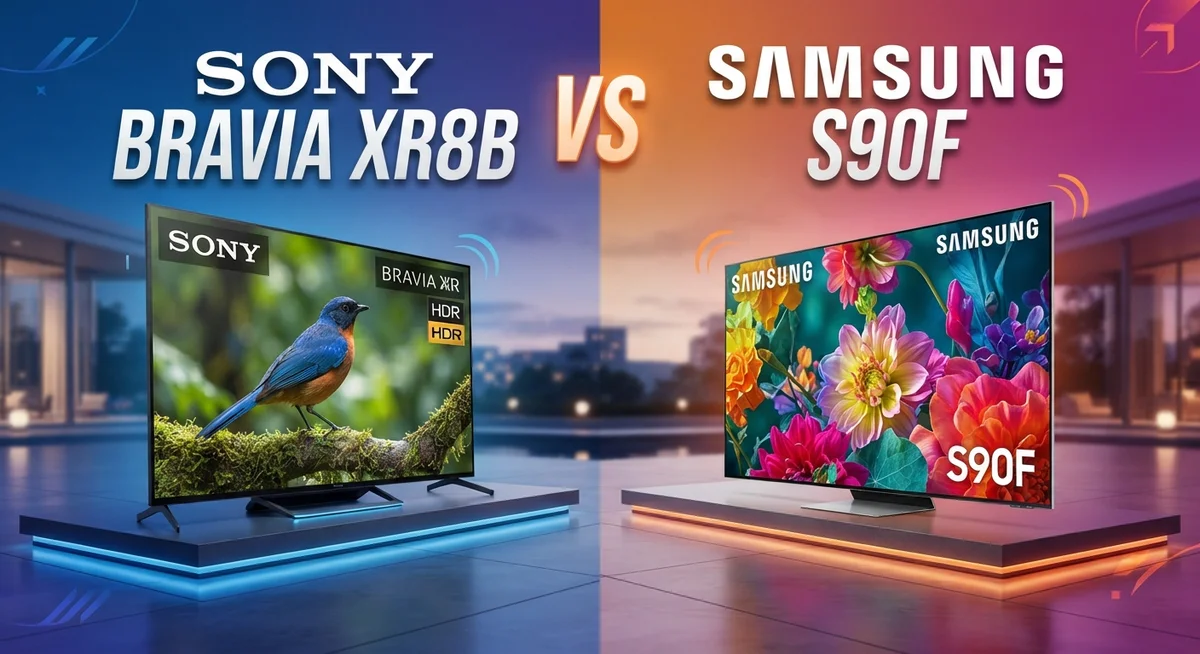
Sony Bravia XR8B vs Samsung S90F: OLED TV Comparison
Picking a new OLED TV can feel tricky. Two big names stand out this year: the Sony Bravia XR8B and the Samsung S90F.
Both TVs bring stunning 4K OLED panels to your living room. But they take very different paths to get there.
Sony focuses on rich contrast and true to life colors. It creates a cinematic experience for movie lovers who watch in darker rooms.
Samsung takes a different approach. The S90F pushes higher brightness and faster refresh rates, making it a strong pick for gamers and bright living spaces.
Quick Comparison: SONY Bravia XR8B vs Samsung S90F
| Feature | SONY Bravia XR8B | Samsung S90F |
|---|---|---|
| Screen Sizes | 55″/65″ | 55″/65″/77″ |
| Panel Refresh Rate | Native 120Hz | Up to 144Hz |
| HDMI 2.1 Ports | 2 ports @4K120 | Available for gaming |
| Peak Brightness | Lower peak brightness | Higher peak brightness |
| Contrast & Blacks | Excellent, near-perfect blacks | Good, less exceptional |
| Reflection Handling | Distracting direct reflections | Anti-reflection coating |
| Color Accuracy | Strong out-of-box accuracy | Needs calibration |
| Best Use Case | Movie enthusiasts, controlled lighting | Gamers, bright rooms |
SONY Bravia XR8B Review


Last update on 2026-07-30 / Affiliate links / Images from Amazon Product Advertising API Some of the links on this website are affiliate links, which means that at no additional cost to you, I earn a commission if you click through and make a purchase. I only recommend products and services that I believe will add value to my readers. Thank you for your support!
The Sony Bravia XR8B is a premium OLED TV built for viewers who want exceptional contrast and color fidelity. It comes in 55″ and 65″ sizes with a native 120Hz panel and full 4K resolution.
This model shines with perfect blacks and minimal blooming around bright objects on screen. The XR8B delivers realistic skin tones and strong color accuracy that movie lovers will appreciate in darker rooms.
The TV includes Wi-Fi 6E, Google TV integration, and HDMI 2.1 ports for next-gen gaming support. Build quality feels solid, and the panel handles motion smoothly for casual gaming sessions.
Real-world performance confirms it excels at picture quality over raw brightness. Direct reflections can be distracting in bright spaces, so a controlled lighting environment works best.
Pros
- Excellent contrast ratio with true blacks and minimal halo effects
- Realistic and accurate color reproduction across all content types
- Strong motion handling and responsive gaming features
- Premium build quality with modern connectivity options
Cons
- Lower peak brightness than some competitors limits HDR pop
- Direct reflections become visible in bright rooms or near windows
Samsung S90F Review

Last update on 2026-07-30 / Affiliate links / Images from Amazon Product Advertising API Some of the links on this website are affiliate links, which means that at no additional cost to you, I earn a commission if you click through and make a purchase. I only recommend products and services that I believe will add value to my readers. Thank you for your support!
The Samsung S90F is a premium OLED display designed for gamers and viewers in bright spaces who want high refresh rates and minimal glare. This model steps into the ring with up to 144Hz refresh rate, making it a powerhouse for fast-action gaming and sports content.
The standout feature is its anti-reflection coating, which cuts down distracting glare far better than traditional OLED panels. Paired with its higher peak brightness, the S90F delivers HDR content that truly pops on screen, even in well-lit rooms.
Samsung packed the S90F with the NQ4 AI Gen3 processor and Vision AI technology for intelligent picture enhancement. You also get Dolby Atmos audio and OLED HDR+ support across 55″, 65″, and 77″ sizes.
Real-world testing shows the S90F excels at motion handling and gaming responsiveness. However, expect white balance and color temperature shifts straight out of the box—blues and reds need calibration before achieving their best look.
Pros
- Up to 144Hz refresh rate perfect for competitive gaming and sports
- Anti-reflection coating significantly reduces glare in bright rooms
- Higher peak brightness makes HDR content stand out more
- Excellent motion handling and responsive gaming performance
Cons
- White balance and color accuracy require professional calibration
- Struggles with color temperature accuracy in factory settings
- Anti-reflection coating doesn’t fully solve bright-room performance issues
Head to Head: Key Differences
The Sony Bravia XR8B and Samsung S90F represent two distinct philosophies for OLED TV design. Sony prioritizes contrast and color accuracy, while Samsung emphasizes brightness and anti-glare technology.
Contrast and Black Levels
The XR8B delivers superior contrast with deeper blacks and virtually no blooming around bright objects. This makes it ideal for dark room viewing where shadow detail matters most.
The S90F produces higher peak brightness, which benefits HDR content but can introduce more blooming in comparison.
Brightness and Glare Handling
Samsung’s S90F reaches significantly higher brightness levels, making HDR scenes pop noticeably. Its anti-reflection coating genuinely reduces glare, though real-world testing shows it still struggles in very bright rooms.
The XR8B lacks anti-reflection technology, so direct sunlight creates more distracting reflections on its screen.
Color and Accuracy
The XR8B excels at realistic skin tones and color fidelity straight out of the box. The S90F requires calibration adjustments for white balance, as blues and reds need tweaking for accuracy.
This gives Sony an edge for content creators and movie lovers.
Gaming and Motion
Both TVs handle motion well, but the S90F’s 144Hz refresh rate appeals to competitive gamers more than the XR8B’s 120Hz native panel. The S90F’s processor also delivers faster response times for gaming scenarios.
Room Conditions Matter
Choose the XR8B for controlled lighting and picture quality focus. Pick the S90F if you have bright windows, game frequently, or want maximum HDR impact.
Your room’s lighting situation becomes the deciding factor between these two capable OLED displays.
Which One Should You Buy
The Sony Bravia XR8B takes the win here. It offers superior contrast, more accurate colors, and realistic skin tones.
The Samsung S90F brings solid brightness to the table. But this strength gets undercut by pre-calibration color inaccuracies and glare issues in bright rooms.
For overall picture quality, the Sony Bravia XR8B stands out as the stronger performer.
Best for each buyer
- Sony Bravia XR8B: Perfect for movie enthusiasts and picture-quality purists who watch in dim, controlled lighting. This TV rewards you with deep blacks and true-to-life colors.
- Samsung S90F: Built for gamers and viewers in bright rooms. It delivers high refresh rates, strong HDR brightness, and effective glare reduction.
Frequently Asked Questions
Which TV performs better for gaming?
The Samsung S90F wins for gaming. It supports up to 144Hz refresh rates, which gives you smoother motion during fast-paced games.
The S90F also handles motion exceptionally well with responsive controls that competitive gamers need.
The Sony XR8B maxes out at 120Hz. It’s still solid for gaming, but the S90F offers a clear advantage if you play demanding titles or watch sports regularly.
Should I choose the Sony XR8B if I watch mostly movies?
Yes. The XR8B is your best choice for film lovers.
It delivers superior contrast with deeper blacks and virtually no blooming around bright objects. You get realistic skin tones and color accuracy straight out of the box.
The XR8B shines in controlled lighting environments. If your viewing room has dim, stable lighting, the XR8B’s picture quality will impress you more than the S90F.
Does the Samsung S90F really handle bright rooms better?
Absolutely. The S90F’s anti-reflection coating cuts down glare significantly compared to traditional OLED screens.
Its higher peak brightness also makes content pop more in well-lit spaces.
The XR8B struggles with direct sunlight and reflections. If your room gets natural light throughout the day, the S90F is the smarter pick.
However, the S90F still performs better than worse in bright rooms, not perfectly.
What’s the main difference in image quality between them?
The Sony XR8B prioritizes contrast and color fidelity. The Samsung S90F emphasizes brightness and glare reduction.
Both are excellent OLED TVs, but they solve different problems.
Choose based on your room and content. Movie lovers in dark rooms pick the XR8B.
Gamers and bright-room viewers pick the S90F.

Hello everyone my name is Alenya and i am a gadget discovering Enthusiast 🐻🐻