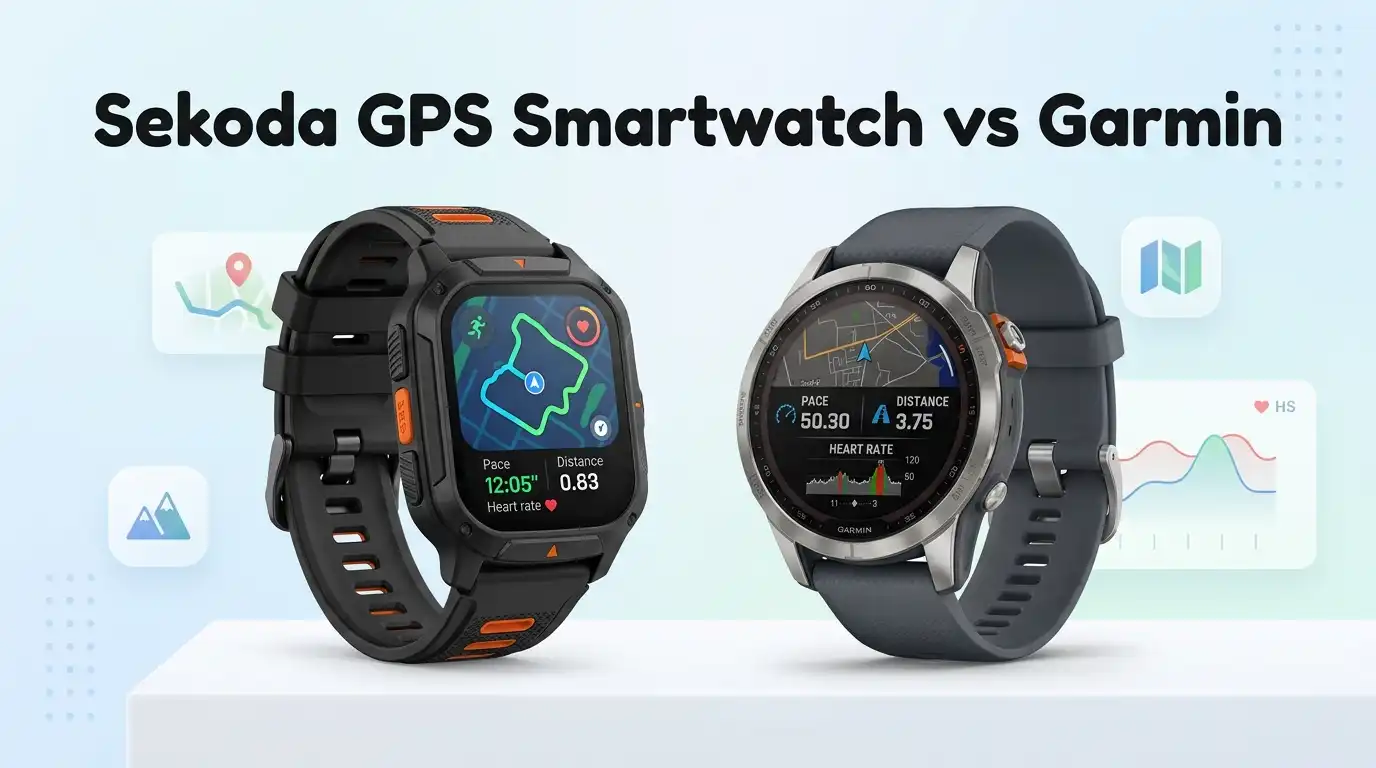
Sekoda GPS Smartwatch vs Garmin in 2026
Are you stuck choosing between a Sekoda GPS Smartwatch and a Garmin watch? You are not alone. Thousands of buyers face this exact choice every month in 2026. One brand promises premium GPS accuracy at a fraction of the cost.
The other brand has decades of trust and a massive fitness ecosystem behind it. The price gap between these two is significant. The feature overlap is surprising. But the differences matter a lot depending on your goals. This guide breaks down every detail you need.
We compare GPS accuracy, battery life, health tracking, build quality, app support, and real user feedback. By the end, you will know exactly which smartwatch fits your lifestyle and budget. Let us dive straight into the facts.
Key Takeaways
- The Sekoda GPS Smartwatch costs around $189, while most comparable Garmin models like the Venu 3 and Forerunner 265 cost $300 to $450. The price difference is the biggest factor for budget buyers who still want GPS and health tracking.
- Garmin offers a far superior fitness ecosystem. Garmin Connect provides deep analytics, training plans, recovery metrics, and years of data history. The Sekoda app is basic and limited in comparison.
- Sekoda claims 15 days of battery life in smartwatch mode and 35 hours in GPS mode. Garmin Venu 3 offers up to 14 days in smartwatch mode and about 22 hours in GPS mode. Battery performance is close, but Sekoda edges ahead on paper.
- GPS accuracy is a major dividing point. Garmin uses proven multi-band GPS with years of firmware refinement. Sekoda uses dual-band L1+L5 satellite positioning, but user reviews report mixed accuracy results.
- Build quality and long term reliability favor Garmin. Garmin watches have a strong reputation for surviving years of heavy use. Sekoda is newer to the market, and some users report durability and accuracy concerns.
- If you want a cheap entry point into GPS smartwatches, Sekoda is worth a look. If you need reliable data for serious training or outdoor adventures, Garmin remains the safer investment in 2026.
Sekoda GPS Sports Smartwatch Overview
No products found.
The Sekoda GPS Sports Smartwatch entered the market as a budget GPS watch with premium ambitions. It runs on a dual-band six-satellite positioning system using L1 and L5 frequencies. The watch supports 170+ sport modes and tracks heart rate, blood oxygen, stress, and sleep data around the clock.
Its 1.54-inch AMOLED HD display delivers bright colors and smooth touch response. The watch body uses a zinc alloy frame with water and dust resistance. Bluetooth 5.3 provides fast pairing and stable connections. A built-in microphone and speaker let you make and receive calls directly from your wrist.
The 500mAh battery powers up to 15 days of regular use. In continuous GPS mode, it lasts about 35 hours. The watch comes with customizable watch faces and automatic activity recognition.
Pros:
- Very affordable price around $189
- Dual-band GPS with L1+L5 frequencies
- Large 500mAh battery with 15-day battery life
- 170+ sport modes with auto activity detection
- Built-in Bluetooth calling with mic and speaker
- AMOLED HD touchscreen display
Cons:
- Mixed user reviews on GPS accuracy and step counting
- App ecosystem is limited and basic
- Brand is new with limited long term track record
- Some users report customer service issues
- Sleep tracking accuracy questioned by reviewers
Garmin Venu 3 Overview


Last update on 2026-09-21 / Affiliate links / Images from Amazon Product Advertising API Some of the links on this website are affiliate links, which means that at no additional cost to you, I earn a commission if you click through and make a purchase. I only recommend products and services that I believe will add value to my readers. Thank you for your support!
The Garmin Venu 3 is one of the most popular Garmin smartwatches in 2026. It features a 1.4-inch AMOLED touchscreen with vivid color and smooth animations. The watch runs on Garmin’s refined GPS engine with multi-band satellite support.
Garmin packed the Venu 3 with advanced health features. Sleep Coach analyzes your sleep patterns and gives actionable advice. Nap Detection logs short rest periods automatically. The Morning Report gives you a daily health summary the moment you wake up. Heart rate, SpO2, stress, and Body Battery tracking run 24/7.
The Venu 3 also supports Bluetooth calling with a built-in speaker and microphone. You get access to Garmin Connect, one of the most powerful fitness platforms available. Battery life reaches up to 14 days in smartwatch mode.
Pros:
- Proven multi-band GPS with excellent accuracy
- Deep health tracking with Sleep Coach and Body Battery
- Garmin Connect ecosystem with advanced analytics
- Built-in mic and speaker for Bluetooth calls
- Up to 14 days battery life in smartwatch mode
- Large community and third party app support
Cons:
- Higher price point around $350
- Heavier than some competitors
- AMOLED display drains battery faster in always-on mode
- Limited smart assistant integration compared to Apple Watch
- Music storage requires Garmin-specific setup
Garmin Forerunner 265: A Runner’s Alternative

Last update on 2026-09-21 / Affiliate links / Images from Amazon Product Advertising API Some of the links on this website are affiliate links, which means that at no additional cost to you, I earn a commission if you click through and make a purchase. I only recommend products and services that I believe will add value to my readers. Thank you for your support!
The Garmin Forerunner 265 is a strong alternative if you focus on running. It delivers a brilliant AMOLED display with both touchscreen and button controls. The 46mm case feels light on the wrist during long runs.
This watch excels at training metrics. It tracks running dynamics, VO2 max, training load, training status, and race predictions. The multi-band GPS provides accurate route mapping for outdoor runs. Battery life reaches up to 13 days in smartwatch mode and 20 hours in GPS mode.
The Forerunner 265 connects to Garmin Connect for detailed post-run analysis. It supports music storage, smart notifications, and contactless payments through Garmin Pay.
Pros:
- Best-in-class running metrics and training tools
- Accurate multi-band GPS tracking
- Bright AMOLED display with button and touch controls
- Up to 13 days battery life in smartwatch mode
- Lightweight and comfortable for long runs
- Full Garmin Connect integration
Cons:
- Priced around $350 to $400
- No built-in speaker for calls
- Design is sport-focused and less casual
- No LTE option available
- Overkill for casual fitness users
GPS Accuracy Comparison
GPS accuracy is the most critical feature for outdoor enthusiasts. Garmin uses multi-band GPS refined over many years. Firmware updates continuously improve route precision. Garmin watches consistently rank at the top of GPS accuracy tests by independent reviewers.
The Sekoda uses a dual-band L1+L5 frequency system across six satellite networks. On paper, this sounds impressive. However, real-world user reviews tell a different story. Several buyers report that the Sekoda records fewer steps than a Garmin worn on the other wrist. GPS tracks sometimes show drift in areas with tall buildings or heavy tree cover.
Garmin wins this category clearly. Its satellite lock speed is faster. Its track recording is more consistent. For hikers, trail runners, and cyclists who depend on accurate mapping, Garmin provides greater confidence.
Battery Life Face Off
Battery life matters for multi-day adventures and daily convenience. The Sekoda GPS Smartwatch claims up to 15 days in smartwatch mode and 35 hours in continuous GPS mode. Its 500mAh battery is larger than what most Garmin models carry.
The Garmin Venu 3 offers up to 14 days in smartwatch mode and about 22 hours in GPS mode. The Forerunner 265 gets 13 days in smartwatch mode and 20 hours with GPS active.
On paper, Sekoda holds a slight edge. But battery life depends on usage patterns. Enabling always-on display, continuous heart rate monitoring, and frequent GPS sessions will drain any watch faster. Garmin’s battery estimates are well-tested and reliable. Sekoda’s claims have less independent verification at this point.
Both brands perform well here. Sekoda offers a bit more on paper. Garmin offers more predictable real-world performance.
Health and Fitness Tracking
Both the Sekoda and Garmin watches track heart rate, blood oxygen (SpO2), stress levels, and sleep. But the depth of data differs greatly.
Garmin offers Body Battery, a feature that scores your energy level throughout the day. Sleep Coach gives specific bedtime recommendations. The Morning Report summarizes your readiness each day. HRV (heart rate variability) tracking helps you understand recovery. Training Readiness and Training Load metrics tell serious athletes if they should push harder or rest.
Sekoda covers the basics well. It monitors heart rate and SpO2 in real time. Sleep tracking breaks down your stages including REM cycles. Stress tracking sends alerts if your levels get too high. However, it lacks advanced recovery metrics, training load analysis, and personalized coaching.
For casual health monitoring, Sekoda does the job. For serious fitness goals, Garmin’s depth of data is hard to match.
Build Quality and Durability
Garmin watches are known for lasting years under harsh conditions. The Venu 3 uses stainless steel bezels and Corning Gorilla Glass. The Forerunner 265 uses fiber-reinforced polymer. Both carry 5 ATM water resistance ratings. Many users report wearing their Garmin watches daily for three or more years without major issues.
The Sekoda GPS Smartwatch uses a zinc alloy frame with water and dust resistance. It claims military-grade durability. The design looks solid for its price. However, the brand is newer, and long term durability data is limited.
Some user reviews mention that the Sekoda watch screen scratches more easily than expected. A few buyers reported water resistance issues. Garmin has a proven track record here. Sekoda still needs time to build that same level of trust.
App Ecosystem and Software
The Garmin Connect app is one of the best fitness platforms in 2026. It shows detailed charts for every health metric. You can create custom workouts, follow training plans, join challenges, and share data with coaches. Garmin also supports Connect IQ, a store with thousands of watch faces, widgets, and apps.
The Sekoda app is functional but basic. It syncs your health data and shows daily summaries. You can customize watch faces and check workout history. But it lacks the depth, community features, and third party integrations that Garmin provides.
If software and data analysis matter to you, Garmin is the clear winner. The ecosystem adds significant value beyond what the watch hardware alone provides. Sekoda’s app gets the job done for casual users but falls short for data-driven athletes.
Garmin Vivoactive 5: A Closer Price Competitor

Last update on 2026-09-21 / Affiliate links / Images from Amazon Product Advertising API Some of the links on this website are affiliate links, which means that at no additional cost to you, I earn a commission if you click through and make a purchase. I only recommend products and services that I believe will add value to my readers. Thank you for your support!
The Garmin Vivoactive 5 sits closer to Sekoda’s price range at around $250 to $300. It features a bright AMOLED display, up to 11 days of battery life, and full access to Garmin Connect.
This watch includes heart rate monitoring, SpO2, Body Battery, stress tracking, and sleep analysis. It supports over 30 built-in sport modes and connects to GPS for outdoor activities. Garmin Pay lets you make contactless payments. Music storage and smart notifications keep you connected.
The Vivoactive 5 is a strong middle ground. It costs less than the Venu 3 but still offers the full Garmin software experience.
Pros:
- Full Garmin Connect ecosystem at a lower price
- Bright AMOLED display with good readability
- Up to 11 days battery life
- Body Battery and advanced health metrics
- Garmin Pay for contactless payments
- Lightweight and comfortable daily wear
Cons:
- Fewer sport modes than Sekoda’s 170+
- Battery life shorter than Sekoda’s claimed 15 days
- No built-in speaker for Bluetooth calls
- Plastic case feels less premium than Venu 3
- Smaller display than some competitors
Price and Value Comparison
Price is the strongest argument for the Sekoda GPS Smartwatch. At around $189, it delivers GPS, AMOLED display, Bluetooth calling, and 170+ sport modes. That is a lot of hardware for the money.
The Garmin Vivoactive 5 starts around $250. The Garmin Venu 3 costs about $350. The Forerunner 265 also sits near $350 to $400. You pay more with Garmin, but you get a proven GPS system, better software, stronger build quality, and a massive support community.
For buyers on a tight budget, Sekoda offers solid value. For buyers who plan to use their watch seriously for training, hiking, or long term fitness goals, the extra investment in Garmin pays off over time. Think about what you need the watch to do. If basic GPS tracking and health monitoring are enough, Sekoda saves you money. If you want deep analytics and reliable accuracy, Garmin justifies the higher price.
User Reviews and Real World Feedback
Garmin watches consistently receive high ratings across Amazon and independent review sites. Users praise GPS accuracy, build quality, and the Garmin Connect app. Common complaints include the higher price and occasional sync issues with phone notifications.
Sekoda reviews are more mixed. Some buyers love the value and battery life. Others report that the step counter reads lower than expected compared to Garmin. GPS tracks show occasional drift. Sleep mode accuracy has been questioned. A number of buyers have reported slow shipping and limited customer service response.
On Trustpilot, Sekoda has received criticism for delivery times and product accuracy. Reddit users have also raised concerns about the overall quality. Garmin has a long reputation that provides buyer confidence. Sekoda is still building that trust.
Who Should Buy Which Watch
Buy the Sekoda GPS Smartwatch if you want an affordable entry-level GPS watch. It works well for casual fitness tracking, daily step counting, and basic health monitoring. If you do not need deep training analytics, Sekoda offers a lot for under $200.
Buy a Garmin watch if you are a runner, hiker, cyclist, or serious fitness enthusiast. Garmin provides accurate GPS, deep training metrics, and a world-class app ecosystem. The Venu 3 is great for all-around use. The Forerunner 265 is perfect for runners. The Vivoactive 5 is the best value within Garmin’s lineup.
Your choice depends on your goals and budget. Both brands have a place in the 2026 smartwatch market. Just make sure your expectations align with what each watch actually delivers.
Frequently Asked Questions
Is the Sekoda GPS Smartwatch as accurate as Garmin?
The Sekoda uses dual-band GPS, but real-world tests and user reviews show that Garmin delivers more consistent accuracy. Garmin’s multi-band GPS benefits from years of firmware optimization. Sekoda’s GPS works but may show drift in challenging environments.
How long does the Sekoda GPS Smartwatch battery last?
Sekoda claims up to 15 days in smartwatch mode and 35 hours in GPS mode. Actual battery life varies based on settings like always-on display, heart rate monitoring frequency, and GPS usage.
Can you make phone calls on the Sekoda GPS Smartwatch?
Yes. The Sekoda GPS Smartwatch has a built-in microphone and speaker. It supports Bluetooth calling when paired with your smartphone. The Garmin Venu 3 also offers this feature.
Is Garmin worth the extra cost over Sekoda?
For serious athletes and outdoor users, yes. Garmin’s GPS accuracy, training tools, recovery metrics, and app ecosystem provide significant value. For casual users who want basic tracking, Sekoda’s lower price makes it a reasonable alternative.
Does Sekoda have a good app for data tracking?
The Sekoda app provides basic health and activity summaries. It shows step counts, heart rate, sleep data, and workout history. However, it lacks the advanced analytics, community features, and third party integrations found in Garmin Connect.
Which Garmin model is the best competitor to the Sekoda GPS Smartwatch?
The Garmin Vivoactive 5 is the closest competitor by price. It costs around $250 to $300 and offers full Garmin Connect access, AMOLED display, and solid health tracking. It gives you the Garmin ecosystem without paying Venu 3 or Forerunner 265 prices.

Hello everyone my name is Alenya and i am a gadget discovering Enthusiast 🐻🐻